 Dog Gear, Sized Right
The Best Dog Bowls & Feeders (Elevated, Slow & Automatic)
We matched the bowl to the job, the everyday stainless set, the mess-proof elevated station, the slow feeder for gulpers and the automatic feeder for busy days, and answered the elevated-bowl bloat question honestly. Here are the picks worth buying.
There is no single ‘best dog bowl’, there are different bowls that solve different problems, and the trick is matching the right one to your dog.
So we split the job four ways: the stainless steel set every dog should have for daily food and water, the elevated feeder for mess and for senior or arthritic dogs, the slow feeder for the dog that inhales dinner, and the automatic feeder for schedules and portion control. Every pick below is real, in stock and routed to a live Amazon listing the day we published, we re-check on every update.
One thing most ‘best dog bowl’ roundups quietly skip: the elevated-bowl bloat debate. Raised feeders are sold hard to big-dog owners, but a well-known 2000 Purdue University study linked them to a higher risk of bloat (GDV) in large, deep-chested breeds. We’ll tell you exactly when a raised bowl helps (arthritis, megaesophagus, very tall or senior dogs) and when to keep the bowl on the floor, because we’d rather lose the affiliate click than put your dog at risk.
The fast way to choose: start with a stainless steel set (our #1) for everyday food and water, then add the one specialty piece that fixes your actual problem. Dog eats too fast? Jump to the slow feeder. Splashy, senior or arthritic? See the elevated feeder. Out of sync with feeding time? The automatic feeder has you covered.
Best dog bowls & feeders at a glance
The stainless set, the elevated station, the slow feeder and the automatic feeder, side by side.
| Product | Best for | Type | Key specs | Our rating | |
|---|---|---|---|---|---|
| #1 Amazon Basics Stainless (2-pack) | Best overall everyday | Stainless steel | 38oz · non-skid · dishwasher-safe · rust-proof | ★★★★★ | Check price |
| #2 Neater Feeder Deluxe | Best elevated (large dogs) | Elevated stainless | 14.5″-17.5″ · mess-proof · water drains · 40+ lbs | ★★★★☆ | Check price |
| #3 Outward Hound Fun Feeder | Best slow feeder | Slow-feed plastic | 4-cup · slows 5 to 10x · BPA-free · dishwasher | ★★★★☆ | Check price |
| #4 PETLIBRO Granary | Best automatic feeder | WiFi auto feeder | 5L · 10 meals/day · app + voice · battery backup | ★★★★☆ | Check price |
The 4 best dog bowls & feeders, ranked
What each one is best at, and the catch you should know before you buy.
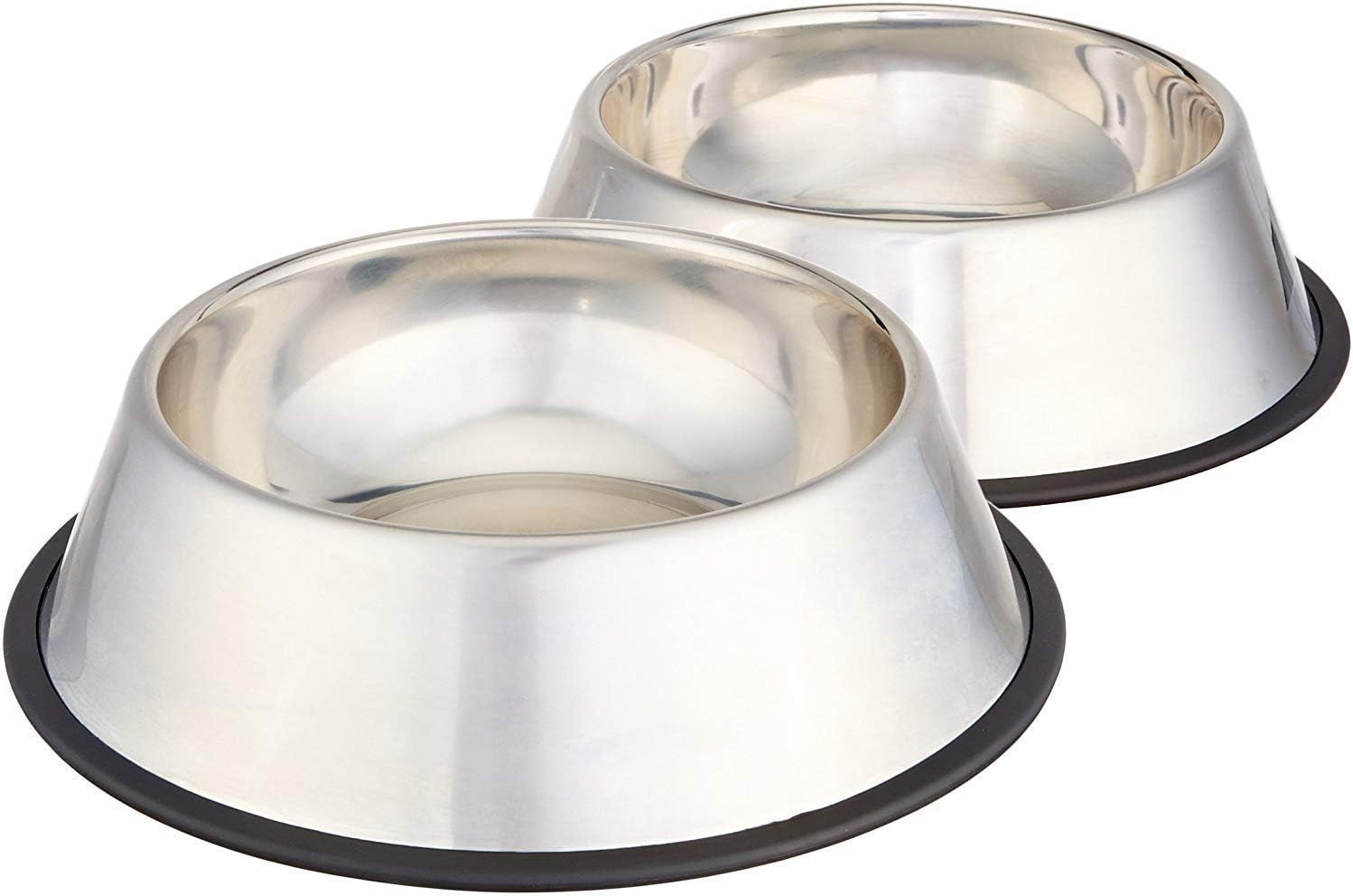
Amazon Basics Stainless Steel Dog Bowls (2-Pack)
For day-to-day feeding, a pair of plain stainless steel bowls beats almost everything fancier, and this 2-pack is the one we hand to new owners. Stainless is the vet-and-breeder default for a reason: it’s non-porous so it won’t harbor bacteria the way scratched plastic does, it won’t chip or crack like ceramic, it’s dishwasher-safe and rust-resistant, and it shrugs off a chewer. The 38oz size suits a big dog, and the rubber non-skid base stops the lunchtime hockey-puck slide across tile. One for food, one for water, done.
What we like
- The most hygienic material: non-porous, no bacteria-trapping scratches
- Indestructible next to ceramic or plastic, no chips, cracks or chew marks
- Dishwasher-safe; takes 30 seconds to keep genuinely clean
- Rubber base keeps it planted for an enthusiastic large-breed eater
The catches
- Lightweight enough that a determined dog can still nudge an empty bowl
- No slow-feed or elevation features, it’s a simple, do-one-thing-well bowl
- Stainless can show water spots; a quick towel-dry sorts it
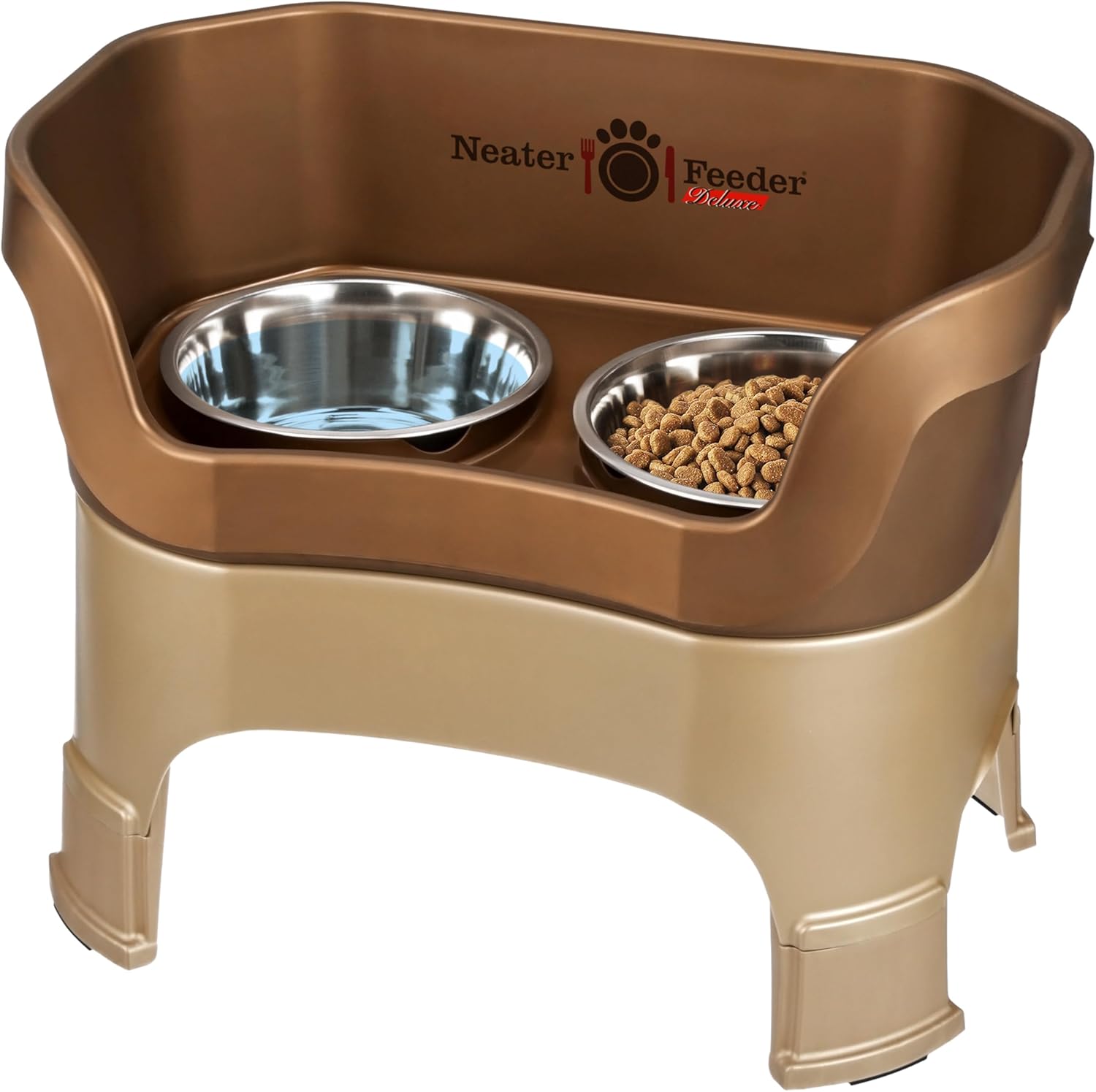
Neater Feeder Deluxe (Elevated, Large Dogs)
If your floor looks like a splash zone after every meal, the Neater Feeder Deluxe is the fix. It’s a raised, mess-proof feeding station for dogs over 40 lbs: spilled kibble is caught in the top tier and dropped water drains into a sealed lower reservoir instead of your floor. The legs adjust between 14.5″ and 17.5″ so you can match it to a tall dog’s shoulder height, the stainless bowls lift out for the dishwasher, and it’s made in the USA. Raised feeding can ease the strain for arthritic, senior or very tall dogs and dogs with megaesophagus, but please read our honest bloat note below before you buy for a healthy deep-chested breed. 📋 Best elevated dog bowls →
What we like
- Genuinely mess-proof: contains spilled food and drains spilled water
- Two heights match a tall or senior dog’s posture
- Removable stainless bowls are dishwasher-safe and hygienic
- Sturdy, weighted base stays put for a big enthusiastic eater
The catches
- Raised bowls are NOT recommended for healthy deep-chested breeds at bloat risk, see below
- Bigger footprint and pricier than a plain bowl
- The catch tray needs a wipe-out every few days
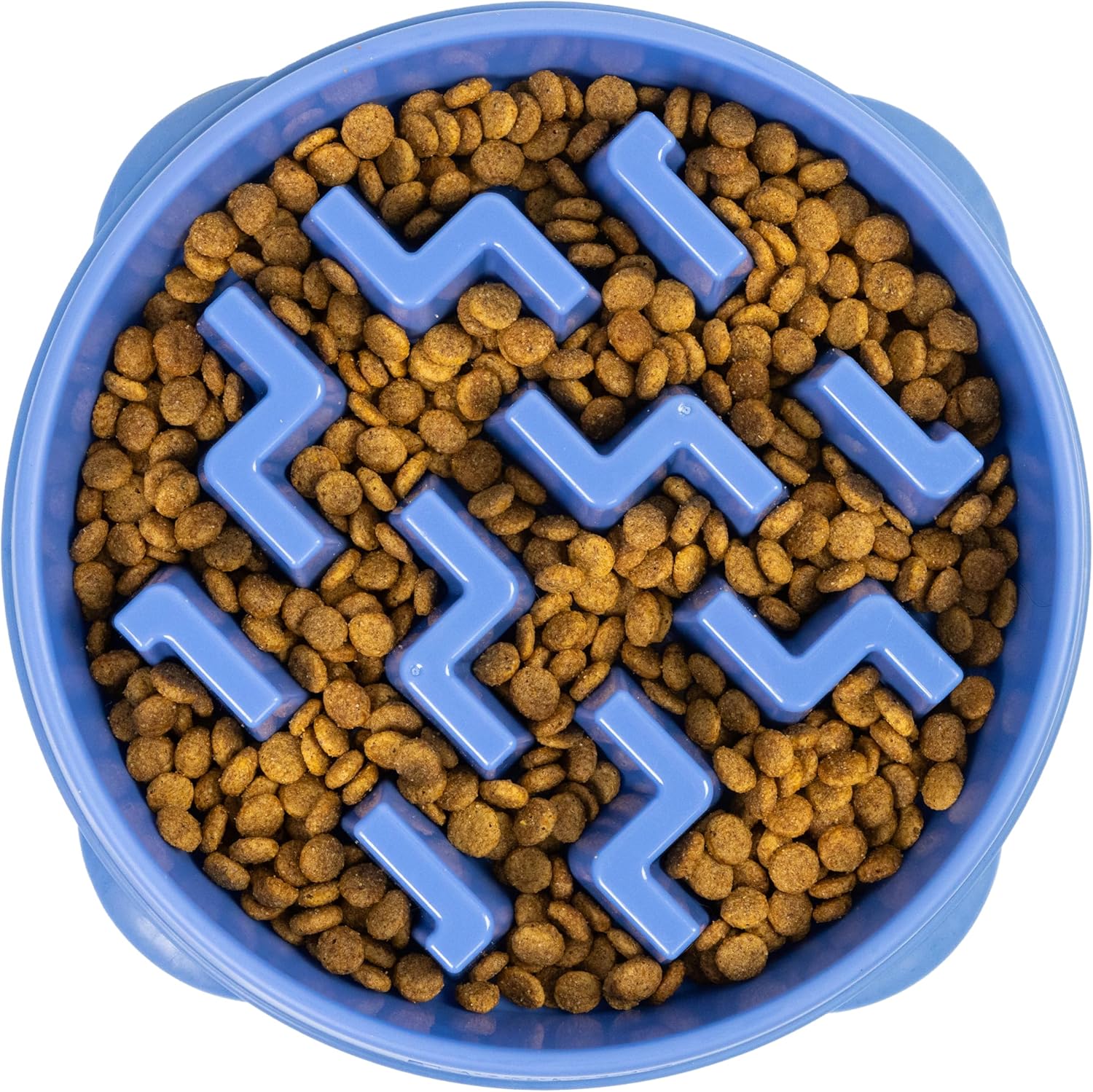
Outward Hound Fun Feeder Slo Bowl (Large)
If your dog finishes a full bowl in nine seconds flat, a slow feeder is the cheapest health upgrade you can buy, and the Outward Hound Fun Feeder is the one that’s sold over a million units. Molded ridges and a maze pattern force your dog to eat around the obstacles, turning a 10-second gulp into a 5 to 10x slower graze. That cuts the gulped air that contributes to bloat, vomiting and choking, and adds a little mealtime enrichment. The Large 4-cup size fits a big dog’s portion, it’s BPA-free and dishwasher-safe, and the non-slip base keeps it from skating off. 📋 Best slow feeder dog bowls →
What we like
- Dramatically slows fast eaters, less gulped air, less bloat/vomit risk
- Large 4-cup capacity actually holds a big dog’s meal
- Adds enrichment; mealtime becomes a mini puzzle
- Cheap, BPA-free and top-rack dishwasher-safe
The catches
- Plastic, so it can scratch over years, replace it if the surface gets rough
- Very determined dogs can shove a light bowl; the non-slip base helps
- Deeper grooves need a brush to clean wet food fully
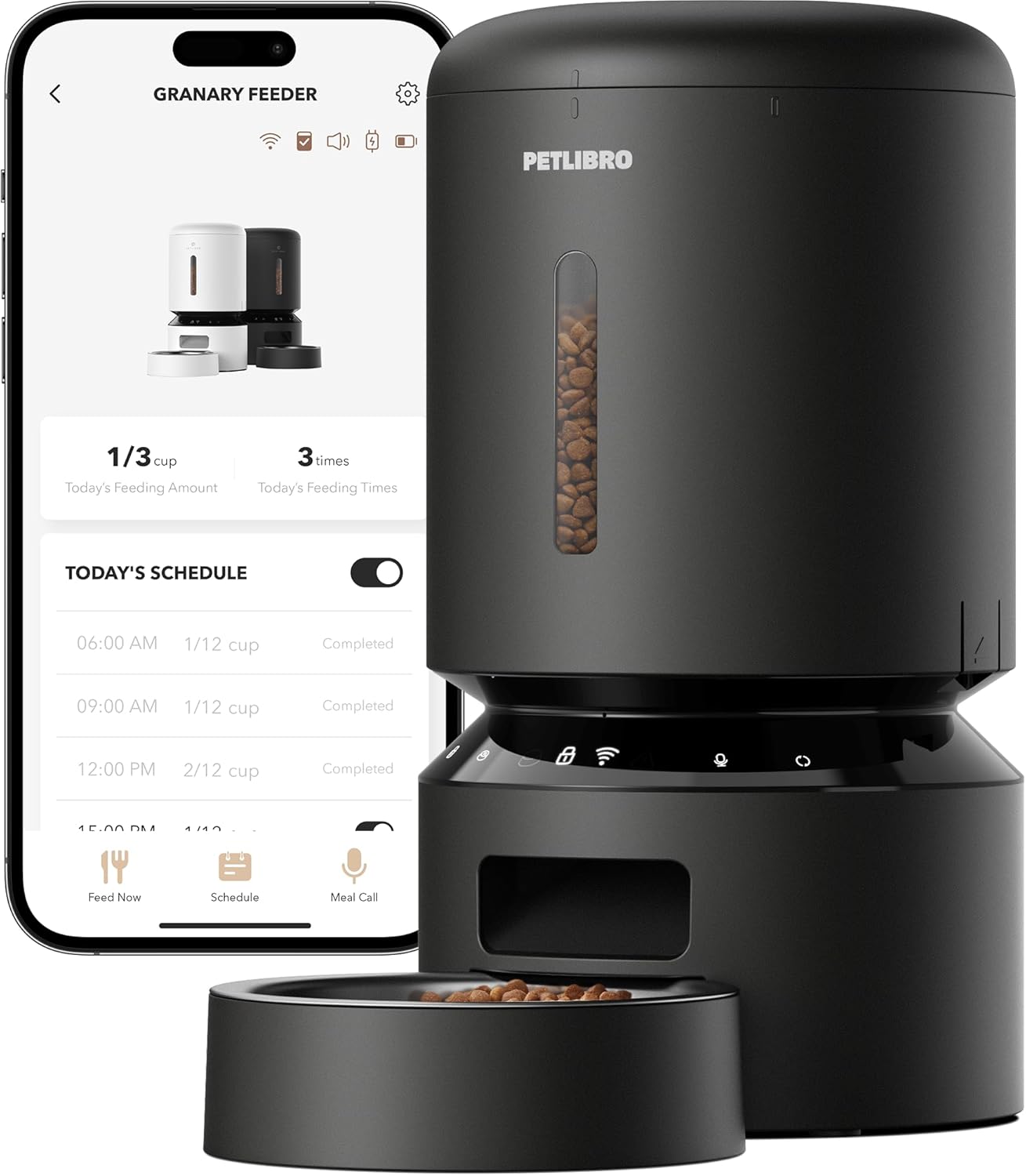
PETLIBRO Granary Automatic Feeder (WiFi)
When your day doesn’t line up with your dog’s stomach, an automatic feeder keeps meals on schedule. The PETLIBRO Granary holds 5L of kibble and dispenses up to 10 meals a day in precise portions, so a weight-watching or schedule-fed dog eats the same amount at the same time whether you’re home or not. You program it from the WiFi app, record a 10-second voice meal-call, and a dual power supply (adapter + battery backup) keeps it running through an outage. A low-food sensor warns you before the hopper runs dry. Note: very large kibble can jam any auger feeder, check your kibble size first. 📋 Best automatic dog feeders →
What we like
- Keeps meals and portions exact whether you’re home or not
- WiFi app scheduling plus a recordable voice call to your dog
- Dual power (plug + batteries) so a power cut won’t skip a meal
- Low-food sensor and a triple-seal lid keep kibble fresh
The catches
- Dry kibble only, and very large kibble can clog the dispenser
- 5L suits one large dog; a multi-dog house may refill often
- It’s a convenience tool, not a replacement for hands-on feeding time
Pick by the problem you’re solving
Shortcut to the right feeder for your dog’s habits, age and your schedule.
How to choose dog bowls & feeders
The eight things that actually decide which bowl or feeder is right for your dog.
1 Material: stainless vs. ceramic vs. plastic
This is the first and biggest decision. Stainless steel is the vet-and-breeder default: it’s non-porous (no bacteria-trapping pores), doesn’t chip, won’t leach, and is dishwasher-safe, the right everyday choice for almost every dog. Ceramic is heavy (so it stays put) and looks great, but it chips and cracks if dropped, and a cracked glaze can harbor bacteria, buy lead-free, food-safe glaze only. Plastic is cheap and light, but it scratches, and those scratches trap bacteria that can cause plastic-dish chin acne; it’s also the easiest for a bored dog to chew. Our rule: stainless for daily food and water, plastic only for purpose-built slow feeders and travel.
2 Get the size right for a large dog
A big dog needs a bowl that holds a real portion without overflowing, and a width that fits a broad muzzle. As a rough guide, large breeds do well with a bowl holding at least 4 to 8 cups (and a water bowl that big or bigger). Don’t go too deep, though, a flatter, wide bowl is easier for a short-faced or senior dog and reduces whisker stress. If you feed a measured diet, match the bowl to the meal, not the day’s total.
3 Elevated bowls, the benefits AND the honest bloat caveat
Raised feeders look tidy and can genuinely help certain dogs: they reduce neck and joint strain for arthritic, senior or very tall dogs and are often recommended for megaesophagus. But here’s the part most roundups skip: a well-known 2000 Purdue University study found that raised bowls were associated with a higher risk of bloat (GDV) in large and giant deep-chested breeds, the exact dogs people buy them for. The current vet consensus: don’t use an elevated bowl as bloat prevention, and if your dog is a healthy deep-chested breed (Great Dane, Setter, Weimaraner, Standard Poodle, etc.) a floor-level bowl is the safer default. Use a raised feeder for a specific reason, arthritis, megaesophagus, a diagnosed need, and ask your vet first. More in our best elevated dog bowls guide.
4 Slow feeders, when your dog eats too fast
If your dog finishes before you’ve sat down, a slow feeder is the single best-value upgrade here. Molded ridges and mazes force the dog to work food out of the gaps, slowing a frantic gulp by 5 to 10x. That matters because gulping swallows air, which contributes to bloat, and fast eating causes vomiting and choking. Slow feeders also add a dash of enrichment. Pick one sized for your dog’s portion, and if your dog is a true power-eater, a stainless slow-feed insert resists chewing better than soft plastic. See our best slow feeder dog bowls guide.
5 Automatic & timed feeders, for schedules and portions
An automatic feeder dispenses measured portions on a timer, which is ideal for weight management, dogs on a strict schedule, long workdays, or early-morning feeders who’d like to sleep in. Look for: enough hopper capacity for a big dog (5L+), precise portion control, a battery backup so an outage can’t skip a meal, and app or WiFi scheduling if you travel. One real limit: augers can jam on very large kibble, so check your kibble diameter. Automatic feeders are for dry food only, wet-food versions exist but are a different category. Full breakdown in our best automatic dog feeders guide.
6 No-spill, non-skid and mess control
Big dogs are messy eaters and drinkers. A non-skid rubber base stops the bowl from sliding across tile (and the racket that comes with it). For dogs that splash water everywhere, a raised-rim or no-spill water bowl, or a mess-catching elevated station like the Neater Feeder, keeps your floor dry. A simple silicone mat under any bowl catches stray kibble and drips and wipes clean in seconds. Mess control isn’t fussy; it’s how you stop a slip hazard by the water bowl.
7 Cleaning, hygiene & dishwasher-safe
The dog bowl is one of the dirtiest things in most homes, a film of bacteria and biofilm builds up fast, especially in water bowls. Wash food bowls daily and water bowls every day or two, and run a deep clean in the dishwasher regularly. This is exactly why stainless steel wins: it’s dishwasher-safe and has no scratches or pores to hide bacteria. Avoid scratched plastic for food, and retire any bowl whose surface has gone rough.
8 Match the bowl to the job, most dogs want two or three
There’s no single ‘best dog bowl,’ because the bowls solve different problems. Most large-dog households end up with a stainless set for water and normal meals, plus one specialty piece: a slow feeder if your dog inhales food, an elevated station if mess or a senior/arthritic dog is the issue (with the bloat caveat above), or an automatic feeder if your schedule needs it. Start with stainless, then add the one that fixes your actual problem.
How we vet dog bowls & feeders
No product is listed until it clears all three. If we wouldn’t put it on our own dogs, it isn’t here.
Model the real demand
We study what’s genuinely working for owners, match the depth of the best guides, then verify every claim independently.
Check the real build
Wattage, R-values, materials, cord safety and weight limits, confirmed against the maker, not the listicle.
Route to the best deal
410+ merchants compared. The buy button goes to the one that’s in stock and priced fairly, never the one that just pays us most.
Best dog bowls & feeders, your questions answered
What is the best dog bowl?
For everyday feeding, a stainless steel bowl is the best choice for almost every dog, our top pick is the Amazon Basics Stainless Steel 2-pack (one for food, one for water). It’s non-porous and hygienic, won’t chip or crack like ceramic, won’t scratch and harbor bacteria like plastic, and it’s dishwasher-safe. From there, add a specialty bowl for your dog’s specific need: the Outward Hound Fun Feeder for fast eaters, the Neater Feeder Deluxe for mess or a senior dog, or the PETLIBRO Granary for scheduled feeding.
Stainless steel vs. ceramic vs. plastic, which is best?
Stainless steel is the overall winner: non-porous, dishwasher-safe, doesn’t chip or leach, and resists chewing. Ceramic is heavy and attractive and stays put, but it chips and cracks if dropped and must use a lead-free, food-safe glaze. Plastic is cheap and light but scratches over time, and those scratches trap bacteria that can cause chin acne, fine for slow feeders and travel bowls, not ideal for everyday food. For daily food and water, choose stainless.
Are elevated dog bowls good or bad for large dogs?
It depends on the dog. Raised bowls can genuinely help arthritic, senior or very tall dogs and dogs with megaesophagus by reducing neck and joint strain. But a 2000 Purdue University study linked elevated bowls to a higher risk of bloat (GDV) in large and giant deep-chested breeds. The current vet consensus is: don’t use a raised bowl as bloat prevention. If your dog is a healthy deep-chested breed, a floor-level bowl is safer; if your dog has a diagnosed need for elevation, talk to your vet first.
Do slow feeder bowls actually work?
Yes. Slow feeders use ridges and maze patterns that force a dog to eat around obstacles, slowing fast eaters by roughly 5 to 10x. That reduces the gulped air that contributes to bloat, and cuts down on the vomiting and choking that come with inhaling food. They also add mealtime enrichment. The Outward Hound Fun Feeder is the most popular, with over a million sold. Match the size to your dog’s portion.
What size dog bowl do I need for a large dog?
As a rough guide, large breeds do well with a food bowl that holds at least 4 to 8 cups and a water bowl that’s at least as large. Width matters as much as depth: a wider, slightly shallower bowl is easier for a broad muzzle and kinder to a senior or short-faced dog than a deep, narrow one. If you feed a measured diet, size the bowl to the meal, not the daily total, and refill the water bowl to the brim.
Are automatic dog feeders safe and worth it?
For the right household, yes. An automatic feeder dispenses measured portions on a schedule, which helps with weight management, long workdays and early feeders. Buy one with a battery backup so a power cut can’t skip a meal, enough capacity for a big dog, and portion control you trust. The main caveat: augers can jam on very large kibble, so check your kibble size, and they’re dry-food only. The PETLIBRO Granary is our pick. Treat it as a convenience tool, not a replacement for feeding-time interaction.
Should you use separate bowls for food and water?
Yes, always give your dog a dedicated food bowl and water bowl. Mixing them fouls the water with food residue and speeds up bacteria growth. That’s why we recommend a 2-pack stainless set: identical, hygienic, dishwasher-safe bowls for each job. Keep the water bowl full and clean it every day or two, and wash the food bowl daily.
How often should I clean my dog’s bowls?
Wash the food bowl after every day (ideally rinse after each meal) and the water bowl every day or two, with a deep dishwasher clean regularly. Dog bowls build up a bacterial biofilm fast, they’re among the dirtiest items in most homes. Stainless steel makes this easy because it’s dishwasher-safe and has no scratches or pores to hide bacteria. Retire any plastic bowl whose surface has gone scratched and rough.
Can elevated feeders cause bloat in dogs?
The evidence says they can raise the risk for the breeds most prone to it. The 2000 Purdue study on canine bloat (GDV) found that raised feeding was associated with an increased risk in large and giant deep-chested breeds. Because of that, vets generally advise against elevated bowls for those dogs unless there’s a specific medical reason (like arthritis or megaesophagus). If bloat risk is your concern, a floor-level bowl plus a slow feeder is the safer combination, and discuss it with your vet.