 Dog Gear, Sized Right
Best Slow Feeder Dog Bowls (Stop Fast Eating & Gulping)
Does your dog inhale dinner in ten seconds flat? A slow feeder bowl makes a fast eater work for every mouthful, slowing the gulping, cutting the air they swallow, and turning a frantic meal into a calmer one. Here are the best slow feeder dog bowls for 2026, with the right difficulty and capacity for big dogs.
If your dog vacuums up a full bowl in under a minute, then burps, coughs, or brings some of it straight back up, a slow feeder dog bowl is the simplest, cheapest fix there is. A slow feeder is just a bowl with raised ridges, a maze, or stiff ‘blades’ built into it, so your dog has to nudge and lick the food out a little at a time instead of gulping it down in big, air-filled mouthfuls. That matters most for big, deep-chested dogs, where fast, gulpy eating and swallowed air are recognised risk factors for bloat, the reason we treat slowing a large dog’s meal as more than a nice-to-have. Below we rank four slow feeders we’d actually buy, then show you how to match the maze difficulty and capacity to your dog, what slow feeding does and doesn’t do, and the puzzle-feeder alternatives worth trying if a bowl alone isn’t enough.
The 4 best slow feeder dog bowls
Ranked for fast eaters and big dogs, by maze difficulty, capacity and how easy each is to clean. Every link goes to a current listing; tap through for the live price.

Outward Hound Fun Feeder Slo Bowl. Large (4-Cup)
If you buy one slow feeder, make it this one. The Large 4-cup Fun Feeder is the bowl that turned slow feeders into a category, over a million sold, and it earns the spot. Its raised maze ridges force a fast eater to nose and lick the kibble out of the channels instead of inhaling it, and Outward Hound says it extends mealtime up to 10×. The 4-cup size is the right capacity for a medium-to-large dog’s full meal, the BPA-free plastic is top-rack dishwasher safe, and the wide non-slip base keeps a shove-happy Lab from pushing it across the kitchen. It comes in several patterns (Notch, Swirl, Drop), all the same difficulty, so pick a colour and go.
What we like
- 4-cup capacity holds a full large-dog meal, no refilling halfway
- Maze pattern slows gulping dramatically (up to ~10× longer to eat)
- Top-rack dishwasher safe and easy to scrub between the ridges
- Wide non-slip base resists the big-dog shove
- Cheap enough to buy two and keep one in the dishwasher
The catches
- Plastic can scratch over years of use, and a determined chewer can damage the ridges
- A truly relentless gulper may learn to bulldoze food out of the wide channels, size up the difficulty (see the Northmate)
Northmate Green Interactive Feeder
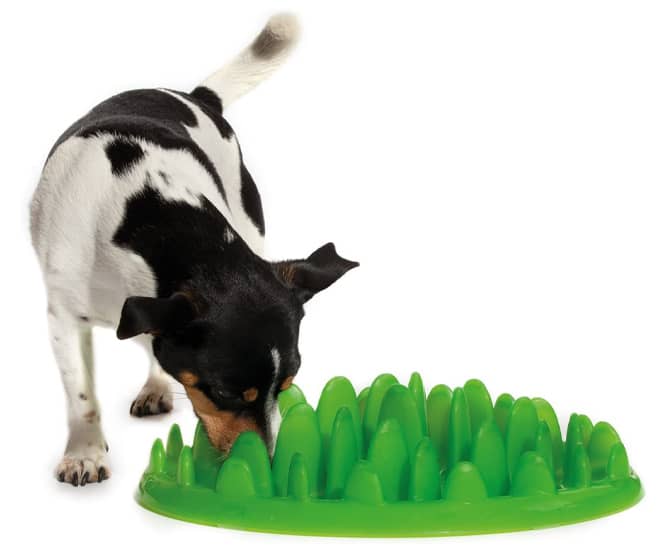
When a normal maze bowl isn’t slowing your dog down, this is the upgrade. The Northmate Green looks like a tuft of stiff plastic grass, and your dog has to work each piece of kibble out from between the tall blades with its nose and tongue. It’s the hardest slow feeder we recommend, there are no wide channels to bulldoze, so even a clever, food-obsessed big dog genuinely has to slow down. One size suits all dogs, it’s hard phthalate-free plastic, it’s dishwasher safe, and it handles dry, wet and raw food. It’s bulkier and a little fiddlier to clean than a maze bowl, that’s the trade-off for being the toughest puzzle here.
What we like
- By far the hardest puzzle, beats the gulper who has ‘solved’ a normal maze bowl
- Tall blades have no wide channels to bulldoze, so it genuinely slows determined eaters
- One size fits all dogs and works with dry, wet and raw food
- Hard phthalate-free plastic, dishwasher safe, good indoors or out
The catches
- Bulkier and a little more fiddly to clean than a flat maze bowl
- Overkill (and frustrating) for a mild fast eater, match the difficulty to the dog

Mr. Peanut’s Stainless Steel Slow Feed Bowl. Large
If you’d rather not feed out of plastic, this is the slow feeder to get. It’s a single piece of stainless steel with a raised central ‘chase’ design that makes your dog circle the food instead of gulping it, and because it’s steel, it won’t leach, won’t scratch into bacteria-harbouring grooves, won’t stain, and won’t hold odours the way plastic can. The Large holds about 3 cups, it’s dishwasher safe, and it sits on a food-grade silicone non-slip base so it stays put. Stainless is the material most vets and we ourselves prefer for everyday feeding; this gives you that hygiene in a slow-feed shape.
What we like
- Stainless steel is the most hygienic material, no scratches to harbour bacteria, no leaching, no odour
- Raised chase design slows eating without a fiddly plastic maze
- Food-grade silicone base grips the floor and protects it
- Genuinely dishwasher safe and effectively indestructible
The catches
- Slows a moderate eater well, but isn’t as fiendish as the Northmate for an extreme gulper
- Costs a little more than a basic plastic maze bowl

Outward Hound Fun Feeder Stainless Steel Slo Bowl
A clever hybrid: a stainless-steel maze insert that lifts out of its own non-slip outer bowl, so you get the hygiene of steel and the easiest clean-up here, pop the insert in the dishwasher and you’re done, with no deep plastic crevices to scrub. The maze does the slowing; the steel keeps it sanitary. It’s a great pick if you feed wet or raw food (which gets gummy in plastic mazes) or if you just hate scrubbing ridges. Capacity is more suited to small-to-medium meals, so for a big dog on a large ration, split the meal or step up to the 4-cup Fun Feeder above.
What we like
- Removable steel insert is the easiest of all to clean, no crevices, just dishwasher it
- Hygienic stainless surface, ideal for gummy wet or raw food
- Non-slip outer bowl keeps the whole thing planted
- Veterinarian-recommended brand with a proven maze design
The catches
- Smaller capacity than the 4-cup plastic Fun Feeder, a big dog on a full ration may need to size up or split the meal
- Two pieces to keep track of (insert + outer bowl)
Why a slow feeder is worth it (especially for big dogs)
A dog that bolts its food isn’t just being greedy, fast eating causes real, practical problems, and a slow feeder fixes most of them for the price of a takeaway coffee. Here’s what changes when you slow the meal down:
- Less gulping, less swallowed air. A gulping dog swallows a lot of air along with each big mouthful. That air is what causes the burping, the gas, and the bloated, uncomfortable belly after meals. Make the dog take small, worked-for mouthfuls and far less air goes down with the food.
- Less vomiting and regurgitation. The classic “eats too fast, then sicks it straight back up” routine is usually just too much food hitting the stomach too quickly. Stretch the same meal over several minutes and it tends to stay down.
- Gentler on digestion. Food eaten slowly is chewed and moistened more, and arrives in the stomach at a manageable pace rather than all at once, easier on the whole system.
- A real factor in bloat risk for deep-chested dogs. In large and giant deep-chested breeds. Great Danes, German Shepherds, Labradors, Boxers, Dobermans, Weimaraners, Standard Poodles, Setters, Akitas, fast eating and swallowing air are among the recognised risk factors for bloat (gastric dilatation-volvulus, or GDV), a genuine emergency. A slow feeder is one simple, sensible thing you can do to address that one factor. It is not a cure or a guarantee, and bloat has several causes, but if you own a big deep-chested dog, slowing the meal is an easy win. (For the warning signs and the full picture, the AKC’s guide to bloat is a good plain-English read, and your vet is the right person to talk to about your individual dog.)
- Mental enrichment. Working food out of a maze is a small, satisfying puzzle. For a bored or anxious dog, that bit of “foraging” at mealtimes is genuinely good for them, closer to how a dog would naturally eat than hoovering a flat bowl.
How much does a slow feeder actually slow a dog down?
Quite a lot, and you’ll see it on day one. A fast eater who clears a normal bowl in 30 to 60 seconds will typically take 5 to 10 minutes from a good slow feeder, the manufacturers like to quote “up to 10× longer,” and for a genuine gulper that’s about right. That 5-to-10-minute window is the sweet spot: long enough to stop the gulping and the swallowed air, without dragging the meal out so far that your dog gets frustrated and gives up.
The exact slowdown depends on three things: the maze difficulty (tall stiff blades like the Northmate slow a dog far more than wide, shallow channels), the kibble size (small kibble disappears into a maze and takes longer; big chunks come out faster), and how determined your dog is. A clever, food-obsessed dog will “solve” an easy bowl in a week, which is exactly when you step the difficulty up.
Maze difficulty: matching the bowl to your dog
This is the part most buying guides skip, and it’s the one that decides whether a slow feeder actually works for your dog. Slow feeders come in roughly three difficulty levels, start easy and move up only if your dog beats it:
- Easy, wide channels and gentle ridges. Big, open maze patterns (a basic spiral or wave). Good for a first-time slow feeder, a senior dog, a flat-faced (brachycephalic) breed that needs room for its muzzle, or a mild fast eater. The downside: a really determined big dog can learn to bulldoze food straight out of wide channels.
- Medium, tighter mazes and a stainless ‘chase’. Closer-set ridges or a raised centre post your dog has to circle (like the Mr. Peanut’s stainless bowl). This is the right level for most fast eaters and where most dogs should land.
- Hard, tall blades, no easy channels. A grass-blade feeder like the Northmate Green has no wide gaps to bulldoze; the dog has to lift each piece out. This is the level for the relentless gulper who has defeated everything else.
Size and capacity for large dogs
This is where a lot of slow feeders fall down for big-dog owners: plenty of them are sized for a puppy’s snack, not a 70-pound dog’s dinner. Two things matter, capacity and stability.
Capacity, match the bowl to your dog’s actual meal so you’re not refilling halfway:
| Dog size | Typical meal per sitting | Slow-feeder capacity to look for |
|---|---|---|
| Small (under 25 lb) | ½ to 1 cup | ¾-cup compact maze |
| Medium (25 to 50 lb) | 1 to 2 cups | 2-cup bowl |
| Large (50 to 90 lb) | 2 to 3½ cups | 3 to 4 cup (e.g. the Large Fun Feeder) |
| Giant (90 lb+) | 3 to 5+ cups | 4 cup+, or split the meal across two sittings |
Capacities are a starting point, feed to your dog’s body condition and your vet’s or the food’s guidance, not to the bowl.
Stability, big dogs are rough on bowls. A heavy or determined eater will shove a light bowl across the kitchen, chasing the last kibble, or flip it to dump the food out. For a large dog, insist on:
- A wide, weighted base or a one-piece design that doesn’t tip.
- A rubber or silicone non-slip ring on the bottom so it grips tile and hardwood (every pick above has one).
- An anti-flip shape, low and broad, not tall and narrow.
If your dog is more of a tall-breed-with-joint-concerns than a gulper, you may want a raised or elevated bowl instead, just read our notes there on the elevated-bowl-and-bloat question first, because for a deep-chested dog the height debate cuts the other way.
Material: plastic vs stainless vs ceramic
Slow feeders come in four materials, and the difference is really about hygiene and durability, they all slow a dog down. Here’s the honest rundown:
- Stainless steel, the most hygienic. It won’t leach anything into the food, won’t scratch into bacteria-harbouring grooves, won’t stain or hold odours, and it’s effectively indestructible and dishwasher safe. This is the material we (and most vets) prefer for everyday feeding. The trade-off: fewer fiendishly-hard maze options, and a higher price than basic plastic. Our top stainless pick is the Mr. Peanut’s bowl above; the Outward Hound steel insert is the easiest of all to clean.
- BPA-free plastic, cheapest and the widest choice. The classic Fun Feeder maze is plastic, and good plastic feeders are BPA/PVC/phthalate-free and top-rack dishwasher safe. The downsides over time: plastic can scratch (and scratches can harbour bacteria), it can pick up odours, and a serious chewer can damage it, so wash it well and replace it if it gets gouged. It’s still the best value and the best place to start.
- Ceramic, heavy and handsome. A glazed ceramic maze is naturally heavy (so it won’t slide), doesn’t scratch or leach, and looks the part. The catch is obvious: it chips and cracks if dropped, and a chipped bowl should be retired. A solid choice for a calmer household, less so for a rowdy big dog.
- Silicone, gentle and flexible. Soft silicone mats and bowls are kind on teeth and snouts and fold up for travel, but they’re best for licking/spreading wet food rather than holding a big dry meal, and a chewer will destroy them.
When a slow feeder isn’t enough (and what to try instead)
A bowl handles most fast eaters, but sometimes you need more, either because your dog has “solved” every maze, or because you want the enrichment, not just the speed control. These are the alternatives worth knowing:
- Step up the difficulty first. Before anything else, move from an easy maze to the hardest bowl (the Northmate). That alone defeats most dogs who’ve beaten a simple feeder.
- Puzzle and spinner feeders. Bowls and toys with sliders, lids and compartments the dog must move to release food. More mental work than a maze, great for boredom and for the very smart dog.
- Snuffle mats. A fabric mat full of fabric “grass” you hide kibble in. The dog sniffs and forages it out, brilliant enrichment and naturally slow, though it’s a wash-by-hand job.
- Lick mats. A textured mat you spread wet food, yoghurt or wet kibble across. Best for soft food and for calming an anxious dog; not for a big dry meal.
- Food-dispensing toys. A stuffed rubber toy (a KONG and the like) makes the dog work food out over a long stretch, great for crate time and for slowing a meal right down.
- Scatter feeding and the muffin-tin trick. The free options: scatter the kibble across a clean floor or the lawn so the dog has to hunt it, or press a tennis ball into each cup of a muffin tin and pour kibble around them so the dog has to nose the balls aside. Both slow a gulper down with things you already own.
- Two smaller meals. Simplest of all for a giant breed, splitting the daily ration into two or three smaller meals means less food hitting the stomach at once, which also fits the general advice for deep-chested dogs at risk of bloat.
And if mealtimes are a fight because your dog is on the wrong schedule, or you’re out all day, a programmable automatic feeder can portion and time meals for you, some even pair with a slow-feed insert to get both jobs done. For everything else feeding-related, start at our dog bowls & feeders hub.
How we picked
We started from the search results, the bowls that actually rank and sell for “best slow feeder dog bowl”, and filtered them through what matters for the big, fast-eating dogs this site is built around. For each pick we checked the maze difficulty (does it really slow a determined gulper, or just look the part?), the capacity (will it hold a large dog’s full meal?), the material and hygiene (food-safe, dishwasher friendly, no nasty scratches), and the stability (does it stay put under a dog that shoves?). We deliberately spread the picks across plastic, stainless and difficulty levels so there’s a sensible choice whether you’ve got a mild fast eater or a relentless one. The result is four bowls we’d be happy to put down in our own kitchen.
Slow feeder dog bowls: common questions
Do slow feeders work?
Yes, and you’ll see it the first time you use one. A fast eater who clears a normal bowl in 30 to 60 seconds typically takes 5 to 10 minutes from a good slow feeder, because the raised maze or blades force them to nose and lick the food out a bit at a time instead of gulping it. That slows the gulping, cuts the air they swallow, reduces post-meal burping, gas and vomiting, and adds a bit of enriching mental work. The catch is matching the difficulty to your dog: a clever, determined dog can ‘solve’ an easy bowl, so step up to a harder maze if they’re still inhaling their food.
What is the best slow feeder for a large dog or a fast eater?
For most large dogs and fast eaters, the Outward Hound Fun Feeder Slo Bowl in Large (4-cup) is the best starting point, it holds a full big-dog meal, the maze really slows the gulping, and it’s cheap and dishwasher safe. If your dog is a relentless gulper who has already beaten a normal maze, step up to the Northmate Green, the hardest slow feeder we recommend, where tall stiff blades give them nothing to bulldoze. If you’d rather avoid plastic, the Mr. Peanut’s stainless steel bowl is the most hygienic choice. Whatever you pick for a big dog, make sure it has the capacity for a full meal and a non-slip base so it can’t be shoved around.
Are slow feeders good for bloat? Do they prevent it?
A slow feeder helps with one of the recognised risk factors for bloat, eating too fast and swallowing air, so for a big, deep-chested dog it’s a sensible, easy precaution. But it is not a cure or a guarantee. Bloat (gastric dilatation-volvulus, or GDV) has several risk factors, including breed, build and genetics, that a bowl can’t change. Treat a slow feeder as cheap insurance against the fast-eating factor, alongside other sensible steps like feeding smaller meals and avoiding hard exercise right after eating. We’re not vets and this isn’t medical advice, if you own an at-risk breed, talk to your vet about bloat, and treat a hard swollen belly, unproductive retching or sudden distress as an emergency.
What size slow feeder does my dog need?
Match the bowl’s capacity to your dog’s actual meal so you’re not refilling halfway. As a rough guide: small dogs (under 25 lb) eat about ½ to 1 cup a meal and suit a ¾-cup compact bowl; medium dogs (25 to 50 lb) eat 1 to 2 cups and want a 2-cup bowl; large dogs (50 to 90 lb) eat 2 to 3½ cups and need a 3 to 4 cup feeder like the Large Fun Feeder; giant breeds (90 lb+) eat 3 to 5+ cups and want a 4-cup-plus bowl, or you split the meal across two sittings. Feed to your dog’s body condition and your food’s guidance, not to the size of the bowl.
Stainless steel, plastic or ceramic, which slow feeder is best?
Stainless steel is the most hygienic: it won’t leach, won’t scratch into bacteria-harbouring grooves, won’t stain or hold odours, and it’s nearly indestructible and dishwasher safe, it’s what we and most vets prefer. BPA-free plastic is the cheapest with the widest choice of maze designs, but it can scratch and pick up odours over time, so wash it well and replace it if it gets gouged. Ceramic is heavy (so it stays put), doesn’t scratch or leach, and looks great, but it chips and cracks if dropped. Silicone is soft and travel-friendly but best for wet food and no match for a chewer. For most big dogs, start with a BPA-free plastic maze for value or go straight to stainless for hygiene.
How do I clean a slow feeder bowl?
Wash it daily, the ridges and channels trap food and grease, which grow bacteria and biofilm fast. The easiest way is the dishwasher: stainless and most BPA-free plastic feeders are dishwasher safe (put plastic on the top rack to keep it away from the heating element). By hand, use hot soapy water and a brush to get right into the maze, then rinse and dry. The Outward Hound stainless insert is the easiest of all, it lifts out so there are no deep crevices to scrub. Whatever you’ve got, give the grooves a proper clean every day, just as you would a normal bowl.
Are slow feeders safe for puppies, and can they cause frustration?
Slow feeders are fine for puppies, just pick a size and difficulty to match: a small, easy maze so they don’t get discouraged, and keep an eye on a teething pup who might chew the plastic. The bigger risk for any dog is frustration from too-hard a bowl too soon. If a dog can’t get the food out, it may give up, knock the bowl over, or get stressed at mealtimes. Avoid that by starting easy and only stepping up the difficulty if your dog is clearly coping and still gulping. For flat-faced (brachycephalic) breeds, choose a shallow, wide-channel maze that leaves room for their muzzle. Done right, the puzzle is enriching, not frustrating.