 Dog Gear, Sized Right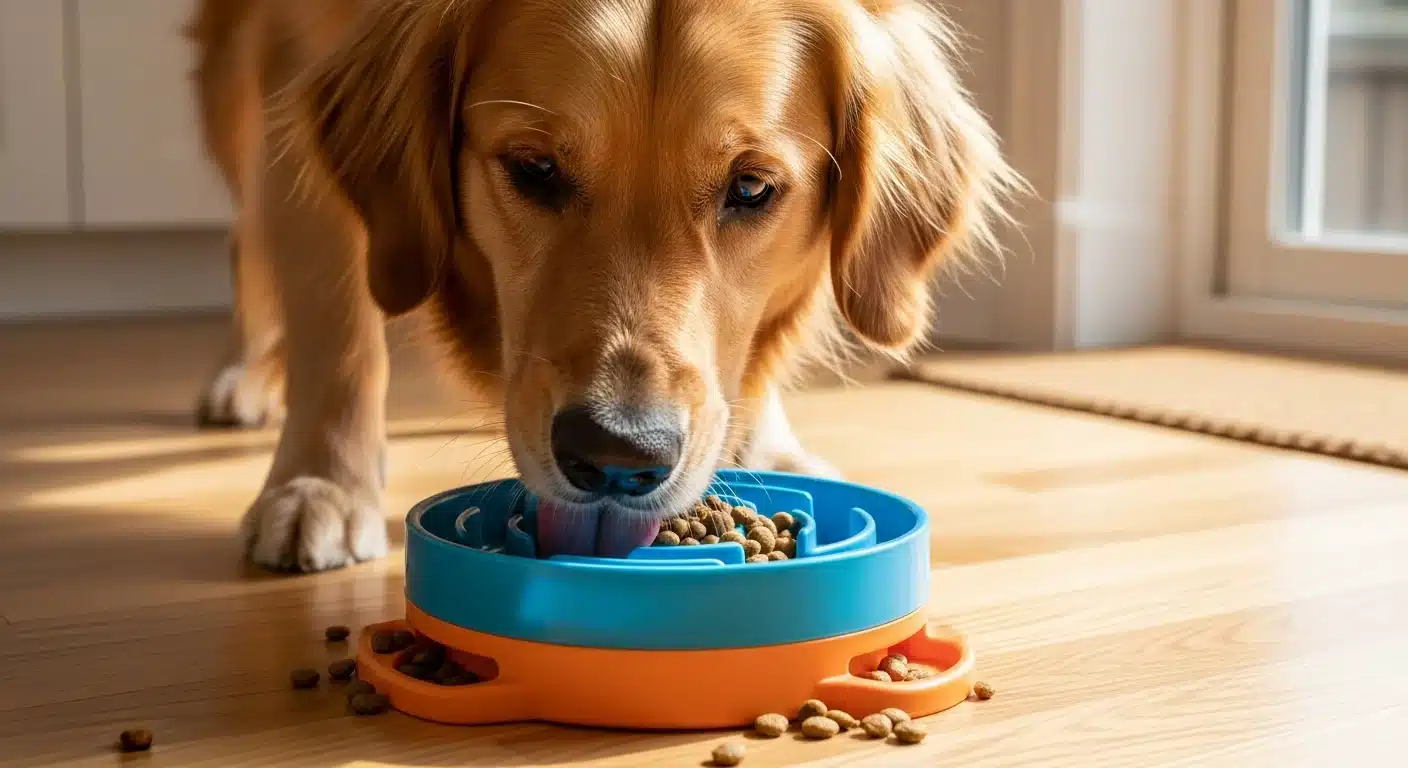
How to Stop a Dog Eating Too Fast (and Why It Matters)
Nine practical fixes, from maze bowls to muffin tins, that actually work.
If your dog hoovers their dinner in under thirty seconds, you’re not alone, and you’re right to be concerned. Fast eating is more than messy: it floods the stomach with swallowed air, increases the risk of regurgitation, and in deep-chested breeds it’s a recognised risk factor for gastric dilatation-volvulus (GDV), a true veterinary emergency. The good news is that slowing a dog down at mealtimes is usually straightforward once you understand why they rush, and there are nine reliable methods to choose from.
Our top slow-feeder pick
Verified in stock. Tap through for the live price, we re-check on every update.

Outward Hound Fun Feeder Slo Bowl. Large (4-Cup)
The bowl that turned slow feeders into a mainstream category, over a million sold. Its raised maze ridges force your dog to nose and lick kibble out of the channels one piece at a time, extending mealtimes up to 10×. The 4-cup size handles a full large-dog meal, BPA-free plastic is top-rack dishwasher safe, and the wide non-slip base stops a shove-happy Lab pushing it across the kitchen.
What we like
- 4-cup capacity handles a full large-dog meal without refilling
- Maze pattern extends eating time dramatically (up to ~10×)
- Top-rack dishwasher safe and easy to clean between ridges
- Wide non-slip base resists the big-dog shove
- Affordable enough to keep one in the dishwasher and one in use
The catches
- Determined gulpers can learn to bulldoze wide channels, step up to a Northmate Green if so
- Plastic can scratch after years of heavy use
Why Do Dogs Eat So Fast?
Dogs are descended from animals that had to compete for food and never knew when the next meal would come. That hardwired instinct to eat fast and eat everything is still very much present, even in a pampered Labrador who has never missed a meal. The most common triggers are:
- Competition: Multi-dog households are the biggest driver. Every dog feels the pressure to finish before a pack-mate steals their food, even if that threat is entirely imaginary in your kitchen.
- Irregular schedules: Dogs fed at unpredictable times become more frantic eaters. Consistent twice-daily meals reduce urgency.
- Breed predisposition: High-drive working breeds (Labs, Beagles, German Shepherds) and giant, deep-chested breeds (Great Danes, Boxers, Dobermanns) tend toward faster eating.
- Anxiety or stress: A dog that is nervous around its bowl, perhaps due to previous scarcity, will eat defensively and quickly.
- Medical factors: Certain conditions (Cushing’s disease, intestinal parasites, steroid medication) spike appetite. If your dog’s eating pace changed suddenly, a vet check is warranted before assuming it’s behavioural.
Is Fast Eating Actually Dangerous?
Yes, and the severity ranges from minor discomfort to life-threatening. Here’s the spectrum:
| Risk | What happens | Who’s most at risk |
|---|---|---|
| Choking / gagging | Large kibble pieces get swallowed whole and can temporarily obstruct the airway | All breeds, especially those on large kibble |
| Regurgitation | Food comes straight back up undigested minutes after eating, different from true vomiting | All breeds; brachycephalics most prone |
| Aerophagia (air gulping) | Excess swallowed air causes visible belly distension and discomfort; usually passes but is unpleasant | All breeds |
| Food bloat | Simple stomach distension from overfill, uncomfortable but usually not dangerous | All breeds |
| GDV (gastric dilatation-volvulus) | The stomach fills with gas and rotates on itself, a veterinary emergency with a high fatality rate without surgery | Deep-chested, large & giant breeds (Great Danes, Weimaraners, Dobermanns, Boxers, Standard Poodles, Irish Setters) |
GDV is the reason fast eating deserves serious attention rather than just being dismissed as an endearing quirk. Aerophagia and gulping are recognised contributing factors. They don’t cause GDV on their own, but in a susceptible dog they increase risk, and slowing mealtimes is one of the few things owners can actually control. Always ask your vet if you have a deep-chested dog who routinely gulps food or shows bloating after meals.
Fix 1. Slow-Feeder Bowls
The most popular and effective single-purchase fix. Slow-feeder bowls have raised ridges, maze channels, or pegs that force your dog to work the kibble out piece by piece instead of scooping it with a flat tongue.
- Easy mazes (e.g., Outward Hound Fun Feeder), great starting point, extend meals 5 to 10× in most dogs.
- Hard mazes (e.g., Northmate Green), grass-blade design that defeats the dogs who learn to bulldoze easier patterns.
- Licking mats, spread wet food, raw food, or a paste of kibble+water thin across the surface. Different muscle group; very calming.
- Works with wet and dry food, most modern designs accommodate both.
Fix 2. Food Puzzle Toys
Food puzzles go further than a maze bowl: they make every bite a mental challenge. A Kong Wobbler or similar dispenser releases kibble one piece at a time as your dog bats it around the floor. The result is a meal that takes 10 to 20 minutes rather than 20 seconds, provides genuine mental enrichment, and tires a bouncy dog better than five extra minutes of fetch.
- Best for high-drive breeds that need mental as well as physical stimulation.
- Works only with dry kibble, moist food tends to clump inside.
- Start with the largest aperture setting and tighten as your dog gets skilled.
Fix 3. Snuffle Mats
A snuffle mat is a rubber base threaded with strips of fleece. You scatter the meal across it and your dog has to root through the fabric to find every piece, exactly mimicking foraging behaviour. It is often slower than a maze bowl, deeply calming (nose-work drains mental energy fast), and machine-washable. It’s particularly good for:
- Dogs with flat faces (brachycephalics) that can’t use a maze bowl comfortably.
- Dogs recovering from illness who need slow, calm eating.
- Anxious dogs, the focused sniffing has a measurable calming effect.
Fix 4. Smaller, More-Frequent Meals
If you feed once a day, switch to twice. If you feed twice, try three smaller portions. A dog with a smaller stomach capacity at each sitting is physically less able to gulp enormous amounts quickly. This is also the most straightforward fix for dogs that regurgitate immediately after a single large meal.
The total daily calories stay the same, you’re just spreading them across time. Some owners use an automatic timed feeder to dispense three or four small portions across the day if they’re out at work, removing the need to be home for every meal.
Fix 5. Hand Feeding and Portion Control
Hand-feeding means exactly what it sounds like: you hold pieces of kibble in your fist and let your dog take them one at a time. It’s a surprisingly powerful tool because it rebuilds impulse control around food, builds trust, and is sometimes used in rehabilitation for resource-guarding dogs.
You don’t have to do it for every meal forever. A few weeks of part-hand-feeding alongside a slow bowl is often enough to reset a dog’s feeding pace. It also doubles as a training session, ask for a ‘sit’ or ‘wait’ before each small handful.
Fix 6. Muffin-Tin and Baking-Sheet Methods (DIY)
No budget for a new bowl? Raid the kitchen cupboard:
- Muffin tin: Divide the meal across 12 cups. Your dog has to move from cup to cup, cannot take more than a mouthful at once, and the feeding time is naturally extended.
- Flat baking sheet: Scatter dry kibble across a large baking tray. With food spread across a large flat surface, a dog cannot scoop, it has to pick up pieces one by one.
- Tennis ball in a bowl: Drop a clean tennis ball (or any large, food-safe object) into the centre of their regular bowl. Your dog has to eat around it, which is a crude but functional slow-feeder hack for a deep bowl.
Fix 7. Add Liquid to Kibble
Adding water, unsalted broth (no onion or garlic), or a small amount of wet food to dry kibble serves two purposes: the dog has to lap liquid between bites, and the swollen, softened kibble is easier to chew properly rather than swallow whole. It also boosts hydration, a bonus for dogs that don’t drink enough water.
- Start with a small amount (a few tablespoons) and increase if your dog tolerates it well.
- Avoid giving very hot food, lukewarm is ideal.
- Note: adding liquid increases the rate of bacterial growth, so don’t leave wet kibble sitting out for more than 30 to 60 minutes.
Fix 8. Separate Multi-Dog Feeding
If you have more than one dog and one of them eats fast, the most likely explanation is competitive feeding anxiety, even if they appear to be eating peacefully side by side. Separating dogs at mealtimes (different rooms, or at minimum opposite ends of the kitchen) immediately removes the perceived competitive pressure.
Many owners find this single change is the only fix they need for a multi-dog household. Once the ‘threat’ is removed, the fast eater often slows down on their own. Supervise for the first few mealtimes to make sure the slower eater finishes before you let the faster dog back in.
Fix 9. Elevated Bowls: Use with Caution
Elevated feeders get mentioned in slow-eating discussions regularly, but the evidence on them and GDV risk is mixed, a notable 2000 Purdue study found elevated feeders were actually associated with increased GDV risk in large and giant breeds, though later research has questioned the methodology.
The current consensus is: don’t use an elevated bowl specifically to slow eating or reduce bloat risk unless your vet recommends it for your specific dog. Some dogs with megaesophagus, arthritis, or mobility issues do benefit from elevation for completely different reasons, but that’s a conversation to have with your vet, not a general feeding tip.
Choosing the Right Method for Your Dog
Not all dogs respond equally to every method. Use this quick guide to find the best starting point:
| Your situation | Best starting fix |
|---|---|
| Single dog, dry kibble | Slow-feeder maze bowl (Fix 1) or muffin tin (Fix 6) |
| Multiple dogs eating together | Separate feeding (Fix 8) first, then slow bowl |
| Wet food or raw diet | Licking mat or snuffle mat (Fix 3) |
| High-energy, bored dog | Food puzzle toy or Kong Wobbler (Fix 2) |
| Flat-faced (brachycephalic) dog | Snuffle mat (Fix 3), avoid deep mazes that require a long muzzle |
| Gulping after large meals | Split into smaller meals (Fix 4), fastest single change |
| Deep-chested breed with GDV family history | Multiple fixes combined; discuss with your vet |
| No budget right now | Baking sheet or muffin tin (Fix 6), free and effective |
Most owners end up combining two or three approaches. A maze bowl for weekday meals, a snuffle mat on weekends, and separate feeding if there are multiple dogs is a well-rounded setup that covers the most common scenarios.
When to See a Vet
Most fast eating is behavioural and responds quickly to the methods above. However, you should contact your vet if:
- Fast eating started suddenly and is new for your dog (rule out a medical cause first).
- Your dog regularly regurgitates immediately after meals despite slowing methods (could indicate megaesophagus or another structural issue).
- Your dog’s belly appears visibly distended or hard after eating, and they are restless, drooling excessively, or attempting to vomit without producing anything, these are emergency GDV warning signs. Do not wait, go straight to an emergency vet.
- Your dog loses or gains weight unexpectedly alongside the fast eating.
Browse the slow-feeding gear
Fast-eating questions, answered
Why does my dog eat so fast?
The most common reasons are competition (real or perceived, especially in multi-dog homes), an irregular feeding schedule that makes dogs feel uncertain about when the next meal arrives, breed instinct (working and giant breeds tend to eat faster), and anxiety around the bowl. Less commonly, a sudden change in eating pace can signal a medical issue. Cushing’s disease, intestinal parasites, or steroid medication can all spike appetite. If it started suddenly, see your vet first.
Is it bad if my dog eats too fast?
Yes, it ranges from minor to serious. At the minor end: choking, gagging, and regurgitation of undigested food shortly after the meal. More seriously, fast eating involves swallowing large amounts of air (aerophagia), which distends the stomach and in deep-chested breeds is a recognised risk factor for gastric dilatation-volvulus (GDV), a life-threatening condition where the stomach fills with gas and rotates. GDV is a veterinary emergency. Slowing mealtimes is one of the few things owners can actively control to reduce this risk.
Do slow feeder bowls really work?
Yes, for most dogs. A maze-style slow feeder bowl forces a dog to pick kibble out of ridges and channels one piece at a time instead of scooping everything in one go. Independent tests and owner data consistently show meal durations extending from under 30 seconds to 5 to 15 minutes. The Outward Hound Fun Feeder specifically claims up to 10× longer, which aligns with typical owner reports. A small number of very determined gulpers learn to bulldoze wide channels, for those dogs, step up to a harder maze pattern (like the Northmate Green) or combine with a snuffle mat.
Can fast eating cause bloat in dogs?
Fast eating causes aerophagia, your dog swallows excess air along with the food. This is a recognised contributing risk factor for GDV (bloat) in susceptible breeds, though it is not the sole cause. GDV is multifactorial: genetics, anatomy (deep chest), age, and stress all play a role. Slowing mealtimes reduces the air-gulping component of that risk. If you have a large or giant deep-chested breed, talk to your vet about GDV prevention specifically, including whether prophylactic gastropexy is appropriate for your dog.
What is the fastest way to slow down a dog eating?
The single fastest change is to split the meal into smaller portions, if you feed once a day, switch to twice; if twice, try three smaller meals. This immediately reduces how much can be gulped at once and is free to implement. The next quickest is adding a slow-feeder bowl or scattering the meal across a baking sheet. For multi-dog homes, separating dogs at mealtimes often resolves the problem instantly.
Are snuffle mats better than slow feeder bowls?
It depends on your dog. Snuffle mats tend to be slower and more calming than maze bowls because they engage the nose as well as the mouth, and nose-work is mentally draining. They also work better for flat-faced (brachycephalic) dogs that can’t reach into deep maze channels comfortably. Slow-feeder bowls are easier to clean and work better with wet food. Many owners use both: a bowl on weekdays and a snuffle mat at weekends for variety and enrichment.
Should I use an elevated bowl to slow my dog’s eating?
No, not for slowing eating or reducing bloat risk. A 2000 Purdue University study actually found that elevated feeders were associated with increased GDV risk in large and giant breeds (though the methodology has since been questioned). The current consensus is to avoid elevated bowls unless your vet recommends them for a specific reason, such as megaesophagus, arthritis, or joint problems. Use a slow-feeder bowl or snuffle mat instead.