 Dog Gear, Sized Right
Best Elevated Dog Bowls (for Large & Tall Dogs)
An elevated bowl that’s the right height stops a big dog craning its neck to eat, but get the height wrong, or pick the wrong dog for one, and you can do more harm than good. This guide is built around the thing the other lists skip: matching the feeder height to your dog, sizing for large and giant breeds, and giving you the honest, even-handed truth about the raised-bowl-and-bloat debate so you can decide with eyes open.
Watch a tall dog eat from a bowl on the floor and you’ll see it: the deep stoop, the splayed front legs, the craned neck. An elevated dog bowl raises the food so a large or tall dog can eat in a more natural, level posture, easier on the neck and joints, kinder to an arthritic or senior dog, and tidier on your floor. But here’s what almost every “best elevated bowls” list leaves out, and why we built this one differently: an elevated bowl is only as good as its height, and the right height depends entirely on how tall your dog is, a 12-inch feeder that’s perfect for a Labrador is uselessly low for a Great Dane and far too high for a Spaniel. There’s also a genuine, decades-old debate about raised bowls and bloat (GDV) in big, deep-chested breeds that responsible owners deserve to hear about honestly. Below we rank the best elevated dog bowls for large and tall dogs, give you a height-by-dog-size chart so you can measure and match, walk through stability, materials and adjustability, and lay out the bloat conversation even-handedly, no scare tactics, no medical claims, just what the evidence says so you can choose well for your dog.
The best elevated dog bowls for large & tall dogs
Ranked and sized for big dogs, from the best mess-proof station to the tallest stand for a giant breed. Each is a real, currently-listed product; prices are last-checked, so tap through for the live price.
Neater Feeder Deluxe (Large Dog)
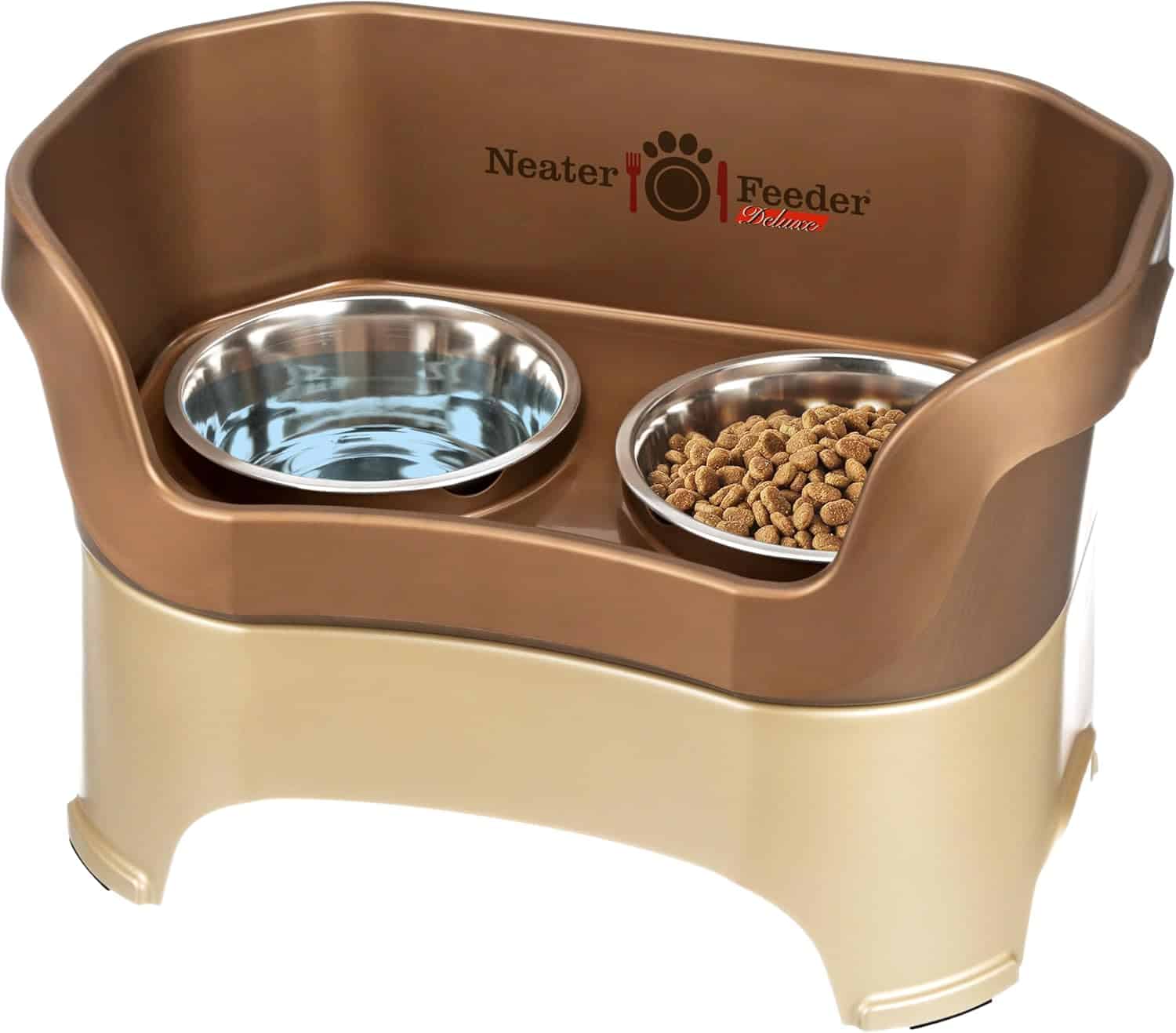
If you have a big, enthusiastic eater who turns the floor around the bowl into a swamp, this is the elevated feeder we’d buy. The Neater Feeder Deluxe is built for dogs over 40 lb and pairs a raised feeding deck with a clever two-tier reservoir: splashed water drains down into a lower trough and spilled kibble stays in the upper tray, so it never ends up soggy on the floor. The two stainless-steel bowls (a 7-cup food bowl and a 9-cup water bowl) lift out for the dishwasher, the molded base has non-slip feet that keep a determined Lab from shoving it across the kitchen, and the stock 8-inch feeding height suits most large dogs. For a tall dog at the top of the range, leg extensions (sold separately) raise it to about 11 inches. It’s not the cheapest, but it’s the one that actually solves the mess, and it’s made in the USA and built to last.
What we like
- The two-tier reservoir genuinely contains spilled water and kibble, the best mess control of any feeder here
- Heavy, non-slip base stays put even when a big dog pushes into it
- Stainless bowls lift out for the dishwasher; the rest wipes clean
- Optional leg extensions raise it to ~11″ for a taller large breed
The catches
- Pricier than a bare stand, you’re paying for the mess-containment design
- At 8″ stock height it’s right for large dogs, not giant breeds (size up to a tall stand for a Dane)
- Leg extensions for the tallest dogs are an extra purchase

XIAZ Adjustable Elevated Dog Bowls (5 Heights)
When you want to dial the height to your dog rather than hope a fixed feeder fits, the XIAZ stand is the smart buy. Its legs lock at five heights, roughly 9, 11, 12 and 14 inches, which covers a medium dog right up to a tall large breed, and lets one feeder grow with a puppy or serve two differently-sized dogs in the same house. The frame is powder-coated metal (not wobbly plastic), the two stainless-steel bowls drop into raised cradles so they can’t tip, and the feet have non-slip pads plus a silent strip so the bowls don’t rattle as a big dog eats. The bowls are dishwasher-safe and the whole thing assembles in a minute with no tools. It’s the elevated feeder we recommend most often, because getting the height right is the single most important thing an elevated bowl has to do, and this one lets you nail it.
What we like
- Five locking heights from ~9″ to ~14″ fit a medium dog up to a tall large breed
- Sturdy powder-coated metal frame, far steadier than plastic risers
- Stainless bowls sit in cradles so they can’t be flipped, and lift out to clean
- Excellent value, and one feeder grows with a puppy or suits a multi-dog home
The catches
- Tops out around 14″, a true giant breed may want our taller stand
- Two bowls only (no integrated storage or mess reservoir)
- Bowls are a fixed size; very big eaters may prefer the larger XL bowls on our giant-breed pick
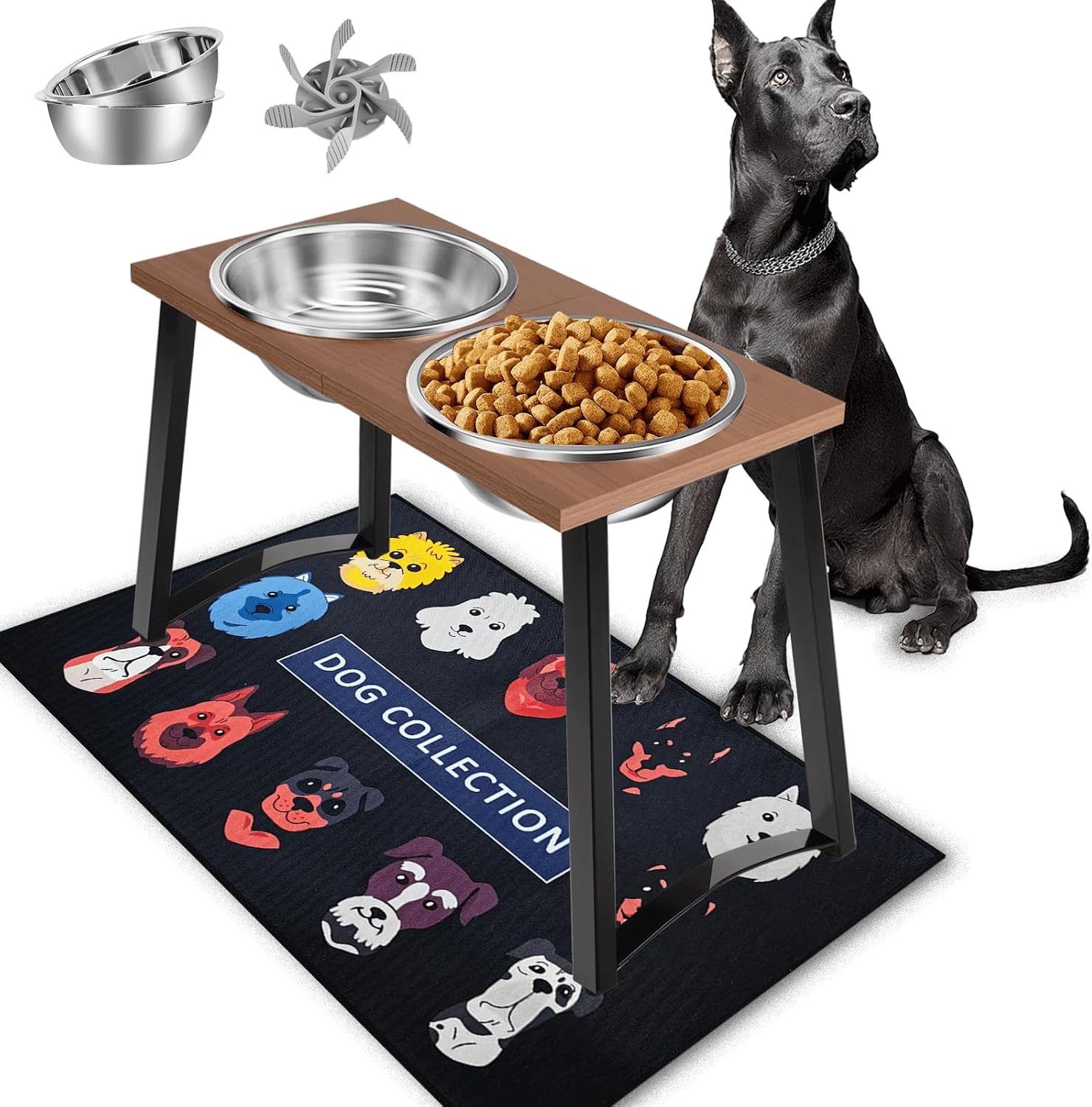
ADENGL 16″ Tall Elevated Dog Bowls (XL / Giant Breed)
A Great Dane, Irish Wolfhound or tall Mastiff dwarfs an ordinary elevated bowl, they need a feeder that comes up near the chest of a dog standing three feet at the shoulder, and that’s exactly what the ADENGL delivers. It stands a full 16 inches tall (about as tall as a freestanding stand gets without going custom), with a wide, stable footprint and a handsome wood-look top that doesn’t look like a science project in your kitchen. The two extra-large stainless bowls hold 3000 ml each, enough for a giant breed’s portion and a full water bowl, and one drops in a spiral slow-feeder insert, a useful touch given that fast eating is part of the bloat conversation for big dogs. A spill mat is included to catch drips. If your dog is genuinely tall, this is the pick that finally puts the food at the right height instead of forcing a deep, neck-craning stoop.
What we like
- A true 16″ height, the right elevation for a Great Dane, Wolfhound or tall Mastiff
- Extra-large 3000 ml bowls hold a giant breed’s portion and a full water bowl
- Built-in slow-feeder insert helps a big dog eat more slowly
- Wide, stable base and an included spill mat; the wood-look top suits a kitchen
The catches
- Fixed 16″ height, too tall for a medium or standard large dog (match the height to the dog)
- The slow-feeder insert is one bowl; you swap as needed
- Big footprint, make sure you have the floor space
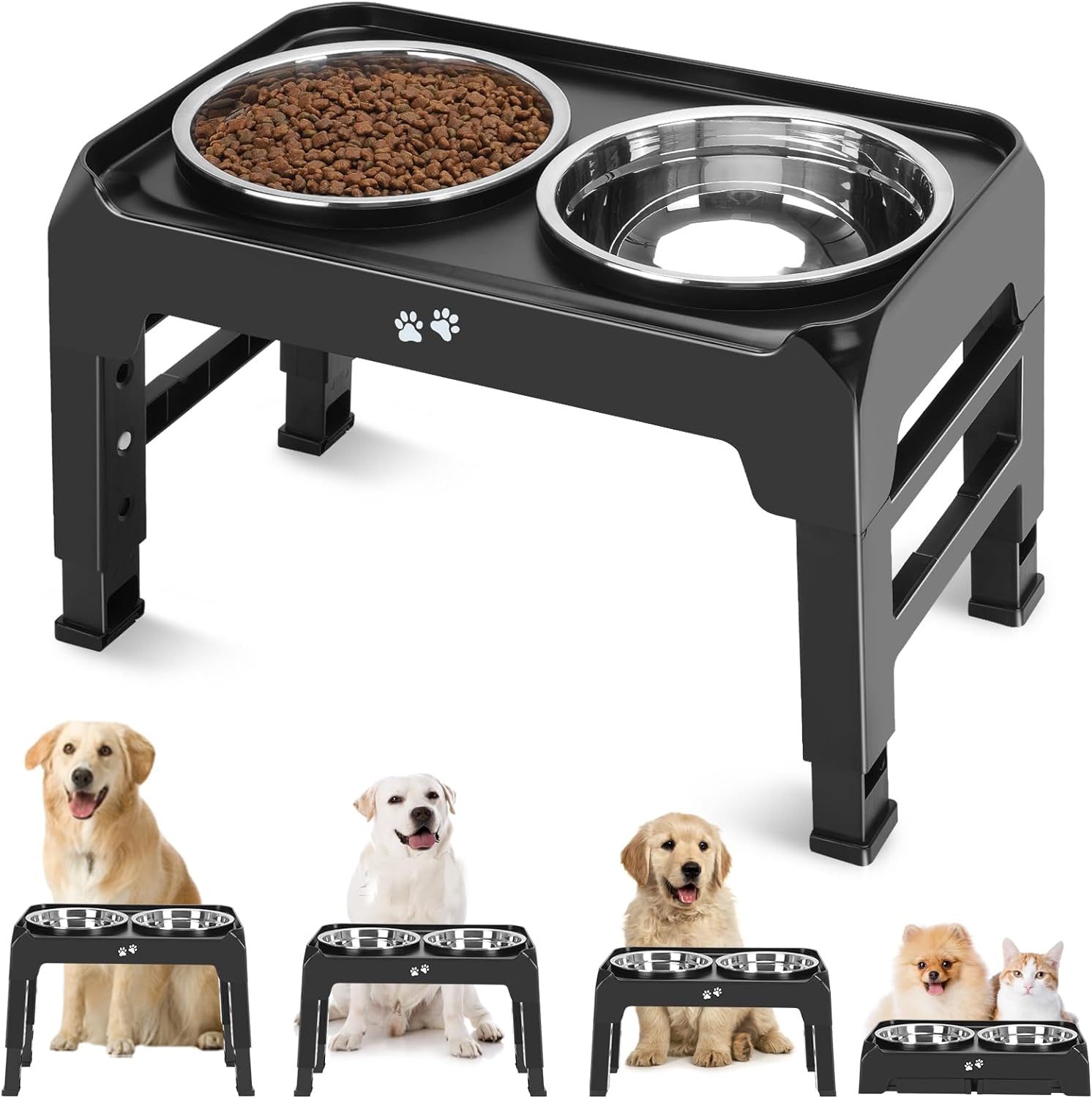
COMESOON Adjustable Elevated Dog Bowls
If you want an adjustable elevated feeder without spending much, the COMESOON is hard to beat. It locks at four heights, 3.7, 9.2, 10.75 and 12.36 inches, so the lowest setting suits a puppy or a small dog and the top settings work for a medium-to-large adult, which makes it a sensible grow-with-your-dog buy. The two bowls are thick 50 oz stainless steel, a proper capacity for a hungry large dog, and they lift out for the dishwasher. The frame uses rounded corners (no sharp edges for a dog to knock into), a silent strip to stop bowl rattle, and anti-slip pads under the feet so it stays put. It isn’t as tall as our giant-breed pick or as mess-proof as the Neater Feeder, but for a little-and-large household on a budget it’s a genuinely good feeder that covers most dogs.
What we like
- Four heights from 3.7″ to 12.36″ cover a puppy or small dog up to a medium-large adult
- Big 50 oz stainless bowls, proper capacity for a hungry large dog
- Rounded edges, a silent anti-rattle strip and non-slip feet
- Excellent price for an adjustable stainless feeder
The catches
- Tops out at ~12.4″, not tall enough for a true giant breed
- Plastic-and-metal build is sturdy but not as premium as the Neater Feeder
- No mess reservoir or integrated storage
Do large dogs actually need an elevated bowl?
Short answer: a large or tall dog usually benefits from one, but it’s a comfort-and-tidiness upgrade, not a medical must, and for a few breeds it comes with a real caveat we’ll cover below. Raising the bowl off the floor means a big dog doesn’t have to stoop, splay its legs and crane its neck down to reach the food. For most large dogs that’s simply more comfortable, and it can matter more as a dog ages:
- Neck and joint comfort. A tall dog eating from the floor holds its head down and forward for the length of every meal. Lifting the bowl lets it eat with a flatter, more level neck and spine, noticeably easier for a big breed, and especially for a senior or arthritic dog who finds bending down to the floor painful.
- Tidier mealtimes. Raised, cradled bowls (and mess-proof designs like the Neater Feeder) keep food and water off your floor and walls, a real bonus with a big, splashy drinker.
- Stops bowl-chasing. Floor bowls get pushed all over the kitchen by a determined large dog. A weighted, non-slip stand stays put.
- Mobility and post-surgery cases. Some dogs recovering from neck or spinal issues are advised by a vet to eat from height. That’s a medical reason, follow your vet’s lead, not a blog.
So who should think twice? Big, deep-chested breeds with a family history of bloat. Great Danes, Weimaraners, Standard Poodles, Setters, German Shepherds and similar, because of a long-running debate we explain in full further down. For those dogs the height decision is worth a conversation with your vet. For most other large and tall dogs, a correctly-sized elevated bowl is a sensible, comfortable choice.
What height should an elevated dog bowl be?
This is the question that actually determines whether an elevated bowl helps or hurts, and it’s the one the other guides gloss over. The goal is simple: the top of the bowl should sit at, or just below, your dog’s elbow / lower-chest height when it’s standing square, so the dog can lower its head slightly to eat, without stooping or reaching up. Too low and you’ve barely helped; too high and the dog has to lift its head, which strains the neck and is exactly the position you don’t want.
How to measure your dog (30 seconds): stand your dog squarely on a flat floor and measure from the ground to the point of the elbow (or the lower chest where the front leg meets the body). Then choose a feeder whose bowl rim height lands at or a touch below that number. As a quick guide:
| Dog size (example breeds) | Typical elbow height | Recommended bowl-rim height |
|---|---|---|
| Small (Beagle, Cocker Spaniel, Frenchie) | ~6 to 9″ | 4 to 7″ |
| Medium (Border Collie, Springer, Aussie) | ~10 to 13″ | 8 to 11″ |
| Large (Labrador, Golden, Boxer, GSD) | ~13 to 17″ | 11 to 14″ |
| X-large (Rottweiler, Doberman, Ridgeback) | ~16 to 19″ | 13 to 16″ |
| Giant / tall (Great Dane, Wolfhound, Mastiff) | ~18 to 24″+ | 16 to 20″+ |
These are starting points, measure your own dog, because two dogs of the same breed can differ by inches, and a leggy youngster grows fast. This is the single biggest reason we lean toward an adjustable-height feeder like the XIAZ or COMESOON: you can fine-tune to your dog, drop it for a puppy and raise it as they grow, and serve two different-sized dogs from one stand. For a genuinely tall giant breed, a fixed 16-inch-plus stand like the ADENGL is the right call, most “adjustable” feeders simply don’t go high enough.
The raised-bowl and bloat (GDV) debate, the honest version
If you own a big, deep-chested dog, you’ve probably heard that elevated bowls cause bloat, and you’ve probably also heard that they prevent it. The truth is more nuanced than either claim, and you deserve the even-handed version. We are not veterinarians and nothing here is medical advice, but here’s what the evidence actually says.
What “bloat” means. Bloat, properly gastric dilatation-volvulus (GDV), is when a dog’s stomach fills with gas and can twist on itself. It’s a true emergency, it can be fatal within hours, and it’s far more common in large and giant deep-chested breeds (Great Danes, Weimaraners, Standard Poodles, Setters, German Shepherds, Saint Bernards and the like).
Where the elevated-bowl worry comes from. A widely-cited Purdue University study (Glickman et al., 2000) of large and giant breeds found a statistical association between feeding from a raised bowl and a higher risk of GDV, the researchers estimated that, in their data, a raised feeder was associated with a meaningful share of the GDV cases (roughly a fifth in large breeds and around half in giant breeds). The leading theory is aerophagia: a raised bowl may let some dogs gulp food faster and swallow more air, and more swallowed air is thought to contribute to bloat. Because of that study, the AKC and many veterinarians now advise caution with raised feeders for at-risk breeds.
Why it’s not the whole story. That study was observational, it found an association, not proof of cause, and it’s now over two decades old. Bloat is multifactorial: the biggest known risk factors are things like breed and body shape, a first-degree relative with bloat, eating one large meal a day, eating very fast, age, and a stressed or anxious temperament. Plenty of dogs eat from raised bowls their whole lives and never bloat; plenty of floor-fed dogs do. Some vets read the same data and remain unconvinced the bowl height itself is the driver.
So what should you actually do? A sensible, even-handed take:
- If your dog is a large or giant deep-chested breed, or has a relative who has bloated, talk to your vet before choosing a raised feeder. For these dogs specifically, many vets prefer caution.
- Slow the eating down regardless. Fast eating is a more consistently-cited risk than bowl height. A slow-feeder bowl (or a slow-feeder insert like the one on our giant-breed pick) helps any big dog eat more calmly.
- Feed two or three smaller meals rather than one big one, avoid heavy exercise right around mealtimes, and keep mealtimes calm.
- For most large dogs that are not in a high-risk group, a correctly-sized elevated bowl is a reasonable comfort choice. Match the height, don’t over-elevate, and watch how your dog eats.
Stability and anti-slip: why a big dog needs a heavy base
A small dog nibbles; a large dog leans, pushes and shoves. If an elevated feeder isn’t stable, a big dog will skate it across the kitchen, tip the bowls, or knock the whole thing over, messy, frustrating, and enough to put a nervous dog off eating. Stability is not a luxury feature for a large dog; it’s the difference between a feeder that works and one that doesn’t.
- Non-slip feet are non-negotiable. Look for rubber or silicone feet (every pick here has them). On a slick tile or hardwood floor, bare plastic or metal feet will slide; grippy feet keep the stand planted while a 60-kilo dog drives its nose into the bowl.
- Weight and footprint matter. A heavier base with a wide footprint resists tipping. The Neater Feeder’s molded base and the ADENGL’s broad stand are deliberately bottom-heavy; flimsy wire frames are the ones that topple.
- Cradled, lift-out bowls beat loose bowls. Bowls that drop into a recessed ring can’t be flipped or carried off, a big plus over a feeder where the bowl just sits on a shelf. All four of our picks cradle the bowls.
- A silent / anti-rattle strip is a nice touch. Stainless bowls in a metal frame can clatter as a big dog eats; a rubber silent strip (XIAZ and COMESOON have one) keeps mealtimes quieter and the bowls seated.
If you’ve ever come home to a feeder shoved under the table and kibble across the room, you already know why this section exists. For a strong, food-motivated large dog, buy for stability first.
Stainless steel vs ceramic vs plastic bowls
The insert bowls matter as much as the stand, because that’s the part your dog’s mouth and the food actually touch. For a large dog, the choice is easy: stainless steel wins for almost everyone, which is why every pick on this list uses it.
- Stainless steel, the default best choice. It’s hygienic (non-porous, so bacteria can’t hide in scratches the way they do in plastic), rust-resistant, almost indestructible, and dishwasher-safe , drop it in the top rack and forget it. It won’t leach, won’t hold smells, and stands up to a big dog’s daily hammering. For a large breed, get bowls with real capacity (our picks range from 7 cups up to 3000 ml / ~12 cups).
- Ceramic, handsome, hygienic, but breakable. Glazed ceramic is non-porous and easy to clean, and a heavy ceramic bowl looks lovely and resists sliding. The downsides for a big dog: it’s heavy to handle, can chip or crack if a clumsy giant knocks it, and a chipped glaze can harbour bacteria. Lovely for a careful household; risky for a bull-in-a-china-shop Lab.
- Plastic, avoid for most dogs. It’s cheap and light, but it scratches easily (those scratches harbour bacteria), can retain odours, and is linked to “plastic dish nasal dermatitis”, a loss of pigment on the nose some dogs develop from plastic bowls. It’s also the easiest for a big dog to chew. Skip it for the food and water bowls; it’s fine for the stand or frame.
Adjustable height, storage bases and other features worth paying for
Beyond height, stability and material, a few design features genuinely earn their keep, and a couple are marketing fluff. Here’s what’s worth it:
- Adjustable height, usually worth it. Because the right height depends on your individual dog (and changes as a puppy grows), an adjustable stand like the XIAZ (~9 to 14″, five settings) or COMESOON (3.7 to 12.36″, four settings) is the most foolproof way to get it right and to serve a multi-dog or growing household. If you have one adult dog of a settled size, a well-sized fixed feeder is fine, but adjustable removes the guesswork.
- Mess-proof reservoir, worth it for splashy dogs. The Neater Feeder’s two-tier base that catches spilled water and food is the best mess control here. If your big dog floods the floor, it’s the feature to buy.
- Built-in storage base, handy, not essential. Some feeders (IRIS and similar) build a kibble storage drawer into the stand, keeping food right where you feed. Tidy and convenient if counter space is tight; just make sure the seal is airtight to keep kibble fresh, and that the storage doesn’t make the base too light to be stable.
- Slow-feeder insert, useful for fast eaters. A spiral or ridged insert (like the ADENGL’s) makes a gulping dog work for the food, slowing the meal, which, as we covered, is one of the few things the bloat evidence consistently points to. Worth having for any big, fast eater.
- Capacity, match it to the dog. A giant breed needs big bowls (look for 50 oz / 3000 ml or larger) and a generous water bowl; an undersized bowl means constant refilling.
Which elevated dog bowl should you buy?
Match the feeder to your dog and your priority, and the choice is straightforward:
- Best all-round for a large dog (and the messiest eaters): the Neater Feeder Deluxe. The mess-proof reservoir, heavy non-slip base and lift-out stainless bowls make it the one we’d buy for a typical large dog, with leg extensions on hand if your dog is on the taller side.
- Best if you want to nail the height (or have a growing / multi-dog home): the XIAZ adjustable stand. Five locking heights from ~9″ to ~14″, a sturdy metal frame and a great price, our most-recommended pick because getting the height right is everything.
- Best for a giant or genuinely tall breed: the ADENGL 16″ stand. A true 16-inch height, XL 3000 ml bowls and a slow-feeder insert, the right answer for a Great Dane, Wolfhound or tall Mastiff that ordinary feeders leave stooping.
- Best value adjustable: the COMESOON. Four heights up to ~12.4″, big 50 oz stainless bowls, safe rounded edges and non-slip feet, for very little money, ideal for a budget-conscious little-and-large household.
Whichever you choose, measure your dog and set the height to the elbow, prioritise a stable non-slip base, keep the stainless bowls clean, and, if you’ve got a deep-chested giant, have the bloat conversation with your vet first. An elevated bowl is part of a wider feeding setup: pair it with a slow-feeder bowl for a fast eater, consider an automatic feeder for portion control and routine, and see our full best dog bowls and feeders hub for the rest of the kit.
Build your feeding station
Elevated dog bowls: common questions
What height should an elevated dog bowl be?
The top of the bowl should sit at or just below your dog’s elbow / lower-chest height when it’s standing square, so the dog lowers its head only slightly to eat, without stooping down or reaching up. Measure from the floor to the point of the elbow and pick a feeder whose bowl rim lands at or a touch below that figure. As a rough guide, that’s about 4 to 7″ for a small dog, 8 to 11″ for a medium dog, 11 to 14″ for a large dog, and 16 to 20″+ for a giant or tall breed like a Great Dane. Two dogs of the same breed can differ by inches, so measure your own dog, which is why an adjustable-height stand is the easiest way to get it exactly right. The quick check: while your dog eats, its neck should look roughly level, never tipped up.
Are raised bowls bad for big dogs, do they cause bloat?
It’s genuinely debated, and the honest answer is that raised bowls are neither proven to cause bloat nor proven safe for at-risk dogs. A widely-cited Purdue University study (Glickman, 2000) of large and giant breeds found a statistical association between feeding from a raised bowl and a higher risk of gastric dilatation-volvulus (GDV), the theory being that a raised bowl may let some dogs gulp food faster and swallow more air. But that study was observational (an association, not proof of cause) and is over two decades old, and bloat is multifactorial, breed and body shape, a relative who has bloated, eating one big fast meal, age and temperament all matter more consistently. The sensible take: for a large or giant deep-chested breed (Great Dane, Weimaraner, Setter, GSD and similar) or a dog with a family history of bloat, ask your vet before using a raised feeder. For most other large dogs, a correctly-sized elevated bowl is a reasonable comfort choice. Either way, slow the eating down, feed smaller meals, and don’t over-elevate. We’re not vets, this isn’t medical advice.
What is the best elevated dog bowl for a large dog?
For a typical large dog our overall pick is the Neater Feeder Deluxe: it’s built for dogs over 40 lb, the mess-proof two-tier base catches spilled food and water, the heavy non-slip base stays put, and the two stainless bowls lift out for the dishwasher, with optional leg extensions for a taller dog. If you’d rather dial in the exact height, or you have a growing puppy or two differently-sized dogs, the XIAZ adjustable stand (five heights from ~9″ to ~14″) is the smarter buy and our most-recommended option, with the COMESOON as a great-value alternative. For a genuinely giant or tall breed like a Great Dane, step up to the ADENGL 16″ tall stand with its XL bowls. In every case, match the bowl-rim height to your dog’s elbow.
Are elevated dog bowls good for dogs?
For most large and tall dogs, yes, a correctly-sized elevated bowl lets the dog eat in a more natural, level posture instead of stooping and craning its neck to the floor, which is easier on the neck and joints and especially welcome for a senior or arthritic dog. Raised, cradled bowls also keep food and water off your floor and stop a big dog pushing the bowls around. The main caveats are getting the height right (too high strains the neck) and the bloat debate for deep-chested giant breeds. For small dogs and breeds at risk of bloat, an elevated bowl is more of a judgement call, measure, don’t over-elevate, and ask your vet if your dog is in a high-risk group.
Do elevated bowls help with digestion?
This is often claimed, but the evidence is thin. The clearest, real benefit of a raised bowl is posture and comfort, a big dog eats with a level neck rather than a deep stoop, not a proven boost to digestion. In fact, the digestion-related concern runs the other way: the bloat (GDV) debate centres on the worry that a raised bowl could let some dogs gulp and swallow air, which is a digestive risk, not a benefit. So treat “aids digestion” claims with caution. If you want to help a big dog’s mealtimes, the things that genuinely help are slowing the eating down (a slow feeder), smaller, more frequent meals, and calm mealtimes, not bowl height alone.
Are stainless steel bowls better than ceramic or plastic?
For most dogs, stainless steel is the best choice, which is why every feeder on this list uses it. It’s hygienic (non-porous, so bacteria can’t hide in scratches), rust-resistant, nearly indestructible and dishwasher-safe. Ceramic is also hygienic and handsome and resists sliding, but it’s heavy and can chip or crack if a big clumsy dog knocks it, and a chipped glaze can harbour bacteria. Plastic is best avoided for food and water bowls: it scratches easily (harbouring bacteria), can hold odours, and is linked to a loss of nose pigment in some dogs (“plastic dish nasal dermatitis”). Whatever you choose, wash it daily, a clean bowl matters more than the material.
Is an adjustable-height elevated bowl worth it?
Usually yes. Because the right height depends on your individual dog, and changes as a puppy grows, an adjustable stand is the most foolproof way to get it right. It lets you fine-tune to your dog’s elbow height, drop it low for a puppy and raise it as they grow, and serve two different-sized dogs from one feeder. Our XIAZ pick offers five heights (~9 to 14″) and the COMESOON four (3.7 to 12.36″). If you have a single adult dog of a settled size, a well-sized fixed feeder is perfectly fine, and for a true giant breed a tall fixed stand like the 16″ ADENGL is often the better call, since many adjustable feeders don’t go high enough. For most other households, adjustable removes the guesswork.
How do I clean an elevated dog bowl?
Keep it simple and do it often. Lift out the stainless bowls and run them through the dishwasher (top rack) regularly, or hand-wash them in hot soapy water, stainless is non-porous, so it cleans up completely. Rinse and wipe the bowls between meals to stop biofilm building up, and empty and refresh the water bowl daily. Wipe down the stand with warm soapy water, paying attention to any mess reservoir (like the Neater Feeder’s) and to the feet and crevices where kibble and drips collect. If your feeder has a slow-feeder insert, scrub the ridges with a brush so food doesn’t lodge in them. A clean feeder matters for your dog’s health as much as the design does.