 Dog Gear, Sized Right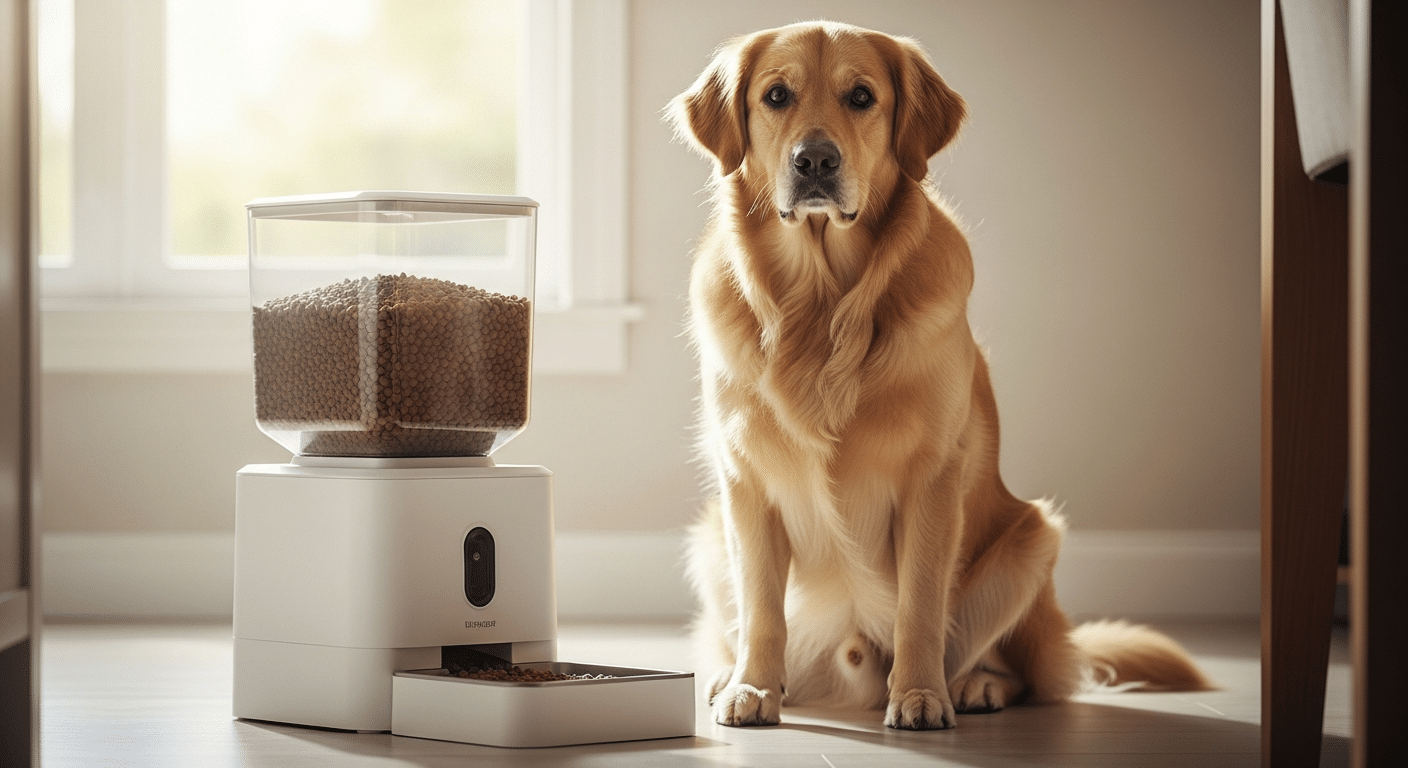
Best Automatic Dog Feeders (Timed & App-Controlled)
An automatic feeder keeps your dog on a consistent schedule whether you’re at work, asleep or away, and the good ones do it with precise portions, a power-cut backup and a chute that won’t jam on big kibble. These are the four timed and app-controlled feeders we’d actually buy, ranked, with a plain-English guide to capacity, portion control, Wi-Fi, battery backup and jam-resistance for large dogs.
An automatic dog feeder is the gear that quietly removes one of pet ownership’s daily stresses: it feeds your dog the right amount, at the right time, every time, even when you’re stuck at the office, on a trip, or just not a morning person. The catch is that they’re not all equal. A cheap one can jam on large kibble, lose its schedule in a power cut, or over-portion a dog that’s already prone to weight gain. Below are the four best automatic dog feeders we’d buy, the Wi-Fi pick for most owners, the large-capacity choice for big dogs, a no-app model for people who don’t want yet another connected device, and a budget high-volume tank, plus an honest buying guide covering hopper capacity, portion control, programmable schedules, app and Wi-Fi, battery backup, and jam-resistance with big kibble, so you can buy once and buy right.
The 4 best automatic dog feeders, ranked
Each pick is verified available and chosen for capacity, portion control, reliability and value. Prices are last-checked, tap through for the live price.
PETLIBRO Granary 5L Wi-Fi Automatic Feeder
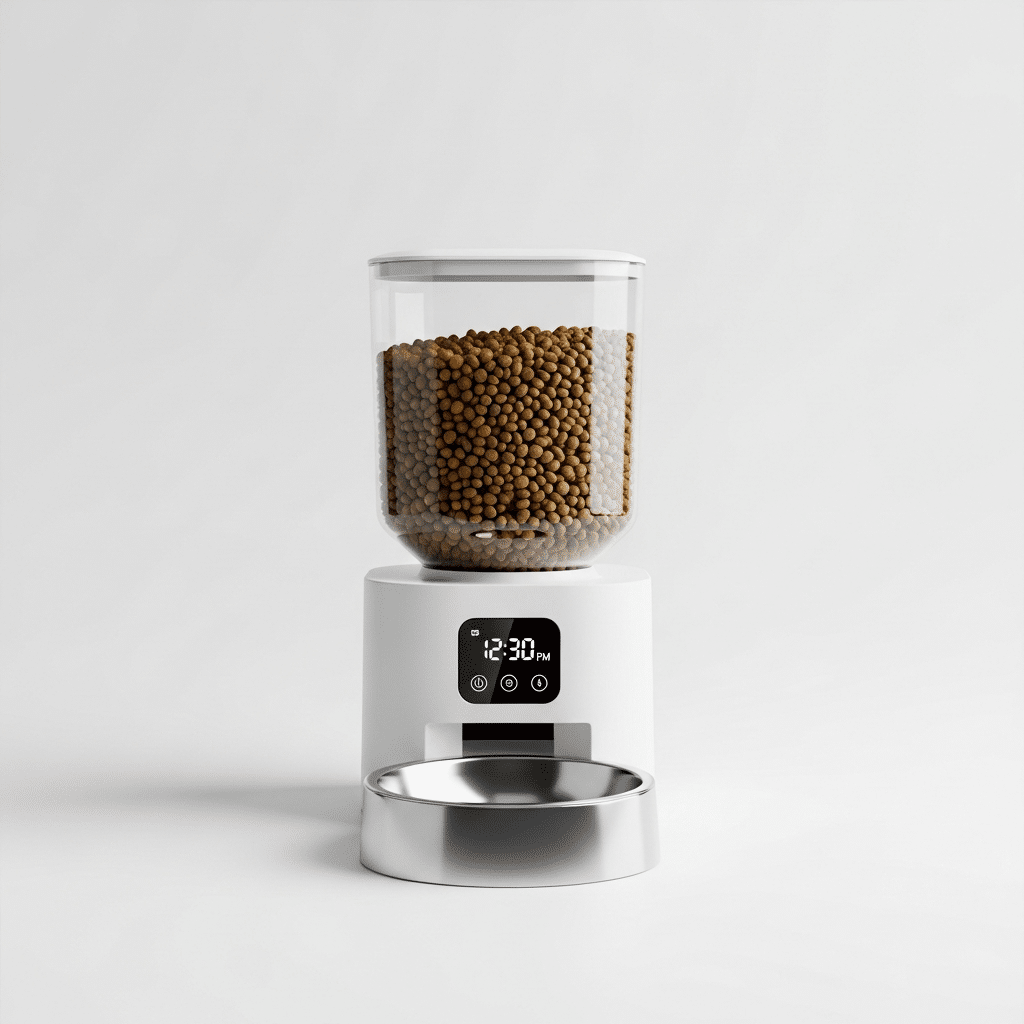
If you want the app-controlled feeder we’d put in most homes, it’s the PETLIBRO Granary 5L Wi-Fi, the model that keeps winning the big automatic-feeder round-ups, and the one we point owners to first. It connects over both 2.4 GHz and 5 GHz Wi-Fi (a genuine rarity, most budget feeders only do 2.4 GHz), so you can set and tweak the schedule, fire an extra meal, or check the food level from the PETLIBRO app anywhere. The 5 L hopper holds about 3 lb of kibble, you can program up to 10 meals a day at 1 to 48 portions per meal (each ~1/12 cup) for genuinely precise portion control, and you can record a 10-second voice message that plays at every feeding to call your dog over. Crucially for reliability, it runs on the wall adapter and takes 3 D-cell batteries as backup, and an infrared anti-jam sensor stops and re-tries if kibble bridges the chute. It’s a dry-food-only feeder with an airtight, freshness-sealed tank.
What we like
- Real app control on both 2.4 GHz and 5 GHz Wi-Fi, set the schedule or feed remotely from anywhere
- Fine portion control (1 to 48 portions per meal, ~1/12 cup each) makes it easy to hit a vet-set daily amount
- Dual power: wall adapter plus 3 D-cell battery backup, so a power cut won’t skip a meal
- Infrared anti-jam sensor, low-food alert and a 10-second voice meal-call; airtight tank keeps kibble fresh
The catches
- 5 L tank is on the smaller side for a big dog, a giant breed eating 4+ cups a day will need refilling every 2 to 3 days
- Best with kibble under ~12 to 15 mm; very large or odd-shaped kibble can still occasionally bridge
- Wi-Fi setup needs a 2.4 GHz-capable phone step and the app; a few owners find first pairing fiddly
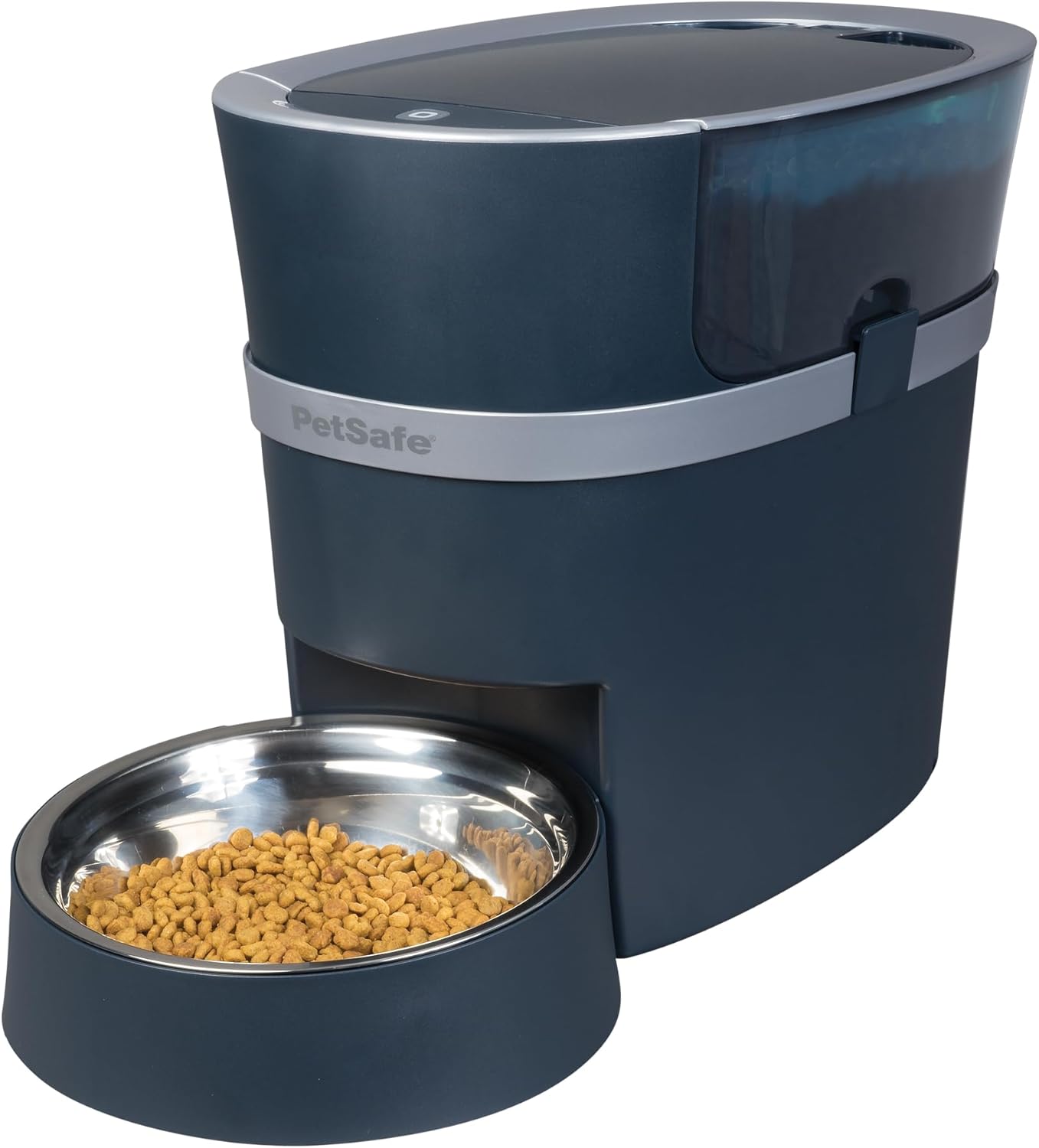
PetSafe Smart Feed (2nd Gen) 6 L / 24-Cup
For a big dog, or anyone who wants the most bullet-proof option, the PetSafe Smart Feed (2nd generation) is the one we’d buy. Its standout is the 6 L / 24-cup hopper, the largest here, which holds enough dry food for several days for a large breed, and a wide conveyor-style dispensing chute that handles big kibble far better than the narrow augers on cheap feeders. It’s Wi-Fi and app controlled (iOS, Android, and works with Alexa), schedules up to 12 meals a day in 1/8-cup increments up to 4 cups per meal, and has a genuinely useful slow-feed mode that spreads a meal out over ~15 minutes to slow a fast eater. Two details set it apart for reliability and upkeep: backup batteries keep meals running during a power outage, and the hopper and bowl are dishwasher-safe, a real perk most feeders can’t match. Dry food only.
What we like
- Largest hopper here (24 cups), best automatic feeder for a large or fast-growing dog, fewer refills
- Wide conveyor chute handles big kibble far better than narrow-auger budget feeders (fewer jams)
- Wi-Fi app plus Alexa control, up to 12 meals/day, and a slow-feed mode to pace a gulper
- Battery backup keeps meals on schedule through a power cut; hopper and bowl are dishwasher-safe
The catches
- One of the pricier picks, you’re paying for capacity, build and the app ecosystem
- Bulkier footprint than the compact PETLIBRO; it needs a bit of floor space
- Wi-Fi can occasionally drop and need a re-pair, as with most connected feeders
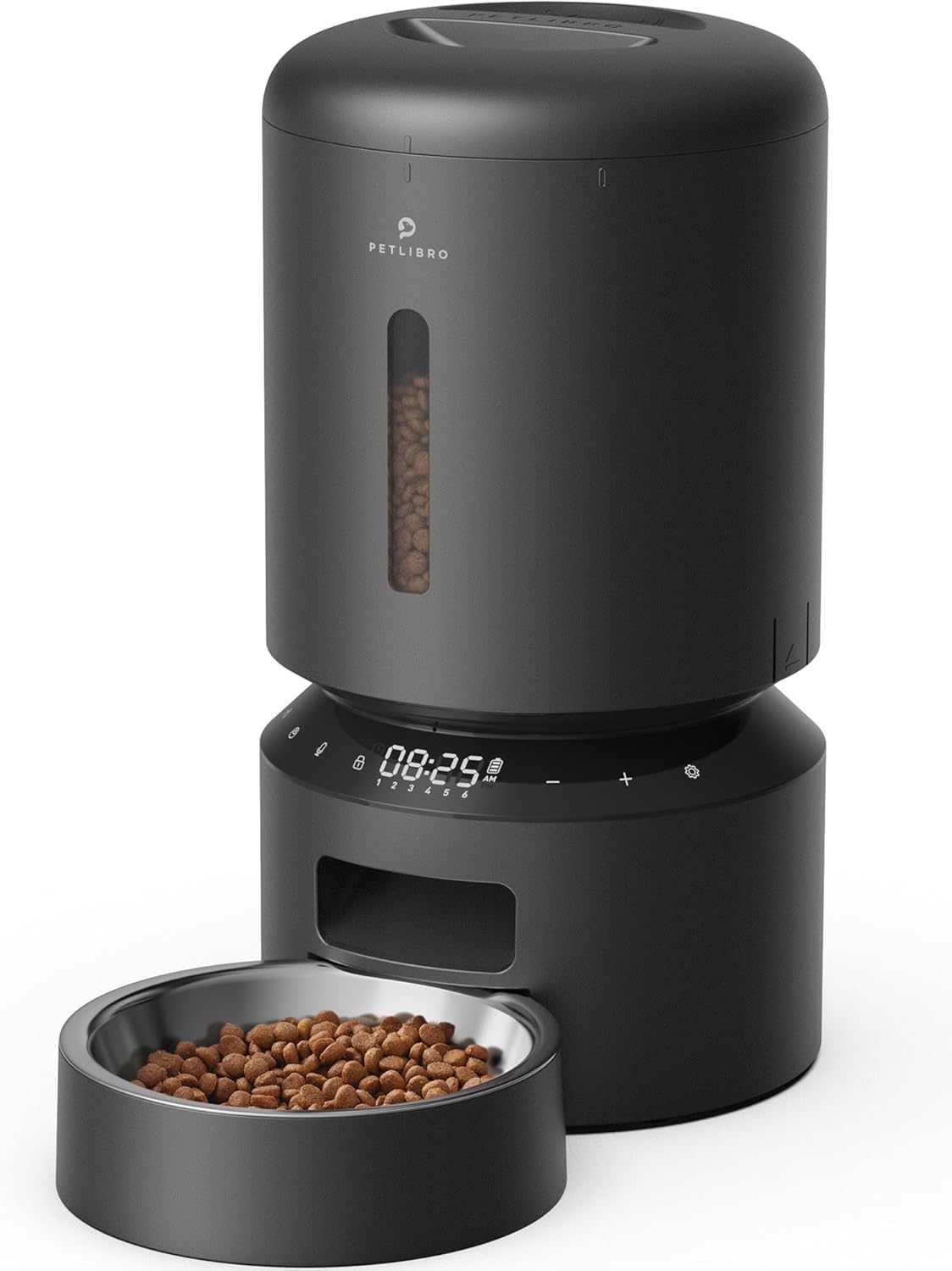
PETLIBRO Granary 5L (No-Wi-Fi Button Model)
Not everyone wants an app, a login and another device on their Wi-Fi, and for those owners the button-programmed PETLIBRO Granary 5L is the smart, no-nonsense choice. It’s the same solid hardware as our top pick, the 5 L airtight tank, the freshness seal, the infrared anti-jam sensor and the dual power (adapter + battery backup), but you set the schedule directly on the on-unit LCD and buttons, with up to 6 meals a day at 1 to 48 portions each and a recordable voice meal-call. There’s nothing to pair, no account and no connection to drop, which makes it genuinely more reliable for a basic daily schedule and a great fit for anyone who just wants the food to come out on time. It’s dry-food-only, like every feeder here.
What we like
- No app, account or Wi-Fi to set up or drop, the simplest, most reliable way to run a fixed schedule
- Same trusted Granary build: airtight 5 L tank, infrared anti-jam sensor and freshness seal
- Dual power (adapter + battery backup) keeps meals running if the mains goes off
- Precise 1 to 48 portions per meal and a recordable voice call, usually cheaper than the Wi-Fi version
The catches
- No remote control, you can’t add a meal or check it from your phone when you’re out
- Caps at 6 meals a day rather than 10; fine for most dogs but less granular than the Wi-Fi model
- 5 L capacity, like the other Granary, means more frequent refills for a large heavy eater
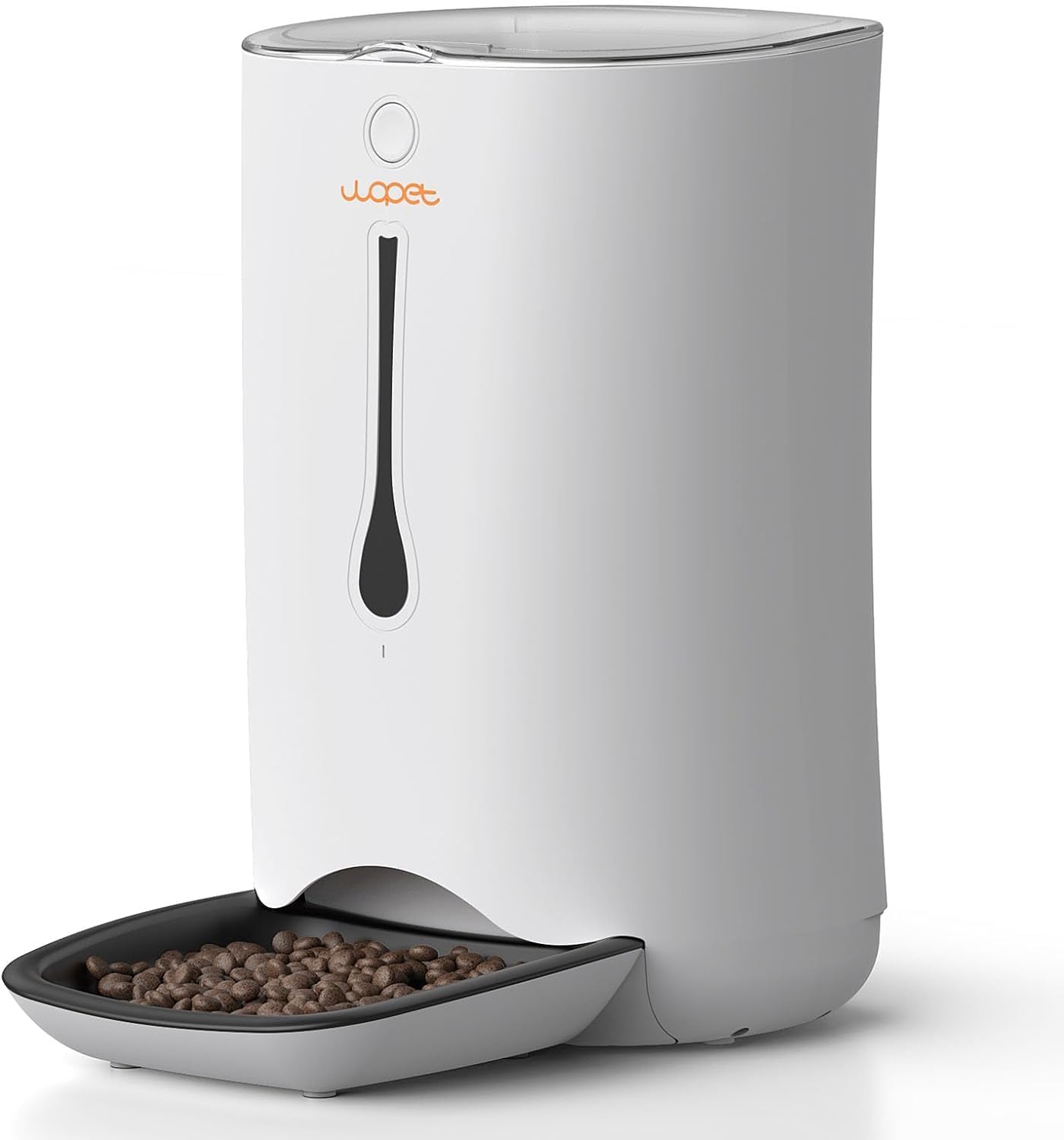
WOPET 7L Automatic Feeder (29-Cup)
If raw capacity and value matter most, a big dog, a long workday, or just hating refills, the WOPET 7L is the high-volume pick. Its 7 L / 29-cup hopper is the biggest electronic feeder here and holds enough dry food to cover a large dog for several days. Scheduling is refreshingly straightforward: a clear timer programs up to 5 meals a day with adjustable portions, there’s a 10-second voice recorder to call your dog, and it runs on the mains adapter with battery backup. It’s not Wi-Fi, there’s no app, so it’s best thought of as a simple, dependable, large-tank timed feeder rather than a smart one. Like every feeder on this list it’s dry-food-only; the removable tank lifts out for easy cleaning.
What we like
- Biggest hopper in our line-up (29 cups), fewest refills, ideal for a large dog or several days’ food
- Simple, dependable timer scheduling with adjustable portions and a 10-second voice meal-call
- Mains adapter plus battery backup, and a removable tank that lifts out for easy cleaning
- Strong value, a lot of capacity for the money when you don’t need an app
The catches
- No Wi-Fi or app, you can’t feed or check it remotely; it’s a timed feeder, not a smart one
- Caps at 5 meals a day; portion granularity is coarser than the PETLIBRO and PetSafe
- Best with regular-sized dry kibble; very large kibble can occasionally jam the dispense wheel
How an automatic dog feeder works (and the two types)
An automatic feeder is, at heart, a sealed kibble hopper on top of a dispensing mechanism and a timer. At the meal times you program, it drops a set portion of dry food into the bowl below, and the good ones add a voice call, a phone alert and a power-cut backup. There are two broad types, and it’s worth knowing which one you’re actually shopping for:
| Type | How it works | Best for |
|---|---|---|
| Programmable / electronic feeder | A motor-driven auger or conveyor dispenses an exact, timer-set portion; many add Wi-Fi, an app, voice recording and battery backup | Portion control, weight management, precise schedules, what this guide is about |
| Gravity feeder | No motor or timer, food simply falls into the bowl as the dog eats and clears space | Free-feeding only; useless for portion control and easy to over-eat from |
Every feeder we recommend here is the programmable / electronic kind, because the whole point of an automatic feeder is controlling how much and when your dog eats. A gravity feeder just keeps a bowl topped up, which for most dogs means overeating. If portion control rather than scheduling is your real goal, a slow feeder bowl tackles the speed-of-eating problem instead, and the two pair well.
Hopper capacity: how big a feeder does a large dog need?
Capacity is the spec to get right first, because it decides how often you’ll be refilling, and for a large dog it’s the difference between a feeder that lasts a long weekend and one you’re topping up every other day. Feeders are sold by tank volume (litres) or by cups of kibble; here’s roughly how they line up:
| Hopper | Holds (dry kibble) | Realistic for |
|---|---|---|
| ~3 to 5 L | ~3 to 12 cups | Small to medium dogs; a large dog for 1 to 2 days |
| 6 to 7 L (PetSafe 24-cup, WOPET 29-cup) | ~24 to 29 cups | Large dogs for several days; the sweet spot for a big eater |
| 12 to 16 L+ | ~50 to 63 cups | Giant breeds, multi-dog homes, or longest trips |
A useful rule of thumb: work out your dog’s cups per day, then buy a hopper that holds at least 4 to 5 days’ worth so you’re not refilling constantly and you have a buffer if you’re delayed getting home. A 70 to 90 lb dog often eats 3 to 4 cups a day, so a 24 to 29 cup hopper (our PetSafe and WOPET picks) covers roughly a week, which is why those two are our large-dog recommendations. A compact 5 L feeder like the PETLIBRO is brilliant for portion precision but you’ll refill it more often for a big dog. Whatever the size, don’t run a feeder bone-empty: most have a low-food sensor that pings your phone, and topping up before it’s empty keeps the dispense reliable.
Portion control and scheduling: feeding the right amount
This is where an automatic feeder earns its keep, and where the cheap ones fall down. The two numbers that matter are how many meals a day it can schedule and how finely you can size each portion. The feeders here program 5 to 12 meals a day, and the best (PETLIBRO) dispense in small ~1/12-cup increments from 1 up to 48 units per meal, which lets you hit a vet-recommended daily amount almost exactly rather than guessing.
Why it matters: more than half of dogs are overweight, and portion creep is the usual culprit. A feeder that doles out a measured amount on a fixed schedule takes the guesswork, and the “just a little extra”, out of feeding. A few practical points:
- Split the daily ration into more, smaller meals. Two to four meals a day is gentler on digestion than one big one, and feeders make that effortless, useful for puppies, seniors and bloat-prone large breeds.
- Calibrate the portions to your kibble. A “portion” is a volume, not a weight, and brands vary, run a test dispense into a measuring cup once and adjust, rather than trusting the number on the box.
- Use the schedule to break the dawn wake-up. A 5 a.m. auto-breakfast is one of the most popular reasons owners buy these, the dog gets fed on time and you get to sleep.
App and Wi-Fi vs. timed feeders: do you need the connectivity?
The big dividing line in today’s feeders is Wi-Fi and an app versus a simple on-unit timer. A connected feeder (our PETLIBRO Wi-Fi and PetSafe picks) lets you set and change the schedule, fire an extra meal, and get low-food and jam alerts from your phone, anywhere, genuinely useful if your day is unpredictable or you travel. A timed feeder (the button PETLIBRO and the WOPET) does everything on the device itself: you set the schedule once and it runs, with no account, no pairing and nothing to drop offline.
- Choose Wi-Fi/app if your schedule changes, you’re often away, or you like remote alerts and the ability to add a meal from your phone. Look for dual-band (2.4 + 5 GHz) support, many cheap feeders only do 2.4 GHz, which can complicate setup on modern routers.
- Choose a timed feeder if you want maximum reliability for a fixed routine, dislike adding another connected device, or simply don’t want an app and a login. There’s less to go wrong.
A reality check on connectivity: app feeders depend on your home Wi-Fi and the maker’s servers, so an internet outage can stop remote control, though the schedule still runs locally on every feeder we recommend. None of our picks charges a subscription, which is worth confirming on any feeder you consider. If you don’t actually need to feed remotely, a good timed feeder is often the more dependable buy.
Battery backup: why it’s the spec that prevents a missed meal
Here’s the feature most “best automatic dog feeder” lists skim over, and it’s arguably the most important: what happens when the power goes out? A feeder that runs on the wall adapter alone will simply stop, and worse, some lose their programmed schedule entirely and need re-setting when the power returns, meaning a missed meal you may not even know about until your dog tells you.
That’s why every feeder we recommend has dual power: a mains adapter plus battery backup (typically 3 to 4 D-cell batteries). The right setup is to run the feeder on the adapter for normal use and keep fresh batteries installed as a fail-safe, so a blackout, a tripped breaker or an unplugged cord doesn’t cost your dog a meal or wipe the schedule. The PetSafe even markets its backup batteries as guaranteeing “meal delivery during a power outage,” and that’s exactly the job they do.
Jam-resistance and large kibble: the big-dog gotcha
The single most common automatic-feeder complaint, and it bites large-dog owners hardest, is jamming. Big breeds often eat large-format kibble, and a feeder with a narrow auger or a small dispense hole can bridge (kibble arches over the opening and stops flowing) or grind, so the dog gets a short meal or none at all. It’s the reason a feeder that’s perfect for a cat or a small dog can be a daily frustration with a Labrador.
How to avoid it:
- Check the kibble-size rating. Better feeders state a maximum kibble size, often up to ~12 to 22 mm. Measure your kibble and stay within it; the PetSafe’s wide conveyor chute is the most forgiving here, which is why it’s our large-dog pick.
- Look for an anti-jam / infrared sensor. The PETLIBRO’s IR sensor detects a blockage at the outlet, stops, and re-tries rather than grinding, and alerts your phone.
- Dry food only, and not too large or oddly shaped. Every feeder here is dry-kibble only: no wet food, no semi-moist, no big dehydrated chunks, all of which clog the mechanism and spoil at room temperature.
- Keep the kibble dry. Humidity makes kibble swell and stick; the airtight, freshness-sealed tanks on the PETLIBRO feeders help, and a desiccant pack in the hopper is cheap insurance.
If your dog eats a very large or unusual kibble, size up the chute (the PetSafe) and stay well inside the rated kibble limit, it’s the difference between a feeder you trust and one you check anxiously.
Voice recording, cleaning and the details that matter day to day
A few smaller features make a real difference in daily life:
- Voice recording / meal call. Most of our picks let you record a 5 to 10 second message that plays at each feeding. It’s not a gimmick, it cues your dog to come eat (handy in a big house) and reassures a dog that associates your voice with food while you’re out.
- Cleaning. A feeder needs regular cleaning, roughly weekly, because kibble dust and oils build up and can turn rancid. Look for a removable hopper and bowl; the PetSafe’s dishwasher-safe parts are a standout, while most others are hand-wash. Dry everything fully before refilling, since moisture is what causes both spoilage and jams.
- Bowl material. A stainless-steel bowl (PetSafe, and the PETLIBRO tray) is more hygienic and easier to clean than plastic, and better for dogs prone to chin acne.
- Stability. A bigger, eager dog will nudge a feeder, a wide, low, non-slip base and a tamper-resistant locking lid stop a clever dog from tipping or raiding the tank.
An automatic feeder is one piece of a good feeding setup. Many owners pair one with a raised stand for comfort and posture, see our best elevated dog bowls guide, or with a slow feeder bowl for a dog that gulps. For the full picture on bowls, stands and feeders together, our best dog bowls and feeders hub ties it all together.
More dog feeding guides
Automatic dog feeders: common questions
Are automatic feeders good for dogs?
Yes, for most dogs an automatic feeder is a genuinely healthy upgrade, because it delivers a measured portion on a consistent schedule, which is exactly what supports a stable weight and good digestion. It removes the guesswork and the “just a bit extra” that lead to the overfeeding behind so much canine obesity, and it keeps meals on time when you’re at work, asleep or away. The caveats are simple: use a programmable feeder, not a gravity one (gravity feeders just keep a bowl full and encourage overeating), set the daily total your vet recommends, and choose a feeder with a power-cut battery backup so a blackout can’t skip a meal. They suit confident, food-motivated dogs best; a very anxious dog or one with a medical feeding issue should be introduced gradually and with your vet’s input.
What is the best automatic feeder for a large dog?
For a large dog the two things that matter most are hopper capacity and a wide, jam-resistant chute that handles big kibble, which is why our top large-dog pick is the PetSafe Smart Feed (2nd gen) with its 6 L / 24-cup tank, conveyor-style chute, app and Alexa control, battery backup and dishwasher-safe parts. If you want even more capacity on a budget and don’t need an app, the WOPET 7L (29-cup) is the high-volume timed alternative. As a rule, buy a hopper that holds at least 4 to 5 days of your dog’s food (a 70 to 90 lb dog often eats 3 to 4 cups a day), check the feeder’s maximum kibble-size rating against your kibble, and make sure it has battery backup. The compact 5 L PETLIBRO models are superb for portion precision but you’ll refill them more often for a big eater.
Do automatic dog feeders work with wet food?
No, almost every automatic feeder, including all four we recommend, is dry-kibble only. Wet and semi-moist food clogs the dispensing mechanism and, just as importantly, spoils quickly at room temperature, so leaving it sitting in a feeder for hours is unsafe. If your dog needs wet food on a schedule, the right tool is a different product: a refrigerated or ice-pack feeder designed for wet food, which keeps a portion or two cold and opens a chilled compartment at the set time, but these hold far fewer meals and are a specialist item. For the vast majority of dogs on dry kibble, a standard programmable feeder like the ones here is the answer; just keep the kibble dry and within the feeder’s size rating to avoid jams.
What happens to an automatic feeder in a power outage?
It depends entirely on whether the feeder has battery backup, which is why we only recommend feeders that do. A feeder running on the wall adapter alone will stop dispensing during an outage, and some even lose their programmed schedule and need re-setting when power returns, meaning a quietly missed meal. Feeders with dual power, a mains adapter plus 3 to 4 D-cell batteries, like all our picks, keep running on the batteries and hold the schedule, so a blackout doesn’t cost your dog a meal. The PetSafe specifically advertises that its backup batteries ensure meal delivery during a power outage. The best practice is to power the feeder from the adapter for daily use and always keep fresh batteries installed as the fail-safe.
Do automatic dog feeders jam with large kibble?
Cheap ones can, and it’s the most common complaint among large-dog owners. Big breeds often eat large-format kibble, and a feeder with a narrow auger or small dispense hole can bridge (the kibble arches over the opening and stops flowing) or grind, leaving your dog short. To avoid it, check the feeder’s maximum kibble-size rating (good ones state up to ~12 to 22 mm) and measure your kibble against it; the PetSafe’s wide conveyor chute is the most forgiving, which is why it’s our large-dog pick. An infrared anti-jam sensor (like the PETLIBRO’s) helps by detecting a blockage, stopping, and re-trying rather than grinding. Also keep the kibble dry, humidity makes it swell and stick, and never load wet or oversized food. Stay within the rated size and a good feeder is reliable.
Do I need a Wi-Fi feeder, or is a timed feeder enough?
A timed feeder is enough for most dogs on a fixed routine, and it’s often the more reliable buy. The schedule runs on the device itself with no account, no pairing and nothing to drop offline, set it once and forget it. Choose a Wi-Fi/app feeder (our PETLIBRO Wi-Fi or PetSafe picks) only if you genuinely value remote control: changing the schedule from your phone, firing an extra meal when you’re running late, or getting low-food and jam alerts while you’re out. If you do go connected, look for dual-band 2.4 + 5 GHz support and confirm there’s no subscription. One reassurance: on every feeder we recommend the schedule still runs locally even if your internet drops. Wi-Fi only affects remote control, not the core feeding.
How often should I clean an automatic dog feeder?
About once a week for the hopper and bowl, and a quick rinse of the bowl more often if your dog leaves food. Kibble sheds dust and oils that build up inside the tank and chute and can turn rancid, which both spoils food and contributes to jams. Empty the hopper, wash the removable parts (the PetSafe’s are dishwasher-safe; most others are hand-wash with warm soapy water), wipe out the chute, and, critically, dry everything completely before refilling, because leftover moisture is what causes both mould and clumping jams. A desiccant pack in the hopper helps keep the kibble dry between cleans. Don’t submerge the motorised base; just wipe it.
Can a puppy use an automatic feeder?
Yes, and it can be a real help, puppies do best on several small meals a day, and a feeder makes that easy to deliver on a consistent schedule even around work. Use a feeder with fine portion control (the PETLIBRO’s 1 to 48 portions are ideal) so you can dial in small puppy meals, split the daily ration across 3 to 4 feedings, and adjust upward as the puppy grows. A couple of cautions: make sure the kibble size is small enough to dispense freely, keep the feeder somewhere a chewing puppy can’t gnaw the cord or tip the tank, and don’t rely on a feeder to replace the supervision and bonding that hand-feeding a young puppy provides. Check with your vet on the right daily amount and number of meals for your puppy’s age and breed.