 Dog Gear, Sized Right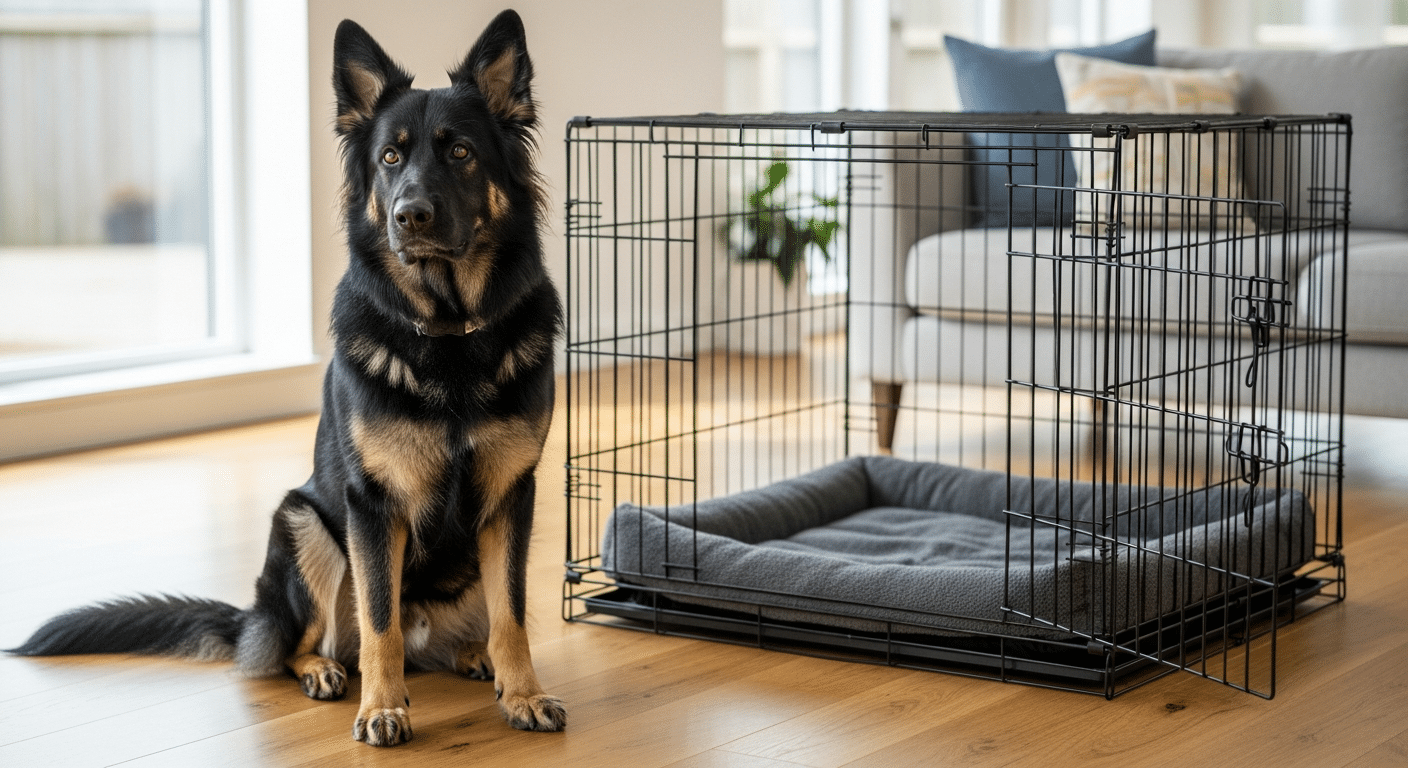
What Size Crate Does a German Shepherd Need?
Short answer: most adult German Shepherds need a 42-inch crate, and large males need a 48-inch. Here’s exactly how to size it, the size-by-age chart, how to measure, and the crates that actually fit.
If you’re asking what size crate a German Shepherd needs, here’s the direct answer: a 42-inch crate fits the large majority of adult German Shepherds, every female and most average males, and a 48-inch crate is the move for large males (roughly 75 to 90 lb, standing 25″+ at the shoulder). A GSD puppy can start in a 30 to 36″ crate, but the smarter play is to buy the adult 42″ and use a divider to keep the space snug while he’s small. Getting the German Shepherd crate size right matters more than owners expect, because it’s really two questions at once: will it fit? and, for this intelligent, high-drive, sometimes separation-anxious breed, can he get out of it? A bored or under-exercised Shepherd will test a flimsy crate, so the best crate for a German Shepherd is a correctly-sized one that’s also built well enough to hold. Below we cover the exact breed measurements, the 42-vs-48 decision, a size-by-age chart, how to measure your own dog, when to go heavy-duty, and our picks. Want the number in seconds? Run him through our dog crate size calculator.
Best crates for a German Shepherd, ranked
Sized for a 50 to 90 lb working breed and chosen for fit and build quality. The MidWest 42″ is the right size for most Shepherds; the Impact is the escape-proof pick for an anxious or destructive dog; the 48″ covers large males. Tap through for the live price.
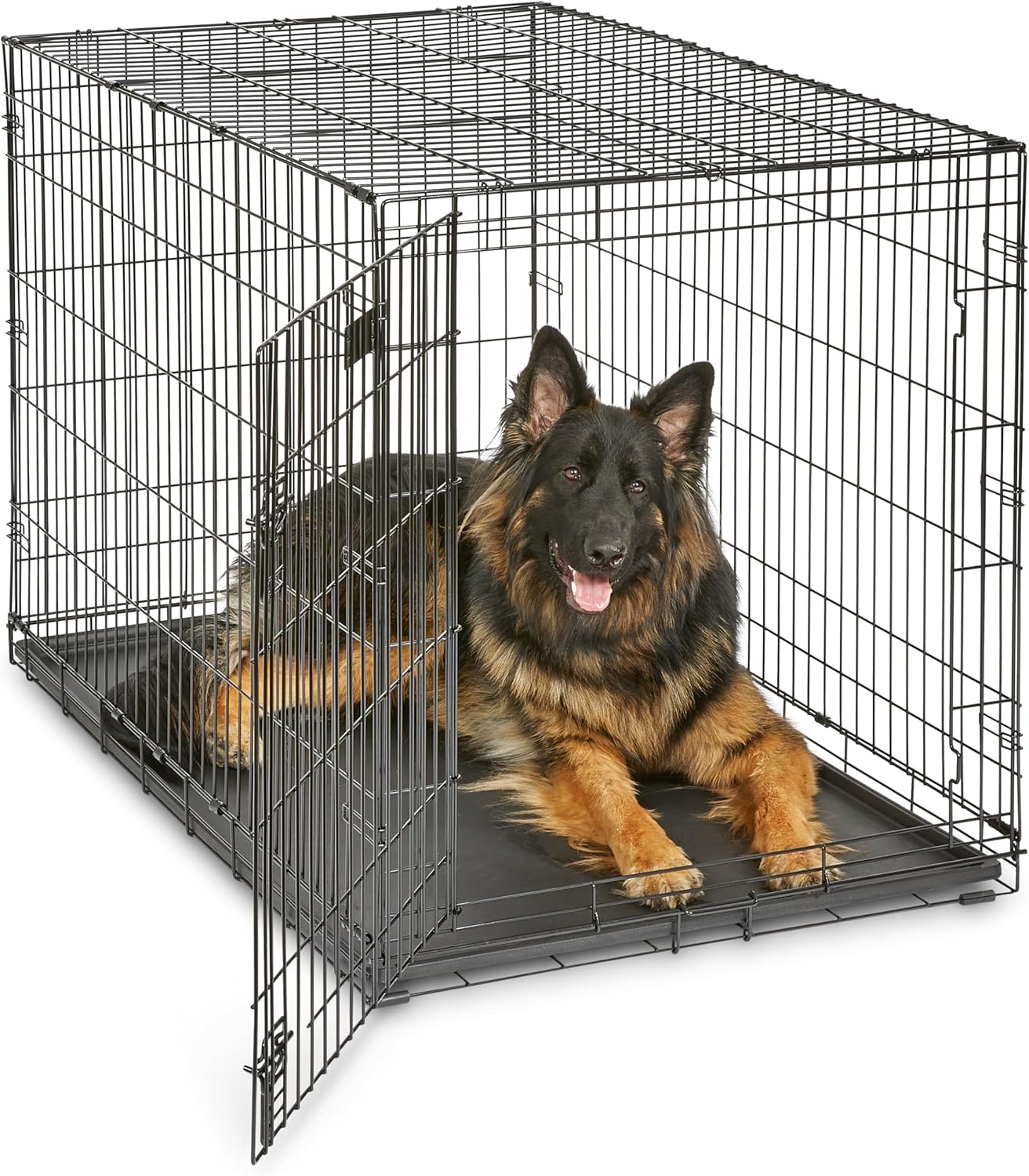
MidWest 42″ iCrate (with divider)
For the large majority of adult German Shepherds, every female and most average males in the 50 to 75 lb range, a 42-inch crate is exactly right, and this MidWest iCrate is the benchmark. It runs about 42″ L × 28″ W × 31″ H, so a Shepherd can stand without ducking, turn around, and stretch out flat. Best of all it ships with a divider panel, so you buy this one crate for your GSD’s whole life: set it tight for a teething puppy, then slide it back as he fills out.
What we like
- The correct 42″ size for the typical 50 to 75 lb adult German Shepherd, room to stand, turn and stretch
- Included divider grows with a GSD puppy: buy once, size it down now, open it up later
- Folds flat, sets up tool-free, and the slide-out tray makes puppy clean-up painless
- Double doors give you flexible placement, and it’s the value benchmark on price
The catches
- Standard wire build, perfect for a settled, trained Shepherd, less so for a determined escape artist
- A young, anxious or under-exercised GSD can bend a wire crate; consider steel/aluminum if so
- Large 75 to 90 lb males or tall males over 25″ should size up to the 48″ instead

Impact Stationary Dog Crate
German Shepherds are intelligent, high-drive working dogs that bond hard to their people, and a bored or separation-anxious one can chew, paw and shoulder a wire crate apart. If that’s your Shepherd, Impact’s welded aircraft-grade aluminum walls and Houdini-proof paddle latch make it genuinely escape-proof, while the solid sides create the den-like calm an anxious dog needs. It comes in a 40″ XL that fits most Shepherds and a 48″ for the biggest males, the splurge that ends the cycle of destroyed crates.
What we like
- Genuinely escape-proof, aircraft-grade aluminum a powerful Shepherd can’t bend, chew or break out of
- Solid walls give the den-like security that calms an anxious, separation-prone GSD
- Crash-tested for travel and backed by a lifetime guarantee against dog damage
- Ends the cycle of replacing wire crates a destructive Shepherd keeps wrecking
The catches
- By far the priciest pick, it’s an investment, not an impulse buy
- Heavy and stationary; it stays where you put it
- Overkill for a calm, fully crate-trained Shepherd that’s never tested a wire crate

MidWest 48″ iCrate (with divider)
Got a big male, pushing 80 to 90 lb, standing 25 inches or more at the shoulder? A 42″ crate starts to feel tight, and this 48-inch iCrate is the answer. Rated for 90 to 110 lb breeds, it gives a tall, leggy Shepherd the headroom and length to stand and stretch in comfort, and it ships with a divider too. Measure your dog first (below), most Shepherds don’t need this, but the truly large males do.
What we like
- Extra length and 33″ of headroom for a tall, leggy 80 to 90 lb male German Shepherd
- Included divider means it still works for a large-breed puppy as he grows
- Same easy fold-flat, tool-free setup and slide-out tray as the 42″
- Affordable insurance if you’re unsure whether your Shepherd will be a big one
The catches
- Most German Shepherds do NOT need 48″, confirm with measurements before sizing up
- Still a wire crate: a powerful chewer or escape artist needs steel or aluminum instead
- Bigger footprint, make sure you have the floor space
What size crate does a German Shepherd need? (quick answer)
For a full-grown German Shepherd, a 42-inch crate is the right size in the large majority of cases. A 42″ crate has interior dimensions around 42″ long × 28″ wide × 31″ tall, which comfortably fits every female and most males, they can stand without ducking, turn around, and lie out flat. That’s the entire test of a correctly sized crate.
The exception is the large male. A Shepherd male can reach 85 to 90 lb and stand 25 to 26 inches at the shoulder, and at that size a 42″ crate starts to feel tight, especially for a tall, leggy, deep-chested dog who needs the headroom and the length. For those dogs, step up to a 48-inch crate. This 42-vs-48 split is the entire German Shepherd crate decision, and you won’t know which side your dog is on until you measure him (we’ll show you how below). As a rule of thumb:
- 42″ crate, most adult German Shepherds: every female, and males up to ~75 lb / under 25″ tall.
- 48″ crate, large males ~75 to 90 lb, or any Shepherd standing 25″+ at the shoulder.
- 30 to 36″ crate (or a 42″ with a divider). German Shepherd puppies, while they’re still small.
How big does a German Shepherd get? (the numbers that decide crate size)
You can’t size a crate without knowing how big the dog actually gets, and the German Shepherd is a large, athletic, deep-chested working breed, leggy and substantial, but not a giant guardian, which is why it lands on a 42″ crate for most dogs rather than the 48″ or 54″ a Mastiff needs. Here are the breed numbers that drive the decision:
- Males: roughly 65 to 90 lb, standing 24 to 26 inches at the withers (shoulder).
- Females: roughly 50 to 70 lb, standing 22 to 24 inches at the withers.
- Body length: nose-to-base-of-tail figures of roughly 36 to 44 inches are typical across the breed (Shepherds are notably longer than they are tall).
That body length is the number that matters most: a crate needs to be a couple of inches longer than the dog measured nose-to-base-of-tail, which is exactly why a Shepherd lands on a 42-inch crate for most dogs and a 48-inch for the largest males. Because the GSD is built long and low through the back, its length tends to settle the size before its height does. It’s also why the giant “XL” 54″ crates built for Mastiffs and Great Danes are simply too big for a Shepherd, a crate that’s far too large undermines house-training (more on that below).
One more thing the numbers tell you: the German Shepherd is muscular and high-drive, not just large. A fit, athletic working dog leaning, pawing or chewing on a crate puts more force on it than a placid couch dog, which is why build quality matters more for a Shepherd than for the average 60-pounder. For the full sizing system across every breed, see our best dog crate for large dogs guide.
42 vs 48 inch crate for a German Shepherd: how to decide
This is the question almost every Shepherd owner ends up Googling, so let’s settle it. The honest answer is that most German Shepherds belong in a 42″ crate, and only the large males need a 48″. Here’s the dimension comparison that drives it:
| Crate size | Interior (approx.) | Rated weight | Right for… |
|---|---|---|---|
| 36″ | 36″ × 23″ × 25″ | 40 to 70 lb | Small females only, the minimum a finished GSD would use |
| 42″ | 42″ × 28″ × 31″ | 70 to 90 lb | Most adult Shepherds, every female and the average male |
| 48″ | 48″ × 30″ × 33″ | 90 lb+ | Large males, 75 to 90 lb, or standing 25 to 26″+ at the shoulder |
Notice the two crates overlap right where the breed lives. A typical 24 to 25″ tall, 70 lb Shepherd is comfortable in either, so the deciding factor is your individual dog: measure him (next section) and let his nose-to-tail length and standing height settle it. If he comes in under about 75 lb and under 25″ tall, the 42″ is the smarter buy, it’s cheaper, takes less floor space, and won’t tempt a puppy to potty in one corner. If he’s a tall, heavy male near 26″, go 48″. When you’re genuinely on the line, size up to the 48″ and use the divider, it’s far easier to shrink a big crate than stretch a small one. You can also skip the math with our dog crate size calculator, which factors in the breed’s long, leggy build automatically.
German Shepherd crate size by age (puppy to adult)
German Shepherds grow fast and finish at a good size, most aren’t fully grown until around 18 months, so the crate that’s right at 10 weeks is far too small by 10 months, and the adult crate is far too big for a puppy in potty training. Here’s the size to use at each stage, and where to set the divider if you’ve bought the 42″ adult crate up front:
| Age | Approx. weight | Crate size | Divider / setup |
|---|---|---|---|
| 8 to 10 weeks | ~15 to 22 lb | 30″ (or 42″ divided down) | Divider set so he can just stand, turn & lie down |
| 3 to 4 months | ~30 to 45 lb | 36″ (or 42″ divided) | Slide divider back ~one section |
| 5 to 7 months | ~50 to 65 lb | 42″ (or 42″ divided slightly) | Open most of the 42″ crate |
| 8 to 18 months | ~60 to 85 lb | 42″ | Divider removed, full crate |
| Adult female / avg male | 50 to 75 lb | 42″ | Full 42″ crate |
| Adult large male | 75 to 90 lb, 25″+ tall | 48″ | Full 48″ crate |
The weights are approximate. German Shepherds vary a lot, and working/West-German lines often run larger than show lines, so always let the measurements beat the age. The point of the table is the path: a divider-equipped 42″ crate covers you from about five months onward, and only the largest males ever graduate to a 48″. A young puppy still needs its space kept snug, because a too-big crate is the number-one reason puppy potty training stalls. Read why in our companion guide on whether a dog crate can be too big.
How to measure your German Shepherd for a crate
Breed averages get you 90% of the way, but your individual dog settles it, especially near the 42″/48″ line. Grab a tape measure and take two numbers:
- Length: measure from the tip of the nose to the base of the tail (where the tail meets the body, not the tail tip). Then add 2 to 4 inches. For a long-bodied breed like the Shepherd, this is usually the number that decides the size.
- Height: measure from the floor to the top of the head while the dog is standing. Then add 2 to 4 inches.
Match those two numbers to the crate’s interior dimensions, not the outside box, manufacturers list both, and the difference can be a couple of inches. The crate is correctly sized when your German Shepherd can:
- Stand up fully without crouching or ducking his head;
- Turn around in a complete circle without squeezing;
- Lie down stretched out on his side with his legs extended.
If his nose-to-tail-base length plus 2 to 4″ comes in around 40″ or under, a 42″ crate (≈42″ interior length) is your size. If it pushes past ~44″, or he’s a tall, heavy male near 25 to 26″, move up to a 48″. When you’re between sizes, size up and use a divider, it’s far easier to shrink a big crate than to stretch a small one, and a cramped crate is genuinely unkind to an athletic working dog. Skip the math entirely with our dog crate size calculator, which converts your measurements into a recommended crate size instantly.
Does a German Shepherd need a heavy-duty crate?
For a German Shepherd, the honest answer is: it depends on the dog. A calm, well-exercised, fully crate-trained Shepherd does just fine in a quality wire crate like the MidWest iCrate, plenty do. But the GSD has two traits that catch owners out: it’s an intelligent, high-drive working breed, and it’s famously bonded and prone to separation anxiety. A bored, under-exercised or anxious Shepherd left in a flimsy crate can chew the corners, bend the wire, pop a simple latch, or shoulder a door open, and an 80 lb working dog has the strength and the problem-solving to do real damage.
So size the crate first, get the 42″ (or 48″) right, then make the second call honestly. Go heavy-duty if your German Shepherd is:
- Young or under-exercised, a Shepherd that hasn’t burned its considerable energy will take it out on the crate.
- Anxious or separation-prone, the breed bonds hard and panics when left, and panic drives escape attempts. Solid-walled, den-like crates (like the Impact) lower arousal and remove the motivation to break out.
- A proven chewer or escape artist, if he’s already destroyed one crate, stop buying wire; welded steel or aircraft-grade aluminum is cheaper than a third replacement.
So, what’s the best crate size for your German Shepherd?
Putting it together: buy a 42-inch crate for almost every adult German Shepherd, and a 48-inch only if you have a large male (roughly 75 to 90 lb, over 25″ tall) who measures out of the 42″. Start a puppy in that same 42″ crate with the divider set tight, and slide it back as he grows so you never have to re-buy. Always let your dog’s actual nose-to-tail length and standing height override the breed averages near the size line, for this long-bodied, leggy breed, length usually decides it.
Then make the second decision that matters for this breed: how heavy-duty? A settled, well-exercised Shepherd is happy in a quality wire crate; a young, anxious, or destructive one is worth the splurge on escape-proof steel or aluminum. Get both the size and the build right and the crate becomes what it should be, your Shepherd’s safe, calm den, not a daily battle. Confirm his exact size with our crate size calculator, then pick from our ranked crate buyer’s guide. And if you’re kitting out a new German Shepherd from scratch, our German Shepherd gear guide covers the harness, bed, chew toys and crate together.
Size it right in two clicks
German Shepherd crate size: common questions
What size crate for a German Shepherd?
A 42-inch crate is the right size for the large majority of adult German Shepherds, every female and most average males up to about 75 lb. A 42″ crate runs roughly 42″ long × 28″ wide × 31″ tall inside, which lets a Shepherd stand, turn around and lie out flat. Large males, around 75 to 90 lb, or taller than about 25″ at the shoulder, should step up to a 48-inch crate. A puppy can use a 30 to 36″ crate, but it’s smarter to buy the 42″ adult crate and use a divider to keep the space snug while he’s small.
Is a 42 inch crate big enough for a German Shepherd?
Yes, for most German Shepherds a 42-inch crate is big enough and is the right size. It comfortably fits every female and the average male, who can stand without ducking, turn around fully and lie stretched out, thanks to its roughly 31″ of interior height and 42″ of length. The one exception is the large male: if your dog is around 75 to 90 lb or stands taller than roughly 25 inches at the shoulder, a 42″ can feel tight and you’ll want a 48″. The way to be sure is to measure him, nose to base of tail, and floor to top of head while standing, add 2 to 4 inches to each, then match the crate’s interior dimensions.
Do female German Shepherds need a smaller crate than males?
Slightly, but usually not enough to change the recommendation. Female Shepherds run a bit shorter and lighter (about 50 to 70 lb and 22 to 24″ tall) than males (65 to 90 lb and 24 to 26″), and a 42″ crate fits a female comfortably with room to spare. In practice a 42″ crate is the right call for both sexes for most dogs, the only Shepherds that genuinely need to go up to a 48″ are the large males at 75 to 90 lb or 25″+ tall. If your female is on the small side, you can buy the 42″ and use the divider to keep it cozy until she’s full-grown, then open it up.
What size crate does a German Shepherd puppy need?
A young German Shepherd puppy needs only a small space, about a 30″ crate at 8 to 10 weeks, so it can stand, turn and lie down but not have so much room that it potties in one corner and sleeps in the other, which derails house-training. Rather than buying a puppy crate you’ll outgrow in weeks, the better move is to buy the adult 42″ crate and use the divider panel to wall off the extra space now, sliding it back as the puppy grows. German Shepherds grow fast, so you’ll be moving that divider often, but you buy one crate for the dog’s whole life and the space is always the right size.
Do German Shepherds need a heavy-duty or escape-proof crate?
It depends on the individual dog. A calm, well-exercised, fully crate-trained German Shepherd does fine in a quality wire crate like the MidWest iCrate. But the breed is intelligent, high-drive and famously prone to separation anxiety, and a young, anxious, under-exercised or destructive Shepherd can chew the corners, bend the wire or pop a simple latch, and an 80 lb working dog has the strength and the problem-solving to do real damage. If that’s your dog, skip the wire crate and go straight to a welded-steel or aircraft-grade aluminum escape-proof crate with a den-like solid wall, it lowers anxiety and outlasts the cost of replacing crates the dog destroys. Plenty of exercise and proper crate training reduce the urge to escape in the first place.
Is a 48 inch crate too big for a German Shepherd?
For most German Shepherds, yes, a 48″ crate is bigger than needed and the right size is 42″. A crate that’s much too large lets a dog potty in one end and sleep in the other, which slows house-training, and it costs more and takes more floor space. The exception is the large male Shepherd, around 75 to 90 lb or 25″+ tall, for whom a 42″ is genuinely tight and a 48″ is correct. If you’ve bought a 48″ for a dog who doesn’t quite fill it, use the included divider to shrink the usable space. When in doubt, measure your dog and match the crate’s interior dimensions rather than guessing.