 Dog Gear, Sized Right
Best Escape-Proof Dog Crate (2026): Tested for Houdini Dogs
Some dogs chew, dig, bend and Houdini their way out of any normal crate, especially when separation anxiety kicks in. These are the crates built to hold them, led by the one crate that’s genuinely escape-proof.
If you’re searching for the best escape-proof dog crate, you almost certainly have one very specific dog: the one that bends wire bars, pops latches, chews through plastic, or claws the door open the moment you leave, often because of separation anxiety. The hard truth is that no crate is 100% escape-proof for every dog, but a small number are close, and the gap between them and an ordinary wire crate is enormous. The single best is the Impact aluminum crate, solid-walled, welded, latch-locked, and backed by a 10-year dog-damage warranty. Below we rank three crates that actually hold escape artists, explain why dogs break out and how to stop it, and give you a material-and-gauge buying guide so you don’t waste $150 on a crate your dog defeats in a week.
The best escape-proof dog crates, ranked
Impact’s aluminum crate is the only one we’d call truly escape-proof; the LEMBERI and MidWest are strong, far cheaper steel options. Each is verified in stock, tap through for the live price.
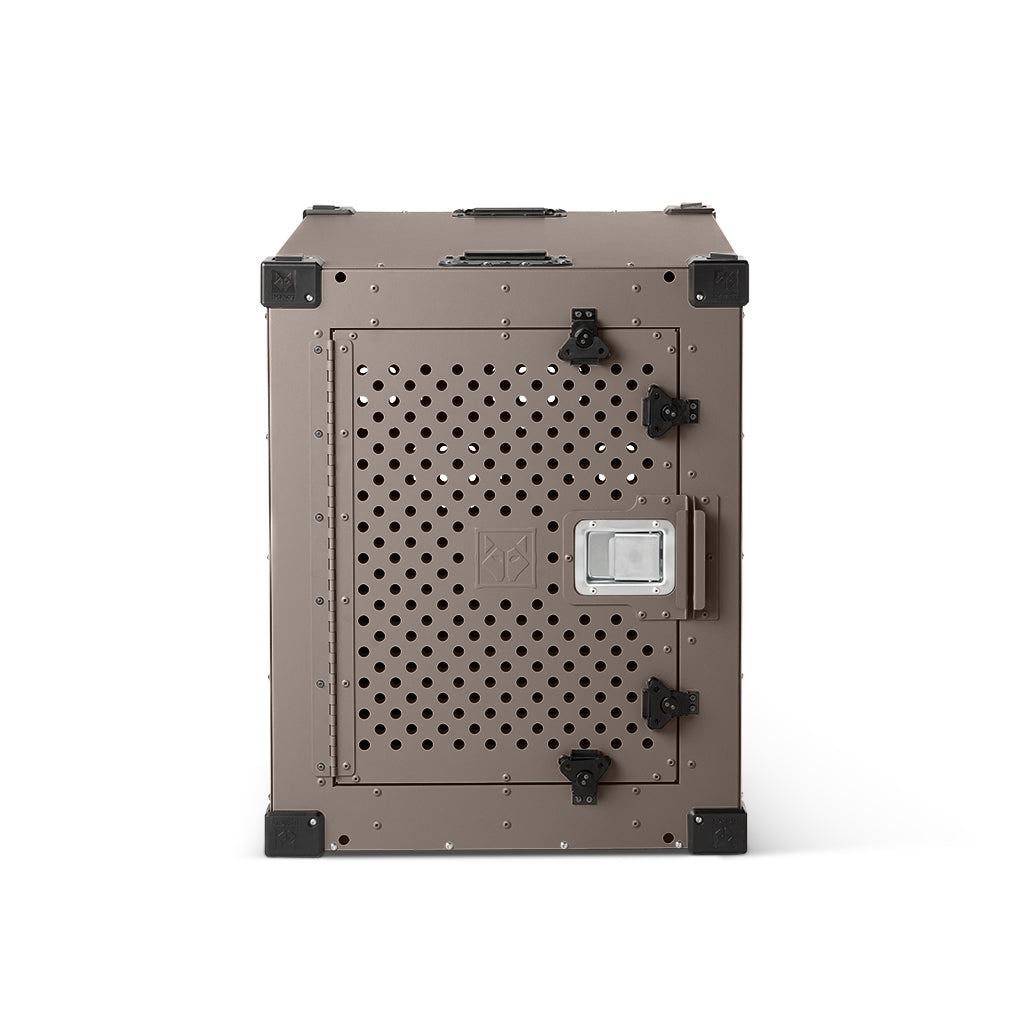
Impact High Anxiety / Stationary Dog Crate
The crate built specifically for the dogs that break out of everything else. Impact’s aircraft-grade aluminum panels (the High Anxiety model is ~60% thicker still), five-point latch system and tooth-safe ½-inch ventilation holes are why Impact can back it with a 10-year dog-damage warranty, and say no dog has ever escaped one.
What we like
- Genuinely escape-proof aluminum build, no flex, no bars to bend, no plastic to crack
- Five secure latches (1 paddle + 4 butterfly) defeat door-popping Houdini dogs
- Solid walls give an anxious dog a calm, den-like space and cut visual triggers
- Backed by a 10-year warranty against dog damage, unmatched in the category
The catches
- The most expensive option here (~$900+; High Anxiety runs higher)
- Heavy and bulky, not something you’ll move room to room often
- Premium price only makes sense for true escape artists / severe anxiety
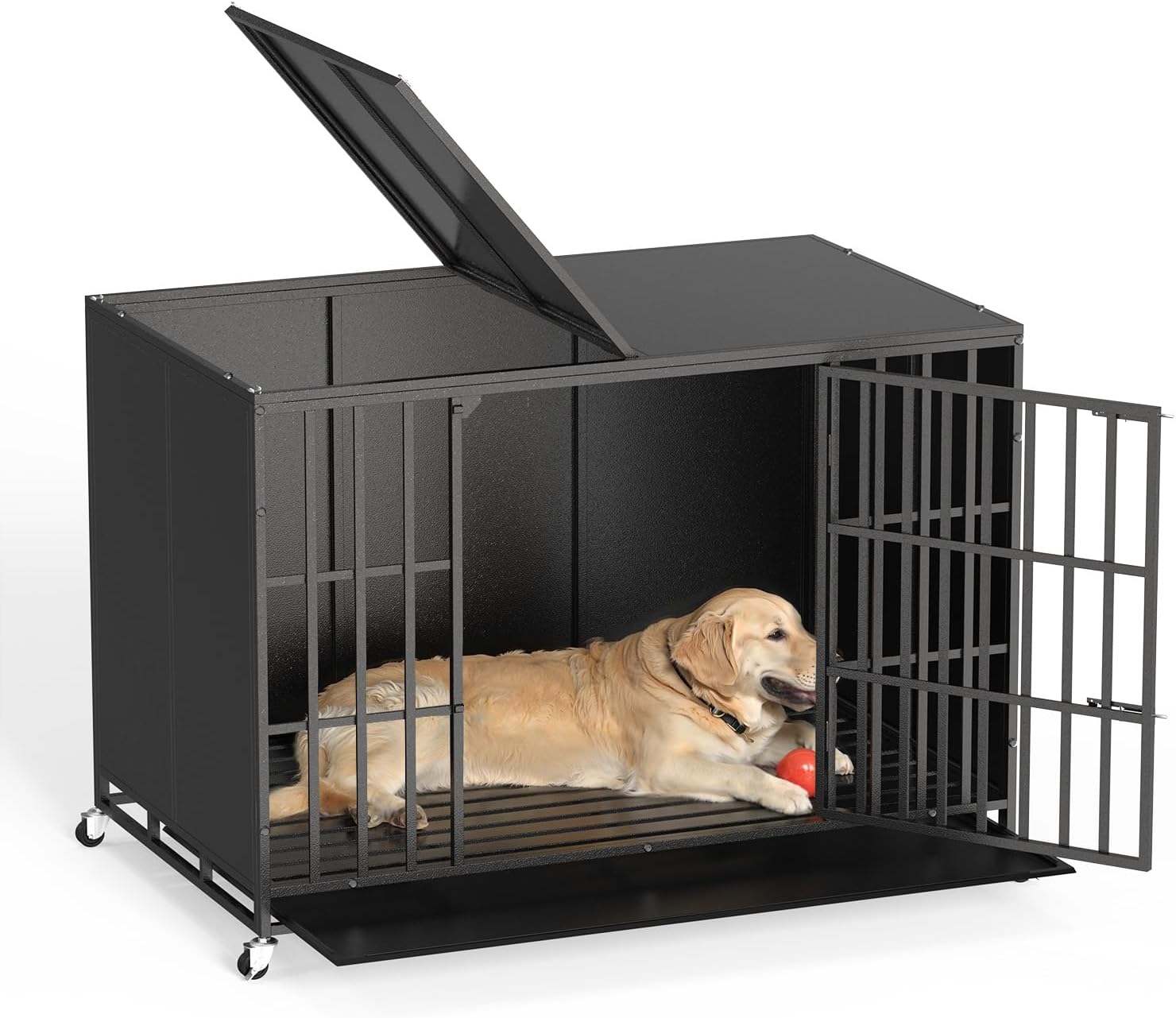
LEMBERI Heavy-Duty Indestructible Steel Crate (48/42″)
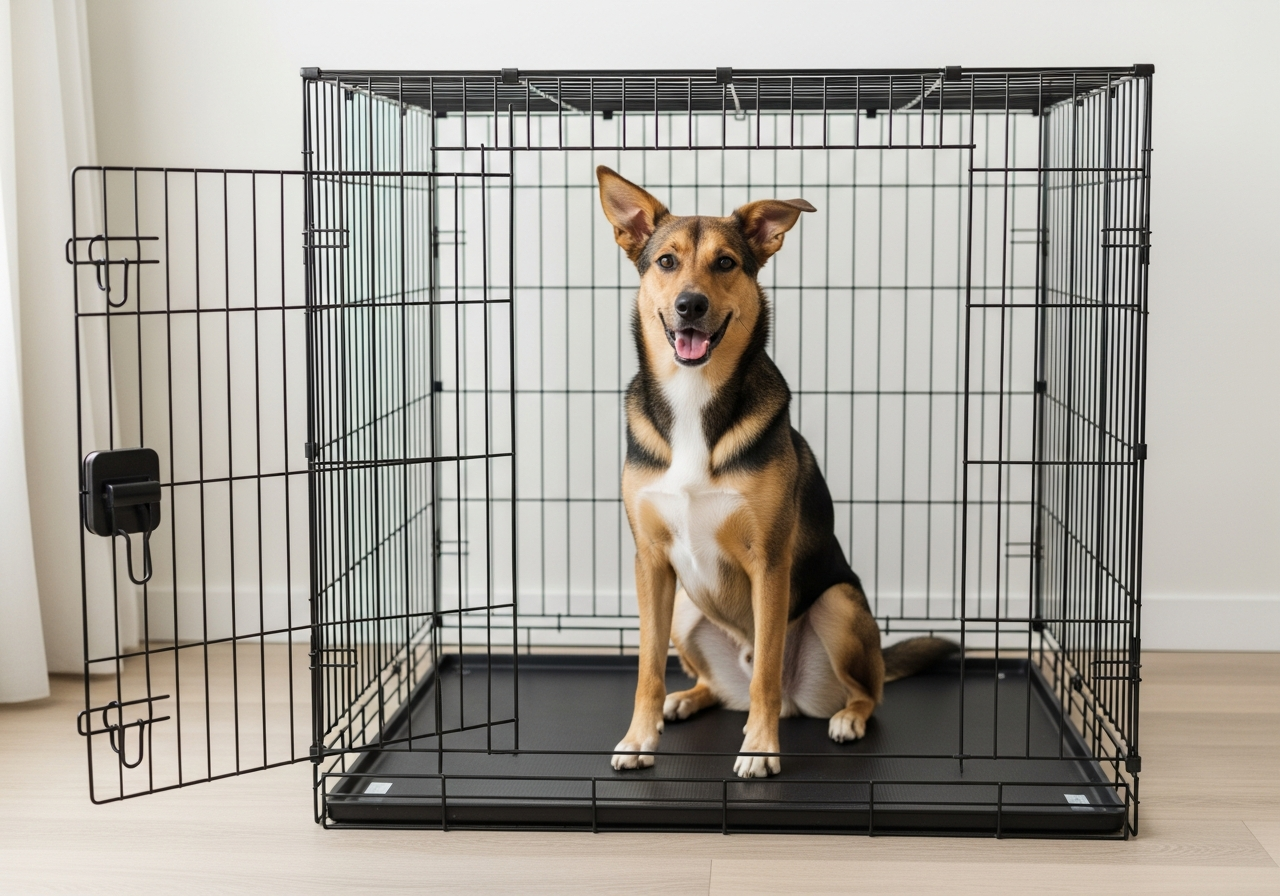
If aluminum is out of budget, this is the most crate-for-the-money for a strong dog. 20-gauge steel with reinforced ½-inch tube bars, welded joints, and dual safety-buckle latches a dog can’t nose open. Lockable casters and a slide-out tray make a 70 to 90 lb crate livable indoors.
What we like
- A fraction of Impact’s price for serious steel strength
- Reinforced tube bars and welded joints resist bending and prying
- Two locking latches with safety buckles foil door-defeating dogs
- Lockable casters + slide-out tray make a heavy crate easy to live with
The catches
- Open-bar design, less den-like and quieter than solid-wall aluminum
- Heavy steel is awkward to move and can mark floors without mats
- No crash-test rating; for home containment, not crash safety

MidWest Ultima Pro Heavy-Duty Steel Crate
MidWest’s toughest crate, professional-gauge steel that’s far stronger than the thin wire crates dogs bend out of. Double-door access, a chew-resistant frame and a leak-proof pan, plus a divider so it grows with a puppy. The sane upgrade for a dog that’s just started testing a standard wire crate.
What we like
- Much stronger steel than a standard collapsible wire crate
- Two doors and a removable pan make daily use and cleaning easy
- Included divider grows with a puppy so you buy once
- Folds for storage and transport despite the heavier gauge
The catches
- Still a barred wire crate, a determined Houdini may defeat it
- Not solid-walled, so less calming for severe separation anxiety
- Best for moderate chewers, not the strongest 90 lb escape artists
Why dogs escape crates, and how an escape-proof crate stops it
Before you spend a dollar, it helps to understand how your dog is actually getting out, because each escape route is defeated by a different feature. A crate is only as escape-proof as its weakest point, and an anxious or determined dog will find it. There are five routes, and the best crates close all of them:
- Defeating the door or latch. The most common escape. A single spring-loaded wire latch can be nosed, pawed or wiggled open. Escape-proof crates use multiple latches. Impact uses one steel paddle latch plus four butterfly latches around the door, so the door can’t pop even if one point is worked loose.
- Bending or spreading the bars. A strong dog can spread the thin bars of a cheap wire crate and squeeze out, or bend a corner until a gap opens. The fix is thicker-gauge steel tube or, better, solid aluminum panels with no bars to bend at all.
- Chewing and prying. Plastic crates crack; flimsy welds snap. Anxious dogs will gnaw a weak point for hours. Escape-proof crates are welded inside and out and use chew-proof materials, with ventilation holes sized so teeth can’t catch and tear.
- Digging out the bottom. Some dogs lift or claw out a slide-out tray and slip through the gap. Heavy crates use a secured floor pan and a low, tray-under-grate design the dog can’t lift from inside.
- Pushing weak corners and seams. A dog that throws its body weight at a crate finds the corner or seam that flexes. Rigid, welded construction with no flex is what holds.
Aluminum vs. heavy-duty steel vs. wire: what actually holds a dog
The material is the single biggest factor in whether a crate is escape-proof. Here’s the honest hierarchy, strongest to weakest, with what each is really for:
| Material | Escape resistance | Best for | The catch |
|---|---|---|---|
| Aircraft-grade aluminum (Impact) | Highest. Solid panels, no bars to bend, welded, crash-tested | True escape artists, severe anxiety, travel/crash safety | Most expensive ($800-$1,200+); heavy |
| Heavy-duty welded steel (LEMBERI, MidWest Ultima Pro) | High. 20-gauge tube bars, welded joints, dual latches | Strong dogs on a budget; chewers and pushers | Open bars are less den-like; very heavy |
| Standard wire crate | Low. Thin bars spread, single latch pops | Calm, crate-trained dogs; puppies; travel | A determined dog defeats it in minutes |
| Plastic / soft-sided | Lowest. Cracks and chews through | Air travel, very mellow dogs only | No match for an escape artist or chewer |
Two terms worth knowing as you shop. Gauge measures steel thickness, counterintuitively, a lower number means thicker, stronger steel, so a 20-gauge crate is sturdier than the 22- or 24-gauge wire of a cheap crate. Welded means the joints are fused rather than clipped or bolted; the strongest crates (Impact, Rock Creek) are welded inside and out so there’s no seam to pry apart. If a listing won’t tell you the gauge or whether it’s welded, assume the worst.
One more material note: only aluminum crates from a few makers (Impact, Rock Creek, Gunner) carry an independent crash-test rating from the Center for Pet Safety. That matters if the crate also rides in your car, no steel wire or plastic crate is genuinely crash-safe, regardless of how “heavy duty” the box says it is.
#1 Impact, the only crate we’d call escape-proof
Impact makes the best escape-proof dog crate you can buy, full stop. It’s our top pick for any dog that has already broken out of a wire crate or is destructive with separation anxiety. It is the most expensive option here, the standard Stationary model starts around $900 and the purpose-built High Anxiety model runs higher, but for the right dog it’s the crate you buy once instead of replacing three cheaper crates your dog defeats.
What the money buys is a fundamentally different box. The panels are aircraft-grade aluminum, solid, not barred, so there is nothing to bend, spread or squeeze through. The High Anxiety variant uses panels roughly 60% thicker again, with ½-inch ventilation holes sized so a dog’s teeth can’t catch and tear at the edges. The door is held by a five-point latch system: one heavy zinc-steel paddle latch plus four butterfly latches around the perimeter, which is what stops the door-popping Houdini dog cold. Everything is welded; there’s no plastic to crack.
It’s also the calmest crate for an anxious dog. The solid walls create a true den-like space that cuts the visual stimulation (people walking past, other pets) that winds an anxious dog up. Impact backs all of this with a 10-year warranty against dog damage, not just defects, and says no pet has ever escaped one; an independent two-year test by k9ofmine on two 90-pound anxious dogs reached the same verdict.
The honest trade-offs: it’s heavy, bulky and hard to relocate, and the price only makes sense if your dog is genuinely an escape artist or severely anxious. For a calm dog you’re overpaying. If you want the same brand in a lighter, foldable form for a more manageable dog, read our Impact collapsible crate review, and see where Impact lands against premium rivals in our Diggs Revol review.
#2 LEMBERI heavy-duty steel, the strong-dog value pick
If Impact’s price is out of reach, the LEMBERI heavy-duty crate is the most steel for the money, about $160 for a 48/42-inch crate that will hold a strong dog far better than any wire crate. It’s our value pick for a powerful chewer or pusher whose owner can’t justify $900.
It’s built from 20-gauge steel with reinforced half-inch tube bars and welded joints, which is the structural difference between this and the bendable wire crate your dog escaped. The door uses two locking latches with safety buckles, the kind a dog can’t simply nose or paw open, and LEMBERI markets it specifically against “Houdini” dogs that unlock doors from the inside. Practical touches make a 70 to 90 lb steel box livable: four lockable caster wheels so you can move it, a slide-out tray for cleanup, and a top door for interaction.
The limits are honest. It’s an open-bar design, so it’s noisier and less den-like than Impact’s solid walls, not ideal for the most severe separation anxiety, where visual calm matters. It’s heavy steel that can mark floors (use a mat), and it carries no crash-test rating, so it’s a home-containment crate, not a car-safety crate. For a strong, anxious-but-not-extreme dog on a budget, though, it’s the most sensible upgrade you can make.
#3 MidWest Ultima Pro, the smart step-up from a wire crate
The MidWest Ultima Pro (~$155) is the right call for a dog that has just started testing a standard wire crate but isn’t yet a hardened escape artist. It’s MidWest’s toughest crate, built from professional-gauge steel that’s substantially stronger than the thin wire of the brand’s everyday iCrate, which is exactly the crate most escape-prone dogs are bending out of.
You get two doors for flexible placement, a chew-resistant frame, and a leak-proof removable pan for easy cleaning. A big practical win for puppy owners: it ships with a divider panel, so you size the space down for a puppy and expand it as the dog grows, you buy one crate instead of two. Despite the heavier gauge it still folds flat for storage and transport.
Be realistic about its ceiling. It is still a barred wire crate, just a much better one, a truly determined 90-pound Houdini may eventually defeat it, and its open sides make it less calming than a solid-walled crate for severe anxiety. Think of it as the strongest conventional crate rather than a true escape-proof one. For moderate chewers and growing puppies it’s an excellent, affordable choice; for the dog that already escapes everything, step up to the LEMBERI or Impact. See more big-dog sizing in our best dog crate for large dogs guide.
Escape-proof crates and separation anxiety: what a crate can and can’t do
Most people shopping for an escape-proof crate are really dealing with separation anxiety, the dog isn’t trying to roam, it’s panicking when left alone. It’s worth being clear-eyed about what an escape-proof crate does here, because it’s part of the answer, not all of it.
What a good crate does: it keeps a panicking dog safe. Dogs with severe separation anxiety injure themselves trying to escape ordinary crates, broken teeth, torn nails, cut gums on bent wire. A solid, escape-proof crate removes the weak points a dog hurts itself on, and a solid-walled, den-like crate (Impact) can genuinely lower arousal by cutting the visual triggers that feed the panic.
What a crate can’t do: it won’t cure the anxiety on its own, and for some severely anxious dogs, confinement actually makes the panic worse. The crate is a containment-and-safety tool that buys you time and protects your dog and home while you address the root cause. Pair it with:
- Gradual desensitization, short absences that slowly lengthen, so being alone stops predicting panic.
- Positive crate association, feed meals in it, use a stuffed Kong or long-lasting chew, never use the crate as punishment.
- Calm departures and arrivals, no drawn-out goodbyes that signal something stressful is coming.
- A vet or veterinary behaviorist for severe cases, sometimes medication or a formal behavior plan is the missing piece.
How to choose the right escape-proof crate for your dog
All three picks are far stronger than a standard crate; the right one comes down to how determined your dog is and what you can spend:
- By escape history: a dog that already breaks out of wire crates, injures itself, or has severe anxiety needs Impact, nothing cheaper reliably holds a true Houdini. A dog that’s a strong chewer but hasn’t fully escaped is well served by the LEMBERI; a dog just starting to test its wire crate fits the MidWest Ultima Pro.
- By anxiety severity: severe separation anxiety wants the solid-walled, den-like Impact for visual calm. Mild-to-moderate cases do fine in barred steel with a covered top.
- By budget: ~$155 MidWest → ~$160 LEMBERI → ~$900+ Impact. Remember the math: three replaced cheap crates can cost more than one Impact, and an injured dog costs more still.
- By size: the crate must let your dog stand, turn around and lie down fully, no more (extra room invites pacing and accidents). For large and giant breeds, size carefully using our large-dog crate guide.
- If it also rides in your car: only the crash-tested aluminum Impact doubles as genuine crash protection; steel and wire crates are containment only.
Whatever you choose, introduce it slowly and pair it with training. The strongest crate in the world fails its purpose if the dog is panicking inside it, containment and behavior work go together. Compare the full field, including premium collapsible options, in our dog crate buyer’s guide.
Is any dog crate truly 100% escape-proof?
No, and any brand that promises a literal 100% guarantee for every dog is overselling. A sufficiently large, determined, panicked dog with unlimited time can damage almost anything. What “escape-proof” honestly means is a crate engineered so that the realistic escape routes, latch, bars, chewing, tray, seams, are all closed, built from materials a dog can’t defeat in a normal absence, and backed by a warranty that proves the maker believes its own claim.
By that standard, Impact comes closest: solid welded aluminum, a five-point latch, tooth-safe ventilation, and a 10-year dog-damage warranty are why it’s earned a reputation that no pet has escaped one. Heavy-duty welded steel (LEMBERI, MidWest Ultima Pro) holds the large majority of strong dogs at a fraction of the price. Standard wire and plastic crates are the ones escape artists defeat, and the reason you’re reading this guide. Choose the level of crate that matches how determined your specific dog actually is, size it correctly, and pair it with training, and you’ll have a containment setup that holds.
Compare the rest of the crate field
Escape-proof dog crates: common questions
What is the most escape-proof dog crate?
The Impact aluminum dog crate is the most escape-proof crate you can buy, and its purpose-built High Anxiety model is the most secure of all. It uses solid aircraft-grade aluminum panels (no bars to bend), a five-point latch system, tooth-safe ½-inch ventilation holes, and welded construction, and it’s backed by a 10-year warranty against dog damage. Impact reports that no pet has ever escaped one, a claim independent long-term testing supports. Heavy-duty welded steel crates like the LEMBERI are the strong runner-up at a far lower price.
Can a dog break out of an Impact crate?
It’s extremely rare. Impact’s solid aluminum panels can’t be bent or spread like wire bars, its five latches resist door-popping, and the ventilation holes are sized so teeth can’t catch and tear. Impact states no pet has ever escaped one, and a two-year independent test on two 90-pound dogs with separation anxiety found it completely escape-proof. No crate is a literal 100% guarantee for every dog on earth, but the Impact is as close as the market gets, which is why it’s our top pick for genuine escape artists.
What is the best dog crate for separation anxiety?
For severe separation anxiety, the Impact High Anxiety crate is the best choice: its solid walls create a den-like space that cuts the visual triggers feeding the panic, and its escape-proof build stops an anxious dog from injuring itself trying to break out. For milder cases on a budget, a heavy-duty steel crate like the LEMBERI with a cover works well. Remember that a crate keeps an anxious dog safe but doesn’t cure the anxiety, pair it with gradual desensitization, positive crate associations, and a vet or behaviorist for severe cases.
Is a steel or aluminum crate better for an escape artist?
Aluminum is stronger and safer; steel is the value option. Solid aluminum panels (Impact) have no bars to bend and won’t crack, and only aluminum crates carry an independent crash-test rating. Heavy-duty welded steel (LEMBERI, MidWest Ultima Pro) is the budget-friendly choice and holds most strong dogs, but it’s an open-bar design that’s less den-like and isn’t crash-rated. For a true Houdini or severe anxiety, choose aluminum; for a strong chewer on a budget, welded steel is a sensible step up from wire.
How do I stop my dog from escaping its crate?
Close the escape route your dog is actually using. If it pops the door, add latches or move to a multi-latch crate; if it bends the bars, you need thicker-gauge steel or solid aluminum; if it chews, you need welded, chew-proof material with tooth-safe vents; if it digs out the tray, you need a secured floor pan. Then size the crate correctly (stand, turn, lie down only) and work on the underlying cause, most crate escapes are driven by separation anxiety, so pair the right crate with gradual alone-time training and positive associations rather than relying on the crate alone.