 Dog Gear, Sized Right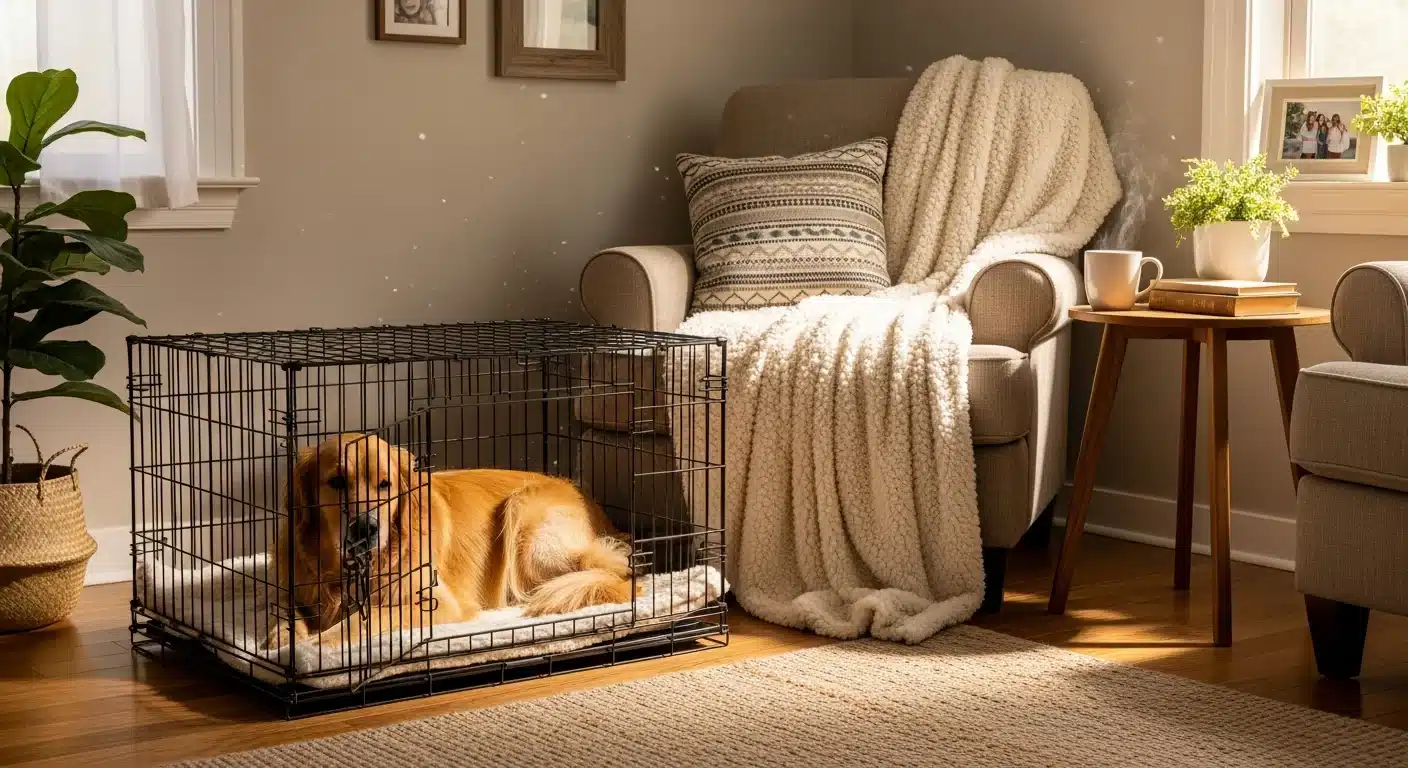
Where Should You Put a Dog Crate?
The short answer: wherever your family is. Here’s the room-by-room breakdown, day, night, puppies, and multi-dog homes.
Where you put a dog crate matters more than most owners realize. Dogs are social animals. Crating a dog in a basement or spare room doesn’t give them quiet, it gives them isolation, which is the number-one driver of crate anxiety and stress whining. The right placement works with a dog’s social wiring: close enough to the family to feel safe, positioned away from the specific hazards (heat vents, drafty doors, direct sun, chaotic foot traffic) that make a crate uncomfortable. This guide covers the best spots for daytime and nighttime, what to avoid and why, whether you need to move the crate at all, and a room-by-room rundown so you can make the call for your actual home.
The crate we recommend for flexible placement
If you want the option to move the crate between rooms, you need one that actually makes that easy. Here’s the pick that earns a buy button, verified in stock. Tap through for the live price.
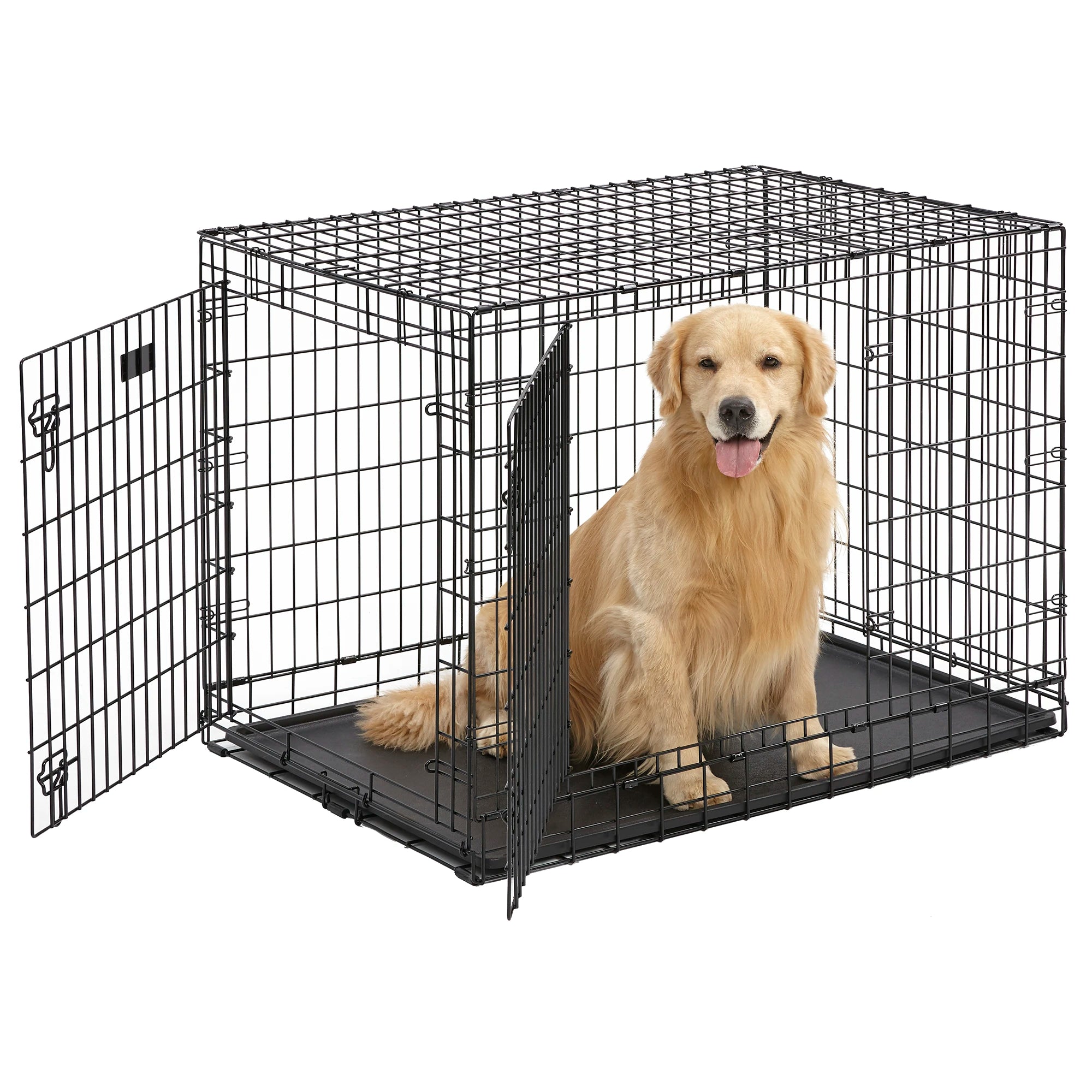
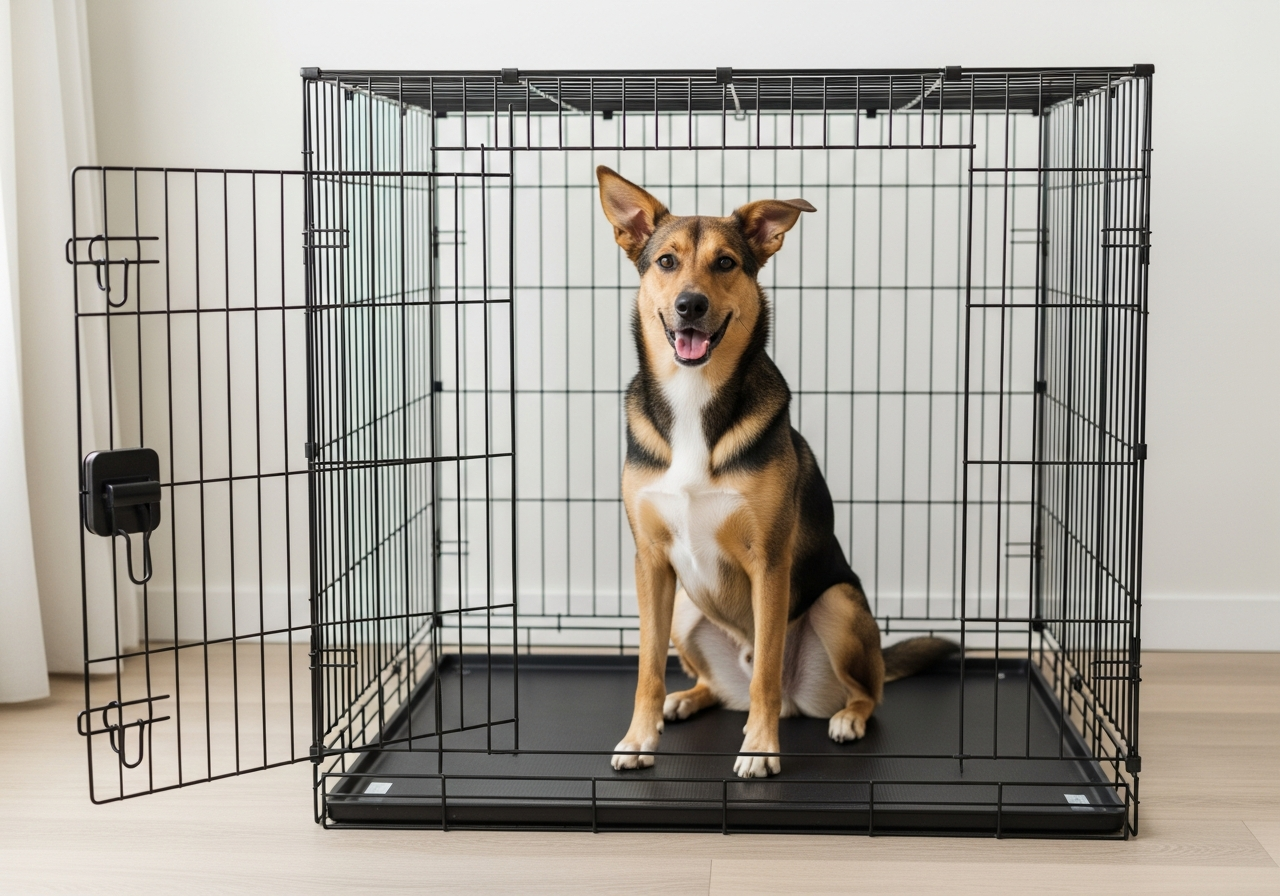
MidWest iCrate Folding Dog Crate
The iCrate folds flat in seconds, making it the most practical choice if you want your dog near you in the living room by day and in the bedroom at night without buying two crates. The included divider panel means you can start small with a puppy and expand the space as they grow, no new crate needed.
What we like
- Folds flat in seconds, easy to move room to room or stow during guests
- Divider panel lets one crate serve a puppy through adulthood
- Double-door design gives flexible placement against a wall or in a corner
- Leak-proof ABS pan is easy to clean if accidents happen
The catches
- Wire construction means it’s not the warmest option, add a crate cover in cold bedrooms
- The latch can feel a bit flimsy on the heaviest-duty sizes (42″+)
- Not escape-proof for a truly determined chewer or bolt artist
The core principle: dogs are social, not solitary
Before the room-by-room breakdown, the principle that makes every placement decision easier: dogs evolved alongside humans as pack animals, and isolation is genuinely stressful for them. A crate is supposed to be a den, a safe, calm space, not a timeout in solitary confinement. When a crate is placed where your dog can see, hear, and smell the family, the crate works. When it’s tucked in a basement or a back laundry room, the dog is just trapped somewhere alone.
This matters practically: a well-placed crate dramatically cuts down on whining, anxious pawing, and the kind of frustration-barking that makes owners give up on crating altogether. The goal is proximity, not silence. “Quiet” and “isolated” are not the same thing, most dogs settle beautifully in a crate that’s in the middle of household life, provided it’s not directly in the path of the busiest foot traffic.
The secondary principle: avoid the physical hazards. Heat vents, radiators, direct sun, drafty exterior doors, and AC vent blast zones can make even a perfectly placed crate uncomfortable or dangerous. More on each below.
Best daytime crate placement: a quiet corner of a living area
For most households, the ideal daytime spot is a corner of the living room, family room, or open-plan kitchen/dining area, somewhere you actually spend time during the day. Specifically, look for:
- A corner or alcove, not a thoroughfare. You want your dog near the action, not in it. A crate in the middle of a high-traffic hallway means constant disturbance; a corner position gives the dog a view of the room with a “wall at my back” den feeling that most dogs prefer.
- Natural light, but not direct sun. A bright room is fine; a crate in a sunny south-facing window is a heat trap by mid-morning. Position so the sun doesn’t hit the crate directly for extended periods.
- Away from heat sources. Radiators, wood stoves, and floor heating vents create hot spots, dogs can overheat in a confined space far faster than when they’re free to move to a cooler spot. Keep at least three feet of clearance.
- Away from AC vents and drafty doors. The opposite extreme: a cold draft blown directly into a crate is uncomfortable, especially for short-coated or older dogs, and especially at night. Check where your floor vents actually blow before you commit to a spot.
- Clear of cords, plants, and hazards. Dogs explore with their mouths. Anything reachable through the crate bars, extension cords, trailing plant leaves, children’s toys, becomes a target. Scan the immediate area before settling on a location.
Where to put a dog crate at night
The research, and the experience of most trainers, is pretty consistent here: the bedroom is the best nighttime spot, especially for puppies. Here’s why it works:
- Proximity reduces crying. A new puppy that can hear you breathe and smell your presence settles much faster than one crated across the house. The whining that makes new owners dread crate training is almost always an isolation response, not a crate response, move the crate next to your bed and the same puppy often goes quiet within a night or two.
- You can hear potty cries. Puppies under four months typically can’t hold it through the night. A crate in your bedroom means you catch the “I need to go” whimper before it becomes a mess. If the crate is two rooms away, you’ll sleep through it.
- It builds trust without bad habits. Contrary to some older advice, letting a dog sleep in your room in a crate does not create co-dependence, it teaches the dog that you’re always nearby, which is actually the foundation of solid separation tolerance. You’re not in the bed; you’re just in the room.
For adult dogs that are fully crate-trained and not prone to anxiety, the bedroom is still the preferred spot for most trainers, but it’s less critical. If your adult dog sleeps calmly in the living room crate and that works for your household, there’s nothing wrong with that arrangement.
What about moving the crate gradually? If your long-term goal is for the dog to sleep in another room, the standard approach is to move the crate a few feet further toward the door every few nights once the dog is consistently settled, rather than relocating it suddenly. Abrupt moves tend to restart the adjustment process from scratch.
Should you move the crate between day and night?
This comes up constantly, and the honest answer is: moving one crate twice a day is more effort than most owners sustain. Here are the real options:
| Approach | Best for | The catch |
|---|---|---|
| One crate, move it daily | Apartments or tight spaces where a second crate won’t fit | Only practical if the crate is lightweight and foldable (like a wire crate). Heavy-duty aluminum or furniture-style crates stay put. |
| Two crates, one per room | Most families; the most consistent setup | Upfront cost, but wire crates are inexpensive. The dog adapts quickly to two locations. |
| One crate in bedroom only | Dogs who free-roam safely during the day | Only works if the dog is past the destructive-puppy phase and has earned free-roam access. |
| One crate in main living area only | Dogs who sleep reliably through the night anywhere | Not recommended for puppies or dogs that need you to hear a potty signal. |
The most common setup that trainers recommend: a foldable wire crate like the MidWest iCrate in the bedroom at night, moved to the living room or kitchen in the morning. The iCrate collapses flat in under 10 seconds and sets back up just as fast, which makes the daily move genuinely low-effort. For owners who don’t want to move anything, a second identical crate is the cleaner long-term solution.
Dogs aren’t confused by two crate locations, they generalize the “crate = safe place” concept quickly, especially if both crates smell familiar and are set up the same way (same bedding, same cover if used).
Room-by-room rundown
Here’s the quick verdict on every room that comes up:
| Room | Verdict | Notes |
|---|---|---|
| Living room | ✅ Excellent (daytime) | Best daytime spot for most homes. Choose a corner, not the center. Cover three sides if it’s a busy household. |
| Bedroom | ✅ Excellent (nighttime) | Best nighttime spot for puppies and anxious dogs. Position next to the bed, not across the room. |
| Kitchen / dining area | ✅ Good | Works well if this is where the family gathers. Easy-to-clean floors are a bonus during potty training. Watch for heat from ovens and drafts from back doors. |
| Home office | ✅ Good (if you work from home) | Ideal if you’re in there all day, the dog is near you. Not ideal if the office sits empty while you’re elsewhere in the house. |
| Hallway | ⚠️ Avoid | High foot traffic, no “back wall” den feeling, and constant disturbance. Dogs don’t settle well here. |
| Laundry room | ⚠️ Marginal | Can work if the dog isn’t isolated from the family. Avoid if the washer/dryer noise will run while the dog is crated, it’s surprisingly stressful. |
| Basement | ❌ Avoid | Even a finished basement puts the dog out of sight, sound, and smell of the family. This is isolation, not a den, and it fuels anxiety. The exception: a busy multi-dog household where the basement is genuinely a family space. |
| Garage | ❌ Avoid | Temperature extremes (hot in summer, cold in winter), fumes, and complete isolation from the household. Not appropriate for crating. |
| Mudroom / entryway | ⚠️ Marginal | Fine as a short-term holding spot (post-walk, drying off). Too much door activity for a dog that needs to settle for hours. |
What to absolutely avoid (and why)
A few placement mistakes come up repeatedly and are worth spelling out clearly:
- Direct sunlight. A wire crate in direct sun turns into an oven within an hour on a warm day. Dogs can’t sweat effectively and overheat faster than most owners expect. Even in a temperate climate, afternoon sun through a west-facing window is enough to cause heat stress in a crated dog.
- Heat vents, radiators, and wood stoves. The same logic applies. Forced-air floor vents in particular blow directly into wire crates at floor level. Check where the warm air actually goes before placing the crate.
- Drafty exterior doors and AC vent blast zones. Cold drafts are the flip side. A dog sleeping in a cold blast from a poorly sealed back door or directly under an AC vent won’t sleep comfortably, and chilling affects older dogs and short-coated breeds significantly.
- Isolated rooms where the family never goes. Basements, garages, spare bedrooms. This is the biggest single error. Isolation is not peace, it’s stress. A dog that’s anxious in the crate is almost always in the wrong location, not the wrong crate.
- High-traffic walkways. A crate directly in a path that people walk through constantly means the dog never gets to settle, each footstep triggers alerting. The goal is near the family, not in the way of the family.
- Near hazards within paw or muzzle reach. Extension cords, houseplants (many are toxic to dogs), children’s small toys, or anything that can be pulled through wire bars. Dogs explore with their mouths; assume they’ll try to reach anything within range.
Crate placement for puppies specifically
Puppies have a few extra considerations that don’t apply the same way to adult dogs:
- Bedroom at night, always. A young puppy waking up in the middle of the night to whine is almost certainly signaling “I need to go out” or “I’m scared”, and you need to hear that. A puppy crated two rooms away from you will soil the crate and learn that asking for help doesn’t work. Both outcomes make crate training harder.
- Eye-level comfort matters. Puppies feel safer when they can see you from their crate. Position the crate so the dog has a sightline to where you’re typically sitting or sleeping, not just generally in the room.
- Watch for separation anxiety triggers. Puppies just home from a litter are used to constant contact with siblings and a mother. An isolated crate placement in the first two weeks can set up a separation anxiety pattern that persists for years. Keep the crate in the room with you, especially at night, for at least the first few weeks.
- Plan for size. If you’re buying one crate for the puppy’s whole life (using a divider panel to keep the space appropriately sized), pick the placement based on the adult crate footprint, a 42″ crate takes up a lot more floor space than the tiny pup in it right now. Measure before you commit to a spot.
For a full walkthrough of the crate training process itself, see our puppy crate training guide, placement is one piece; how you introduce the crate and build duration is the rest.
Crate placement in multi-dog homes
When you have more than one dog, the general rule is: each dog gets its own crate, and the crates go in the same room. The reasoning:
- Separate crates prevent conflict. Even dogs that love each other can get testy when confined together, they can’t move away from each other if a resource (toy, treat, blanket) becomes an issue. Separate crates eliminate this entirely.
- Same room reduces isolation. Two dogs crated in different rooms are each isolated. Two dogs crated in the same room, even a few feet apart, can hear, smell, and see each other, which is calming for most dogs that have an established bond.
- Side-by-side placement with some gap. Adjacent crates work, but leave a few inches of space between them. Dogs that can touch through the bars can play-fight, which disrupts settling. Some dogs also resource-guard their crate space from a neighbor.
- Watch for one dog stressing the other. If one dog is anxious and vocalizes in the crate, place the crates far enough apart that it doesn’t set off the calmer dog. Stress is contagious between dogs.
For a household with mixed breeds or a large size difference, crate placement logistics get more interesting, a giant-breed crate next to a small-dog crate in a bedroom is sometimes impractical. In that case, the best compromise is often to prioritize the puppy or the anxiety-prone dog for the bedroom placement, and give the settled adult dog the quieter living-area spot.
Getting the crate setup right once you’ve chosen a spot
Placement gets the dog in the right part of the house. Setup seals the deal:
- Cover three sides. A crate cover, or a blanket draped over the top and two sides, creates the enclosed den feeling that helps dogs settle. Leave the front open for air and so the dog can see out. Most wire crates don’t feel “den-like” uncovered.
- Add a non-slip mat or crate pad. Bare wire or plastic is uncomfortable and cold. A washable crate mat gives the dog something to nest in, which encourages them to lie down and settle.
- Skip the food and water bowl during long crating. A full water bowl in a crate just increases the urgency to go outside. A small water clip-on for short stints is fine; a full bowl overnight usually isn’t. Always water before crating.
- Size it correctly. The crate should be large enough for the dog to stand up, turn around, and lie on their side comfortably, and not much bigger, especially during potty training. Too much space and a dog can soil one end and sleep in the other. Use the divider panel. Not sure of the right size? Our crate size calculator makes it quick.
- Don’t leave it as a punishment space. If the crate is only used when you’re angry, or the dog is only put in it when something bad is about to happen (bath, vet trip), they’ll resist it. Feed meals in the crate, drop treats in randomly, let the dog go in voluntarily, the crate needs good associations, not just a location.
And on duration: even a perfectly placed and perfectly set up crate isn’t a substitute for exercise and interaction. Most adult dogs should not be crated more than 4 to 6 hours at a stretch during the day. Puppies need more frequent breaks. See our honest breakdown of how long a dog can stay in a crate for the full picture by age.
For the crate itself, our full dog crate roundup covers every style, wire, furniture, heavy-duty, soft-sided, with size and use-case guidance.
Dog crate placement: common questions
Where is the best place to put a dog crate?
The best place is a quiet corner of a room where your family actually spends time, the living room, family room, or kitchen. Dogs are social animals, so a crate tucked away in a basement or spare bedroom creates isolation, which drives anxiety and whining. During the day, a corner position with a wall at the dog’s back gives the enclosed den feeling that helps them settle. At night, the bedroom next to your bed is best, especially for puppies, proximity means you can hear potty signals, and the dog can smell your presence, which dramatically reduces nighttime crying.
Should I put my dog’s crate in my bedroom at night?
Yes, especially for puppies and newly adopted dogs. A crate in the bedroom lets you hear a puppy’s potty signals before they soil the crate, helps an anxious dog settle by staying within smell and sound of you, and builds trust without creating the co-dependence people worry about. The dog is in a crate, not in the bed, it just happens to be in the same room. For fully settled adult dogs that sleep reliably through the night, the bedroom is still recommended but less critical.
Can I put a dog crate in the basement or garage?
A garage is not appropriate for crating, temperature extremes (dangerous heat in summer, cold in winter), fumes, and complete isolation from the family make it unsuitable. A basement is better than a garage but still problematic: even a finished basement puts the dog out of sight and sound of the family, which is isolation rather than a restful den. Most dogs crated in a basement show higher anxiety than those in a main living area. The exception would be a finished basement that’s genuinely a family gathering space, not an afterthought location.
Should I move the dog crate from the living room to the bedroom at night?
Moving one crate between rooms twice a day is practical if you have a lightweight foldable wire crate (the MidWest iCrate collapses flat in seconds), but most owners find it hard to sustain long-term. The most common sustainable solutions are: two inexpensive crates (one in each location), or a single crate that stays in the bedroom if the dog free-roams safely during the day. Dogs adapt quickly to two crate locations, they generalize the concept rather than being confused by the two spots.
What locations should I avoid for a dog crate?
Avoid: direct sunlight (turns a wire crate into an oven within an hour on a warm day), heat vents and radiators (overheating risk), AC vent blast zones and drafty exterior doors (chilling), high-traffic hallways (constant disturbance prevents settling), isolated rooms the family never uses (basement, garage, spare bedroom, these cause isolation anxiety), and anywhere that puts hazards like extension cords, toxic plants, or small objects within reach through the bars.
Where should I put crates in a multi-dog home?
Each dog should have its own crate, and the crates should be in the same room so the dogs can hear and smell each other, this is calming for bonded dogs and prevents the isolation anxiety that comes from being separated. Place the crates a few inches apart rather than touching; dogs that can make contact through bars sometimes play-fight or resource-guard, which disrupts settling. Prioritize the puppy or the anxiety-prone dog for the bedroom placement if space limits you to one room.