 Dog Gear, Sized Right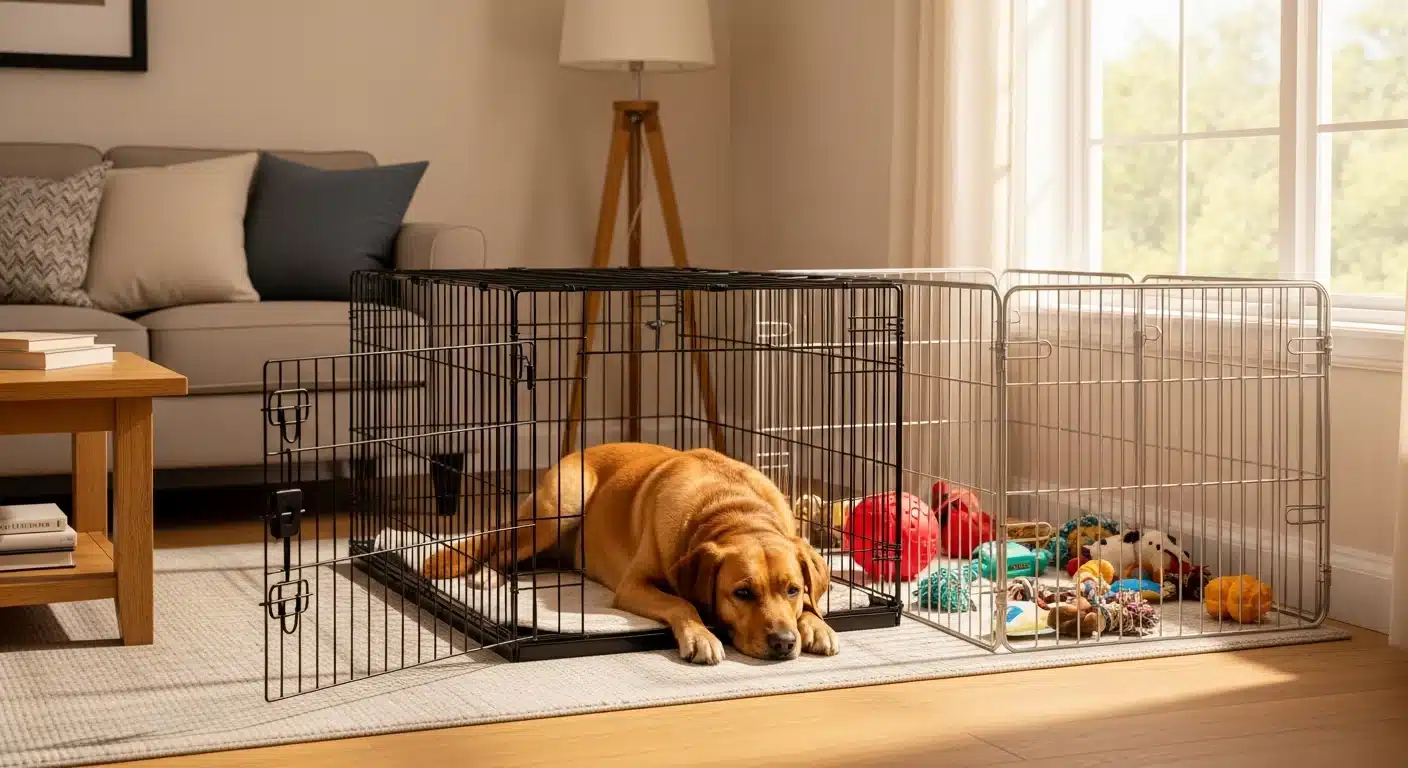
Crate vs Playpen: Which Is Better for Your Dog?
They look similar but solve completely different problems, here’s when to use each, and why most owners end up needing both.
Crate or playpen, which is better for your dog? The honest answer: it’s the wrong question, because a crate and a playpen aren’t competing tools. They solve different problems. A crate is a small, den-like space designed for sleeping, house-training, and safe travel, it works because most dogs won’t soil the area where they sleep. A playpen (also called an exercise pen or x-pen) is a larger enclosed area for awake, unsupervised time, it gives a puppy room to move, toys to play with, and space for a water bowl and a potty pad on days when you’re out longer than the crate-safe limit. Most experienced owners end up using both: crate for sleeping and house-training, pen for longer stretches of awake containment. This guide breaks down exactly when each tool works, where each one fails, and how to combine them so neither feels like punishment.
Our pick for the crate half of the setup
One money pick only, this post is a comparison guide, not a roundup. The MidWest iCrate is our recommended starting crate for most dog owners. Verified in stock; tap through for the live price.
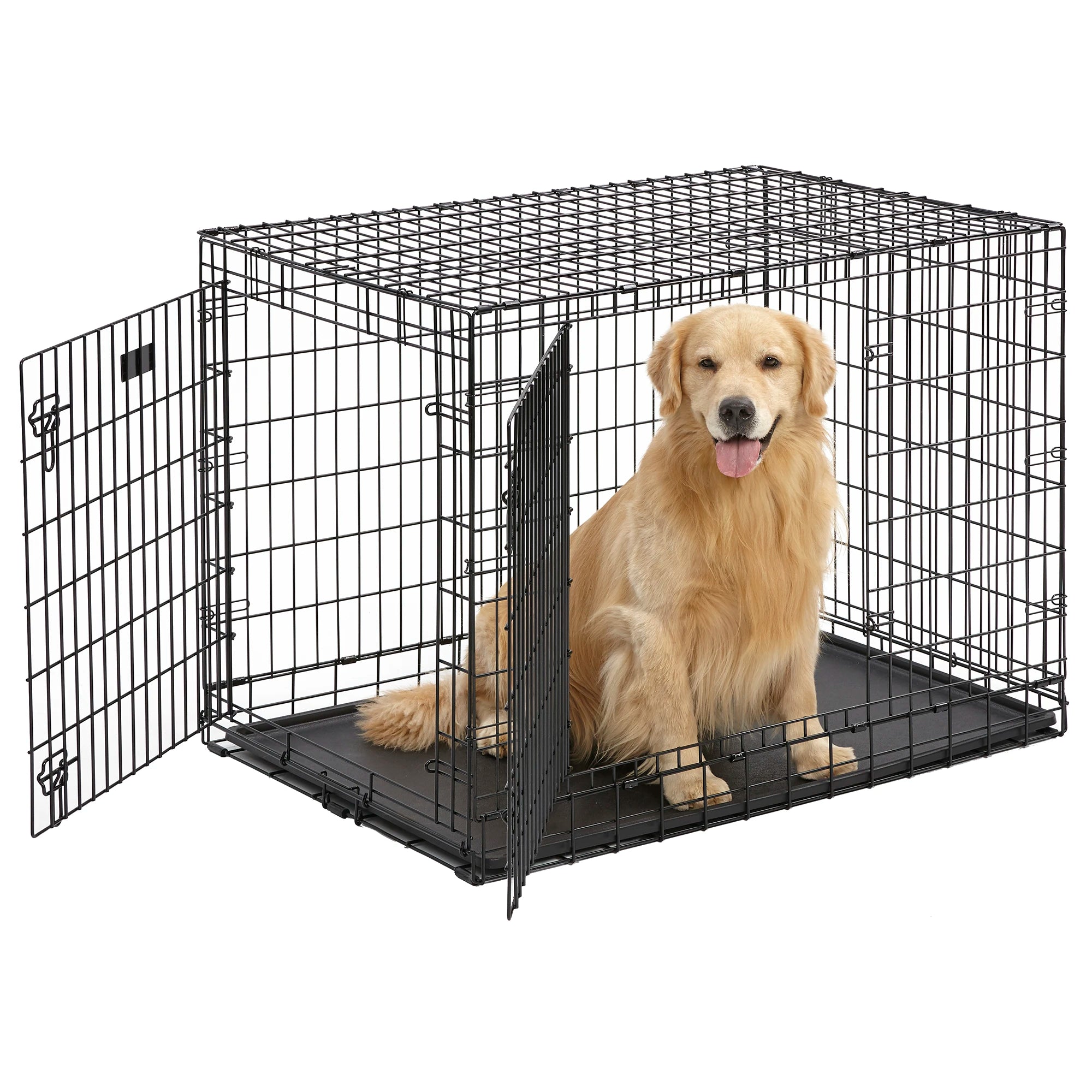
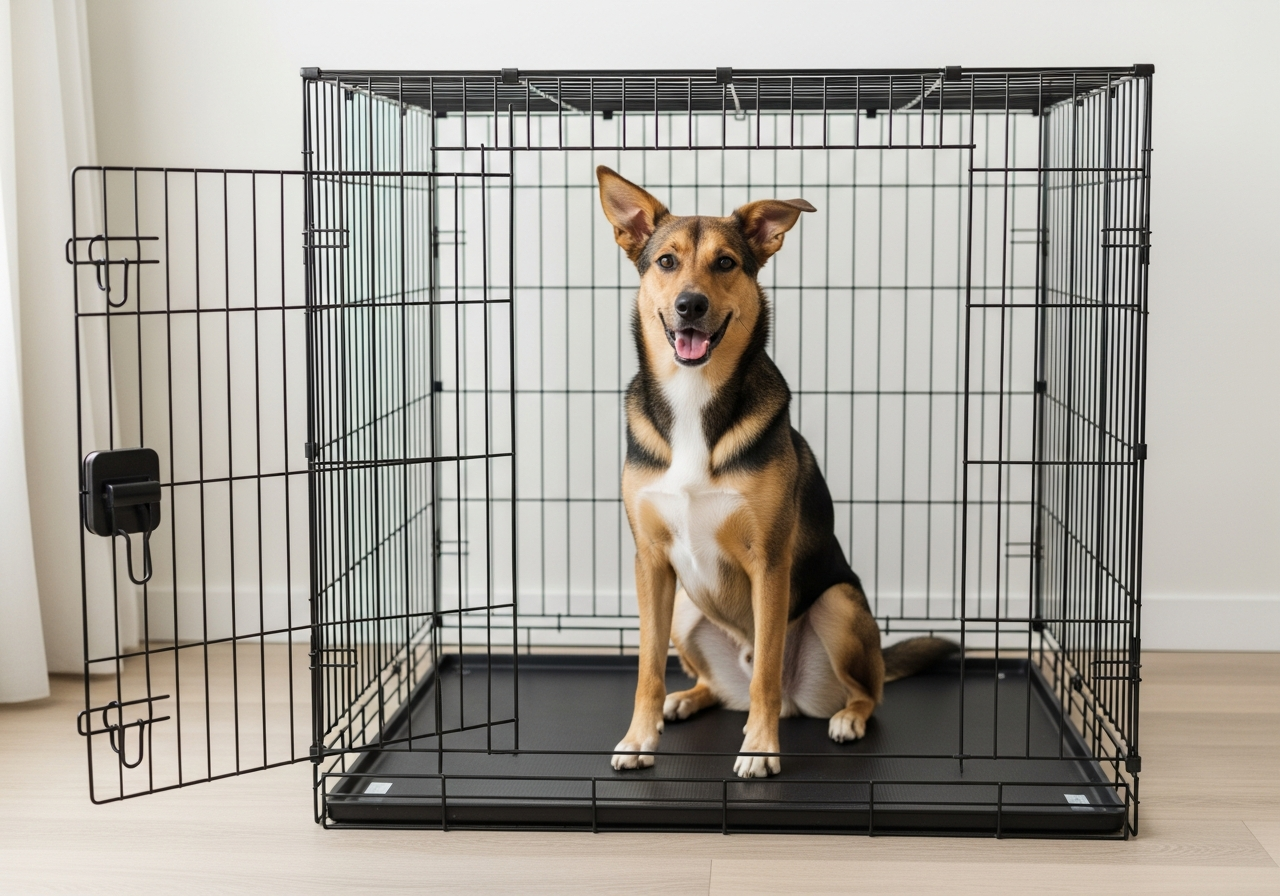
MidWest iCrate Folding Dog Crate
The MidWest iCrate is the crate we recommend most as the containment half of a two-tool setup. The included divider panel lets you shrink the space for a puppy who’s still learning not to soil their den, then open it up as they grow, so you’re not buying a second crate in six months. Double-door entry and a leak-proof pan keep daily life simple, and it folds flat in seconds for travel or storage alongside the pen.
What we like
- Divider panel lets you right-size the den as your puppy grows, no second crate needed
- Double-door entry gives flexible room placement and easier loading from either end
- Folds flat for travel or tuck-away storage; pairs well beside a pen
- Excellent value, less than half the price of premium crates with nearly identical everyday function
The catches
- Thin gauge wire, a strong, determined escape-artist dog can bend or pop the tray; step up to an Impact or Diggs Revol for those dogs
- Roller feet can mark hardwood floors; worth adding rubber pads
- Heavier than soft-sided travel crates, not ideal for airline cabin use
What a crate actually is, and what it’s for
A dog crate is a small, enclosed space sized so the dog can stand up, turn around, and lie down comfortably, but not much more. That snugness is intentional. Dogs are den animals: in the wild, they rest in tight, enclosed spaces that feel safe and protected. A well-introduced crate taps into that instinct. The result is a dog who treats its crate as its space, somewhere to retreat to voluntarily, not a cage it dreads.
The practical uses break down like this:
- House-training: A snug crate is the single most effective house-training tool for puppies, because most dogs won’t soil their sleeping area. They hold it in the crate, which builds the bladder control and the habit of going outside, provided you’re taking them out frequently enough (more on this below).
- Sleep and downtime: A crate gives a dog a quiet, dark space to decompress. Many adult dogs continue using their crate voluntarily for years, it becomes their bed.
- Travel and safety: A crate-trained dog travels safely in a car, stays calm at the vet, and adjusts more easily to hotels, boarding, or a new home. The crate goes with them; the den goes with them.
- Short-term management: When you can’t actively supervise a puppy or a newly adopted dog, in the shower, on a call, cooking, the crate keeps them out of trouble for a short stretch.
The key constraint: a crate is for limited time. Puppies under six months shouldn’t be crated for more than 3 to 4 hours at a stretch during the day (they simply can’t hold it longer). Adult dogs shouldn’t be crated more than 4 to 5 hours during the day in normal circumstances. Longer than that without a break crosses from management into misuse. That’s exactly where the playpen fills the gap.
What a playpen (exercise pen) actually is, and what it’s for
A playpen, often called an exercise pen, x-pen, or puppy pen, is a larger fenced enclosure, typically made of linked wire or metal panels. Most are 24 to 36 inches tall (puppy-appropriate) or 42 to 48 inches (harder to jump). Unlike a crate, it’s not a sleeping space, it’s an awake space. The extra room lets you put in a bed, water bowl, a few toys, and if needed, a potty pad. That last point matters: a pen is the right tool for longer stretches when a puppy simply cannot hold it the whole time.
Practical uses for a pen:
- Long alone-times: If you’re out for 5 to 8 hours, a pen with a potty pad is more humane than a crate, the puppy has room to move, play, and eliminate in an appropriate spot without being forced to hold it past the limit of physical comfort.
- Awake playtime containment: A pen gives a young dog freedom of movement while keeping them out of the living room furniture, the shoes, and the trash. It’s a safe bubble when you’re home but busy.
- Transitional training: As a puppy becomes reliable in a small space, you expand the pen gradually, a step toward full house freedom, with guardrails still in place.
- Multipurpose barrier: X-pens can fence off a section of a room, block stairs, or create a pet-safe zone in an unfamiliar space like a vacation rental.
The pen’s weak point: escape. A motivated dog can jump a standard pen, tip it, or find panel gaps. They’re not containment for an escape artist (that’s what a heavy-gauge crate is for), and they’re not suitable for a dog left completely unsupervised in a situation where getting out would be dangerous.
Crate vs playpen: the house-training difference (this matters a lot)
This is the most important distinction and the one that trips up the most new puppy owners. A crate works for house-training because dogs instinctively avoid soiling their sleeping area. The biology: a confined dog holds its bladder, then gets taken outside and goes there, repeatedly. Each repetition builds the habit: outside is the bathroom. This is why crate training is the fastest, most reliable route to a house-trained puppy when done correctly.
A playpen can quietly undermine house-training if a potty pad is inside. Here’s why: with enough space in the pen, a puppy learns it’s fine to eliminate in its living area (on the pad). That habit, indoor elimination is acceptable, is the opposite of what you’re trying to build. It’s not that playpens ruin house-training; it’s that they can stall it if used as a substitute for the crate during house-training. Many trainers see puppies who are ‘pen-trained’ at six months still not reliably house-trained at a year, because the pad taught them that inside was fine.
The right framework: use the crate as your primary house-training tool, keep potty pads out of it, and use the pen only when the alternative is leaving a puppy in a crate past its physical limit. If a pad is in the pen, treat it as managed indoor elimination, not a house-training tool, and plan for the extra weeks of outdoor work to solidify the habit later.
Crate vs playpen at a glance
| Factor | Dog Crate | Playpen / Exercise Pen |
|---|---|---|
| Best use | Sleeping, house-training, short-term management, travel | Awake containment, long alone-times, transitional freedom |
| House-training | Excellent, snugness triggers the “don’t soil your den” instinct | Can slow training if a potty pad teaches indoor elimination is OK |
| Space needed | Small footprint, fits most rooms and vehicles | Larger footprint, needs a dedicated corner or room section |
| Max alone time | 2 to 4 hrs (puppy) / 4 to 5 hrs (adult) | Can go longer with a pad for elimination |
| Containment strength | Strong, latched, enclosed; heavy-gauge = escape-proof | Moderate, jumpable, tippable; not for determined escape artists |
| Travel-friendly | Yes, folds flat, airline-approvable (hard-sided) | Limited, bulky, not practical for most travel |
| Cost | $40-$600+ depending on size and type | $30-$150 for most wire x-pens |
| Best for puppies | House-training phase, overnight, short stretches | Long work-day stretches when puppy can’t hold it 8 hours |
| Best for adult dogs | Ongoing safe haven, travel, vet visits | Expanding freedom before full house access; post-surgery recovery |
Puppy vs adult dog: does the answer change?
For puppies, crate and pen serve distinct phases of the same journey. The crate is the core tool from the moment you bring the puppy home through house-training, it’s used for every nap, overnight, and short-absence. The pen comes into play for working owners who are away longer than a young puppy can hold it (which is roughly one hour per month of age, plus one, so a three-month-old can manage about four hours). As the puppy’s bladder develops and reliability grows, the pen becomes less necessary and freedom expands.
For adult dogs, the calculus shifts. A fully house-trained adult dog doesn’t need a crate for training purposes, but many love it as a retreat. If your adult dog goes to their crate voluntarily, that’s a healthy relationship with the space: keep it accessible and consider leaving the door open. A pen for an adult dog is less common but useful in specific situations: post-surgery recovery that requires restricted movement, introducing a new pet, or managing a newly adopted dog who isn’t yet trusted with full house access.
One note on giant breeds: the math on crate size matters more. A Great Dane or Mastiff needs a 54-inch crate as an adult, larger than many owners expect. Our crate size calculator gives you the right measurement based on your dog’s breed and adult height, so you’re not buying the wrong size twice.
Space, escape, and safety: practical differences
Space: A crate takes up a predictable rectangle, easy to fit under a desk, in a bedroom corner, or behind a car’s rear seat. An x-pen requires a bigger, more flexible footprint and usually stakes out a section of a room. If you’re in a small apartment, a crate is far more space-efficient; the pen becomes harder to place without it eating the living room.
Escape: A crate is enclosed on all six sides with a latching door, the gold standard for containment when you genuinely need the dog to stay put. An x-pen is a fence, not a cage: a confident jumper can clear it, a clever dog can tip a lighter model, and the panel gaps on cheap pens can be exploited. For an escape-risk dog, one who’s tested and cleared a standard pen, a heavy-gauge crate is the right tool. Our escape-proof crate guide covers Impact, Gunner, and other containment-grade options for dogs with real determination.
Safety: Both tools, used correctly, are safe. Both used incorrectly create problems. A crate used for too long without breaks causes physical and psychological stress. A pen without adequate supervision can let a dog get into a tangle, tip over a water bowl they can’t escape from, or chew panel connectors. The brief is the same for both: set up the environment so the dog can’t hurt themselves, and respect the time limits.
Travel: clear winner
The crate wins this one outright. A folding wire crate or a hard-sided plastic crate travels in the car, checks as airline baggage, and gives your dog a familiar den in a hotel, a friend’s house, or a new temporary space. The containment is absolute, latched, enclosed, and the familiar smell of their own space helps dogs stay calm in an unfamiliar environment.
An x-pen is almost impossible to travel with practically. The panels are bulky even when folded, they don’t fit in most cars without folding the rear seats flat, and they don’t provide any meaningful containment in an unfamiliar space, they can be moved, tipped, or jumped. A few owners bring a small pen on camping trips for yard containment, and that works fine for a calm dog in an open-air setting, but for anything involving vehicles, flights, or indoor stays, the crate is the only practical option.
If you’re traveling with a crate-trained puppy, the crate’s value multiplies: it carries the dog’s familiar scent and association with safety, which means the dog settles faster in new places than an uncrated dog who has to decompress in an unfamiliar space from scratch. That emotional portability is one of the strongest arguments for crate-training early, even if you plan to phase it out later.
The right answer for most situations: use both
Here’s the setup that most trainers and experienced owners land on:
- Crate: overnight sleep, every nap during the house-training phase, and any short absence where you’d be back within the crate-safe limit. This is the house-training workhorse.
- Pen: longer absences (work days, errands stretching past 4 hours), awake playtime when you’re home but busy, and gradual expansion of freedom as the dog earns it.
- Combined setup: crate inside or beside the pen for full work-day absences, door open so the dog can sleep in the crate voluntarily, use the pen for movement and play, and use a pad in the far corner of the pen only if the duration demands it.
Dogs who grow up with both tools tend to be more adaptable: they’ve learned to be calm in a snug space and in a larger enclosure, which covers every containment scenario they’ll encounter across a full life, car travel, vet stays, boarding, new homes.
If you can only afford or fit one: start with the crate. House-training is the immediate priority for a puppy, and a crate is the most reliable way to accomplish it. Add the pen when you need longer containment or your dog starts earning more space.
For more on crate timing, exactly how long is too long at each age, see our guide on how long a dog can stay in a crate.
Choosing the right crate: quick spec guide
If you’re buying a crate as the containment half of this setup, the core choices are:
- Wire folding crate (MidWest iCrate, etc.): The practical choice for most owners. Folds flat, has a divider to grow with a puppy, good ventilation, easy to clean. The weakness: thin wire, not for dogs who push, bend, or pull at bars. Brands like Diggs Revol and Impact Case are built for tougher dogs.
- Plastic (airline-style) crate: Better for travel (airline-approved), more den-like and enclosed which some dogs prefer, easier to clean up after illness. Heavier and doesn’t collapse flat.
- Soft-sided crate: Lightest option for travel, best for calm dogs who won’t try to exit. Zero containment strength for an escape-prone dog.
- Heavy-gauge / escape-proof: Impact, Gunner, ProSelect Empire, for dogs who’ve destroyed standard crates. Significantly heavier and more expensive, but containment is serious.
On size: the crate should be just big enough for your adult dog to stand, turn around, and lie stretched out, no larger during house-training. Too much space and a puppy will use one corner as a bathroom. Use the divider panel (included with the iCrate) to shrink it for a young puppy and expand it as they grow. Get the exact inches using our crate size calculator, and check our full crate roundup for the complete ranked list across all types.
Keep researching crate training and containment
Crate vs playpen: common questions
Is a crate or playpen better for a puppy?
Use both, they serve different roles. The crate is your primary house-training tool: its snugness triggers the instinct not to soil the sleeping area, building the habit of going outside. The playpen is for longer stretches when a young puppy can’t hold it the whole time, add a potty pad, water, and toys. For overnight and every nap during the house-training phase, the crate wins. For a full work day away from home, the pen wins. Most owners need both.
Can I use a playpen instead of a crate?
For awake containment and long alone-times, yes. For house-training and overnight, a playpen is a poor substitute: it’s large enough that a puppy will use one corner as a bathroom, which teaches that indoor elimination is acceptable, the opposite of house-training. If a playpen is your only option, keep the potty pad in the far corner and expect house-training to take longer. The crate is almost always the better tool for building outdoor bathroom habits.
How long can a puppy be in a playpen?
Longer than a crate, because a pen can contain a potty pad, but it still depends on age and temperament. There’s no hard ceiling the way there is with a crate (where holding it past the physical limit is cruel), but a puppy left in a pen all day without human contact isn’t thriving. Most trainers suggest no more than 4 to 6 hours for a young puppy in a pen, with a break in the middle if possible. For adult dogs in a pen during a work day, 8 hours is manageable if the pen is well set up, water, toys, a comfortable resting spot, though mid-day visits or a dog walker are always better.
Will a playpen undermine house-training?
It can, if a potty pad is inside it during the house-training phase. A puppy that learns to eliminate on a pad in the pen may generalize this to ‘inside is fine’, slowing or stalling outdoor house-training. The risk is highest in puppies under five or six months. To minimize it: use the crate as your primary containment during active house-training, use the pen only for long absences where the puppy truly can’t hold it, and treat the pad as a managed indoor option rather than a training tool. You’ll typically need to do a bit more outdoor repetition to solidify the habit afterward.
Can I put a crate inside a playpen?
Yes, and this is actually one of the best setups for a puppy left home alone all day. Place the open crate inside the x-pen as a sleep space. The puppy can go in and out of the crate voluntarily (preserving the den association), has room to move in the pen, and has a potty pad in the far corner for elimination. It’s the best compromise between long-duration containment and protecting house-training progress.
What size crate do I need alongside a playpen?
The crate should be just big enough for your adult dog to stand up, turn around, and lie down comfortably, no larger during house-training. Use a divider panel to shrink it while the puppy is small. If you’re not sure on size, use our dog crate size calculator, it gives you the exact inches based on your dog’s breed and expected adult height.