 Dog Gear, Sized Right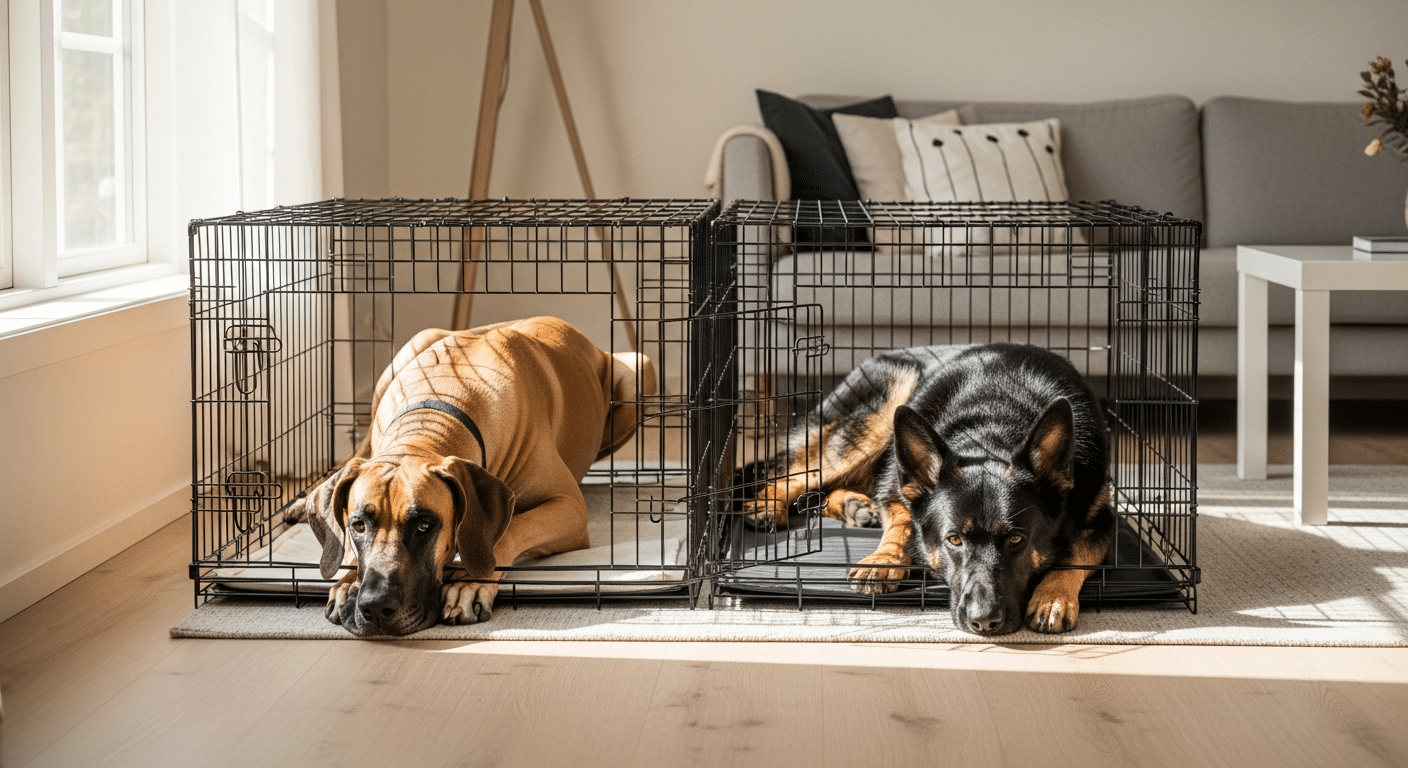
Best Dog Crate for Large Dogs (XL & Giant Breeds)
The crates most ‘best crate’ lists skip, 48″ and 54″ sizes built for 70 to 150+ lb dogs. We rank them by size and strength, then show you exactly which size your breed needs.
Here’s the problem with almost every “best dog crate” list: they’re written for a 40 lb dog. The moment you own a Great Dane, Mastiff, German Shepherd, Rottweiler or any 70 to 150+ lb dog, most of those picks are too small, too flimsy, or simply don’t come in your size. This guide fixes that. Every crate below is a genuine large, XL or giant-breed crate, 48″ and 54″ footprints, heavy-duty where it matters, and we lead with the one thing those other lists bury: what size crate your dog actually needs by weight. Get the size right first, then pick the build that fits your dog’s strength, your budget and your home.
The best large, XL & giant-breed crates
Ranked for dogs 70 to 150+ lb. Each pick is verified in stock, tap through for the live price. Match the size to your dog using the table below first.

Impact Stationary Dog Crate (48″ / 54″)
For a 90 to 150 lb dog that bends wire, chews bars, or panics in a flimsy crate, this is the one that finally holds. Aircraft-grade aluminum, a paddle latch plus four butterfly latches, and a 48″ or 54″ footprint built for Great Danes, Mastiffs and Shepherds. It is the crate you buy once instead of replacing three wire crates a destructive dog destroys.
What we like
- Genuinely escape-proof, built for the dogs that destroy wire crates
- Aluminum is far lighter than steel for the same strength
- 48″ and 54″ sizes cover giant breeds most crates leave out
- Handmade in the USA with a strong warranty; lasts the dog’s life
The catches
- Premium price, this is the investment pick, not the budget one
- Solid-sided, so less airflow/visibility than open wire
- Heavy to move room-to-room (it is built to stay put)

MidWest 54″ Drop Pin Crate (Giant Breeds 100+ lb)
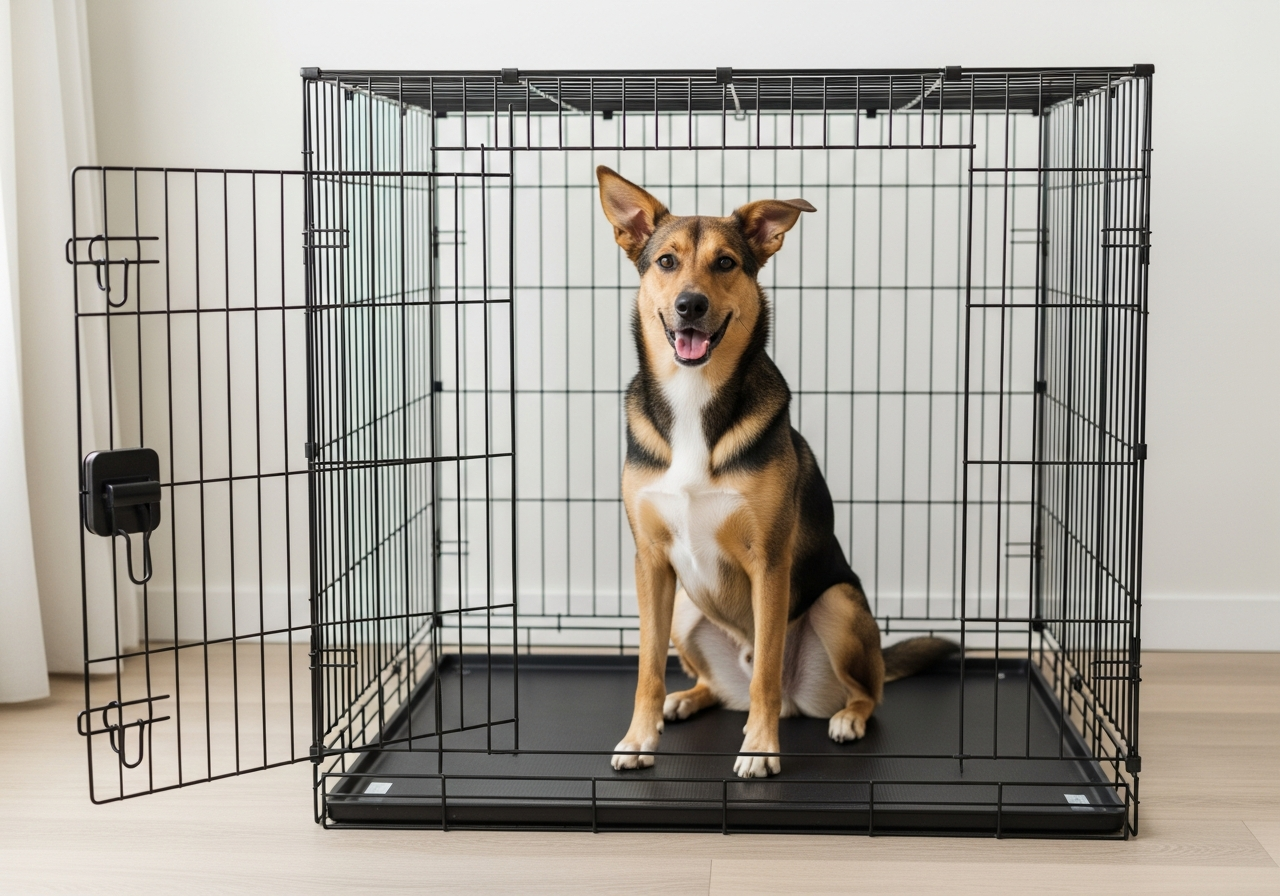
The crate most Great Dane and Mastiff owners actually buy. At 54″ long with reinforced drop-pin construction, a tall dog can stand fully, turn and stretch out without touching wire. A leak-proof slide-out pan and double doors make daily life easy, and it costs a fraction of the premium picks.
What we like
- True 54″ size for Danes, Mastiffs and St. Bernards at a fair price
- Reinforced drop-pin frame and L-bar handle big-dog force
- Double doors + removable leak-proof pan for easy cleaning
- Folds flat for storage and transport
The catches
- Open wire, a determined escape artist can still test the door
- Heavy when assembled (it’s a lot of steel)
- No divider at this size, pair with our calculator for a growing pup

MidWest 48″ iCrate (Large Breeds 90 to 110 lb)
Over 100,000 reviews and the default first crate for large-breed owners. The 48″ iCrate fits 90 to 110 lb dogs and ships with a divider panel so you can buy it for a Lab or Shepherd puppy and grow the space as they do, no second crate needed. Under $90 makes it the easy starting point.
What we like
- Unbeatable value, the most-reviewed large dog crate on the market
- Divider panel grows with a large-breed puppy (buy once)
- Folds flat in seconds; carry handle for moving it around
- Leak-proof pan and double doors included
The catches
- 48″ is the ceiling, a full-grown Dane needs the 54″ above
- Light-duty wire, not for serious chewers or escape artists
- Powder coat can scratch over years of heavy use

Diggs Revol Collapsible Crate (Large)
If your crate lives in the living room, the Revol is the one you won’t hate looking at. Diamond-mesh steel (safer than straight bars), a slide-out tray, wheels and three entry points, including a ceiling hatch. The Large fits dogs up to ~90 lb, so it suits big Labs, Boxers and Goldens rather than true giants.
What we like
- By far the most attractive crate here, designed for the home
- Rounded, anti-pinch diamond mesh is safer than straight bars
- Slide-out tray and wheels make cleaning and moving genuinely easy
- Collapses for travel; included divider for a growing puppy
The catches
- Large tops out around 90 lb, not for a Dane or full Mastiff
- Pricey for the size; you pay for the design and convenience
- Heavier than wire, and packs down tall (mind small cars)
What size crate does your large dog need? (by weight)
This is the step the other lists skip, and it’s the one that matters most. Crate size goes by your dog’s length and standing height, which track closely with weight. The crate should be just big enough for your dog to stand fully, turn around, and lie out flat, no bigger (a too-large crate undermines house-training). Use this table to find your size, then pick a crate above that comes in it:
| Dog weight | Crate size | Example breeds |
|---|---|---|
| 26 to 40 lb | 36″ | Cocker Spaniel, Bulldog, smaller Beagle/Border Collie |
| 41 to 70 lb | 42″ | Boxer, Labrador, Golden Retriever, Australian Shepherd |
| 71 to 90 lb | 48″ | German Shepherd, Doberman, Rottweiler, Weimaraner |
| 91 to 110 lb | 48″-54″ | Bernese Mountain Dog, large GSD, Bullmastiff (younger) |
| 110 lb+ | 54″+ | Great Dane, Mastiff, St. Bernard, Newfoundland, Irish Wolfhound |
Still between two sizes, or buying for a puppy who’ll double in size? Run your dog’s numbers through our dog crate size calculator, it converts breed and measurements into the exact crate dimensions to buy, including whether a divider makes more sense than buying twice.
How we chose these large dog crates
A crate that’s “big” isn’t automatically a good large-dog crate. Big dogs are stronger, heavier and harder on hardware, so we ranked on the things that actually break or fail at this size:
- True interior size. The advertised length is the outside, we checked the usable interior against the breeds each crate claims to fit. A 48″ crate that fits a Dane on paper rarely does in reality.
- Structural strength. Gauge of the wire or steel, frame reinforcement (drop-pin, L-bar), and how the doors latch. Big dogs lean, push and dig, weak corners bend.
- Escape & chew resistance. The bigger and more anxious the dog, the more the latch and bar spacing matter. Our top pick is built specifically for the dogs that destroy ordinary crates.
- Floor protection & cleaning. A leak-proof, slide-out pan is non-negotiable at this size, a 100 lb dog’s accident is a real cleanup.
- Value for the dog you have. We span a $90 starter to a $900 lifetime crate, because the right pick depends on whether your dog is a calm Lab or a wire-bending escape artist.
Wire, steel or aluminum: which build for a big dog?
For large dogs the material decision matters more than for small ones, because a big dog can defeat a build a small dog never tests:
- Standard wire (MidWest iCrate, Drop Pin): the value default. Great airflow and visibility, folds flat, cheap. Fine for calm large dogs; a determined chewer or escape artist will eventually find a weak door or bent corner.
- Heavy-duty steel (BOLDBONE, Oranland-style): thick 20-gauge tube steel, 250 to 400 lb-rated, multi-point locks. The middle ground for strong or anxious dogs that bend ordinary wire but don’t need an Impact.
- Aircraft-grade aluminum (Impact): the strongest and lightest option. This is what you buy for a genuine escape artist, a heavy chewer, or a dog with separation anxiety, and what we recommend for serious car travel.
- Diamond-mesh + frame (Diggs Revol): a design-forward middle ground, safer rounded mesh than straight bars, prettier in the home, but tops out around a 90 lb dog.
If your dog is the reason you’re reading this, the one who’s already escaped or destroyed a crate, skip straight to our best escape-proof dog crate guide, which ranks the heavy-duty and aluminum options head-to-head.
Do you need a divider for a large-breed puppy?
Yes, and it’s the single best money-saver for big-dog owners. A large-breed puppy will quadruple in size, so buying a tiny puppy crate now means buying again in six months. Instead, buy the adult size and use a divider panel to wall off just enough space for the puppy today, then move the panel back as they grow.
The reason size matters for a puppy: a crate that’s too big lets them potty in one corner and sleep in the other, which sabotages house-training. The divider keeps the usable space “just right” at every stage. The MidWest 48″ iCrate and the Diggs Revol both ship with a divider; the 54″ giant crates generally don’t, since their owners are buying for an already-enormous adult.
Floor protection and where to put a big crate
A large dog crate is a lot of weight and a lot of potential mess, so two practical things save your home:
- Use the leak-proof pan, and add a mat under it. Every crate here has a removable plastic pan; on hardwood or laminate, put a waterproof mat or a piece of vinyl under the whole crate. The pan catches accidents; the mat catches what slides out the gaps and protects the floor from scratching when the crate shifts.
- Pick the spot before you assemble. A 54″ crate is hard to move once it’s up. Choose a low-traffic but not-isolated corner, dogs want to be near the family but out of the foot-traffic, away from direct sun and heating vents. Solid-sided crates like the Impact feel more den-like for anxious dogs; open wire suits dogs who want to watch the room.
For the full big-dog crate lineup, including reviews, comparisons and the heavy-duty options, start at our dog crate hub.
Our verdict: which large dog crate should you buy?
Match the crate to your dog, not the other way around. For a calm large-breed dog or a growing puppy, the MidWest 48″ iCrate with its divider is the obvious value buy, and the 54″ Drop Pin is the same value scaled up for a true giant breed. For a destructive, anxious or escape-prone big dog, the one who’s already wrecked a wire crate, stop replacing cheap crates and buy the Impact Stationary once. If the crate lives in your living space and looks matter, the Diggs Revol is the one you’ll actually be happy to see, as long as your dog is under ~90 lb.
Whichever you choose, get the size right first, run the numbers through the crate size calculator, and read the full Impact crate review or Diggs Revol review before you commit to a premium pick.
Keep researching big-dog crates
Large dog crates: common questions
What size crate does a 70 lb dog need?
A 70 lb dog (think Labrador, Golden Retriever or smaller German Shepherd) needs a 42″ crate as a starting point, stepping up to 48″ if the dog is tall or long-bodied. Measure nose to base of tail and add 2 to 4″, and floor to head while sitting and add 2 to 4″, buy the crate that satisfies both. Tall breeds often need the next size up for height even when 42″ covers length.
What size crate does a 90 lb dog need?
A 90 lb dog needs a 48″ crate in most cases, that covers large German Shepherds, Dobermans, Rottweilers and Weimaraners. If your 90 lb dog is unusually tall or long, or still growing, size up to 54″. The MidWest 48″ iCrate is the popular value pick at this size; for a strong or anxious 90 lb dog, a heavy-duty or aluminum 48″ crate holds up far better.
What size crate does a 100 lb dog need?
A 100 lb dog should be in a 54″ crate, or a generously-built 48″ only if the dog is on the shorter side. At 100+ lb you’re into Bernese Mountain Dog, Bullmastiff and large-Shepherd territory, and the extra length lets the dog stretch out flat without touching wire. The MidWest 54″ Drop Pin is built specifically for dogs over 100 lb.
What size crate does a Great Dane need? Can a Dane fit a 48-inch crate?
A full-grown Great Dane needs a 54″ crate, a 48″ is too small for an adult Dane to stand and turn comfortably, and they’ll be cramped. A 48″ works only for a Dane puppy (and you’ll be buying the 54″ within the year). Look for a 54″ with extra height, like the MidWest Drop Pin or a pitched-roof XXL crate, since Danes are exceptionally tall.
What is the biggest dog crate size?
The standard largest mainstream crate is 54″ long, which suits Great Danes, Mastiffs and St. Bernards. Beyond that, specialty XXL crates run 64″ to 72″+ for the very largest dogs or for housing two dogs together. For most giant breeds a 54″ is plenty, bigger isn’t better, since a crate should be only large enough for the dog to stand, turn and lie flat.
Wire or solid-sided crate for a large dog?
It depends on the dog. Wire gives the best airflow and visibility, folds flat and costs the least, ideal for a calm large dog who likes watching the room. Solid-sided crates (like aluminum Impact crates) feel more den-like and calming for anxious dogs, are far harder to escape or destroy, and are the safer choice for car travel. Strong, anxious or escape-prone big dogs are better in a solid heavy-duty crate.
What’s the best crate for a large dog with separation anxiety or that escapes?
For an escape artist or a dog with separation anxiety, an ordinary wire crate isn’t enough, they bend bars, pop latches and injure themselves trying. The best option is a heavy-duty steel or aircraft-grade aluminum crate with multi-point latches, like the Impact Stationary. We rank these head-to-head in our best escape-proof dog crate guide.
Do I need a divider for a large-breed puppy?
Yes, buy the adult-size crate now and use a divider to limit the space while the puppy is small. A crate that’s too big lets a puppy potty in one corner and sleep in another, which slows house-training. Move the divider back as the puppy grows so the usable space stays “just right.” This saves you from buying two crates. The MidWest 48″ iCrate and Diggs Revol include dividers.