 Dog Gear, Sized Right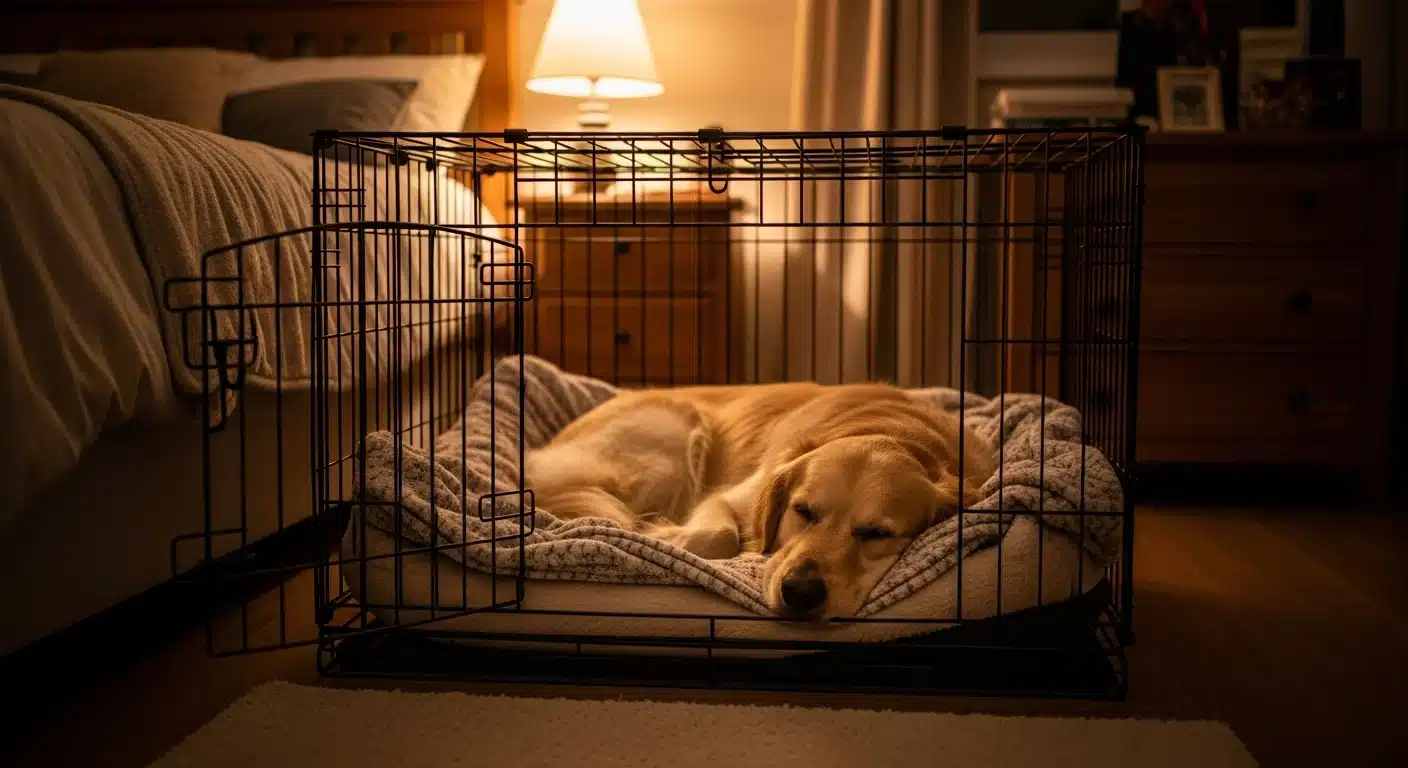
Should a Dog Sleep in a Crate at Night?
The honest answer: yes, for most dogs, especially puppies and dogs still in training. Here’s why it works, how long is too long, and when to skip it.
Should a dog sleep in a crate at night? For most dogs, and especially for puppies and dogs still learning the house rules, yes. A properly sized, comfortably set-up crate taps into a dog’s natural instinct to seek a small, enclosed den. It speeds up house-training, prevents nighttime chewing disasters, and gives your dog a calm, predictable place to decompress. Many adult dogs, even once they’ve earned full household freedom, choose to sleep in their crate because it feels like theirs. That said, crating isn’t right for every dog or every situation, we’ll cover exactly when it helps, when it doesn’t, and the one or two scenarios where it genuinely shouldn’t happen at all.
The overnight crate most trainers recommend
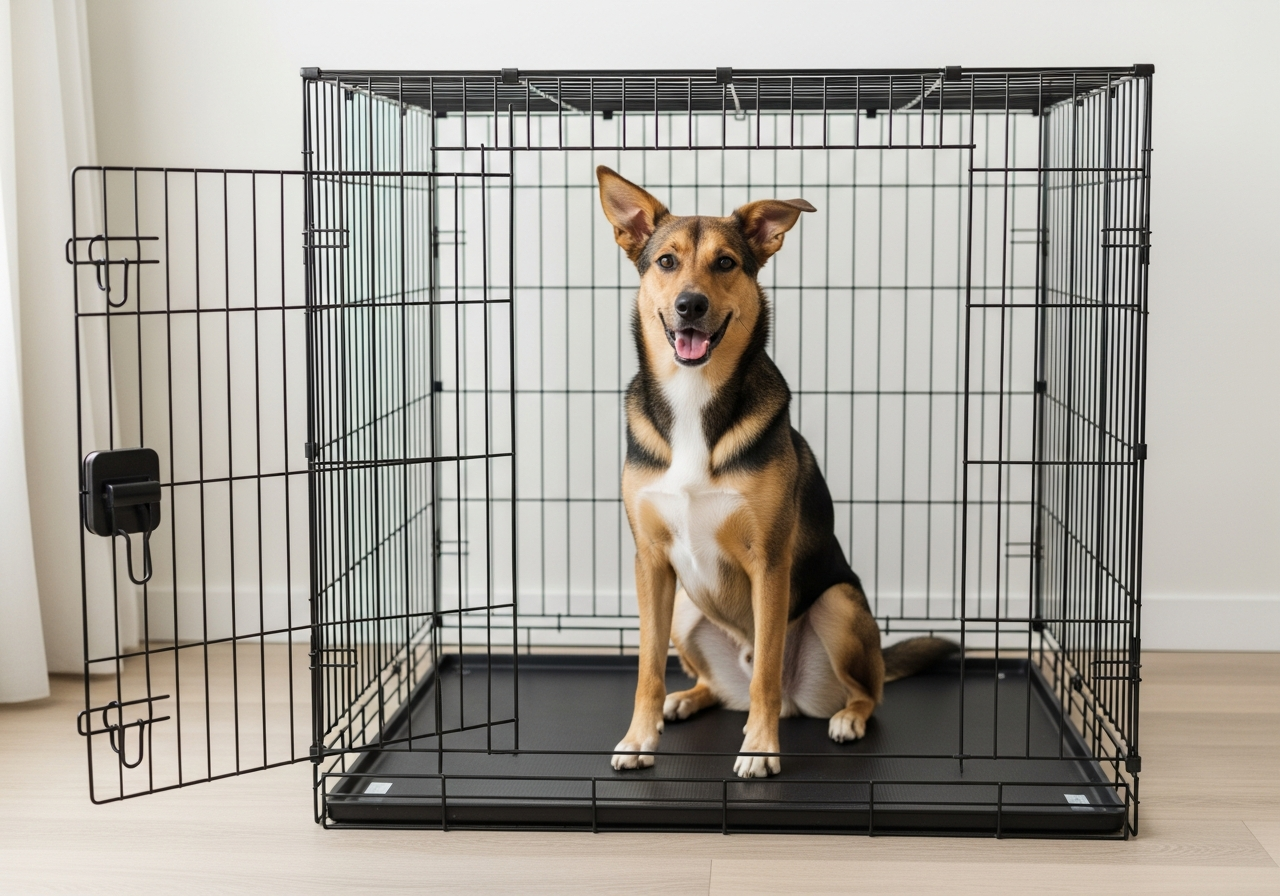
One pick, because this is an explainer, not a roundup. The MidWest iCrate earns its place on merit: it’s the divider-panel design that trainers point to for overnight puppy use and it scales to adulthood. Verified in stock; tap through for the live price.
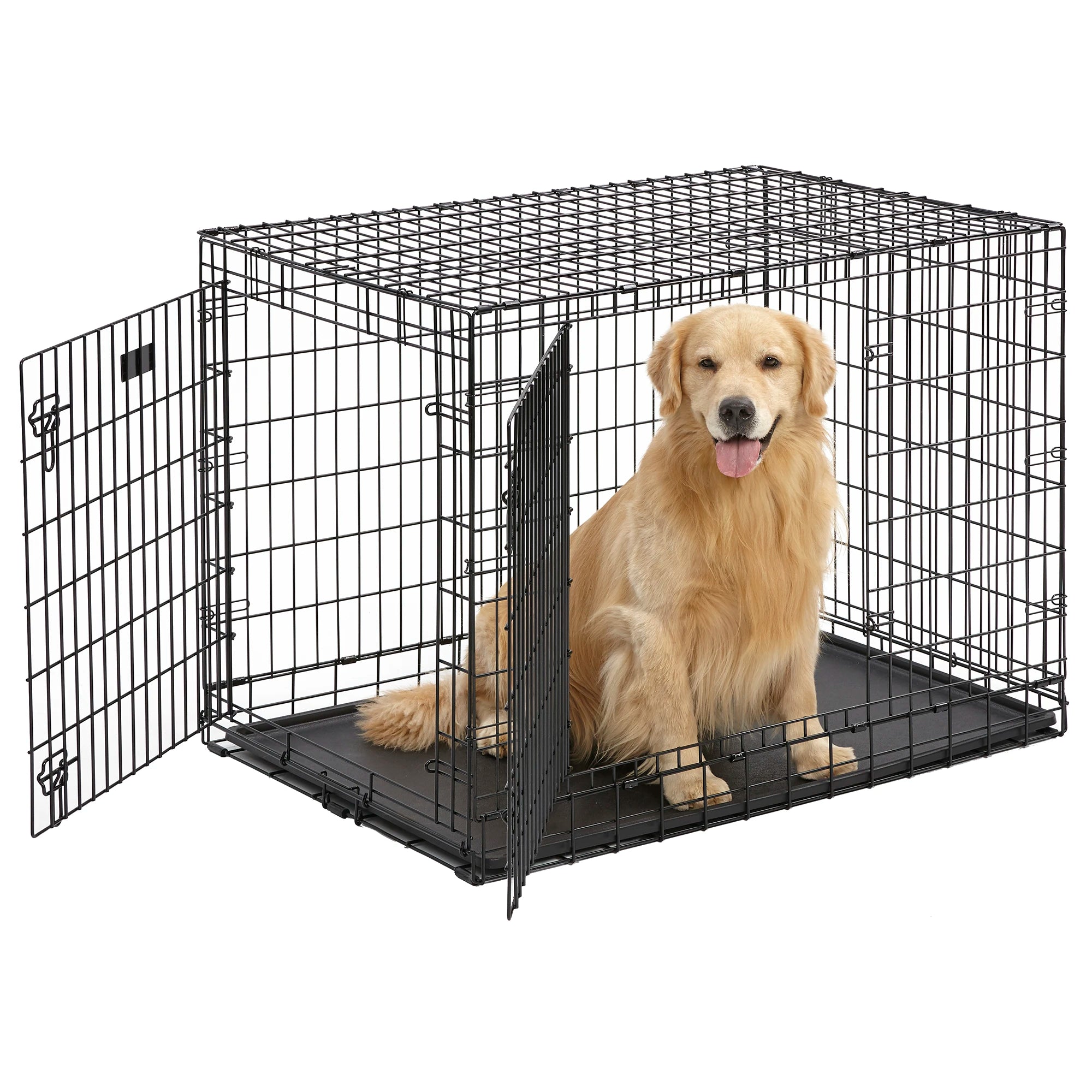
MidWest iCrate Folding Dog Crate
The MidWest iCrate is the crate most trainers recommend for overnight use, and it’s easy to see why. The included divider panel lets you shrink the sleeping space to just big enough for a puppy (discouraging nighttime accidents), then expand it as they grow. The double-door design means you can position it flush against a bedroom wall and still open it from the front or side, and the leak-proof pan keeps those early-morning slip-ups contained. It folds flat in seconds for travel.
What we like
- Divider panel grows with puppies, one crate from 8 weeks to adult
- Double door lets you place it flush against a wall and still access easily
- Leak-proof removable pan handles overnight accidents without mess
- Folds flat in seconds, easy to move between bedroom and living room
The catches
- Wire construction is not escape-proof for determined chewers or climbers
- Can rattle slightly if your dog shifts around, add a mat underneath to dampen noise
- Not as aesthetically polished as furniture-style crates like Diggs Revol
Why the crate works at night: the den instinct
Dogs are descended from animals that slept in small, enclosed dens, not sprawled in the open. That hardwired preference doesn’t disappear with domestication. A crate that’s properly sized (just big enough to stand up, turn around, and stretch out) feels snug and secure, not confining, to most dogs. It shuts out the visual noise of a dark house, reduces startling from household sounds, and gives the dog a space that is unambiguously theirs.
This is why trainers don’t describe the crate as a cage, they describe it as the dog’s bedroom. The framing matters: a dog that’s been introduced to the crate gradually, with positive associations, will walk in on its own and sigh. A dog that’s been shoved in and left to cry will associate it with anxiety. The crate itself is neutral. What matters is how you introduce it.
For overnight sleeping specifically, the den instinct is an asset. Dogs naturally avoid soiling where they sleep, which is the entire engine of crate-based house-training, and it’s why the crate works so well at night when there’s no chance of a mid-sleep potty break.
The real benefits of crating a dog at night
These are the concrete reasons trainers and vets recommend overnight crating during puppyhood and training, not marketing copy, not myths:
It’s the fastest route to a house-trained dog
Dogs don’t soil where they sleep. Pairing a correctly sized crate with a consistent morning-potty routine teaches the puppy that holding it until outside is the only option. Remove the crate, and the puppy has the whole house as a potential toilet. Keep the crate, and the signal is unambiguous. Most puppies on a crate schedule are reliably house-trained weeks faster than those given free run.
The key word is correctly sized: a crate with room to wander lets the puppy sleep in one corner and potty in another. The MidWest iCrate’s divider panel solves this exactly, you set it to puppy-small and expand as they grow.
It protects the dog from nighttime hazards
A puppy or adolescent dog loose in the house overnight can chew electrical cords, swallow socks, topple heavy objects, or find the one thing in the kitchen that’s toxic. These aren’t hypothetical risks, they’re the reason emergency vets see spikes in after-midnight ingestion cases. A crate removes the opportunity entirely. You sleep. The dog sleeps. Nobody eats a power strip.
It gives anxious and overexcitable dogs a reset
Some dogs, especially high-energy puppies and adolescents, struggle to settle on their own in an open room. Too many sights, sounds, smells. A crate creates a predictable, low-stimulation environment where the dog’s nervous system can actually downregulate. This is different from using the crate to manage separation anxiety (which it won’t fix on its own), but for the dog that just won’t stop pacing and whining, the crate provides containment for calm.
Adults choose it, even when they don’t have to
Once a dog has been crate-trained properly, many owners find their dog voluntarily returns to their crate to sleep even after the door stops being closed. It became their space. This is the most honest evidence that the crate isn’t inherently unpleasant, it’s what dogs trained to love the crate tell you with their behavior.
Where to put the crate at night
Location matters more than most people expect, particularly for puppies in their first weeks home.
| Crate location | Best for | Trade-off |
|---|---|---|
| Your bedroom | New puppies, anxious dogs, any dog in early crate training | You may hear every shift and whimper, but you’ll also hear when they actually need to go out |
| Bedroom doorway / hallway | Dogs that are mostly settled but still need a nighttime break | Slightly less proximity; harder to judge a “need to go” whine vs. a “bored” whine |
| Another room | Fully house-trained adults who know their crate well | Not suitable for puppies, they can’t signal a potty need you can’t hear |
The case for the bedroom is strongest with puppies. A new puppy in another room is also a frightened puppy, it just left its littermates and everything familiar. Hearing you breathe, smelling your presence, knowing you respond when it cries is the difference between a dog that settles within a few nights and one that cries until 3am for weeks. The proximity also lets you wake up when a puppy needs to go out, rather than waking to an accident in the crate.
How long can a dog be in a crate overnight? (The bladder math)
This is where most owners get caught out: puppies cannot hold their bladder all night. The rule of thumb is age in months + one hour for maximum hold time. So:
| Puppy age | Max daytime hold | Overnight expectation |
|---|---|---|
| 8 weeks (2 months) | ~3 hours | 4 to 5 hours (rest slows metabolism) |
| 3 months | ~4 hours | 5 to 6 hours |
| 4 months | ~5 hours | 6 to 7 hours |
| 5 months | ~6 hours | Often through the night with late potty break |
| 6+ months | ~7 hours | Through the night for most dogs |
Why is overnight slightly longer than daytime? When a dog is asleep and not eating, drinking, or running around, its bladder empties more slowly. A 10-week-old puppy that can’t be left alone for 3 hours in the afternoon may still make it 4 to 5 hours from a late-night final potty trip.
The practical plan: give the last food/water 2 to 3 hours before bed, take the puppy out for a final potty right before you turn off the lights, set an alarm to take them out once in the night (based on the table above), then again first thing in the morning. Most puppies reliably sleep through the night by 4 to 5 months. A few earlier, a few later, all normal. For a deeper breakdown of maximum crate time at other parts of the day, see our how long can a dog stay in a crate guide.
Setting up the crate so the dog actually wants to sleep in it
A crate your dog hates is a crate that won’t work. A few non-negotiable setup steps:
- Right size: Big enough to stand, turn, and lie flat, not so big there’s room to designate a toilet corner. Use the divider panel on an adult-sized crate while the puppy grows.
- Comfortable bedding: A mat, crate pad, or folded blanket. Some puppies chew bedding, so start with a simple mat and upgrade when they’ve earned it. The crate pan should be covered.
- Cover three sides: A crate cover (or a blanket draped over the top and sides) reduces visual stimulation and makes the space feel more den-like. Leave the front open or slightly ventilated.
- Familiar scent: Put something that smells like you in the crate with a new puppy. An old T-shirt works. The scent is calming and makes the crate feel less foreign.
- Never lock the door as discipline: The crate should be a positive space. If you only ever close the door when you’re angry at the dog, you’ve built an association between “crate” and “bad thing happened.” Reserve it for sleep, calm time, and meals, never as a penalty.
The introduction process matters too. Before the dog ever sleeps in the crate, it should have eaten meals near it, explored it voluntarily, and slept in it with the door open. Rushing this step is the most common reason crate training fails. For the full step-by-step, see our crate training guide.
Transitioning out of the crate as your dog matures
The crate doesn’t have to be forever, and for most dogs, it shouldn’t be. Once a dog is reliably house-trained and has shown it won’t chew or destroy things when unsupervised, you can start giving it more freedom at night. The progression usually looks like this:
- Phase 1 (puppyhood): Crate every night, closed door, with a middle-of-the-night potty break if needed.
- Phase 2 (adolescence, ~5 to 12 months): Crate most nights; door may start being left open once the dog reliably goes in on its own and isn’t having accidents.
- Phase 3 (adulthood): Dog has the option of the crate or a dog bed in the bedroom. Many dogs choose the crate. Some spread out on the dog bed. A few push their way onto yours.
There’s no magic age, it depends on the individual dog. A Labrador that’s been chewing the furniture at 18 months is not ready for Phase 3. A calm 10-month-old that’s had zero accidents in two months probably is. Let behavior drive the timeline, not age alone. The test: leave the dog loose in the bedroom (or a dog-proofed space) while you sleep. If the morning reveals no accidents, no destruction, and a calm dog, you’re through.
When a dog should NOT be crated at night
Crating overnight is the right call for most dogs in most situations during training, but not all. Know these exceptions:
- Severe separation anxiety or claustrophobia. A dog with genuine anxiety disorder (not just protest barking) can injure itself trying to escape a crate, bent wire, broken teeth from chewing bars, lacerations from escape attempts. If your dog is panicking (not just complaining), crating alone at night is the wrong tool. Work with a veterinary behaviorist on the anxiety first.
- As punishment. The crate loses all its value the moment it becomes associated with being bad. Never send a dog to its crate angry. If you feel yourself starting to say “go to your crate!” the way you’d say “go to your room!”, stop. Find a different consequence.
- 12+ hours overnight. Even if you’re going to bed at 10pm and waking at 10am, a puppy cannot hold it that long, and an adult shouldn’t have to. If your schedule requires an extremely long overnight, arrange a mid-night potty, a dog door, or doggy daycare rather than extending crate time into cruelty territory.
- Medical issues that affect bladder or bowel control. A dog with a UTI, digestive upset, or other condition can’t be expected to hold it. Crating overnight during a gastrointestinal episode, for example, is setting both of you up for a miserable night.
- A dog that’s never been introduced properly. Shoving an untrained adult dog into a crate at 11pm and hoping for the best is not crate training. If the dog hasn’t been gradually introduced, you’ll create a negative association that makes real training much harder. Introduce it slowly first, even if it means a few nights of other management.
Common questions about other crate types
Wire crates like the MidWest iCrate are the default for overnight use because of their ventilation, visibility, and ease of cleaning, but they’re not the only option:
- Plastic airline-style crates feel more den-like because they’re darker and more enclosed. Some dogs that are restless in wire crates settle better in plastic. The trade-off is less airflow, so they’re better in temperate rooms.
- Soft-sided crates are lightweight and portable, but are not appropriate for dogs that haven’t been crate-trained or are prone to chewing, they offer no containment for a determined dog. Fine for a calm, trained adult on a road trip.
- Heavy-duty crates (Impact, Gunner, ProSelect) are built for dogs that genuinely escape or destroy standard wire crates. They’re expensive ($300-$600+) and overkill for most dogs, but for a true escape artist they’re the only option that works. We compare the top options in our escape-proof dog crate roundup.
- Furniture-style crates (Diggs Revol, Fable) look like end tables and are easier to keep in a bedroom aesthetically. The Diggs Revol is particularly well-designed with rounded edges and smooth latches. They’re pricier but genuinely double as furniture if décor matters to you.
For most puppies and training situations, the standard wire crate with divider panel is the most practical, affordable, and vet-recommended choice for overnight use.
Dog sleeping in a crate: common questions
Should a dog sleep in a crate at night?
Yes, for most dogs, especially puppies and dogs still in house-training or who chew when unsupervised. A properly introduced crate taps into a dog’s den instinct, speeds up house-training by discouraging nighttime accidents, and prevents destructive chewing while you sleep. Many adult dogs voluntarily continue sleeping in their crate once trained because it’s their safe, comfortable space. The exception is dogs with severe separation anxiety, for whom crating can cause injury, those dogs need behavioral work, not just a crate.
Is it cruel to crate a dog at night?
No, when done correctly. A properly sized crate, introduced gradually with positive associations, mimics the enclosed den space dogs are instinctively drawn to. The cruelty question usually comes from imagining a dog locked in a small space unwillingly, which is exactly what happens if a dog is shoved in without training. Gradual introduction, correct sizing, comfortable bedding, and not using the crate as punishment make it a place the dog seeks out. The cruelty is in the execution, not the crate itself.
How long can a dog sleep in a crate at night?
Adult dogs can comfortably sleep in a crate for 7 to 9 hours overnight. Puppies cannot, use the formula: age in months plus one hour for maximum hold time, extended slightly overnight because resting slows metabolism. An 8-week-old puppy can typically make it 4 to 5 hours overnight before needing a potty break. A 4-month-old usually manages 6 to 7 hours. Most puppies sleep through the night reliably by 4 to 6 months with a late-evening potty and an age-appropriate crate size.
Where should I put my dog’s crate at night?
In or near your bedroom, especially for puppies. Proximity means the puppy can hear and smell you, which reduces anxiety dramatically. It also means you can hear when they need to go out, rather than waking to a soiled crate. Once a dog is fully house-trained and settled, the crate can be moved gradually to wherever fits your home, a hallway, living room, or dedicated dog space. Move it slowly (a few feet at a time) rather than relocating it overnight.
At what age can a dog stop sleeping in a crate?
There’s no fixed age, it depends on the individual dog’s behavior. Most dogs are ready for more nighttime freedom once they’re reliably house-trained and not destructive when left unsupervised, which for many dogs is somewhere between 1 and 2 years. The test is behavioral, not age-based: if the dog can be left loose overnight with no accidents and no destruction across several nights, it’s ready. Keep the crate available even after you stop closing the door, many dogs continue using it voluntarily.
Should I put a blanket over my dog’s crate at night?
Yes, for most dogs. Covering three sides of the crate with a blanket or crate cover reduces visual stimulation, makes the space feel more den-like, and can help anxious or restless dogs settle faster. Leave the front open or slightly ventilated for airflow. Don’t use heavy blankets that block all ventilation in a warm room. Some dogs prefer an uncovered crate, if your dog consistently tries to pull the cover off, leave it off.