 Dog Gear, Sized Right
How Long Can a Dog Stay in a Crate?
The short answer: an adult dog can usually be crated for 4 to 6 hours at a time, and never more than about 8, but the right number depends on your dog’s age. Here’s the full breakdown, including puppies, overnight, and what to do if you’re gone all day at work.
It’s one of the most-asked questions in dog ownership, how long can a dog stay in a crate? The honest answer is that it depends mostly on age: a healthy adult dog is generally fine for 4 to 6 hours at a stretch and should not be crated for more than about 8 hours without a real break to potty, move and stretch. Puppies can only hold on for a couple of hours, and seniors need more frequent breaks too. Below is a clear age-by-age chart, plus straight answers on overnight crating, what to do if you work full-time, the signs a dog is being crated too long, and humane alternatives. None of this is veterinary advice, it’s the practical, widely-agreed guidance to keep crating a safe, positive tool rather than a problem.
If you’re crating, do it in a comfortable, right-sized crate
Time limits matter most, but the crate itself matters too. A calm, correctly-sized crate makes the hours your dog does spend inside far easier. Two picks we trust; tap through for the live price.
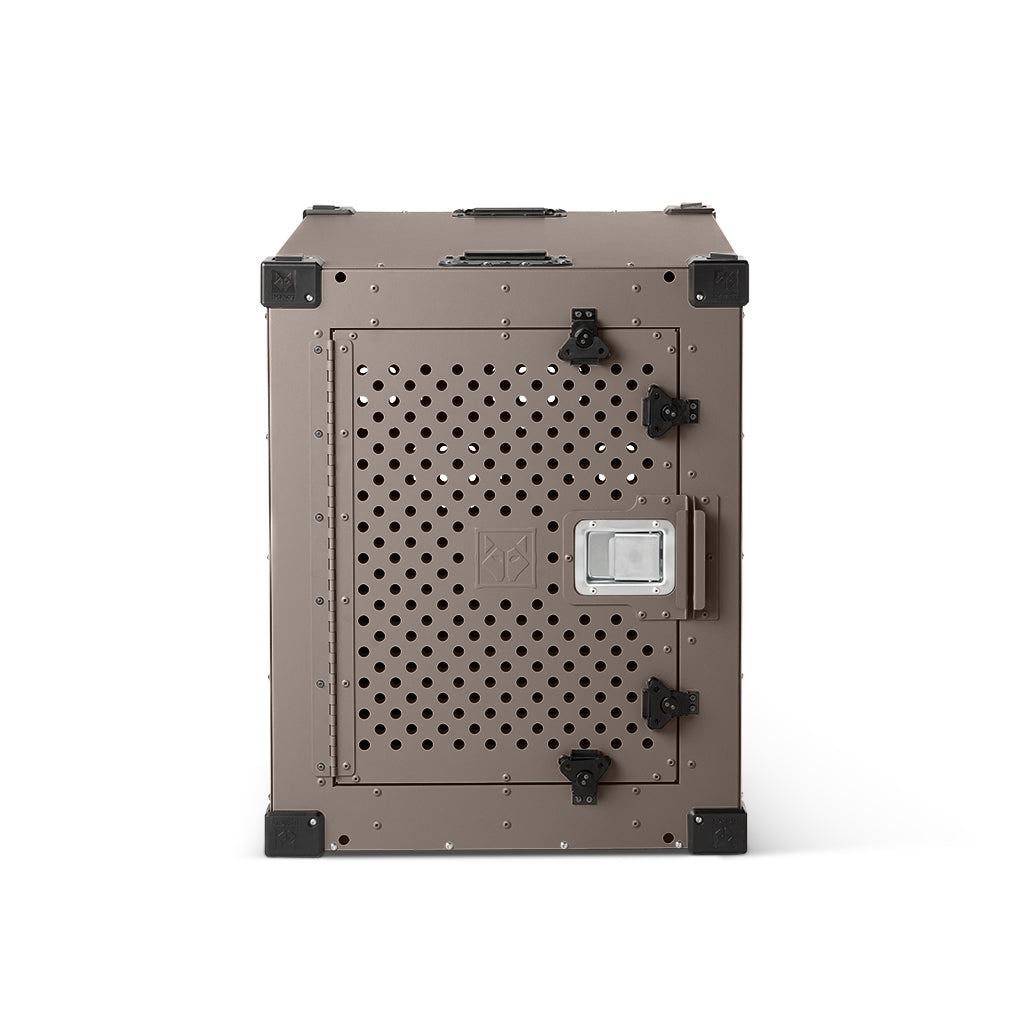
Impact Stationary / High Anxiety Dog Crate
If your dog will spend real stretches of the day crated, comfort and calm matter as much as the clock. Impact’s solid aircraft-grade aluminum walls create a quiet, den-like space that cuts visual triggers for anxious dogs, with smooth tooth-safe edges and ventilation that keeps air moving. It’s the crate we’d choose for a dog that finds confinement stressful.
What we like
- Solid walls give an anxious dog a calm, low-stimulation space to settle
- Aircraft-grade aluminum won’t flex, bend or crack under a determined dog
- Smooth edges and generous ventilation make longer stays more comfortable
- Backed by a long dog-damage warranty, built to be a once-in-a-lifetime buy
The catches
- The most expensive option here (~$900+), overkill for an easygoing dog
- Heavy and bulky; not something you’ll move room to room
- A great crate never replaces breaks, no crate makes 10 hours okay

MidWest Ultima Pro Crate (with divider)
For most owners, the smart move is a right-sized crate with a divider panel so it grows with your puppy. The MidWest Ultima Pro pairs pro-gauge steel with a movable divider, two doors and a leak-proof pan, you set it small enough to discourage soiling now, then open it up as your dog grows. A practical, affordable everyday crate.
What we like
- Movable divider keeps the space puppy-right now and grows with your dog
- Two doors plus a removable pan make daily use and cleaning easy
- Pro-gauge steel is far sturdier than a thin collapsible wire crate
- Folds for storage and travel, a sensible buy-once everyday crate
The catches
- Open-bar design is less den-like and quieter than solid-wall aluminum
- Heavier-gauge steel can mark floors without a mat underneath
- Built for home containment, not crash-test travel safety
How long can a dog stay in a crate? (age-by-age chart)
Crate time is almost entirely a function of age and bladder control. A young puppy physically cannot hold it for long; a healthy adult can comfortably settle for a normal work-morning; a senior needs to get up and move more often. Use this as your at-a-glance guide, then read the notes below it.
| Age / life stage | Max crate time at a stretch | Why |
|---|---|---|
| Puppy 8 to 10 weeks | 30 to 60 minutes | Tiny bladder, needs very frequent potty trips |
| Puppy 3 to 6 months | 1 to 3 hours | Growing control, still needs midday breaks |
| Puppy 6 to 12 months | 3 to 4 hours | Building toward adult tolerance |
| Healthy adult (1 to 7 yr) | 4 to 6 hours (8 absolute max) | Can settle and hold comfortably; 8+ hours needs a break |
| Senior (7+ yr) | 2 to 4 hours | Weaker bladder, stiff joints, needs to move more often |
The number everyone should remember is the ceiling: no healthy adult dog should be crated for more than roughly 8 hours without a chance to come out, relieve themselves and stretch, and 8 hours should be the rare exception, not the daily routine. Two things shift a dog toward the shorter end of these ranges: energy level (a Border Collie or Belgian Malinois needs out far sooner than a Bulldog or Bernese Mountain Dog) and how much exercise and stimulation they got beforehand. A well-walked, mentally-tired dog rests calmly; an under-exercised one stews.
How long can a puppy be crated? (the age-in-months rule)
Puppies are the most time-sensitive case because their bladders are tiny and still developing. The widely-used rule of thumb, credited to rescue and humane groups, is simple:
Treat that as an upper limit, not a target. During the day, most young puppies do best with breaks every 1 to 2 hours regardless of the formula, because crate training works far better when the puppy never has to soil their space. Each successful “out, potty, play, back in calm” cycle teaches them the crate is a safe, predictable place. Overnight is the exception (more on that below), since a sleeping puppy’s body slows down, but a very young puppy will still usually need one middle-of-the-night trip outside.
The goal of these short, frequent sessions isn’t just bladder management, it’s building a positive association so the crate becomes your dog’s den for life. Our step-by-step guide to crate-training your puppy walks through the whole process, and the size calculator helps you pick a crate (or divider setting) that’s puppy-right today and right-sized as they grow.
Can a dog be crated overnight?
Yes, overnight crating is one of the most appropriate uses of a crate, and the rules are gentler than daytime. While a dog is asleep their body slows down, so a healthy adult can comfortably stay crated for a full 6 to 8 hours overnight without a potty break. That’s why so many owners crate at night even if they’d never crate that long during the day, sleeping hours and awake hours are not the same.
Two caveats. First, puppies: a young puppy (under ~4 months) will usually need one overnight trip outside, and you should keep that trip calm and businesslike, out, potty, straight back in, so it doesn’t become playtime. Second, placement: most dogs settle far better with the crate in or near your bedroom for the first weeks, because being close to you reduces stress. A dog that whines all night isn’t being stubborn, it may be anxious, need a potty trip, or be in a crate that’s the wrong size or in an isolating spot.
The big difference between a good overnight crate routine and a stressful one is the day around it: a dog that’s been exercised, fed on a sensible schedule and given a last potty trip before bed sleeps through. A crate left as the dog’s only space for both work hours and sleep hours is where problems start.
Is it cruel to crate a dog while at work?
This is the worry behind most searches, so let’s be direct: crating itself is not cruel, but crating a dog for a full 8 to 10 hour workday, every day, with no break, is too much. A crate used correctly is a safe den that prevents destructive chewing, accidents and danger while you’re out. A crate used as all-day containment becomes a problem, for the dog’s comfort, their bladder, and their mental wellbeing.
The math rarely works for a standard workday. Most commutes plus a workday run 9 to 10 hours, which is well past the 6-hour comfortable mark and the 8-hour absolute ceiling for an adult dog, and impossible for a puppy. So if you work full-time and want to crate, the answer isn’t “don’t crate,” it’s “don’t leave the crate unbroken all day.” Build in a break:
- A midday dog walker or pet sitter, even one 20 to 30 minute visit resets the clock, gives a potty trip and breaks up the day. This is the single most popular fix for working owners.
- Doggy daycare a few days a week, full of company and exercise, and a good option for social, high-energy dogs who’d otherwise be alone too long.
- Come home at lunch if you can, or split crating across two shorter sessions rather than one long one.
What crosses the line into genuinely unfair treatment is the combination of too long, too often, too little exercise, and a crate that’s too small, or using the crate as punishment, which poisons the one place your dog should feel safe. Avoid those and crating during work hours, with a break, is a perfectly humane tool.
What if you can’t break up the day? Crate alternatives
If a midday break truly isn’t possible, the better answer is usually more space rather than more crate. A dog confined to a crate for 9+ hours daily is the scenario welfare groups warn against, but the same dog given a safe, larger area can be home alone all day far more comfortably:
- An exercise pen or playpen, gives room to move, stand and stretch, with space for a bed at one end and a pee pad or water at the other. The most common upgrade from an all-day crate.
- A dog-proofed room, a kitchen or laundry behind a baby gate, with hazards removed, often beats a crate for a trustworthy adult dog who’s past the chewing stage.
- Daycare or a sitter, best for social dogs and for puppies who simply can’t be alone that long.
The crate still earns its place: for overnight, for shorter daytime stretches, for travel and vet visits, and as a safe den a dog chooses on their own. Many owners use a crate inside a playpen, door open, so the dog has a cozy retreat plus room to move. For the crates and pens we rate, see our best dog crates roundup.
Signs your dog is being crated too long
Dogs tell you when crate time has tipped over from helpful to too much. Watch for these, and treat any of them as a cue to shorten sessions, add breaks, or rethink the setup:
- Soiling the crate or rushing to eliminate the instant the door opens, a clear sign they were held too long.
- Persistent whining, barking or crying that continues well past the settling-in period.
- Stress signals, heavy drooling, panting, or pacing and circling in the crate.
- Destruction, chewed bedding, bent bars, or worn paws/teeth from trying to get out.
- Reluctance to go in, or low, withdrawn behavior, early signs the crate has gained a negative association, which over time can shade into anxiety or a flat, depressed mood.
A dog crated correctly does the opposite: walks in willingly, settles quickly, and is calm (not frantic) when you return. If you’re seeing the warning signs, the fix is almost always shorter sessions plus more exercise and breaks, not a tougher crate. And if escaping or destruction is the issue, a sturdier, calmer crate can help; see our best escape-proof dog crate guide and our crates for large dogs for dogs that have outgrown a flimsy wire model.
How to make crate time humane and positive
Whatever the hours, a few habits separate a crate your dog loves from one they dread. None require special skill, just consistency:
- Exercise and a potty trip before every long stay. A tired dog rests; a pent-up dog can’t. A walk or play session before crating does more for calm crate time than anything else.
- Make the crate worth being in. Comfortable bedding, a safe chew or a stuffed puzzle toy, and access to water for longer stays turns the crate into a positive space rather than a holding pen.
- Right-size it. Big enough to stand, turn and lie down, no more. Use the size calculator to get it right.
- Never use the crate as punishment. It must stay a safe den, never a time-out box, or the whole tool breaks down.
- Build duration gradually. Don’t jump from zero to a full morning. Short, positive sessions that slowly lengthen teach a dog the crate is no big deal.
- Pick a calm, sturdy crate for a dog that finds confinement hard, solid-wall, den-like crates cut visual triggers and help anxious dogs settle. See our Impact crate review.
Do these and crating becomes what it’s meant to be: a safe, restful space your dog chooses for themselves, used within the time limits above, broken up across the day, and never as a substitute for company, exercise and a life outside the bars.
How long can a dog be in a crate: common questions
How long can a dog stay in a crate?
A healthy adult dog can typically stay in a crate for 4 to 6 hours at a time, and should not be crated for more than about 8 hours without a break to potty, move and stretch. Puppies can only manage 1 to 3 hours during the day (less when very young), and seniors need breaks every 2 to 4 hours. Energy level matters too, high-energy breeds need out sooner than laid-back ones.
How long can a puppy be crated?
Use the age-in-months plus one rule: a puppy’s age in months, add one, is roughly the maximum hours they can be crated before needing a break. So a 2-month-old manages about 3 hours, a 3-month-old about 4 hours, and so on. Treat that as an upper limit, most young puppies do best with potty breaks every 1 to 2 hours so they never have to soil their crate.
Is it cruel to crate a dog while at work?
Crating itself is not cruel, but crating a dog for a full 8 to 10 hour workday every day, with no break, is too long for any dog. Most workdays plus a commute exceed the 8-hour ceiling, so the answer for full-time workers is to break up the day: a midday dog walker or pet sitter, doggy daycare, or coming home at lunch. If no break is possible, an exercise pen or dog-proofed room is kinder than an all-day crate. Used with a break, crating during work hours is perfectly humane.
Can a dog be crated overnight?
Yes, overnight is one of the most appropriate uses of a crate. Because a sleeping dog’s body slows down, a healthy adult can comfortably stay crated 6 to 8 hours overnight without a potty break. Young puppies (under about 4 months) usually need one calm middle-of-the-night trip outside. Most dogs settle best with the crate in or near your bedroom, especially in the early weeks.
What are the signs a dog is being crated too long?
Watch for soiling the crate or rushing to eliminate when the door opens, persistent whining or barking, stress signals like drooling, panting or pacing, destroyed bedding or bent bars, and reluctance to go in or a withdrawn, low mood. Any of these means it’s time to shorten sessions, add breaks and increase exercise, not to buy a tougher crate.
Can I crate my dog for 12 hours?
No, 12 hours is too long for any dog to be crated without a break. It exceeds an adult dog’s bladder comfort and the roughly 8-hour ceiling, and it’s far too long for puppies or seniors. If you’ll be away that long, arrange a midday walker or sitter, use doggy daycare, or switch to an exercise pen or dog-proofed room that lets your dog move and relieve themselves.