 Dog Gear, Sized Right
Metal vs Plastic vs Soft Dog Crate: Which Is Best?
Wire, plastic, and soft-sided crates each win in different situations. Here’s the honest breakdown, and which type is right for your dog.
Which type of dog crate is best, metal wire, plastic airline, or soft-sided fabric? The short answer is: it depends on your dog, not on the crate. Each type is genuinely better in certain situations and actively wrong in others. A soft crate that works beautifully for a calm, crate-trained Border Collie will be destroyed in 20 minutes by a bored Labrador puppy. A plastic crate that feels cozy and den-like for an anxious rescue may be the worst choice for a flat-faced breed that runs hot. This guide breaks down every type, wire/metal, plastic/airline, soft-sided fabric, and heavy-duty aluminum, across ventilation, durability, portability, travel, and price, then tells you which one to buy based on your actual situation.
Our top pick: the wire crate for most dogs
We only put a buy button on one product here, the MidWest iCrate, which is the best all-round wire crate for most households. Other products (Impact, Diggs Revol, soft crates) are discussed honestly in the guide. Verified in stock; tap through for the live price.
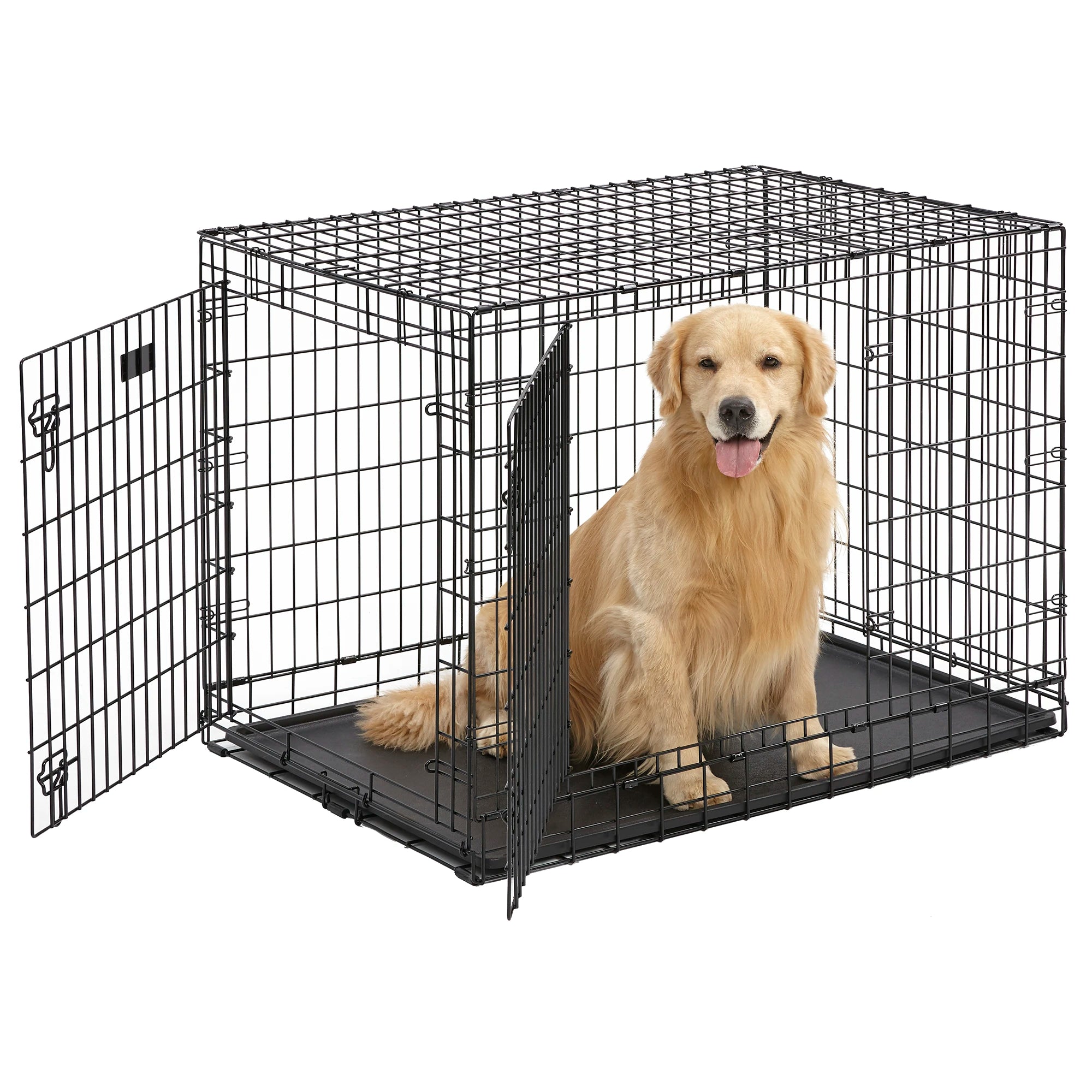
MidWest iCrate Folding Dog Crate
The iCrate is the wire crate we recommend first for almost every household. It ships with a divider panel so you can start small for a puppy and expand as they grow, no buying a second crate. Double-door access makes placement flexible, the leak-proof pan handles accidents, and it collapses flat in seconds for storage or travel. At ~$60 for a 42″ crate, it genuinely does everything 90% of dog owners need.
What we like
- Divider grows with a puppy, one crate from 8 weeks to adult
- Collapses flat in seconds; easy to store or transport
- Double-door access suits corner or against-wall placement
- Excellent value, ~$60 for a 42″ (fits most medium-to-large dogs)
The catches
- Less den-like than plastic, some anxious dogs prefer enclosed sides
- Strong escape artists can bend or pop the door; upgrade to heavy-duty for those dogs
- Wire floors benefit from a crate mat for comfort on hard surfaces
The four types at a glance
Before going deep on each type, here’s how they line up across the criteria that matter most:
| Crate type | Ventilation | Durability | Portability | Airline travel | Best for | Rough price |
|---|---|---|---|---|---|---|
| Wire / metal | Excellent (all sides open) | Good (bends under extreme pressure) | Good (folds flat) | No | Most dogs at home; puppies with divider | $40-$120 |
| Plastic / airline | Moderate (vents + door) | Good (hard shell, hard to chew) | Moderate (bulky; doesn’t fold) | Yes (IATA-approved models) | Den-seekers; in-cabin or cargo air travel | $35-$150 |
| Soft-sided / fabric | Good (mesh panels) | Poor (chewable, scratchable) | Excellent (collapses to a bag) | Some (in-cabin only, small dogs) | Calm, trained dogs; car trips; events | $30-$100 |
| Heavy-duty / aluminum | Good (vented panels) | Excellent (welded aluminum; escape-proof) | Poor (very heavy) | No | Escape artists; severe separation anxiety | $300-$600+ |
The sections below explain exactly when each type wins, and when it’s the wrong choice.
Wire / metal crates: best all-round option for most dogs
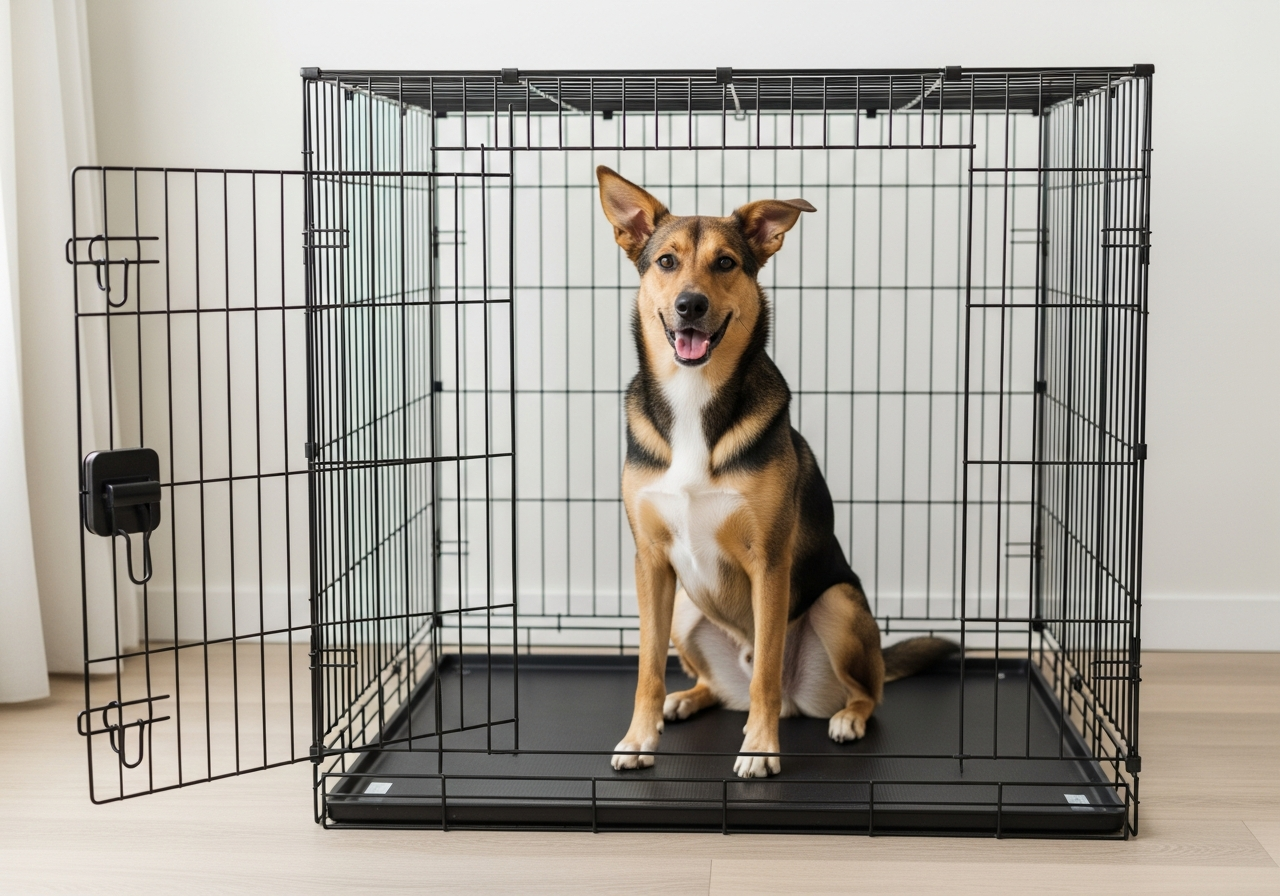
Wire (or “metal”) crates are the workhorse of the crate world, and for good reason. Open wire panels on all four sides give you maximum ventilation and visibility, your dog can see the room, and you can see your dog. Dogs that feel cut off from household activity often settle better in wire crates than in enclosed plastic ones. The removable divider panel that comes with most models (including the MidWest iCrate above) is a genuine game-changer for puppy owners: you start with a smaller sleeping space to discourage accidents, then slide the panel back as the puppy grows. One crate from 8 weeks to adulthood.
Wire crates also fold flat in seconds for storage in a closet or transport in a car boot, something plastic crates almost never do. The leak-proof plastic pan at the bottom slides out for cleaning, and the wire panels wipe down easily. For a dog that isn’t an extreme escape artist, wire is the most practical choice for daily home use.
Where wire crates fall short: they’re less den-like than plastic. A dog that actively seeks dark, enclosed spaces, curling into corners, preferring spots under tables, may be less settled in a fully open wire crate. They also rattle and clang more than plastic, which can disturb light sleepers in open-plan homes. And a genuinely determined escape artist, a dog that will bite, pull, and lever the door or panels, can eventually bend a standard wire crate. For those dogs, see the heavy-duty section below.
Best wire crates: The MidWest iCrate (our pick above) is the most popular and best-value option, $59.99 for a 42″ with divider, double door, and fold-flat frame. The Diggs Revol is a premium alternative with a sliding divider, top door, and a more furniture-friendly aesthetic, at around $200-$250. For sizing help, see our dog crate size calculator.
Plastic / airline crates: the den-seeker’s choice and the only option for air cargo
Plastic (often called “airline crates” or “travel crates”) enclose your dog on all four sides with solid plastic walls and ventilation slits or grated openings at the front and rear. That enclosed feeling, which can seem claustrophobic to a human, is exactly what a den-seeking dog wants. Dogs that naturally seek dark, tight spaces, under beds, in closets, behind sofas, often prefer plastic crates and settle faster in them. The solid walls also reduce visual stimulation, which helps anxious dogs that become reactive to every movement they can see.
For air travel, plastic is the only real option. IATA-approved hard-shell plastic crates (Petmate Sky Kennel, Ruffmaxx, and similar) are required for in-cargo travel on most airlines. The hard shell protects your dog if baggage is handled roughly, and the bolt-together construction is secure enough that airlines accept it. Soft crates and wire crates are not accepted for cargo travel.
Where plastic crates fall short: ventilation is genuinely more limited than wire. In warm climates or during summer, a plastic crate can get stuffy. Always check airflow before leaving a dog in one for hours, and never use one in a hot car or direct sun. Plastic crates are also bulky and don’t fold, they take up the same space whether your dog is in them or not, which is annoying in small homes. Most disassemble into top and bottom halves for storage, but that still leaves two large pieces. Cleaning requires more effort than a wire crate: liquids pool inside instead of draining through, and crevices along the bolt holes trap odour. And a strong chewer that gets into the ventilation grill can break through plastic over time.
Good plastic crate options: The Petmate Sky Kennel (23″-48″) is the classic airline-approved choice, well-made and widely available. The Ruffmaxx has a tougher shell and better ventilation. For in-car travel where the airline-approved design isn’t required but the den feel is wanted, any solid-shell plastic crate works well.
Soft-sided crates: only for calm, fully crate-trained dogs
Soft-sided crates, fabric or nylon mesh over a lightweight steel or fibreglass frame, are genuinely excellent for the right dog in the right situation. They fold down to almost nothing, weigh almost nothing, and set up in under a minute. For a calm, fully crate-trained dog at agility trials, dog shows, camping trips, or vet waiting rooms, they’re the obvious choice.
The problem is that they’re marketed too broadly. A soft crate is not suitable for:
- Any dog that chews. Nylon fabric gives way quickly, and most soft crates can be destroyed in minutes by a motivated chewer. The escaping dog ingests synthetic fibres and potentially sharp zipper hardware in the process.
- Dogs left unsupervised. If you’re not in the same room, a soft crate gives you no containment guarantee. Use one only when you’re present and the dog is calm.
- Puppies. Puppies are almost always chewers to some degree, and they haven’t yet built the crate association that makes them want to stay. A soft crate is a disaster waiting to happen for a puppy that hasn’t been trained.
- Separation anxiety. A panicking dog will destroy a soft crate and possibly injure itself on the frame or zips.
Used correctly, as a portable resting spot for a calm adult dog that already loves its crate, soft-sided crates are wonderful. Used as a general containment tool for an untrained dog, they’re both useless and potentially dangerous.
Good soft crate options: The Midwest Canine Camper and EliteField Soft Crate are durable for the category and easy to fold. Expect to spend $30-$80. None are escape-proof; durability is relative.
Heavy-duty crates: for escape artists and severe separation anxiety
If your dog has repeatedly escaped from standard wire or plastic crates, or has injured itself trying, a heavy-duty crate is not optional. Standard crates are not rated for a dog that will commit to escaping: a determined large dog can lever wire panels, pop doors, and eventually get through plastic. Heavy-duty crates are purpose-built to stop that.
The benchmark for this category is Impact Dog Crates, which uses welded 6061 aluminium construction with military-grade latches and reinforced door hinges. The crate genuinely cannot be opened from the inside by a dog; even powerful breeds like Huskies and Malinois with documented crate destruction histories typically give up after an hour and settle. The trade-off is significant: Impact crates start at around $300-$350 for a small model and run to $500-$600 for a large one. They’re also very heavy, not practical to carry around, and not foldable.
The ProSelect Empire is a steel-tube alternative at a lower price point (~$120-$180) that provides a meaningful upgrade from standard wire without the cost of aluminium. It won’t stop the most extreme escape artists, but it handles most strong dogs.
Heavy-duty crates are almost always used at home, not for travel. If your dog’s crate anxiety is severe, pair the stronger crate with a proper crate-training programme, containment alone doesn’t address the underlying anxiety, and a dog that’s panicking in a heavy-duty crate is still a stressed dog. See also our best escape-proof dog crate guide for a full breakdown of the options.
Which crate type is right for your situation?
The best crate is the one that fits your specific dog and use case. Here’s the honest scenario guide:
- Puppy or young dog at home →Wire crate with divider. The divider lets you right-size the space at each stage, the open sides let you monitor, and fold-flat storage is practical while the crate size changes. The MidWest iCrate is the go-to.
- Anxious dog that seeks enclosed spaces →Plastic crate. If your dog curls under the bed or prefers dark corners, a plastic crate matches that instinct. You can also drape a wire crate if you prefer the ventilation.
- Flying by air cargo →IATA-approved plastic crate only. No other type is accepted for cargo. Check the airline’s exact size and construction requirements before you buy.
- Car travel / road trips →Wire or plastic. Wire crates fold flat when the car is empty. Plastic crates protect better in a collision (the hard shell absorbs some impact). Both work; choose based on your dog’s preference and your car space.
- Travel, shows, events (calm trained dog) →Soft-sided crate. Folds to nothing, sets up in a minute. Only safe for a dog that is already 100% comfortable in its crate and won’t attempt to escape or chew.
- Escape artist / severe separation anxiety →Heavy-duty (Impact or equivalent). Don’t try to make a standard crate work for a dog that will commit to escape, injury risk is real. Combine with proper training (our crate training guide) to address the root cause.
- Hot climate / brachycephalic breed (Bulldog, Pug, Frenchie) →Wire crate. Maximum ventilation is non-negotiable for flat-faced breeds that struggle to thermoregulate. Never leave a brachycephalic dog in an enclosed plastic or soft crate in a warm space.
- Tight budget →Wire crate. The MidWest iCrate at ~$60 for a 42″ is the best value you’ll find in any crate category, solid build, practical features, and a divider panel that means you won’t need to buy another crate as a puppy grows.
How to size any crate type correctly
Whichever type you choose, the size matters. A crate that’s too small is inhumane; a crate that’s too large defeats the purpose of crate training because the dog can sleep at one end and toilet at the other.
The rule of thumb: your dog should be able to stand up without their head touching the top, turn around in a complete circle, and lie fully stretched out. That’s the minimum. A little extra is fine; a lot extra (more than 6 to 8 inches in any direction beyond the dog’s body) undermines the den instinct and makes house-training harder.
For puppies in a wire crate with a divider: set the divider so the puppy has just enough room for the basics above. As they grow, typically every 4 to 8 weeks in the first year, slide the divider back. By adulthood the divider comes out entirely.
Use our dog crate size calculator to get the exact dimensions for your dog’s breed and current weight. There’s also specific guidance for how long any dog should realistically spend in a crate, covered in detail in our how long can a dog stay in a crate guide.
What about wood, furniture-style, and decorative crates?
Wood and furniture-style crates, designed to double as end tables or console pieces, have their place, but they’re rarely the best functional choice. Wood is harder to clean thoroughly, absorbs odour, and can be chewed. Most don’t have a removable floor pan, which makes accident clean-up much messier. Ventilation varies: some furniture crates have open-bar fronts with good airflow, others have mostly solid sides.
If aesthetics are the priority and your dog is calm, a quality furniture crate (companies like Fable, Merry Products, or New Age Pet) can look excellent in a living room. Just know the trade-offs: you’re paying more for the look and accepting compromises on ventilation, cleanability, and durability versus purpose-built wire or plastic. Most experienced dog owners use the right functional crate for the dog, then worry about interior design separately, a wire crate draped in a neutral throw blanket disappears into a room surprisingly well.
The honest bottom line
For most dogs, in most homes, for most of their life, a wire crate is the right answer. It ventilates well, folds flat, comes with a divider for puppies, is easy to clean, and the MidWest iCrate does all of this for around $60. That’s why it’s our pick.
The cases where you should go a different direction are clear:
- Air travel by cargo → plastic (airline-approved only)
- A dog with strong den instincts that won’t settle in open wire → plastic or blanketed wire
- A calm, fully trained adult on the go → soft-sided
- A proven escape artist or severe anxiety case → heavy-duty aluminium
- A brachycephalic breed in any warm environment → wire (always)
Once you’ve picked the right type and sized it correctly, the rest is training. A good crate doesn’t do anything without a dog that actually likes being in it, our crate training guide covers the full process, and the dog crate hub has our ranked picks across every category.
Dog crate type questions, answered
Is a wire or plastic crate better for dogs?
Wire crates are better for most dogs at home, they provide maximum ventilation, fold flat for storage, and come with a divider panel that grows with a puppy. Plastic crates are better for dogs that actively seek enclosed, den-like spaces, or for any air travel that involves cargo holds (IATA-approved plastic is required). For a brachycephalic (flat-faced) breed, wire is always the safer choice because ventilation is critical.
Can I use a soft-sided crate for my dog?
Only if your dog is calm, fully crate-trained, and will not attempt to chew or scratch the fabric. Soft crates are excellent for trained adult dogs at events, shows, or car trips. They are not safe for puppies, chewers, escape artists, or dogs with separation anxiety, a motivated dog can destroy a soft crate in minutes and may ingest synthetic fabric or sharp zipper hardware in the process. Never leave a dog unsupervised in a soft crate.
What crate type is needed for airline travel?
For in-cargo air travel, you need an IATA-approved hard plastic crate, the Petmate Sky Kennel and Ruffmaxx are two common examples. Wire crates and soft crates are not accepted for cargo. For very small dogs that can travel in-cabin under the seat, some airlines accept soft-sided crates, but check your airline’s specific requirements before purchasing, size limits are strict and vary by carrier.
What crate type is best for a puppy?
A wire crate with a divider panel is the best choice for most puppies. The divider lets you right-size the sleeping space, small enough to discourage toileting in the crate, and then expand it as the puppy grows, so you won’t need to buy a second crate. The open wire sides also let you monitor a puppy easily. The MidWest iCrate includes a divider and is the most popular choice for this reason.
What is the best crate for an escape artist dog?
A heavy-duty aluminium crate, the Impact Dog Crate is the benchmark, is the only reliable option for a dog that has repeatedly escaped from standard wire or plastic crates. Standard wire crates can be bent or levered by a determined large dog; plastic can be chewed through. Heavy-duty aluminium crates use welded construction and reinforced latches that dogs cannot open from the inside. They’re expensive ($300-$600+) and heavy, but for a genuine escape artist they’re the safe option. Combine with proper crate training to address the anxiety driving the escape behaviour.
How do I know what size crate to get?
Your dog should be able to stand up without their head touching the top, turn around in a complete circle, and lie fully stretched out, that’s the minimum. A little extra room is fine, but avoid buying too large: excess space lets a dog toilet at one end and sleep at the other, which slows house-training. For puppies in a wire crate, use the divider to create a smaller space and expand it every 4 to 8 weeks as they grow. Use our dog crate size calculator for exact dimensions based on your dog’s breed and weight.