 Dog Gear, Sized Right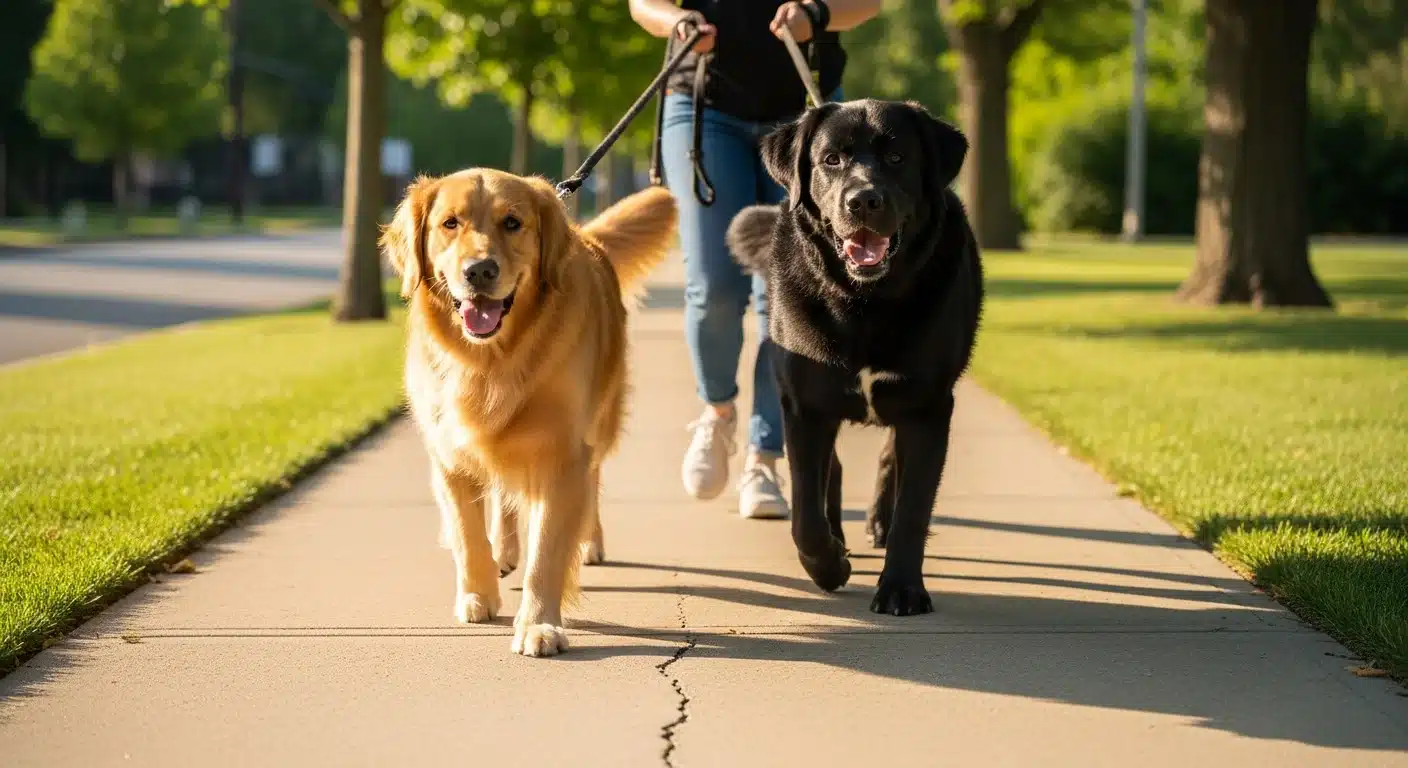
How Long Should a Dog Leash Be?
The right leash length depends on what you’re doing, not on what came in the bag at the pet shop. Here’s how to match length to use case, dog size, and environment, including why retractables aren’t really a length at all.
Most dogs spend their whole lives on a 6-foot leash, and that’s fine, because the 6-foot standard exists for good reason. But it isn’t the only answer. A 4-foot lead gives tighter control in a busy city street. A 15-to-30-foot long-line is the right tool for recall training. A hands-free bungee leash suits a runner. A 1-to-2-foot traffic handle is something your everyday leash should already have built in. Below we break every leash length down by use case, dog size, and environment, and link you to our verified gear picks so you can shop with confidence. If you want the full buying guide first, start with our best dog leashes round-up for a comparison of top-rated leashes across all lengths and uses.
The 6-foot leash: why it is the standard for everyday walking
Walk into any pet shop, search any retail site, pick up any leash that doesn’t say “training” or “long” on the label, chances are it’s 6 feet long. That length became the default because it balances the two things every owner wants from a walk: enough freedom for the dog to sniff, explore and move naturally, and enough control to bring them back in quickly when something appears on the path.
At 6 feet, there’s enough slack for a dog to move a full body-length to the side to investigate a lamp post, another person, or a smell worth investigating, without pulling you off balance. And you can gather that 6 feet back to a tight lead in a second or two when a cyclist, child, or another dog appears. That combination is why 6 feet is used for guide dogs, assistance dogs, police dogs, and competitive obedience work: it’s the length that gives both parties room to operate without either having too much or too little.
For most dogs, in most environments, on most walks, a 6-foot leash is the right answer. The rest of this guide is about when it isn’t, and what to use instead.
When to use a 4-foot leash: tight control in busy environments
A 4-foot leash gives you roughly half a body-length less slack than a 6-footer. That sounds small, but in practice it’s a significant difference in how close your dog stays and how quickly you can bring them in. 4-foot leashes work best in three situations:
- Busy city streets and pavements. When you’re walking along a narrow pavement with cyclists, pushchairs, or other dogs coming the other way, the extra 2 feet of slack on a 6-foot leash can mean your dog is almost at the kerb while you’re safely on the pavement. A 4-foot lead keeps them much closer to your side without you having to shorten-grip the leash constantly.
- Vet clinics, pet shops, and other dogs’ spaces. Anywhere with competing stimuli and unpredictable encounters, a shorter lead reduces the range of movement and the speed at which a dog can reach another dog or person before you can intervene. Many vets and pet shops ask owners to keep dogs on short leads for exactly this reason.
- Training sessions where heel position matters. When you’re working on heel, especially in the early stages, a 4-foot leash makes it physically harder for the dog to drift out of position without immediately hitting the end of the lead. That physical boundary speeds up the learning that “close to my person’s leg” is the correct place to be.
The trade-off: 4 feet feels short and restrictive on a big or long-striding dog for a normal walk. Most large-dog owners find it uncomfortable for their daily route. Keep a 4-foot lead as a secondary tool for the situations above rather than making it your only leash.
Long-lines (15 to 30 ft): the right tool for recall training and open-space freedom
A long-line is not an everyday leash. It’s a training tool and a safety net for the specific situation of building a reliable recall and letting a dog move with relative freedom before they’re ready to be trusted off-lead. Understanding what long-lines are for, and what they’re not for, will stop you using the wrong tool in the wrong place.
What a long-line does well
Recall training. Teaching a dog to come reliably when called requires, at some point, practising at increasing distances. With a 6-foot leash you can only create about 6 feet of distance before you’re at the end of the line. With a 20-to-30-foot long-line in an open field, you can let the dog move away, then call, and if they don’t respond, you have the line to apply gentle pressure and show them that “come” is non-negotiable regardless of distance. This is the most important use case for a long-line.
Safe free-range movement in a controlled space. If your dog isn’t reliably off-lead ready, perhaps they’re a rescue, a young dog still learning recall, or a breed with a strong chase drive, a long-line lets them experience something close to freedom (sniffing, exploring, covering ground) while you maintain a last resort. It’s far better for the dog than a 6-foot leash in an open field, and far safer than going off-lead before the dog is ready.
What to use: length options
| Long-line length | Best use | When to avoid |
|---|---|---|
| 15 ft (4.5 m) | Early recall training, working in smaller parks or spaces; manageable in one hand for intermediate handlers | Can be short for breeds with a very long stride (Irish Wolfhound, Great Dane) at speed |
| 20 to 25 ft (6 to 7.5 m) | Good all-round training length; gives enough distance to practise proper recall without too much line to manage | Avoid on paths or in areas with cyclists, 25 ft of line across a path is a serious trip hazard |
| 30 ft (9 m) | Maximum reach for advanced recall distance work; experienced trainers often use this length in large open fields | Requires gloves if the dog runs and the line runs through your hand, rope burn at 30 ft is not insignificant |
A note on materials: Long-lines come in nylon, biothane, and cotton webbing. For wet or muddy conditions, biothane (a rubberised coating) is the best choice, it doesn’t absorb water, cleans in seconds, and slides through grass without snagging. Nylon is lighter and cheaper; cotton webbing is soft in the hand but takes forever to dry. If you train in all weathers, biothane is worth the premium. See our best long line for dog training picks for verified options in all three materials.
The traffic handle: why a 1-to-2-foot short grip belongs on every large-dog leash
This isn’t a separate leash length, it’s a feature that should be on your main everyday leash. A traffic handle is a second, shorter grip placed near the clip end of the leash, about 1 to 2 feet from the dog’s collar or harness ring. You use it in the same way you’d use a very short leash: by gripping the short handle to bring the dog right to your side the instant you need them there.
For large or powerful dogs, the traffic handle is one of the most genuinely useful design features a leash can have:
- Cyclist or pedestrian appears suddenly. Grip the short handle, dog comes immediately to your side without you having to reel in 4 feet of leash first.
- Another dog approaches. In the 2 to 3 seconds before a reactive dog can lunge, a traffic handle gives you direct control without any fumbling.
- Crossing a road. Full control from the moment you step off the kerb, without the dog having the slack to be 6 feet away when you need them at your heel.
- Navigating a crowd. Gripping the short handle puts the dog close in to your leg, reducing the chance of them jumping up at people or being trodden on.
The mechanism is simple: you’re not shortening the leash, you’re just gripping a closer attachment point. Most double-handle leashes have the traffic handle pre-stitched about 15 to 18 inches from the clip. Once you’ve walked a large dog with a traffic handle, walking without one feels genuinely reckless.
Our pick of the best dog leashes for large breeds prioritises double-handle designs precisely for this reason, the combination of a padded long handle for normal walking and a grabable short handle for moments that require instant control is, for a big dog, close to non-negotiable.
Hands-free leashes: the right length for running, hiking, and both-hands situations
A hands-free leash clips to a waist belt or running belt rather than being held in the hand, which frees both arms for running, hiking, pushing a buggy, or carrying gear. The “length” of a hands-free leash is the distance between the belt and the dog, typically 3 to 6 feet when extended, though most good hands-free designs incorporate a bungee section that extends beyond the base length.
The bungee section is why hands-free leashes work for running with a dog: instead of being jarred sideways every time your dog accelerates or slows, the bungee absorbs the sudden pull and translates it into a smooth, sustained tension. Without a bungee, running on a fixed-length hands-free leash with a large dog will knock your stride off constantly.
What length of hands-free leash works best?
For road running, a shorter base length (3 to 4 feet) keeps the dog from cutting in front of your feet mid-stride. For trail hiking, a slightly longer length (4 to 6 feet) gives the dog room to pick their path through rough terrain without you steering them constantly. Most adjustable hands-free leashes, like the Ruffwear Roamer (3.5 to 5 feet, adjustable), cover both bases with a single leash.
When to avoid hands-free: Around other dogs, near roads, or in any situation where you need to instantly grab and control the leash. A hands-free leash that clips to your waist means the dog’s force transfers directly to your hips, fine for a 25-lb dog, potentially destabilising for a 90-lb dog that sees a squirrel. In mixed environments, carry the leash in hand rather than clipping it to your belt until you’re on a clear trail.
See our full guide to the best hands-free dog leashes for verified picks across running, hiking, and canicross use cases.
Leash length by dog size: does a bigger dog need a longer or shorter leash?
Size affects how a leash length feels in practice, a 6-foot leash on a Chihuahua gives that dog enormous freedom relative to its stride; the same 6-foot leash on an Irish Wolfhound gives the dog almost no slack at all before the human needs to start moving. Here’s how to think about length by size:
| Dog size | Recommended everyday length | Notes |
|---|---|---|
| Toy / small (under 25 lb) | 4 to 6 ft | Small dogs can manage 6 feet easily; 4 feet is plenty of length for their stride and gives the owner solid control. Some owners prefer 6 feet to allow sniffing without bending down constantly. |
| Medium (25 to 55 lb) | 6 ft | The standard is ideal for medium dogs, long enough to walk comfortably, short enough to control easily. Double-handle useful for reactive-prone breeds (Cocker Spaniels, Beagles, Border Collies). |
| Large (55 to 90 lb) | 6 ft, double-handle | A 6-foot leash is still the right base length. Add a double-handle and strong clip hardware. A bungee leash is worth considering for dogs that lunge, it absorbs the jolt that a sudden movement would otherwise transfer directly to your shoulder and wrist. |
| Giant (90 lb+) | 6 ft with rated hardware | Length stays the same; hardware becomes critical. Look for 1-inch webbing, a clip rated to at least 500 to 800 lb, and a padded handle. Never use a thin-cord retractable or a leash designed for smaller dogs on a giant breed. See our large-dog leash guide for picks with hardware tested to large-dog force loads. |
The key point:length doesn’t change much by dog size, it’s width, material, and clip strength that need to scale with weight and pulling force. A 60-lb Lab and a 10-lb Bichon both walk best on a 6-foot leash; the difference is the 1-inch webbing and rated Talon clip the Lab needs to stay safe.
City vs trail: does your environment change the right leash length?
Yes, significantly. Your walking environment is one of the most important factors in choosing leash length, and it’s often overlooked in general buying guides that assume all walks are the same.
City and urban walking
In a city, shorter is safer. Pavements are narrow, encounters with other dogs and people are frequent and unpredictable, roads are close, and the traffic volume means you need instant control at any moment. The priorities are:
- 6 feet is the maximum practical length for busy urban walking
- A traffic handle is close to essential for a large dog, the ability to bring the dog to your side in a second without reeling in leash is a safety feature in traffic
- Reflective stitching matters more in cities where you walk on lit roads early morning and late evening
- A reliable, strong clip matters more in cities where leash failure has immediate consequences
Countryside, trail, and open-space walking
Away from roads and crowds, the calculus shifts:
- A bungee or hands-free leash becomes more practical for long days on trail
- A long-line becomes available (no trip hazard to cyclists or pedestrians)
- Biothane or durable nylon handles mud and water better than premium-feel cotton
- You have more space to let the dog set their own pace, so a slightly longer or adjustable leash (like the Ruffwear Roamer at 3.5 to 5 feet, or a 6-foot trail leash) suits the terrain better
Many owners with both a city and a countryside walk keep two leashes: a shorter double-handle 6-footer for urban use and a bungee or adjustable trail leash for open-country days. If you only want one, a good 6-foot double-handle leash with strong hardware handles both environments, at the cost of slightly less comfort on a long trail day compared to a bungee.
Why retractable leashes aren’t a ‘length’, and where they fall short
Retractable leashes are often marketed as a flexible-length solution: the dog can have 3 feet of rope or 26 feet, on demand, at the press of a button. In practice, retractable leashes are neither a short leash nor a long-line, they’re a different tool with specific trade-offs that make them a poor substitute for either.
| What you want | Right tool | Why a retractable doesn’t work as well |
|---|---|---|
| Everyday walking control | 6-ft fixed leash | Retractable reel adds reaction time delay before you can stop the dog; constant reel tension teaches the dog to pull |
| Busy street / traffic control | 4-ft or 6-ft with traffic handle | Thin retractable cord is near-invisible to cyclists and a trip hazard; reel lock has slower response than a fixed short grip |
| Recall training at distance | 15 to 30 ft long-line | Retractable cord typically rated to 60 to 100 lb, failing under large-dog force at full extension; reel mechanism teaches the dog that tension = more rope, the opposite of the recall lesson |
| Open-space freedom (dog not off-lead ready) | 20-ft long-line | Retractable cord tangles, knots, and can wrap around the dog’s legs; cord can snap under sudden full-extension lunge from a large dog |
For large or strong dogs especially, retractable leashes are not the right tool for most situations. The thin cord (usually nylon monofilament or tape) is rated to 60 to 100 lb in most models, a 90-lb dog sprinting to the end of 26 feet of line generates significantly more force than that. Cord failures on large dogs are common, and when the cord snaps, you have a dog at distance with nothing attached to them.
The practical alternative: use a 6-foot leash for everyday walking, and a proper long training line for open-space recall work. The long-line is stronger (usually nylon or biothane webbing rather than thin cord), purpose-built for the task, and teaches the dog the right lesson about distance and recall.
Our verified leash picks, matched to length and use
Dog leash length: common questions
What is the best leash length for everyday dog walking?
6 feet (1.8 m) is the best everyday leash length for most dogs. It gives the dog enough room to walk naturally, sniff, and explore without being constantly at your heel, while keeping them close enough to bring in quickly in any situation. Most professional dog handlers, guide dog programmes, and competitive obedience trainers default to 6 feet for exactly this reason. If you walk in busy city environments or have a large, reactive dog, add a traffic handle (a short second grip near the clip) so you can shorten instantly without reeling in the lead.
Should I use a 4-foot or 6-foot leash for a large dog?
For daily walking, a 6-foot leash is better for a large dog, 4 feet feels restrictive and uncomfortable for a long-striding breed on a normal walk. Use a 4-foot leash only in situations where you specifically need tight control: busy pavements, vet clinics, training sessions focused on heel position. The better all-round solution for a large dog is a 6-foot double-handle leash, the main handle for normal walking, and a short traffic handle to shorten instantly when needed. See our best leash for large dogs guide for hardware-verified picks built for heavy, strong breeds.
How long should a training leash be?
It depends on what stage of training you’re at:
- Heel training and loose-lead work: 6-foot fixed leash, the standard length used in obedience classes. Long enough for real-world walking feedback; short enough to correct position quickly.
- Recall training at distance: 15 to 30 foot long-line. This gives the dog room to move away so you can call them back and practice distance recall. A 20-foot line is the most practical all-round length. See our best long line picks for verified options.
- Off-lead preparation: Start with a 15-foot line, build up to 30 feet as the recall becomes reliable, then introduce off-lead in fully enclosed spaces before open areas.
What leash length is best for a puppy?
Start a puppy on a 4-to-6-foot leash. A shorter lead (4 feet) helps in early training sessions where you want the puppy physically close to practise heel position and loose-lead basics. For general walks, 6 feet gives enough room for the puppy to explore and experience the world without being overwhelmed by too much rope to manage. Avoid retractable leashes with puppies, constant reel tension and the absence of a fixed end-point makes it much harder to teach a puppy what ‘end of the lead’ means and where loose-lead position is. Keep it simple: fixed length, 4 to 6 feet, lightweight leash the puppy can barely feel.
Can I use a retractable leash instead of a long-line for recall training?
No, a retractable leash is not a substitute for a proper training long-line, for several reasons: (1) The reel mechanism actively works against recall training, the dog learns that walking forward creates more rope, not that ‘come’ means come. (2) Retractable cord is thin and typically rated to 60 to 100 lb; at full extension with a large dog sprinting, cord failure is common. (3) The reel lock is slower to engage than managing a long-line in your hands, giving the dog more time to make a wrong decision before you can respond. Use a purpose-built biothane or nylon long-line for recall training, it’s stronger, teaches the right lesson, and is safer for both dog and handler.
Does leash length affect how much a dog pulls?
Indirectly, yes, but not in the way most people expect. The leash length itself doesn’t cause or stop pulling; the handler’s behaviour and the dog’s training do. However: a longer leash (or a retractable leash) that constantly provides more rope when the dog moves forward reinforces pulling, the dog learns that forward pressure = forward movement. A fixed-length leash teaches a clearer lesson: when the leash is taut, forward stops. For a dog that pulls, a fixed 6-foot leash and consistent loose-lead training will do far more than a leash length change. Our guide to how to stop a dog pulling on the leash covers the techniques that actually work without harsh corrections.
What is a hands-free leash and how long should it be?
A hands-free leash clips to a waist belt rather than being held in the hand, freeing both arms for running, hiking, or carrying gear. The effective length between belt and dog is typically 3 to 6 feet when extended, with the best models incorporating a bungee (shock-absorbing) section that stretches to smooth out sudden pulls from the dog. For road running, a shorter 3 to 4-foot base keeps the dog from cutting in front of your feet; for trail hiking, 4 to 6 feet gives the dog room to navigate rough terrain. See our best hands-free dog leash picks for verified options across running, hiking, and canicross use.