 Dog Gear, Sized Right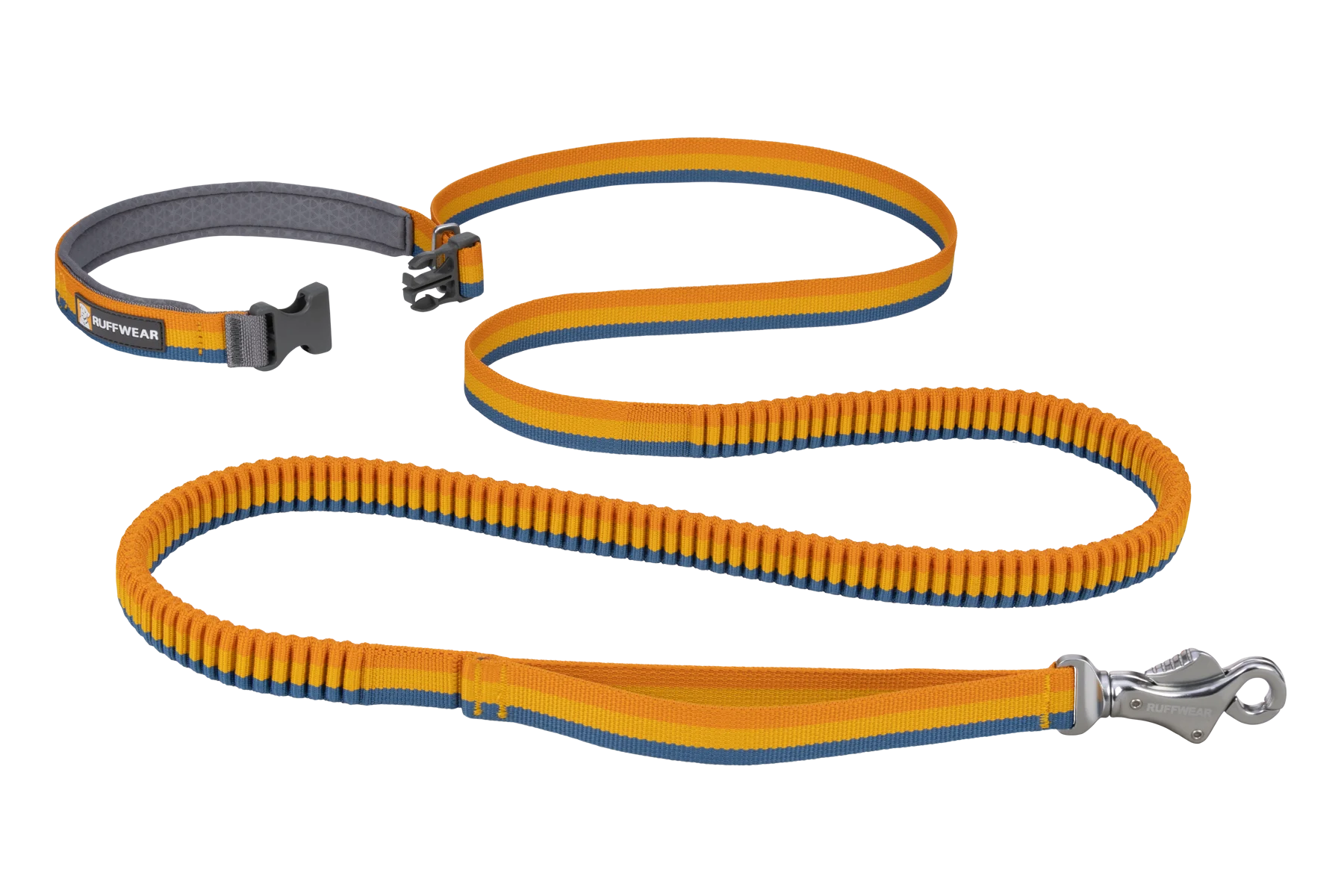
Best Hands-Free Dog Leash for Running & Hiking (2026)
The right hands-free leash lets you run, hike and scramble with your dog without holding a handle, and without your shoulder taking the hit every time they lunge. Here are the two best hands-free (waist-belt) dog leashes verified for 2026, plus exactly how to choose between them.
A hands-free dog leash clips to your waist belt instead of your hand, freeing both arms for running form, trekking poles, scrambling or just not holding anything at all. For a large or active dog, the difference is significant: instead of a jerk to your wrist every time they surge, the force goes through your hips and core, the same way a running pack transfers weight. Below we review the two best hands-free leashes we’ve verified, then walk through everything you need to choose the right one, bungee vs fixed length, belt fit, running vs hiking use cases, and what to do with two dogs.
The best hands-free dog leashes: our verified picks
Every pick on this page is a genuine waist-belt hands-free leash, not a standard leash, not a harness, not a retractable. Buy buttons go to live listings; prices are last-checked.
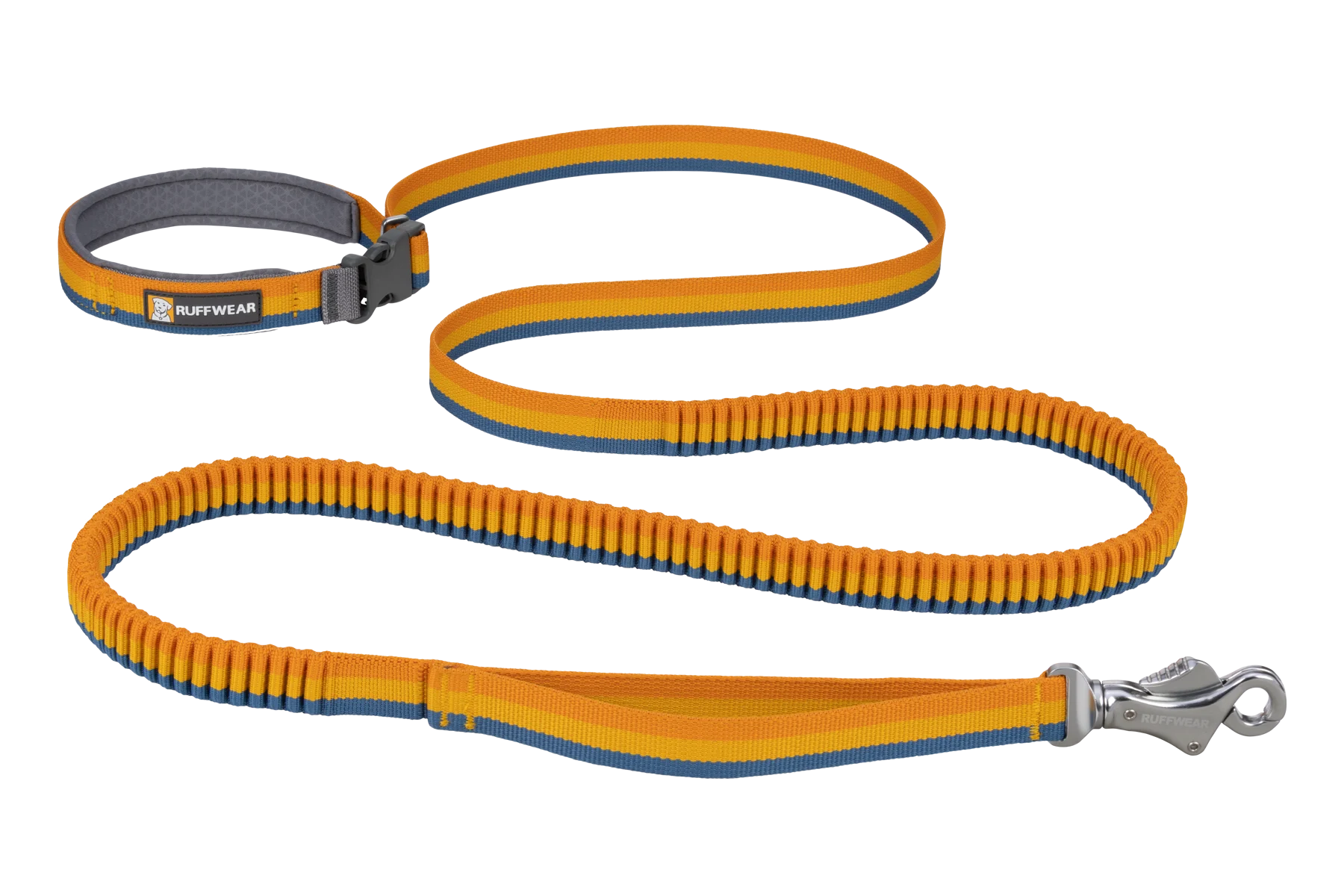
Ruffwear Roamer™ Bungee Dog Leash
The Roamer is the benchmark hands-free dog leash, and the SERP top pick for a good reason: it combines a bungee shock section with a built-in waist-belt clip into one leash, so you don’t need a separate belt. The bungee middle stretches under sudden force, turning a jarring lunge into a smooth, even pull. When your dog spots a squirrel mid-run and bolts, your stride stays unbroken and your wrists stay safe. The length adjusts between 3.5 and 5 feet, use the shorter end for heel work or crowded trail sections, longer for open-road running. The Talon clip at the dog end is rated to 800 lb and opens wide enough to clip cleanly onto thick harness D-rings without wrestling. There’s also a traditional padded handle loop if you want to go hand-held instead of waist-clipped. Tubelok webbing is the same reinforced nylon Ruffwear uses in their harnesses and climbing-rated pack systems, it doesn’t fray, stretch permanently, or absorb mud the way cheaper nylon does. Backed by Ruffwear’s lifetime warranty. This is the first leash we’d put in the hands of any runner or hiker who wants their dog along for the ride.
What we like
- Bungee absorbs lunges mid-run, your pace stays smooth, your shoulder stays intact
- Waist clip built into the leash, no separate belt needed, one product does everything
- Adjustable 3.5 to 5 ft suits every situation from close heel work to open trail
- Talon clip is rated 800 lb, genuinely strong enough for a 100+ lb dog at full sprint
- Tubelok webbing won’t fray, kink or absorb mud, it outlasts multiple cheap leashes
- Lifetime warranty: Ruffwear replaces it if it ever fails, no questions
The catches
- ~$50 is a premium price, it earns it, but it’s not an impulse buy
- The bungee section makes it less precise for formal heel training (use a fixed leash for that)
- Waist belt loop runs small, check the sizing chart before ordering if you have a larger waist
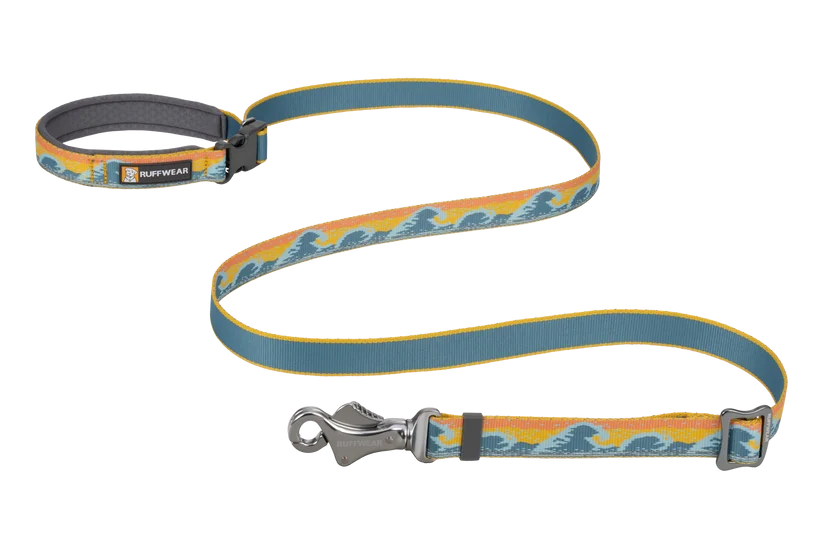
Ruffwear Crag EX™ Adjustable Dog Leash
Where the Roamer is built for running, the Crag EX is built for hiking. It doesn’t have a bungee section, intentionally. On rocky or uneven terrain, a fixed-length leash gives you precise, predictable control: you know exactly where your dog is relative to your feet, and a sudden surge doesn’t get amplified by bungee rebound on a scramble. The length adjusts from 3.5 to 7 feet using a simple slide-lock adjuster, snap it to 3.5 ft for a tight single-track trail, open to 7 ft on a wide fire road. The waist loop converts it to hands-free the same way as the Roamer: clip the loop over your belt or pack hipbelt and your hands are free for trekking poles, scrambling or a camera. The Talon clip is the same 800 lb-rated hook as on every Ruffwear product, and Tubelok webbing is the reinforced nylon that handles mud, stream crossings and abrasion without degrading. At 7 ft maximum, it gives more room for a dog to explore ahead on switchbacks without tangling, something the shorter Roamer can’t match. A solid pick for anyone who hikes with their dog more than they run.
What we like
- Adjusts from 3.5 ft to 7 ft, more range than the Roamer, great for switching between tight trail and open trail
- No bungee = precise control on scrambles and technical sections where you need to know exactly where the dog is
- Waist loop clips over pack hipbelt, keeps the dog clipped while your hands are free for poles or scrambling
- Talon clip and Tubelok webbing: the same build quality as the Roamer at a lower price
- Lighter and less bulky than bungee leashes, packs down smaller in a hiking kit
The catches
- No bungee section, you’ll feel sudden lunges directly through the waist belt (the waist distributes the force better than a wrist, but it’s still there)
- Not ideal for road running where bungee shock makes a bigger difference
- Slide-lock adjuster requires a two-hand action to move, you can’t adjust length single-handed mid-hike
What makes a leash hands-free? (and what doesn’t)
A genuine hands-free dog leash attaches to your body, usually a waist belt, so your hands are completely free while walking, running or hiking. This is different from:
- A leash with a hand loop. Standard loop-handle leashes are hand-held, they don’t convert to waist-clip. Even a bungee leash with a handle is not hands-free unless it has a separate waist clip built in.
- A “2-in-1” crossbody leash. Some leashes loop over a shoulder or across the chest rather than around the waist. These work, but they put force on your shoulder instead of your hips, less comfortable for long runs or a strong dog.
- A retractable leash with a wrist strap. The strap keeps you attached but it’s still wrist-held and the thin cord is a safety risk at running pace. Not hands-free in any meaningful sense.
A true waist-belt hands-free leash uses a belt loop that fits around your waist (usually adjustable), with the leash itself attached to that belt loop rather than a handle. When your dog surges, the force goes through your hips and core, not a single wrist or shoulder. Both picks above use this design.
Bungee vs fixed length: which do you need?
This is the most important decision in choosing a hands-free leash. Both our picks are hands-free; they differ on whether there’s a bungee section:
| Feature | Bungee (Roamer) | Fixed length (Crag EX) |
|---|---|---|
| Shock absorption on lunges | Yes, stretchy section absorbs the jolt | No, force transfers directly |
| Best for road running | Yes, absorbs gait differences between you and the dog | Less ideal |
| Best for technical hiking/scrambling | Less ideal, bungee rebound can surprise you on rocks | Yes, you always know exactly where the dog is |
| Max length | 3.5 to 5 ft | 3.5 to 7 ft |
| Length adjustability | Continuous (stretch) | Slide-lock adjuster |
| Price | ~$50 | ~$30 |
The short version: if you run with your dog, get the Roamer. The bungee absorbs the natural difference in stride between human and dog, you don’t slow down for a surge, and the dog doesn’t get a neck-jolt when you accelerate. If you hike with your dog, the Crag EX gives you more length range (7 ft max vs 5 ft) and fixed-length precision on terrain where you want to know exactly where the dog is placed relative to your feet.
How to fit a hands-free waist belt (so it actually stays put)
A poorly-fitted waist belt is the most common complaint about hands-free leashes, the belt rides up, twists or bounces with every step. Here’s how to avoid it:
- Wear it at your natural waist, not your hips. The waist (just above the hip bones) is where the belt stays put most reliably. On the hip bones it slides; below them it rotates. Most runners instinctively put it too low.
- Tighten until it doesn’t bounce. The belt should be snug enough that it doesn’t ride up when the dog pulls, but not so tight it restricts your breathing. You’re looking for “secure” not “cinched.”
- Check the size chart before ordering. The Roamer waist belt runs slightly small. Ruffwear publishes a size chart, measure your waist (not your jeans size) and size up if you’re between sizes.
- If you wear a running pack, use the hipbelt. The Crag EX waist loop clips over a pack hipbelt as well as a standalone belt, if you run or hike with a hydration pack, you can skip the extra belt entirely.
- Start short on the leash. When you first go hands-free, use a shorter leash length (3.5 to 4 ft) until you’re used to the waist attachment. The force dynamics feel different to a hand-held leash, and a shorter length gives you more immediate control while you adjust.
Running with your dog: what the leash needs to handle
Running with a dog on a hands-free leash is different from walking. The leash needs to handle:
- Stride mismatch. Dogs don’t run at exactly your pace, they surge forward, slow to sniff, then sprint to catch up. A bungee absorbs those constant small variations so your stride stays even. Without bungee, you’ll feel every one as a hip-tug.
- Sudden stops. A dog that spots a squirrel and brakes to zero puts all their momentum into the belt. This is why clip rating matters: the Talon clip on both Ruffwear picks is rated to 800 lb, far beyond what any dog generates. Cheap running leashes use lighter clips that can fail under this kind of repeated shock.
- Road visibility. If you run at dawn or dusk, your dog needs to be visible to drivers. The Roamer comes in high-visibility colours (Cloudburst yellow, Salmon Pink). For night running, add a clip-on LED collar light to your dog’s harness, the leash colour alone isn’t enough in the dark.
- Heat and sweat. Nylon webbing absorbs sweat and can get rank. Both Ruffwear leashes wipe clean and dry quickly. After hot-weather runs, rinse the belt loop as well as the leash webbing, the belt contact point absorbs the most sweat.
One thing hands-free leashes don’t do: train a pulling dog. If your dog currently pulls on a regular leash, going hands-free just moves the pulling to your hips. Sort out the pulling first, our guide to how to stop a dog pulling on the leash covers the techniques that actually work, then enjoy the hands-free difference once they walk loosely.
Hiking with your dog: what changes
Hiking demands slightly different things from a hands-free leash than running does:
- Length range. On trail you switch between tight control (3.5 ft on a narrow single-track) and loose exploration (6 to 7 ft on a wide fire road or meadow). The Crag EX’s 3.5 to 7 ft range is the better tool here; the Roamer tops out at 5 ft.
- Technical terrain. On scrambles, river crossings or steep sections, you want to know exactly where the dog is. A fixed-length leash at 3.5 ft keeps the dog beside you; a bungee can allow a sudden surge that catches you off-balance on a rock.
- Pack hipbelt compatibility. Most day hikers and backpackers wear a pack. The Crag EX loop slips over a hipbelt easily, no separate belt needed. Check that your pack’s hipbelt is wide enough to take the loop before relying on it.
- Wildlife. On trail, a dog’s instinct to chase is stronger than on the road, deer, chipmunks, birds. A hands-free leash that can’t be released instantly could pull you over on a steep section. Know the quick-release on your leash before you need it in a hurry. The Talon clip on both Ruffwear leashes opens with one hand.
Not sure which is the right leash for you overall? Our complete leash buyer’s guide covers all leash types, materials and use cases in full, including training leashes, traffic-handle designs and the case for reflective stitching for night walks.
Running with two dogs: the coupler option
If you run or hike with two dogs, a coupler lets you run them both from a single hands-free leash. A coupler is a short Y-shaped lead (usually 6 to 12 inches per arm) that connects two dogs to one clip. You clip the coupler to your hands-free leash and both dogs run side by side.
It works, with caveats:
- Both dogs should be roughly matched in size and pace. A fast 80 lb dog and a slow 20 lb dog on one coupler make for a frustrating run for everyone.
- The combined force of two dogs lands on your waist belt at once. Make sure the clip rating on your hands-free leash can handle both dogs (800 lb rated clips like the Talon are fine for any realistic dual-dog setup).
- If one dog needs to stop and the other doesn’t, you’ll feel it. Practise dual-dog walking before you run with a coupler.
Ruffwear makes the Double Track Coupler, a purpose-built coupler that pairs with their leashes. It’s the cleanest solution if both dogs are Ruffwear-harness-wearing hikers.
Large dogs and hands-free leashes: what to check
Hands-free leashes were designed for all dog sizes, but there are specific things to check if you have a large or powerful dog:
- Clip rating. A 100 lb dog at full sprint generates significant force. Budget hands-free leashes use clips rated to 60 to 80 lb. The Talon clip on both our picks is rated to 800 lb, meaningfully different from a wire-gate snap on a £12 Amazon leash.
- Belt width and padding. A large dog’s surge goes straight to the belt. A narrow, unpadded belt concentrates that force in a line across your hips, unpleasant on a long run. Both Ruffwear belts use wider webbing that distributes the load more evenly.
- Leash width. Both picks use 3/4″ to 1″ Tubelok webbing, the right width for a large dog. Thin 1/2″ nylon webbing (common on budget leashes) is fine for a small dog but can dig into the belt loop hardware on a big dog’s pull.
- Waist belt sizing. Larger-waisted runners should check size charts carefully, some hands-free belts (especially the Roamer) max out at a medium waist. Ruffwear sells the Roamer in S/M and L/XL specifically to address this; size up if you’re on the boundary.
Also see our roundup of the best leashes for large and strong dogs for the full spectrum of heavy-duty picks, including double-handle designs and the Mendota training lead, for times you want to go hand-held.
More dog leash and gear guides
Hands-free dog leashes: common questions
What is the best hands-free dog leash?
The Ruffwear Roamer Bungee Dog Leash is the top pick for most runners and active dog owners. It combines a bungee shock section with a built-in waist-belt clip, one product that does everything. It adjusts 3.5 to 5 ft, uses a Talon clip rated to 800 lb, and is backed by a lifetime warranty. For hiking specifically, where fixed-length control matters more than bungee shock, the Ruffwear Crag EX is the better pick, with a 3.5 to 7 ft range and no bungee for precise placement on technical terrain. Both are available via Ruffwear’s website (Skimlinks).
Are hands-free dog leashes safe for large dogs?
Yes, for large dogs specifically, hands-free leashes are often safer than wrist-held ones. The force from a big dog’s lunge goes through your hips and core (which are stronger and more stable than your wrist and shoulder) instead of a single joint. The important thing is the clip rating: budget hands-free leashes use clips rated to 60 to 100 lb, which a powerful large dog can stress. Both our picks use the Ruffwear Talon clip, rated to 800 lb, appropriate for any large breed. Also check the belt size: most hands-free belts max out at a medium waist, so large-waisted runners should size up.
How should I fit a hands-free waist belt?
Fit the belt at your natural waist (just above the hip bones), not on the hip bones themselves, the natural waist is where it stays put without riding up. Tighten until the belt doesn’t bounce with each step, but not so tight it restricts breathing. Measure your actual waist before ordering, the Ruffwear Roamer belt runs slightly small, and sizing up avoids the most common fit complaint. If you run or hike with a hydration pack, the Crag EX loop can clip directly over your pack’s hipbelt, saving you the extra belt entirely. Start with a shorter leash length (3.5 to 4 ft) until you’re used to the waist attachment, the force dynamics feel different from a hand-held leash.
Do I need a bungee section on a hands-free leash?
For running, yes, a bungee section makes a significant difference. Dogs don’t run at a perfectly even pace. They surge, sniff-stop, then sprint to catch up, creating constant small force variations. A bungee absorbs those so your stride stays even and your dog doesn’t get micro-jolts to the neck every time the rhythm changes. Without bungee (like the Crag EX), every surge goes directly to your waist belt. For hiking, bungee is less critical and some hikers prefer the fixed-length predictability on technical ground. If you mainly run, get the Roamer (bungee). If you mainly hike, the Crag EX (non-bungee) is a cleaner tool.
Can I use a hands-free leash for both running and hiking?
The Ruffwear Roamer works for both, plenty of hikers use it on trail as well as road runners. The bungee doesn’t hurt on hiking; it just provides less of an advantage there than it does while running. If you do both activities regularly and want one leash, the Roamer is the better choice because it excels at the harder task (running). If you primarily hike and occasionally run easy trails, the Crag EX’s longer range (7 ft max) and lower price make it the better investment. There’s no wrong answer, both are genuinely hands-free and both will work for either activity.
What length is best for a hands-free running leash?
For road running, 3.5 to 4.5 ft is the sweet spot. You want the dog beside you rather than ahead, running directly in front of you is a trip hazard, and a shorter length keeps them close to your hip. The Roamer’s bungee section means the effective length extends another foot or two when the dog pulls, so 3.5 ft nominal gives you 4.5 to 5 ft under tension, enough for the dog to run comfortably beside you without tangling your feet. For trail hiking where you want the dog to range further ahead on open sections, extend to 6 to 7 ft and shorten for narrow trail or crowded sections.
Do you need a special harness to use a hands-free leash?
No, a hands-free leash clips to your dog’s existing collar or harness the same as any other leash (via the standard D-ring). The “hands-free” refers to how the leash attaches to you, not the dog. That said, for running specifically, a front-clip or back-clip harness is better than a collar because it distributes pulling force across the chest rather than the neck, more comfortable for the dog over miles of running. Our best dog harnesses guide covers the top picks for running and hiking dogs.