 Dog Gear, Sized Right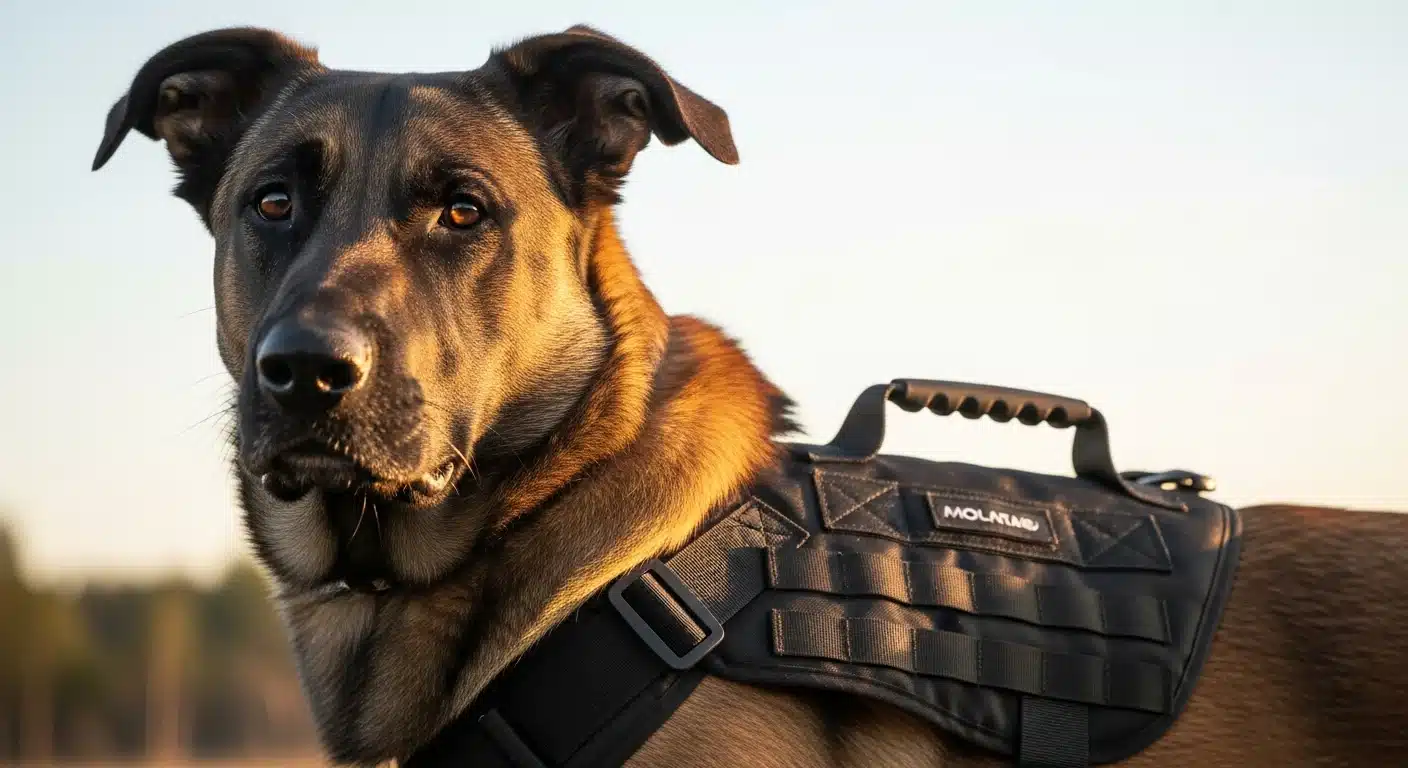
Do You Need a Tactical Dog Harness?
Tactical harnesses are genuinely excellent gear, for about 20% of dogs. Here’s how to figure out which category yours is in, and when a padded everyday harness is the smarter buy.
Do you need a tactical dog harness? The honest answer depends entirely on what your dog actually does. If you have a large, powerful working dog, a service dog, or a dog you take on serious off-leash adventures where you need to physically grab and control them, yes, a real tactical harness earns its price. If you have a calm 15-lb dog who goes on neighborhood walks and looks cute in photos, you’re buying aesthetics, not function. This guide breaks down exactly what makes a harness ‘tactical’ (beyond marketing), the specific scenarios where those features matter, and when a well-made padded everyday harness is the better choice for your dog and your wallet.
The everyday harness for dogs that don’t need tactical
Most dogs don’t need MOLLE webbing. If you’re looking for the best-built everyday harness, durable, well-fitted, dual-clip, this is the one we point most owners toward. Verified in stock; tap through for the live price.
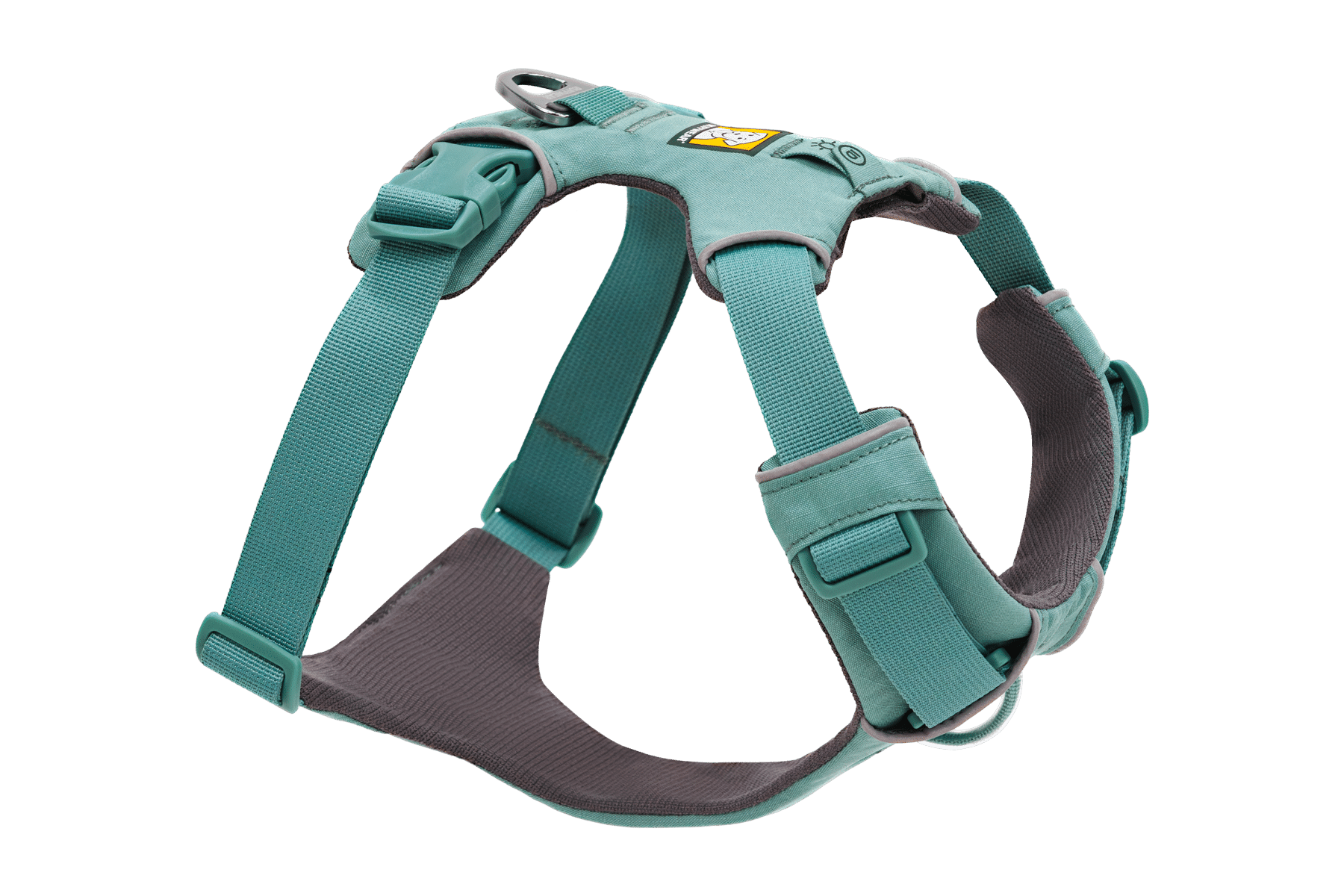
Ruffwear Front Range Harness
If this article talked you out of spending $80-$120 on a tactical harness your dog doesn’t need, the Front Range is the honest answer. It offers front and back clip points for no-pull training, four adjustment points for a precise fit on barrel-chested or deep-chested dogs, and padded foam panels that stay comfortable on all-day outings. No MOLLE webbing you’ll never use, no stiff military nylon, just a well-made, durable harness that works for 90% of dogs.
What we like
- Dual clip points (front chest + back dorsal) cover no-pull training and everyday walking
- Four adjustment points fit a wide range of dog builds, great for barrel-chested breeds
- Foam-padded panels distribute pressure evenly; stays comfortable on multi-hour hikes
- Reflective trim for early-morning and evening visibility
The catches
- No MOLLE webbing or ID patch panel, not suitable for working-dog gear attachment
- Lighter nylon than a true tactical harness, not rated for extreme bite-work or tethering
- Top handle is softer, not a rigid grab handle, less useful in an emergency lift
What ‘tactical’ actually means on a dog harness
The word ‘tactical’ gets applied to a wide range of products, from legitimately heavy-duty working-dog gear to costume pieces with a military aesthetic. Real tactical dog harnesses share a specific set of construction features, if a harness doesn’t have most of these, it’s marketing, not engineering:
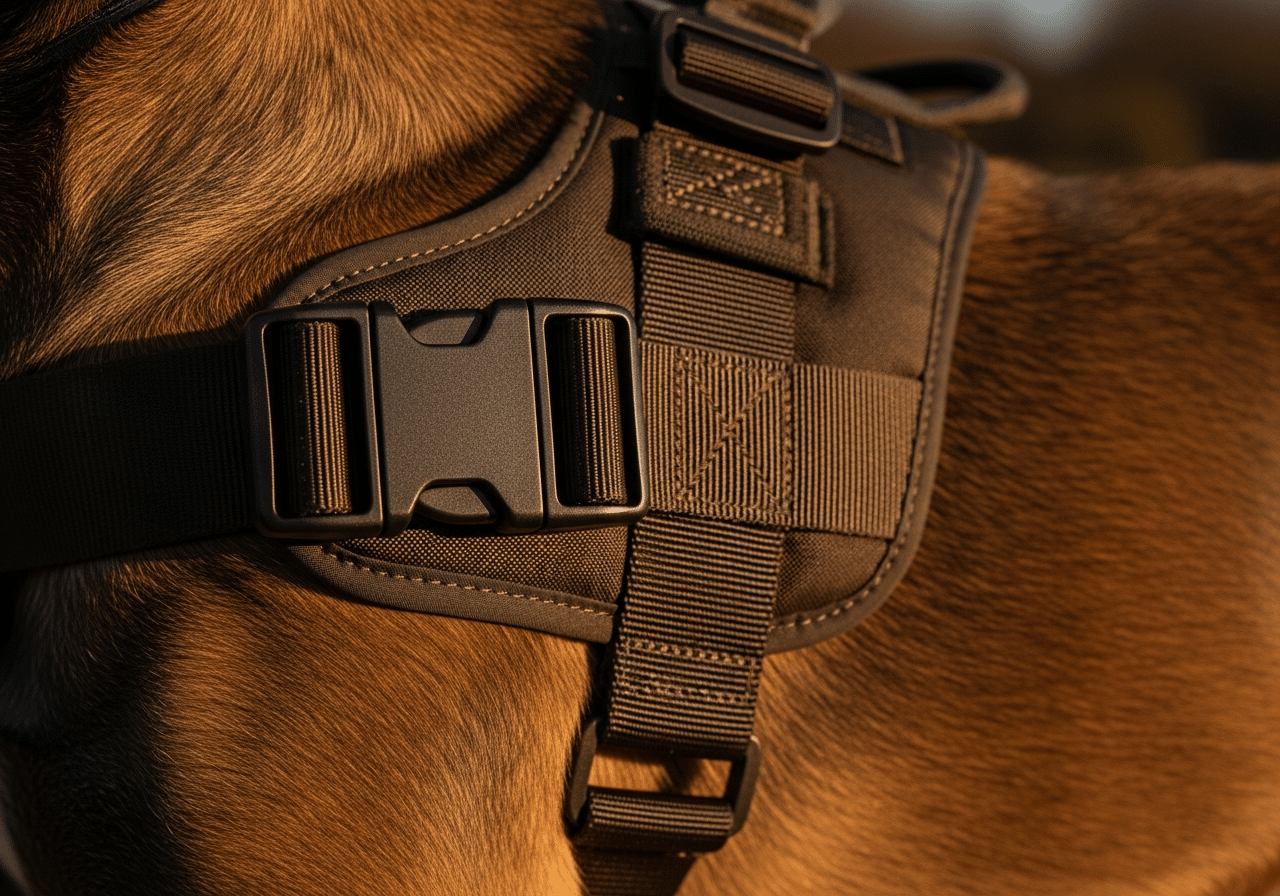
- 1000D Cordura nylon: This is the defining material. Genuine 1000-denier Cordura (or similar heavy-duty woven nylon) is significantly more abrasion-resistant than the 600D or lighter nylon used in most everyday harnesses. It resists tearing on rocks, brush, and rough terrain in a way lighter fabric won’t.
- MOLLE webbing: Modular Lightweight Load-carrying Equipment, the grid of horizontal nylon straps that lets you attach compatible pouches, ID patches, and accessories. On a real tactical harness, this webbing is stitched through and load-rated. On a cosmetic one, it’s glued on or stitched only at the edges and will tear off under any real load.
- A rigid top handle: A stiff, padded handle mounted at the back of the harness, designed so you can physically grab and lift or restrain the dog with one hand. This is a functional safety feature, not decoration. Everyday harnesses have soft fabric loops that serve a similar purpose but aren’t rated for full-body weight or sudden force.
- All-metal hardware: True tactical harnesses use aluminum or steel buckles, D-rings, and adjustment sliders. Plastic buckles, even high-grade ones, are the point of failure under sustained load, a large dog’s full weight, or impact. Metal hardware adds cost and weight but holds.
- A sturdy front D-ring: A chest-mounted clip point for a leash, essential for no-pull control on a large, strong dog. Not all tactical harnesses include this; it’s worth verifying before you buy.
The most reputable brands building real tactical harnesses include OneTigris, BARKBAY, Dean & Tyler, and Julius-K9. You’ll also see these features on working-dog gear from police and military supply companies. A $25 “tactical” harness from an unknown brand almost certainly cuts corners on the nylon weight, hardware quality, or stitching density, the exact places where the harness needs to hold.
Who genuinely benefits from a tactical harness
Tactical harnesses are purpose-built, and there’s a real population of dogs for whom they’re the right tool. Here’s the honest list of use cases where the features justify the cost:
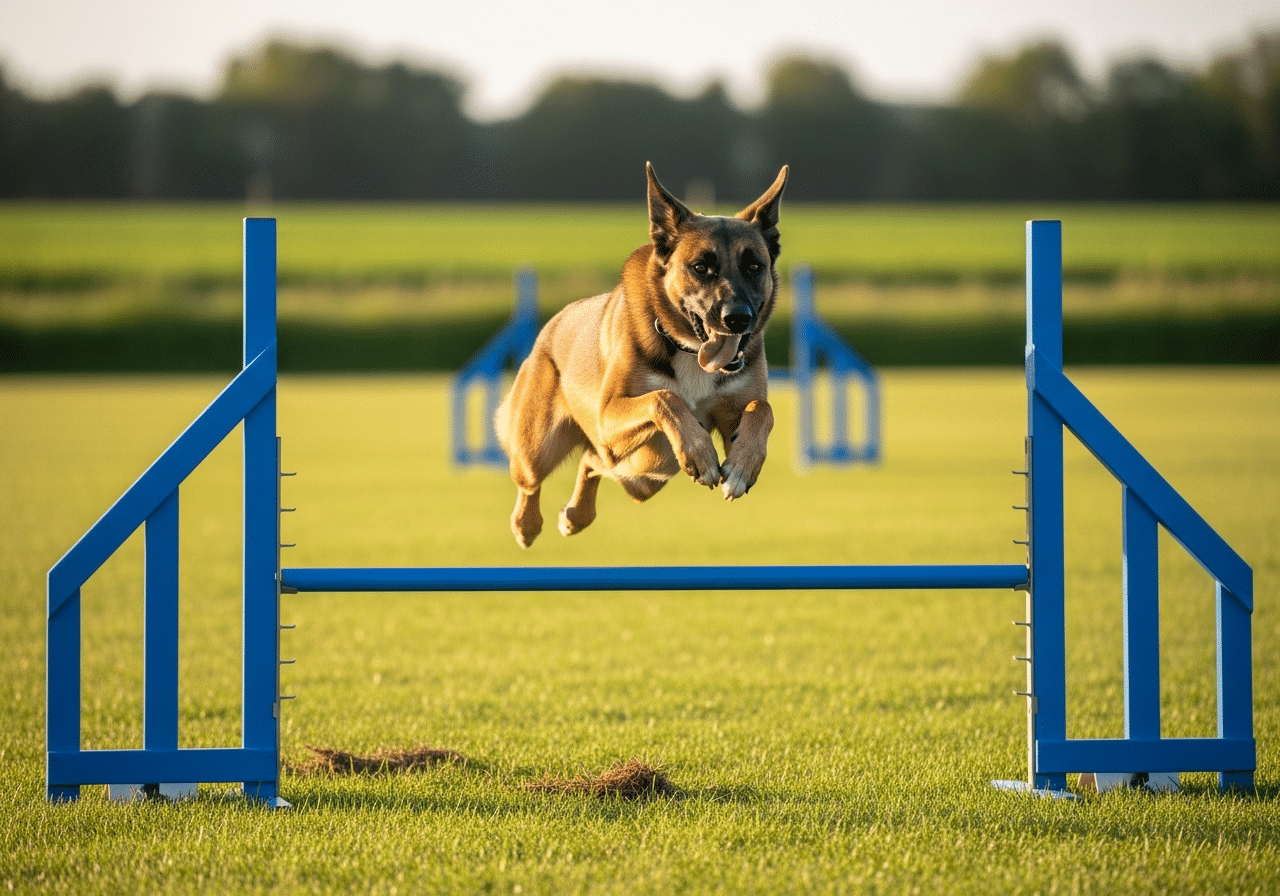
- Large, strong, high-drive dogs: A 90-lb Malinois, Rottweiler, Cane Corso, or German Shepherd that lunges, pulls hard, or needs immediate physical control benefits from a harness that won’t flex, deform, or have a buckle fail under 80 lbs of pressure. The rigid construction keeps the harness from torquing or riding up under load.
- Service dogs and working dogs: Dogs in service, therapy, police K9, or search-and-rescue work often carry gear, a first-aid pouch, a light, an ID panel, a GPS tracker. MOLLE webbing is the right system for this. A service dog handler needs a harness that holds equipment securely and can be grabbed in an emergency.
- Hiking, adventure, and off-leash terrain: On boulder fields, river crossings, steep trails, or in thick brush, you may need to physically lift or guide your dog through or over an obstacle. The rigid top handle on a tactical harness is genuinely useful here, it lets you spot a dog over a gap or haul them out of water. The 1000D nylon also holds up against sharp rock and undergrowth that would abrade a lighter harness in a season.
- Training and bite work: Dogs in protection sport, Schutzhund/IPO, or bite-work training often use tactical harnesses specifically because they’re designed to hold under extreme pulling and sudden directional force. The harness sees loads that consumer gear isn’t built for.
- Dogs in high-visibility/working contexts: Dogs doing therapy visits, events, or public-access work where an ID panel (“Service Dog,” “Do Not Pet”) needs to be visible benefit from the patch-panel MOLLE system. A standard harness typically can’t mount a rigid ID patch securely.
What these use cases share: the dog is large and strong, the harness will see real mechanical loads or needs to carry gear, or the environment is genuinely demanding. If your dog fits one of these scenarios, a quality tactical harness is a legitimate tool, not a toy. See our full tactical dog harness roundup for the best options across these use cases.
Who is just paying for the look
This is the section the gear industry doesn’t want to write, but it’s the most useful one on this page. A substantial fraction of tactical harness purchases are aesthetic, the owner likes the military look, the dog looks tough in photos, and that’s genuinely fine as a reason to own something, as long as you know that’s what you’re buying. Here’s where the value case breaks down:
- Small and medium dogs on low-demand walks: A 15-lb Frenchie or a 35-lb Beagle on neighborhood walks has no mechanical need for 1000D Cordura or metal buckles. The harness will outlive three of the dog’s harnesses from a quality everyday brand, but it won’t perform better in any way that matters for the actual use case.
- Calm, easy-to-control dogs: If your dog doesn’t pull, doesn’t lunge, and you’ve never needed to grab and restrain them physically, the structural advantages of a tactical harness aren’t being accessed. You’re paying for engineering headroom you’ll never need.
- Dogs carried mostly in cars and apartments: A dog that goes from couch to car to sidewalk doesn’t need abrasion-resistant nylon. A padded, comfortable everyday harness is kinder to wear all day, and your dog will tell you, stiff 1000D nylon is less comfortable for sedentary dogs and dogs prone to chafing.
- Owners who want MOLLE but have nothing to attach: MOLLE is the right system if you’re attaching a water bottle pouch, a GPS device, or an ID patch. If you don’t have anything to attach, you’re carrying the weight and bulk of the webbing system for zero function.
None of this is a judgment, it’s just useful to know before spending $60-$120 on a harness. If you like the aesthetic, own it. If you want the best harness for your actual situation, read the section below on everyday alternatives.
Tactical harness vs everyday harness: a use-case comparison
The table below is the honest breakdown by situation. A ✓ means the harness type is the better or equal choice for that scenario; an ✗ means it’s overkill, underpowered, or a poorer fit.
| Situation / Use Case | Tactical Harness | Padded Everyday Harness |
|---|---|---|
| Large dog (70+ lbs) that pulls hard | ✓ Rigid construction holds under load | ✓ Front-clip harness handles most pullers fine |
| Service / working dog needing gear attachment | ✓ MOLLE is the right system | ✗ No load-rated attachment points |
| Hiking on rough terrain with need to grab dog | ✓ Rigid handle + durable nylon excel here | ~ Soft handle works for most hikes |
| Protection sport / bite work training | ✓ Built for these loads | ✗ Will deform or fail under sustained force |
| Daily neighborhood walks, easy dog | ✗ Overkill, stiff nylon, extra weight | ✓ Comfortable, well-fitted, appropriate |
| Small or medium dog (under 50 lbs) | ✗ Most tactical fits are bulky and stiff | ✓ Purpose-built fit and comfort |
| All-day wear / sensitive dog | ✗ Stiff edges can chafe over hours | ✓ Padded panels designed for comfort |
| Wanting an ID/patch panel | ✓ Velcro patch panels on most tactical builds | ✗ No standard patch attachment |
| Budget under $40 | ✗ Quality tactical harnesses cost $60-$120+ | ✓ Many excellent options in this range |
The pattern: tactical harnesses win on durability under load, gear attachment, and emergency control. Everyday harnesses win on comfort, fit for smaller dogs, and value for dogs that don’t need the heavy construction.
The features that actually matter vs pure marketing
Knowing which specs are real and which are selling points will save you from wasted money. Here’s the breakdown:
Features that deliver real value
- 1000D nylon (vs 600D or “heavy-duty polyester”): The denier number matters. True 1000-denier Cordura has measurably better abrasion resistance. Any harness claiming “tactical” without specifying material weight is likely using lighter fabric.
- Through-stitched MOLLE: Webbing attached with rows of stitching through the full harness body holds under load. Webbing attached only at the edges or heat-bonded will tear off under any real attachment weight.
- Dual D-rings (front chest + back dorsal): The front clip is for no-pull control; the back is for standard walking or attaching working gear. Both serve real functions.
- All-metal hardware: Aluminum and steel buckles and D-rings hold; plastic breaks at sustained load or in cold temperatures when the material gets brittle.
Features that are mostly aesthetic on non-working dogs
- Camo or multicam patterns: No functional advantage on a pet dog. Serves military camouflage purposes on actual working dogs in the field; on a suburban dog it’s a visual choice, nothing more.
- Morale patches: Fun, personalizable, and zero performance impact. Fine to want; just don’t pay a premium for them.
- Extra MOLLE rows: A harness with four rows of MOLLE is not more useful than one with two rows if you’re only attaching one ID patch. More isn’t better unless you have gear to fill it.
- “Military grade” without specification: Not a standards designation. Means nothing without the underlying specs (denier, hardware material, stitching density).
When a padded everyday harness is the smarter buy
For most dogs, even large ones, a well-made no-pull harness outperforms a tactical harness on the metrics that matter for daily life:
- Comfort for all-day wear: Padded foam panels and softer webbing are kinder on shoulders and chest over a full day. A stiff 1000D tactical harness can create pressure points on a dog that’s just lounging or on a leisurely walk.
- Fit accuracy: Consumer harnesses from brands like Ruffwear, Julius-K9 (in their everyday line), and Kurgo are engineered specifically for pet dog anatomy with multiple adjustment points. Many tactical harnesses are adapted from military sled or working-dog designs and can be a poor fit on deep-chested or narrow-waisted breeds.
- No-pull mechanics: A harness with a front chest clip redirects pulling toward the owner better than many tactical builds, which are often designed for back-clip use where the handler is in complete control. If leash manners are your main concern, a no-pull everyday harness is the purpose-built tool.
- Cost: A quality everyday harness like the Ruffwear Front Range costs around $60 and will last several years on a large dog. A comparable-quality tactical harness starts around $80-$120. If you’re not using the tactical features, you’re paying for them unnecessarily.
If you’ve concluded that everyday is the right lane, our full dog harness guide covers the best options for large dogs, no-pull training, and everyday use across breed types.
Sizing and fit: what to know before you buy either type
Harness fit problems, chafing, escape, restricted movement, come from sizing errors far more often than from buying the wrong style. A few things to get right regardless of which type you choose:
- Measure the chest girth, not body weight: Most sizing charts list weight ranges, but barrel-chested breeds (Pit Bulls, American Bulldogs, English Bulldogs) and deep-chested breeds (Greyhounds, Whippets, Vizslas) can vary by 6 to 8 inches at the same body weight. Measure the widest point of the chest with a soft tape.
- Check adjustment range: A harness with a 4-inch adjustment range in the chest and neck gives you room to get the fit right. Too tight creates chafing at the armpits; too loose allows the “Houdini” reverse escape that many dogs figure out quickly.
- Test for armpit clearance: Once fitted, slide two fingers under each strap at the armpit. If you can’t, it’s too tight and will rub. If you can slide a whole hand through, it’s too loose and the dog can escape.
- For tactical harnesses specifically: The rigid construction means there’s less flex to accommodate fit errors. Get the chest measurement right and size up if you’re between sizes, it’s easier to tighten a strap than to stretch a stiff nylon panel.
The bottom line: do you need a tactical dog harness?
Run through this checklist honestly. If you tick two or more items in the first group, a quality tactical harness is a defensible purchase:
- My dog is 60 lbs or more and pulls or lunges with real force
- I need to attach pouches, a GPS tracker, or an ID patch to the harness
- I hike on rough terrain where I physically need to grab and guide the dog
- My dog is in service, therapy, protection sport, or working roles
- The harness will regularly contact rocks, brush, water, or other abrasive surfaces
If you ticked zero or one, an everyday harness will serve your dog better. The tactical features you’d never use become liability, added weight, reduced comfort, poorer fit for a pet build, and $30-$60 of extra spend.
For dogs that need the real thing, see our full tactical harness roundup, we’ve ranked and tested the legitimate options from OneTigris, BARKBAY, Julius-K9, and Dean & Tyler. For dogs that need an excellent everyday harness, the pick below is what we recommend to most owners after this exact conversation.
Keep researching dog harnesses
Tactical dog harness: common questions answered
Do you need a tactical dog harness?
Only if your dog genuinely needs what tactical harnesses offer: a large or strong dog that puts real mechanical load on the harness, a working or service dog that needs to carry gear via MOLLE webbing, or a dog you take on demanding terrain where you need a rigid grab handle to physically assist them. For the majority of dogs on everyday walks, a padded no-pull harness is more comfortable, better-fitted, and doesn’t ask you to pay for features you’ll never use.
What is a tactical dog harness for?
A tactical dog harness is designed for high-demand use cases: working and service dogs that carry gear via MOLLE webbing, large powerful dogs in training or protection sport, dogs on demanding outdoor terrain where the handler needs a rigid top grab handle, and situations where the harness hardware must hold under extreme load. The heavy-duty 1000D nylon, through-stitched MOLLE webbing, all-metal hardware, and rigid construction exist to handle mechanical stress that consumer everyday harnesses aren’t built for.
What does MOLLE webbing on a dog harness do?
MOLLE (Modular Lightweight Load-carrying Equipment) is a grid of horizontal nylon straps on a tactical harness that lets you attach compatible pouches, a GPS tracker, a water bottle, an ID patch, or other accessories. On a genuine tactical harness the webbing is load-rated and stitched through the harness body; on cheaper cosmetic versions it’s attached only at the edges and will tear off under real weight. If you have no gear to attach, MOLLE webbing adds bulk and weight with no functional benefit.
Are tactical dog harnesses good for everyday use?
For large, active dogs they can work well for daily use, but they’re not optimized for it. The stiff 1000D nylon can cause chafing on dogs wearing a harness for hours at a stretch, the rigid construction fits less precisely on typical pet builds versus working-dog builds, and the added weight and bulk are unnecessary if the dog isn’t accessing the tactical features. For most daily walks, a padded no-pull harness is more comfortable and a better fit for the actual use case.
How do I know if my dog needs a tactical harness?
Ask whether your dog genuinely uses what tactical harnesses provide: Does the dog put enough force on the harness that hardware failure or material deformation is a real concern? Do you need to attach gear to the harness? Do you regularly need a rigid grab handle to physically assist the dog on terrain? Is the harness going to see sustained abrasion from rocks, brush, or water? If yes to two or more of those, a tactical harness is the right tool. If no, an everyday padded harness serves the dog better at lower cost.
What’s the difference between a tactical harness and a regular harness?
A tactical harness uses heavier nylon (typically 1000D Cordura), all-metal hardware, through-stitched MOLLE webbing for gear attachment, and a rigid top handle, construction engineered for mechanical load, rough terrain, and working-dog use. A regular everyday harness uses lighter, more flexible materials, plastic hardware, foam padding for comfort, and is shaped for pet-dog anatomy and daily wear. The everyday harness wins on comfort and fit for most dogs; the tactical harness wins on durability under load and functional gear attachment.