 Dog Gear, Sized Right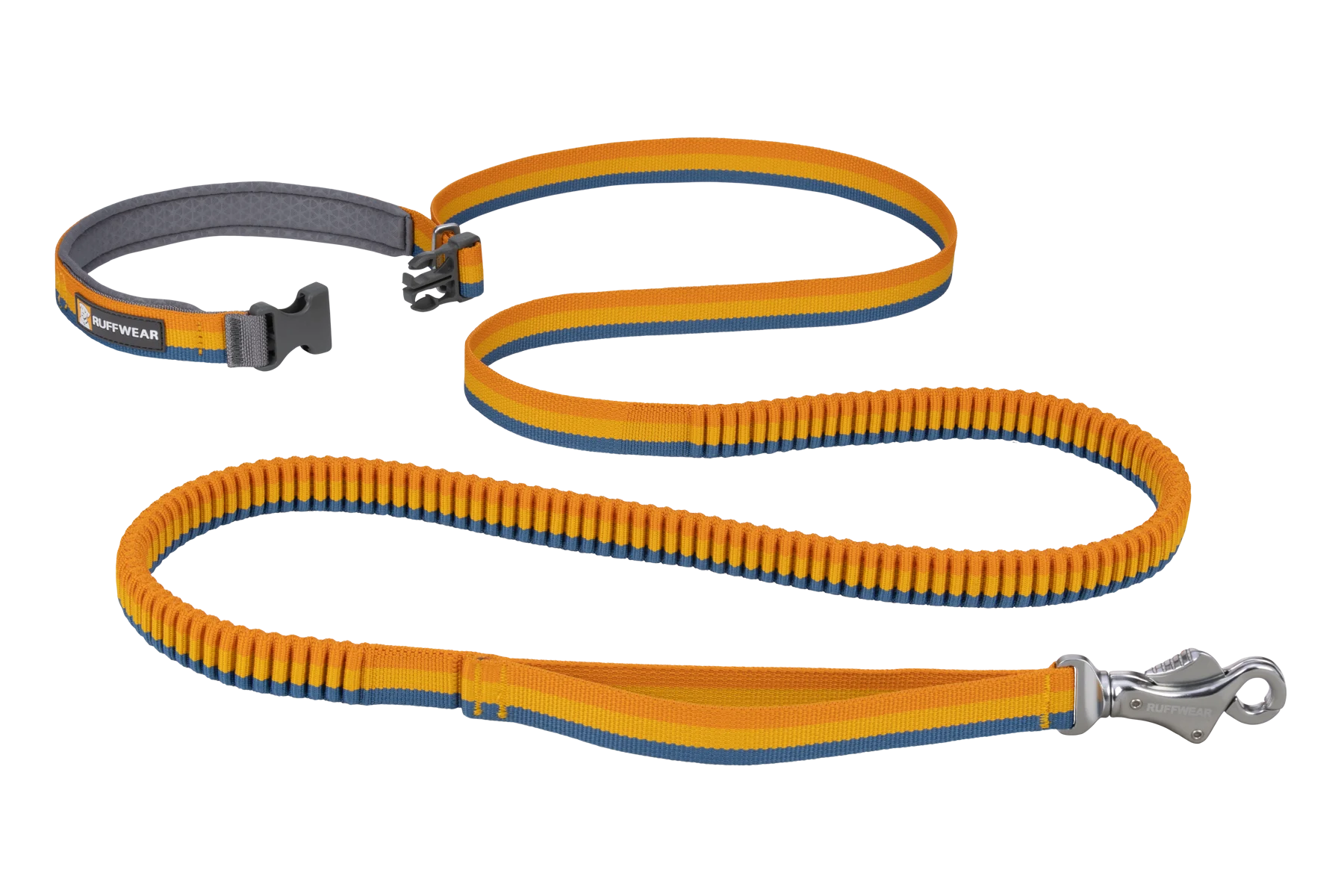
Best Dog Leash for Large & Strong Dogs (2026 Heavy-Duty Picks)
A standard leash built for a 30-pound dog is not the right tool for an 80-pound Lab or a 100-pound Rottweiler that pulls. Width, clip rating and bungee shock absorption change everything for large, strong dogs. Here are the three heavy-duty leashes we’d actually buy, with the full breakdown of what to look for in hardware, webbing and handle design.
Most dog leashes are designed for a 25 to 40 lb dog. Put one on an 80-pound Labrador that lunges after a squirrel, and you’ll feel it in your shoulder for the rest of the day, if the clip holds at all. For large, strong and heavy-pulling dogs, the right leash is different in three specific ways: wider webbing (1-inch nylon, not 5/8-inch) that distributes force across your hand instead of cutting into it; rated hardware (a load-tested clip, not a wire-gate snap); and ideally bungee shock absorption that takes the jolt out of a sudden lunge. Below are the three leashes we’d put on a large dog today, with an honest breakdown of why thin, retractable and budget leashes fail big dogs, and exactly what to look for instead.
Best leashes for large & strong dogs: our top 3
Ranked by construction quality, clip strength and suitability for heavy-pulling dogs. Every buy button goes to a live listing, prices are last-checked, tap through for the current price.
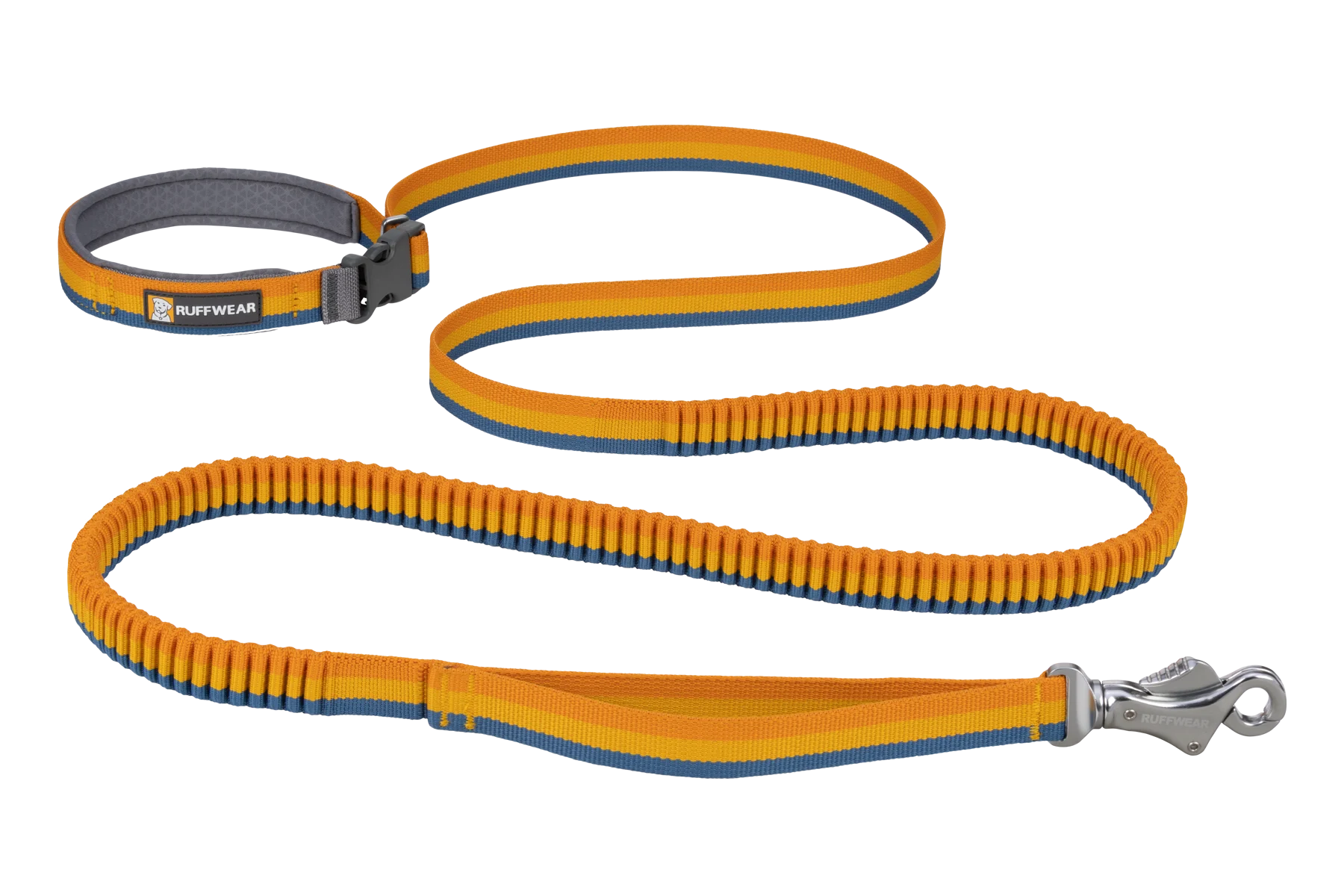
Ruffwear Roamer™ Bungee Dog Leash
For an 80, 90 or 100-pound dog that pulls hard, the Roamer is the leash that changes how you walk. The secret is the bungee section in the middle: when your large dog lurches after a squirrel or another dog, the stretchy core absorbs the jolt instead of snapping it directly through your wrist and shoulder. On a dog this size, that difference is felt in your body every single walk. The leash adjusts between 3.5 and 5 feet, tight for crowded pavements, longer on quiet trails, and the waist belt clip goes hands-free so you can hike or run without gripping anything. Hardware is where this leash earns its price: the Talon clip is rated to 800 lb, far beyond what the thin wire-gate snaps on budget leashes can handle. The webbing is Ruffwear’s Tubelok nylon, reinforced, grippy-soft and designed for climbing and outdoor gear, not just dog accessories. The padded EVA handle is wide and won’t cut your palm even when a 100-pound dog leans into it. Backed by a lifetime warranty. For a large, strong or reactive dog, this is the benchmark.
What we like
- Bungee section absorbs lunges from a heavy dog, the single biggest quality-of-life upgrade for large-dog owners
- Talon clip is rated to 800 lb and opens wide onto thick D-rings on large-breed harnesses and collars
- Adjustable 3.5 to 5 ft length works for heel drills at short and loose trail walking at long
- Waist belt clip makes it genuinely hands-free for running or hiking without wrestling the handle
- Lifetime warranty. Ruffwear replaces it, full stop
The catches
- At ~$50 it’s the premium pick; worth it for daily large-dog use, but not if you’re testing a new behaviour
- Bungee flex isn’t ideal for formal obedience work where fixed length gives cleaner feedback
- Waist belt sizing runs small, check the size chart before ordering
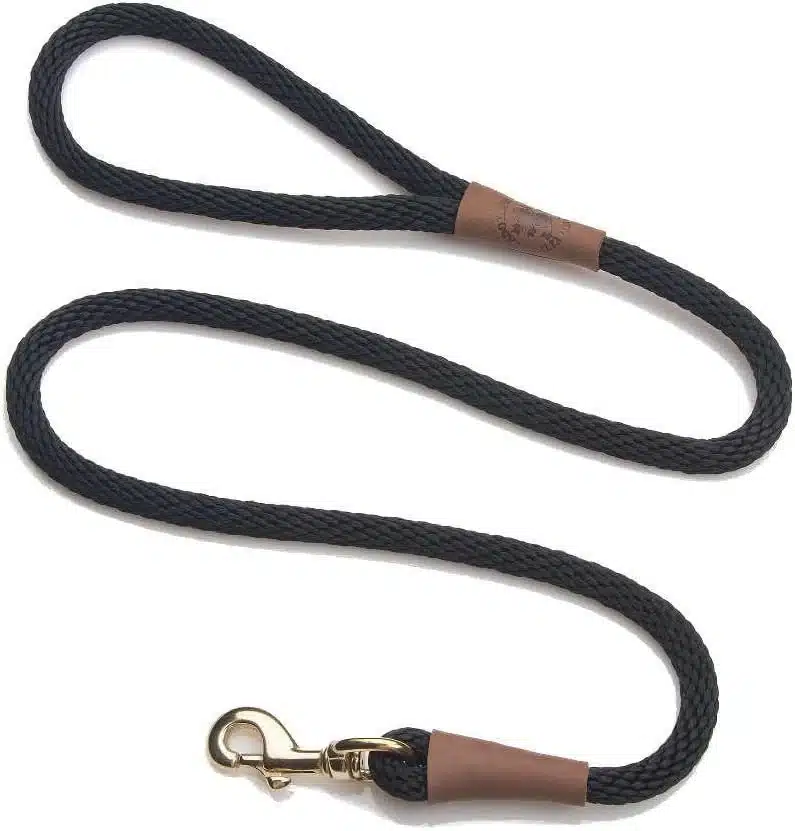
Mendota Pet Snap Leash (Large Breeds)
When you are doing serious training with a large dog, heel work, recall, manners classes, working with a trainer, the Mendota Snap Leash is the professional’s standard. The 1/2-inch braided nylon gives it a rope feel rather than a flat webbing feel in your hand, which is significantly more comfortable when a 70 or 80-pound dog pulls against it over an hour of work. The snap clip is sized for large breeds, a solid bolt-snap, not a lightweight wire gate that flexes under force. At 6 feet fixed, it gives exactly the standard training length: loose enough for a natural walk, short enough to reel in fast. The braided nylon is grippy, soft and durable, it doesn’t kink or coil the way some rope leashes do after a few months of use. Made in Wisconsin, USA, since the 1970s. Available in a wide range of colours. At under $25, it’s exceptional value for a lead that will outlast a dozen budget alternatives, and one that professional trainers in the US and UK have trusted for decades. If you train your large dog seriously, this belongs in the kit.
What we like
- 1/2-inch braided rope feel is far more comfortable in the hand than thin flat nylon when a big dog pulls
- Bolt-snap clip is solid and sized for large-dog hardware, not a fragile wire gate
- Made in Wisconsin since the 1970s: genuine long-term durability, not offshore marketing copy
- 6-foot standard training length, the right size for a heel drill or a loose-lead walk
The catches
- Fixed 6 ft only, no bungee, no adjustable length, no waist clip
- Snap clip (not a locking carabiner), the right tool for daily walking; not for tie-outs or tethering
- Braided nylon absorbs water; air-dry after wet walks, takes longer to dry than Tubelok webbing
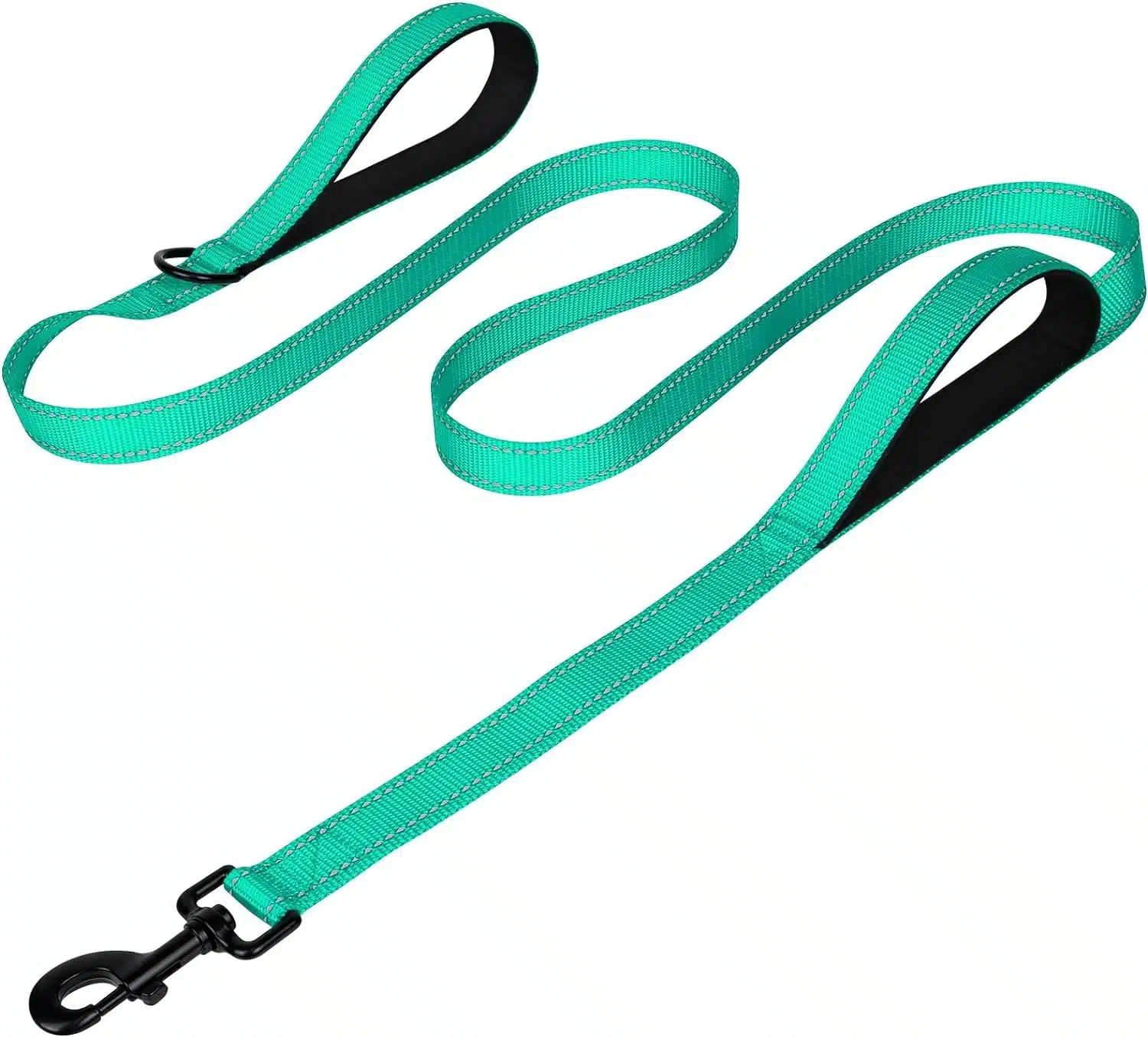
Joytale Double-Handle Reflective Dog Leash
For large-dog owners who need a reliable everyday leash without a premium price tag, the Joytale hits the two features that matter most for big-dog walking: dual handles and reflective visibility. The traffic handle, a second padded grip near the clip end, lets you instantly shorten the leash and pull your dog tight to your side the moment a cyclist, car, small child or reactive dog appears. On a 70+ lb dog who moves faster than you expect, being able to grab that handle without fumbling 6 feet of leash is a genuine safety feature. Pair that with full-length double-sided reflective stitching, not just a strip on one side, but woven into both faces of the webbing, and drivers will see your large, dark dog in headlights at 6am and 10pm. The nylon is heavy-duty: properly thick and stiff, not the sewing-thread webbing that frays after six months on a large dog who pulls. The snap clip is solid for daily use. Under $15, this is the smartest first leash for a new large-dog owner, a reliable backup, or a training leash you won’t mind if it gets muddy.
What we like
- Traffic handle near the clip lets you shorten instantly when a hazard appears, critical on a large dog
- Double-sided reflective stitching runs the full length, drivers see your dog from both angles at night
- Heavy-duty nylon construction holds up on a large puller far better than budget alternatives
- Under $15, the right starting leash for any new large-dog owner before committing to a premium
The catches
- Clip isn’t load-rated like the Ruffwear Talon, fine for daily walking, not for a determined 100-lb escape artist
- No bungee section, all of a large dog’s sudden lunge comes straight through the handle
- Reflective stitching may fade faster than woven-in reflective strands on more expensive leashes
Why standard leashes fail large, strong dogs
The leash aisle at a pet store is mostly designed around the average dog, a 25 to 40-pound animal whose pulling force a human can easily manage. When you put those same leashes on a large dog, you run into four specific failure points:
- Thin webbing cuts your hand. A 5/8-inch nylon leash on a 90-pound dog who pulls becomes a cheese-wire across your palm over the course of a 45-minute walk. The wider the webbing (1 inch is the right size for a large breed), the more the load spreads across your hand. Budget leashes skimp on webbing width to cut costs.
- Wire-gate clips fail under lateral force. The standard thin wire-gate snap clip on most leashes can be opened by sideways pressure, exactly the kind a large dog creates when they lunge sideways at full speed. A bolt snap (the Mendota’s clip) or a solid-gate hook (Ruffwear’s Talon, rated to 800 lb) is the right hardware for a big dog.
- No shock absorption transfers every jolt. A 90-pound dog hitting the end of a rigid leash at speed applies a significant impact to your wrist, elbow and shoulder. Over time, this is how people injure themselves walking large dogs. A bungee section in the leash absorbs that spike. It won’t prevent pulling, but it removes the jolt that causes injury.
- No traffic handle loses control at the worst moment. When a cyclist or another dog appears suddenly, you need to shorten a 6-foot leash to a 1-foot grip in under a second. Without a second handle near the clip, you’re physically sliding your hand down the leash under pressure, which is how large dogs bolt. A traffic handle solves this instantly.
Webbing width and strength: sizing a leash by your dog’s weight
A leash that’s too thin for your dog’s weight is both uncomfortable and potentially unsafe. Here’s a practical width guide for large dogs:
| Dog weight | Minimum webbing width | Recommended |
|---|---|---|
| Under 40 lb | 5/8 inch | 5/8 or 3/4 inch |
| 40 to 60 lb | 3/4 inch | 1 inch if the dog pulls |
| 60 to 100 lb | 1 inch | 1 inch, padded handle essential |
| 100 lb+ | 1 inch | 1 inch + rated clip + bungee |
Beyond width, look at what the webbing is made of. Standard nylon is fine for a calm dog, but on a dog who pulls hard every day, budget nylon frays faster, absorbs smell and loosens at the stitching. Ruffwear’s Tubelok webbing is a reinforced nylon used in their climbing and outdoor products, it’s meaningfully more durable than commodity webbing. Braided nylon (like the Mendota snap leash) distributes force across a round cross-section rather than a flat edge, which is noticeably easier on your hand during training work.
Bungee shock absorption: is it worth it for a large dog?
Bungee leashes have a stretchy section, usually in the middle third of the lead, that absorbs the sudden jolt when a dog lunges to the end of the leash. For a large, reactive or strong dog, this is genuinely useful rather than a marketing gimmick. Here’s the honest breakdown:
What it does do: absorbs the spike of impact force when a dog hits the end of the leash at speed. This protects your wrist, elbow and shoulder from the sharp jolt that accumulates over thousands of walks. On a 90 to 100-pound dog who reacts suddenly, the difference between a bungee and a rigid leash in your hand is real and immediate.
What it does not do: teach your dog to stop pulling. A bungee leash makes the consequence of pulling softer, which for some dogs means they pull more. If you’re actively training loose-lead walking, use a fixed-length leash (like the Mendota) during training sessions, bungee is for walks where you’re managing a dog who still pulls, not actively teaching them not to.
When it’s the right choice: a large, strong or reactive dog; running or hiking where sudden movements are common; or an owner with existing wrist, elbow or shoulder issues. The Ruffwear Roamer is our pick, the bungee section is well-calibrated for a large dog (it compresses meaningfully, not just a token stretch) and the rest of the leash is built to the same heavy-duty standard.
The double handle: the most underrated feature for large-dog walking
A double-handle leash has two grips: a main handle at the top for normal walking, and a shorter traffic handle right above the clip. For a large dog, this is the most practically useful safety feature a leash can have, and most budget options skip it entirely.
The scenario that makes it matter: you’re walking an 80-pound dog on a loose lead when a cyclist, child, reactive dog or car appears suddenly from the side. You have less than two seconds to shorten that 6-foot leash to under a foot of control. Without a traffic handle, you are physically sliding your hand along a taut leash with a large dog pulling against it, which most people cannot do fast enough. With the traffic handle, you reach down one hand, grip it, and you instantly have the dog at your side with 12 inches of slack. Situation handled. Then you release it and go back to the main handle for the rest of the walk.
The Joytale double-handle leash is our budget pick that does this correctly, both handles are padded, the traffic handle is positioned at the right point on the leash, and the reflective stitching makes the whole thing visible at night. For a new large-dog owner, this leash and a understanding of how leash hardware works will get you further than a $60 premium leash with no traffic handle.
Why retractable leashes are a serious risk for large, strong dogs
Retractable leashes are popular but they are specifically unsuited to large, strong or reactive dogs. The reasons are physical, not stylistic:
| The problem | Why it matters for a large dog |
|---|---|
| Thin cord, low load rating | Most retractables are rated to 60 to 110 lb. A 90-pound dog hitting the end of a reel at a full sprint applies far more than 90 lb of force at the attachment point. Cord failures happen, and they’re catastrophic. |
| Reel mechanism delay | When something dangerous appears, you have to lock the reel and physically reel in the dog before you have control. On a large, reactive dog, that delay is the difference between a near-miss and an incident. |
| Thin cord is a trip hazard | At 26 feet of extension, the cord is nearly invisible to approaching cyclists, pedestrians and other dogs. A 90-pound dog changing direction wraps that cord around a cyclist’s legs before either of you can react. |
| Teaches pulling | A retractable reel provides constant light resistance when the dog pulls out, which rewards pulling with more rope. This is the opposite of what you want when training a large dog to walk on a loose lead. |
For a large dog, a standard 6-foot leash (with a padded handle, 1-inch webbing and a rated clip) gives you far more control in any urban or trail environment. If you want your dog to have more range in open space, a 20 to 30-foot long-line used only in fields or parks is the safe way to do that, not a retractable in traffic.
Clip types and load ratings: what matters for a 100-pound dog
The clip is the single mechanical point that stands between your dog and a running lane. For a large dog, clip quality matters more than on any other size of dog:
- Wire-gate snap. The standard cheap clip, a wire spring gate that bends to open. Light and easy to use, but the gate can flex open under sideways force. A 90-pound dog lunging at 45 degrees can generate enough lateral force to open a wire-gate snap. This is how dogs escape leashes that “never” fail. Use case: calm dogs under 40 lb. Not for large, strong or reactive dogs.
- Bolt snap (bolt hook). The gate slides rather than bends. Much higher load rating, far less likely to open under lateral force. The Mendota snap leash uses a bolt snap sized for large breeds. Use case: most large dogs for daily walking and training.
- Locking carabiner. Gate requires a deliberate twist to open. Won’t open accidentally even if the dog body-checks the clip. Use case: dogs that have learned to nose or paw clips open; specialist sport use.
- Talon clip (Ruffwear). Ruffwear’s proprietary solid-gate hook, rated to 800 lb. Opens wide to clip cleanly onto the large-diameter D-rings on big-breed harnesses and collars without the clip rocking sideways. Used on both Ruffwear leashes in our picks. Use case: any large or very strong dog.
Large-dog leash buying guide: the short version
If you don’t want to read the full breakdown, here’s the decision tree for picking the right leash for your large dog:
- Dog is 60+ lb and pulls or reacts: Ruffwear Roamer bungee. The bungee section and Talon clip are built for exactly this use case. Worth the price for a dog you walk every day for 10+ years.
- You train your dog or do formal work: Mendota Snap Leash (large). Fixed length, solid clip, braided nylon, trainer-standard. Also the right pick as a daily lead if you prefer a traditional feel.
- You need a reliable everyday or backup leash under $15: Joytale double-handle. The traffic handle alone is worth the $13 on a large dog in an urban environment. Buy it as your “every other walk” leash.
- You want the full picture on leash options (all dog sizes):our general leash guide covers all sizes, materials and use cases including retractables, long-lines and slip leads.
Whatever leash you choose, pair it with the right hardware on the other end: a well-fitted no-pull harness distributes force across your large dog’s chest rather than their throat, and cuts the peak pull force you feel through the leash by a significant margin. The leash and harness work together, neither works as well without the right partner on the other end. And once the gear is right, working on stopping your dog pulling on the leash will reduce the load on every component, your hands, the hardware, and the dog’s neck.
Complete the large-dog walking setup
Large dog leash questions: honest answers
What is the strongest leash for a large dog that pulls hard?
For a large dog that pulls hard, the strongest everyday leash is the Ruffwear Roamer bungee: its Talon clip is rated to 800 lb, the webbing is Tubelok reinforced nylon, and the bungee section absorbs the jolt of sudden lunges rather than transmitting it directly to your wrist. Pair it with a front-clip or dual-clip harness to reduce the pull force before it reaches the leash. For training, the Mendota Snap Leash (large) uses a solid bolt-snap clip rated well above budget wire-gate snaps, and the braided nylon gives a secure grip under load. The key hardware spec for any large-dog leash: the clip should be a bolt snap or rated solid-gate hook, not a lightweight wire gate.
What width leash do I need for an 80-pound dog?
For a dog of 60 lb or more, 1-inch webbing is the minimum for comfort. A 5/8-inch or 3/4-inch leash on a large dog who pulls distributes the load across a narrow edge that presses into your palm, uncomfortable over a long walk and potentially damaging to your hand over years of use. The 1-inch Ruffwear Roamer and the 1/2-inch braided-nylon Mendota (which has a wider effective contact surface due to the round cross-section) are both comfortable for large-breed daily use. If your current leash is leaving red marks on your hand after a walk, switch to a wider leash before anything else, that’s a width problem, not just a pulling problem.
Why are retractable leashes dangerous for large, strong dogs?
Retractable leashes have four specific problems with large dogs: (1) The thin cord is typically rated to 60 to 110 lb, but a 90-pound dog hitting the end of the reel at a full sprint generates far more peak force than that. Cord failures are documented and they are catastrophic. (2) The reel mechanism adds a reaction-time delay before you can stop the dog, on a fast, reactive large dog, that delay is when incidents happen. (3) At 20 to 26 feet of extension, the thin cord is nearly invisible to cyclists and pedestrians and is a serious trip hazard. (4) The constant reel tension rewards the dog for pulling outward, which actively makes loose-lead training harder. For large dogs, a standard 6-foot leash with rated hardware gives far more control. For open-space freedom, a 20 to 30-foot long-line (not a reel) is the safe alternative.
What is a traffic handle and why do large-dog owners need one?
A traffic handle is a second padded grip positioned close to the clip end of a leash, typically 12 to 18 inches from the collar attachment. It lets you instantly shorten the leash to a very short lead by reaching down and grabbing the lower handle, pulling your dog tight to your side, without sliding your hand along 6 feet of taut leash under pressure. For a large, heavy dog, this is a critical safety feature: when a cyclist, car, small child or reactive dog appears suddenly, you have under two seconds to get your dog under control. The traffic handle makes that possible. The Joytale double-handle leash is our budget pick with this feature built in. If you walk a large dog in any urban or suburban environment, a traffic handle is not optional, it’s a safety requirement.
How much should I spend on a leash for a large dog?
For a large dog, budget $15 to 50 for a leash you can use confidently every day. The Joytale double-handle leash is under $15 and covers the essentials (1-inch webbing, double handles, reflective stitching). The Mendota Snap Leash is around $23 and is the trainer’s choice for durability and feel. The Ruffwear Roamer is ~$50 and is worth that price if you walk a large dog every day and want the bungee absorption and hands-free clip. What you should not buy is a $6-$8 leash for a large dog, the webbing is thin, the clip is a wire gate, and it’s likely to fail under a large dog’s real-world force within months. The cost of replacing two or three cheap leashes exceeds the price of one good one.
What clip type is safest for a 100-pound dog?
For a 100-pound dog, the safest everyday clip is a solid-gate bolt snap or a load-rated solid hook, not a wire-gate snap. The Ruffwear Talon clip (used on the Roamer) is rated to 800 lb and uses a solid gate that won’t flex open under lateral force. The Mendota uses a robust bolt-snap sized for large breeds. Both are appropriate for a 100-pound dog in everyday use. A locking carabiner is overkill for most owners but is worth considering if your dog has ever nosed or pawed a clip open. Whatever clip you choose, make sure it fits the D-ring on the harness or collar without rocking sideways, a rocking clip is more likely to open under load than a properly fitted one.
Can a bungee leash handle a 90-pound dog’s full pulling force?
Yes, a quality bungee leash like the Ruffwear Roamer is built to handle a large dog’s pulling force. The bungee section is designed to stretch under the peak load of a lunge and then return, it’s not a fragile elastic that snaps. The load limit of the system is the clip, not the bungee: the Roamer’s Talon clip is rated to 800 lb, so the bungee will stretch well before the clip reaches its limit. What the bungee does is convert a sharp spike of force (the jolt of a lunge) into a smoother, progressive pull, better for your wrist and elbow, and better for the dog’s neck. It does not reduce the total force the dog is applying; it spreads it over a longer time. If the primary goal is reducing pulling force, pair the leash with a front-attachment no-pull harness.