 Dog Gear, Sized Right
Do GPS Dog Fences Actually Work? (Honest Answer)
The honest answer: yes, but only a good one, on the right land, with the training done. Here’s exactly how well they work, where they fail, and whether they’re humane.
Do GPS dog fences actually work? Short answer: yes, a good GPS fence really does contain a dog, reliably enough that owners trust them with acreage every day. But that’s the honest version, not the marketing one. A GPS fence works when three things line up: you buy a system with accurate positioning, your land has reasonably open sky, and you put in the one-to-two weeks of training that any boundary collar needs. Get those wrong and it can drift, false-correct, or let a determined dog slip through. Below we explain exactly how they work, how accurate they really are, where they struggle, and whether they’re humane, then point you to the systems that genuinely deliver.
The GPS fences that actually deliver
This is an explainer, not a roundup, but if you want the two systems that earn the ‘yes,’ here they are. Each is verified in stock; tap through for the live price.
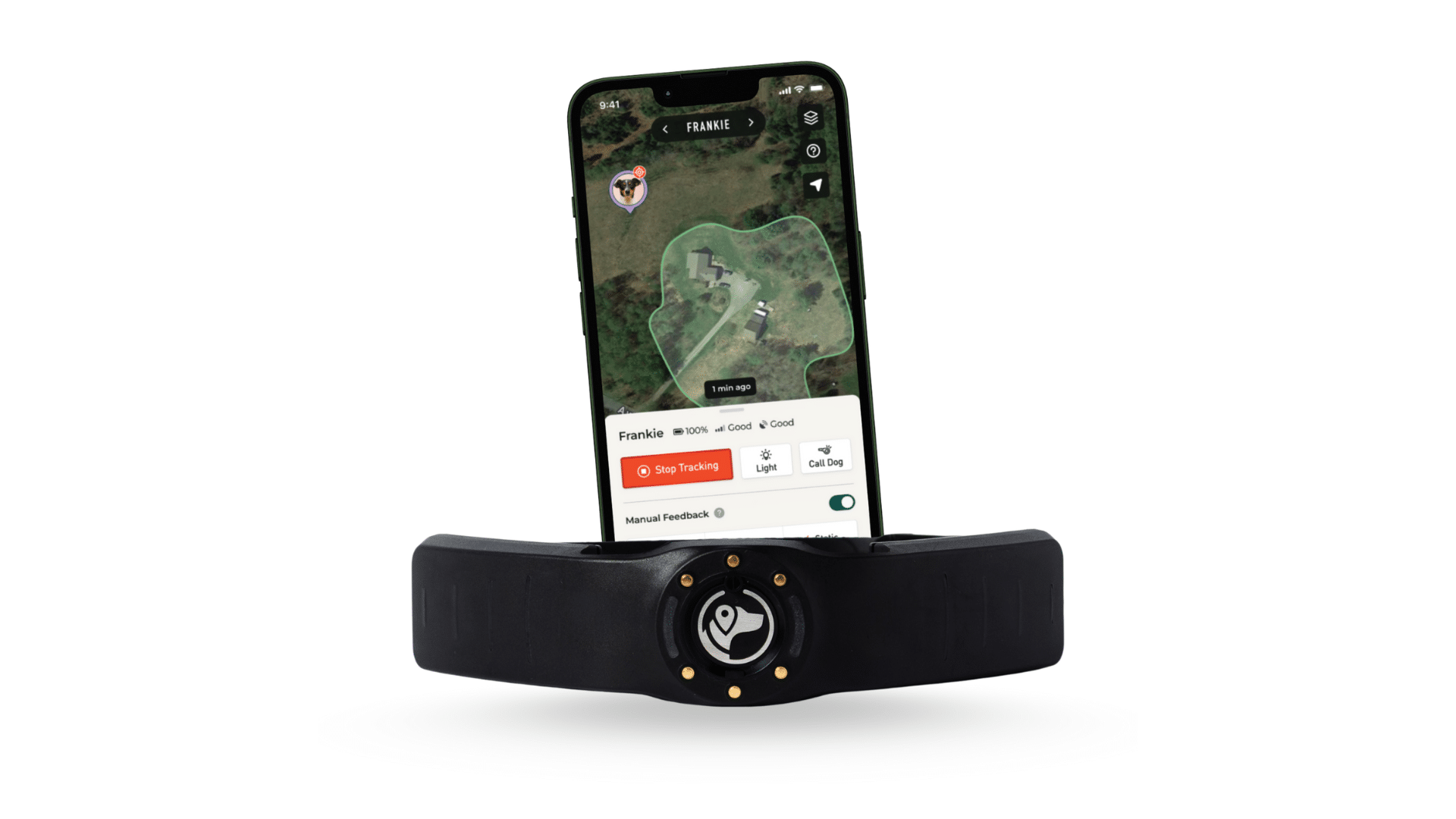
SpotOn GPS Dog Fence (Nova)
If you want proof a GPS fence can genuinely contain a dog, this is it. SpotOn’s True Location™ positioning pulls from 120+ satellites across four networks and holds the boundary to roughly 2 to 5 feet even under tree cover (it ships a Forest Mode for exactly that). No buried wire, no monthly fee to keep the fence running.
What we like
- Tightest real-world accuracy (2 to 5 ft) and best performance under trees
- No monthly fee to run the fence, you own it outright
- Free 30-minute call with a certified trainer to set the dog up right
- No upper limit on property size; walk any shape boundary
The catches
- Highest up-front price ($999 Nova / $899 Omni)
- Large collar, built for medium-to-large dogs, not toy breeds
- ~22 hr battery, most owners charge it nightly

Halo Collar
A strong, more affordable option for an open suburban yard, slicker app, longer battery, Cesar Millan training program. The catch worth knowing before you decide if it’ll work for you: the fence only functions while you pay the Pack Membership (from ~$9.99/mo).
What we like
- Lower up-front price than SpotOn
- Longest battery life, up to 48 hours
- Polished app with activity/health tracking and indoor beacons
The catches
- Pack Membership is mandatory, the fence stops if you stop paying
- Accuracy can drift more (3 to 10 ft) near dense trees or buildings
- Base plan caps you at 5 saved fences
The short answer: yes, but with conditions
A quality GPS dog fence works. On open or lightly-wooded land, with a dog that’s been trained on the boundary, the best systems hold a dog inside a software fence as reliably as many owners would get from a buried wire, and far more conveniently. That’s not a hedge; it’s what the field testing shows and what thousands of acreage owners rely on daily.
The reason the answer needs an asterisk is that “GPS dog fence” covers a huge quality range, from $999 systems engineered for wooded acreage down to cheap collars that struggle the moment a cloud rolls over. And unlike a physical fence, a GPS fence is a learned boundary, not a wall, it works because the dog has been taught to turn back at a warning tone, not because anything physically stops it. So whether a GPS fence “works” depends on three things you control:
- The system you buy. Accurate positioning (True Location™-class, multi-satellite) is the difference between a tight 2 to 5 ft boundary and one that wanders 30+ feet.
- Your land. GPS needs a view of the sky. Open and rural land is ideal; dense canopy, deep valleys and tight urban lots make it work harder.
- The training. One to two weeks of consistent boundary training is what turns the hardware into a fence the dog actually respects.
Get all three right and a GPS fence is genuinely reliable. Skip the training, buy a bargain collar, or expect it to work in a forested gully, and you’ll be in the camp that says they “don’t work.” The rest of this guide breaks down each factor so you can tell which camp you’ll land in.
How a GPS dog fence works
A GPS dog fence replaces a buried wire (an in-ground invisible fence) or a plug-in radio bubble with a boundary drawn in software. You open the app, walk or draw your property line on a satellite map, and a small computer in the collar figures out where the dog is by listening to positioning satellites overhead. When the dog approaches the line, the collar warns it, first with a tone, then vibration, then a static correction if it ignores both. The dog learns to retreat at the tone, and that’s the fence.
Crucially, there’s no base station and no wire. The “fence” lives entirely in the collar and the app, which is why you can reshape it any time, save a different boundary for the cabin, or fence land that would be impossible to trench. The collar checks the dog’s position several times a second and compares it to the boundary you set, deciding in real time whether the dog is safe, near the edge, or crossing.
The whole thing hinges on one question: how precisely does the collar know where the dog is? That’s not a fixed number, it depends on how many satellites the collar can see, which positioning networks it uses, and how cleverly it filters the signal. Which is exactly where accuracy comes in.
How accurate are GPS dog fences, really?
Accuracy is the whole ballgame, and it’s where honest numbers matter. Here’s the real-world range:
- Best systems (e.g. SpotOn): roughly 2 to 5 feet in good conditions, holding near 5 feet even under tree cover. SpotOn’s True Location™ pulls from 120+ satellites across four networks (GPS, GLONASS, Galileo, BeiDou) and cross-checks positions to fight drift.
- Good premium systems (e.g. Halo): around 2 to 10 feet in the open, widening near dense trees or tall structures.
- Budget collars: frequently 15 to 30+ feet, and worse in poor conditions, which is why they get a reputation for “not working.”
The enemy of accuracy is GPS drift: when the signal bounces off trees, walls, hills or metal, the collar’s idea of where the dog is can wobble. On a budget unit that wobble can be tens of feet, which means false corrections (the dog gets warned while standing safely in the yard) or a dog crossing the real line before the collar notices. The premium systems fight drift by reading more satellites, more networks, and filtering the data. SpotOn even ships a dedicated Forest Mode for wooded land, and can work off-grid with no cell coverage.
If you want the deep comparison of which systems hit which numbers, see our best GPS dog fence roundup and the head-to-head SpotOn vs Halo breakdown.
Do GPS dog fences work in the woods?
This is the single most common worry, and the honest answer is: the good ones do; the cheap ones don’t. Tree canopy is the toughest environment for any GPS device because leaves, branches and wet wood scatter and weaken the satellite signal, that’s what causes the drift owners notice on cloudy days or under heavy cover.
Premium systems are specifically engineered for it. SpotOn’s Forest Mode and multi-network positioning are built to hold a boundary under canopy, and reviewers consistently rate it the most reliable GPS fence for wooded and rural land. Halo improves with each hardware generation but is more prone to wander near dense trees. Budget collars largely fall apart in real woods.
What still defeats every GPS fence: a deep, narrow ravine with sky blocked on both sides, the dense interior of a thick forest with no sky gaps, or land hemmed in by tall buildings. In those spots, an in-ground wired fence, which doesn’t care about the sky, is the more reliable tool. For partly-wooded or large rural land, though, a top GPS system genuinely works; we cover this in depth in our large & wooded property guide.
Where GPS dog fences struggle (the honest list)
No one selling these will lead with the downsides, so here’s the straight version of where a GPS fence is the wrong tool or needs extra care:
- Tiny urban yards surrounded by buildings. Reflected signal off walls causes drift, and most premium systems want a minimum boundary (SpotOn ~⅓ acre) bigger than a small city lot.
- A dog already at full sprint. Position refreshes every couple of seconds, so a flat-out runner can clear a few feet before the correction lands. The fence relies on the dog respecting the tone before it’s committed to bolting.
- High-prey-drive or panic-prone dogs. A dog that will take a static correction to chase a deer, or that bolts in a thunderstorm, can blow through any learned boundary. GPS or wired.
- Deep canopy, ravines, or no clear sky. As above: GPS needs to see satellites.
- Skipping training. The most common reason a GPS fence “doesn’t work” is that the dog was let off-line before it understood the boundary.
None of these are reasons to avoid GPS fences, they’re reasons to match the tool to your situation. If your land and dog fit, a quality system is reliable. If you’re in one of the hard cases above, a wired fence or a physical fence is the safer call, and we lay out exactly when to choose which in our GPS vs wireless vs wired comparison.
Are GPS (invisible) dog fences humane?
This deserves a straight answer because it’s where a lot of buyers hesitate. A GPS fence can be humane, and modern systems are designed around making it so, but how you use it matters.
Every reputable system is tone-first: the dog hears a warning beep well before the boundary, and a properly trained dog turns back at the beep and never feels anything else. Vibration is the next step, and the static correction is a last resort the dog rarely reaches once trained. On the best systems the static is fully adjustable across many levels (SpotOn offers 30, Halo 15) so you can find the gentlest setting that gets a response, and static is off by default on collars like Halo until you enable it. The correction is a startle, comparable to a carpet static shock, not a punishment.
The humane question really comes down to training, not hardware. Used correctly, gradual boundary training, the lowest effective setting, a dog that’s a good temperament fit, a GPS fence causes brief, mild discomfort during learning and essentially none afterward, while giving the dog far more freedom to roam than a leash or a small kennel. Used badly, high static, no training, a fearful dog left to hit the line repeatedly, it’s stressful and unfair. Many trainers and behaviorists are fine with the former and firmly against the latter.
How much training does a GPS fence need?
Plan on one to two weeks of consistent, daily practice before you trust the fence off-leash, this is the step that decides whether the fence “works.” The standard method is gradual:
- Days 1 to 3: walk the boundary on a long line with the collar on warning-tone only. The dog learns the flags/edges and that the tone means “turn back here.” Lots of treats and praise for retreating.
- Days 4 to 10: keep practicing on the long line, adding gentle distractions, letting the dog start to self-correct at the tone. Introduce the next level only if the dog ignores the tone.
- Week 2+: supervised off-line time, gradually extending as the dog proves reliable.
The best systems make this easier: SpotOn includes a free 30-minute session with a certified trainer, and Halo ships an in-app program co-developed with Cesar Millan. The collars are the same in this respect, the training is what builds the fence in the dog’s head, and rushing it is the number-one cause of escapes.
GPS vs wireless vs wired: which actually contains a dog?
“Does it work” is partly a question of which kind of invisible fence. There are three, and they trade precision against flexibility:
| Type | How well it contains | Best for |
|---|---|---|
| In-ground (wired) | Most precise, razor-sharp boundary, unaffected by trees or sky | Small, wooded or tightly-bounded yards where inch-perfect edges matter |
| Wireless (radio) | Decent but only a circle that warps near walls/metal | Simple round, open yards; cheapest and fastest to set up |
| GPS | Reliable on open/rural land; any shape, any size; needs sky | Large, open, irregular or temporary land, the only option for real acreage |
So all three “work”, for the right property. A wired fence is the most reliable containment per dollar but you can’t move it and you have to dig. A wireless fence is the cheapest but only makes a wobbly circle. A GPS fence is the only one that fences any shape of large land with nothing to install, at the cost of needing open sky and being the least pinpoint-precise. For most big-dog owners on acreage, GPS is the practical winner. We compare all three in detail in the GPS vs wireless vs wired guide.
So should you buy one?
Here’s the decision in one paragraph. Buy a GPS fence if you have open, rural, large or irregular land with reasonable sky, a stable-tempered dog, and you’re willing to do the one-to-two weeks of training, that’s the sweet spot where they genuinely work, and a top system like SpotOn will reliably contain your dog with no buried wire and no recurring fee. Choose a wired or physical fence instead if you have a tiny urban lot, deep canopy or a ravine, or a high-prey-drive dog that bolts regardless of correction.
If you’re in the “yes” camp, the systems that earn it are the two at the top of this page. SpotOn for accuracy and no subscription, Halo as the cheaper open-yard option. Read the full SpotOn GPS fence review and our SpotOn vs Halo comparison before you commit, and use the 90-day trial both offer, set the fence up on your own dog and land, and let the results answer the question for you.
Keep researching the GPS-fence field
Do GPS dog fences work: common questions
Do GPS dog fences actually work?
Yes, a quality GPS dog fence reliably contains a dog on open or lightly-wooded land, provided the dog has been trained on the boundary. The best systems hold to within 2 to 5 feet. They work less well on tiny urban lots, in deep canopy or ravines, and with dogs that bolt regardless of correction. The honest rule: a good system + suitable land + one to two weeks of training = a fence that works; skip any of those and it won’t.
Are GPS dog fences reliable?
The premium ones are. Systems like SpotOn hold a 2 to 5 ft boundary and stay accurate even under tree cover using multi-satellite positioning and drift correction. Budget collars are the unreliable ones, drifting 15 to 30+ feet and triggering false corrections. Reliability also depends on open sky and proper training, a well-trained dog on suitable land with a good system gets containment comparable to a buried wire.
Do GPS dog fences work in the woods?
Good ones do; cheap ones don’t. Tree canopy is the hardest environment for GPS because leaves and branches scatter the satellite signal. Premium systems are engineered for it. SpotOn ships a Forest Mode and uses multiple satellite networks to hold the line under cover. What defeats every GPS fence is a deep ravine or thick forest interior with no clear sky; in those spots a wired in-ground fence is more reliable.
Are invisible (GPS) dog fences humane?
They can be, when used correctly. Reputable systems are tone-first: a trained dog turns back at the warning beep and rarely feels the adjustable static, which is a last resort comparable to a carpet static shock. The static is off by default on many collars until you enable it. Used with gradual training and the lowest effective setting on a stable-tempered dog, a GPS fence is a humane way to give a dog freedom. Used with high static and no training on a fearful dog, it isn’t, the humaneness is in how you use it, not the hardware.
What happens if my dog escapes a GPS fence?
A determined dog at full sprint can occasionally clear the boundary before the correction lands, since position refreshes every couple of seconds. If that happens, most systems send a breach alert to your phone, and premium ones offer live GPS tracking to find the dog. Tighter-accuracy systems shrink the escape window, and once the dog is outside the boundary the collar typically stops correcting so it doesn’t punish the dog for being out. Good training to a reliable tone response is the real prevention.