 Dog Gear, Sized Right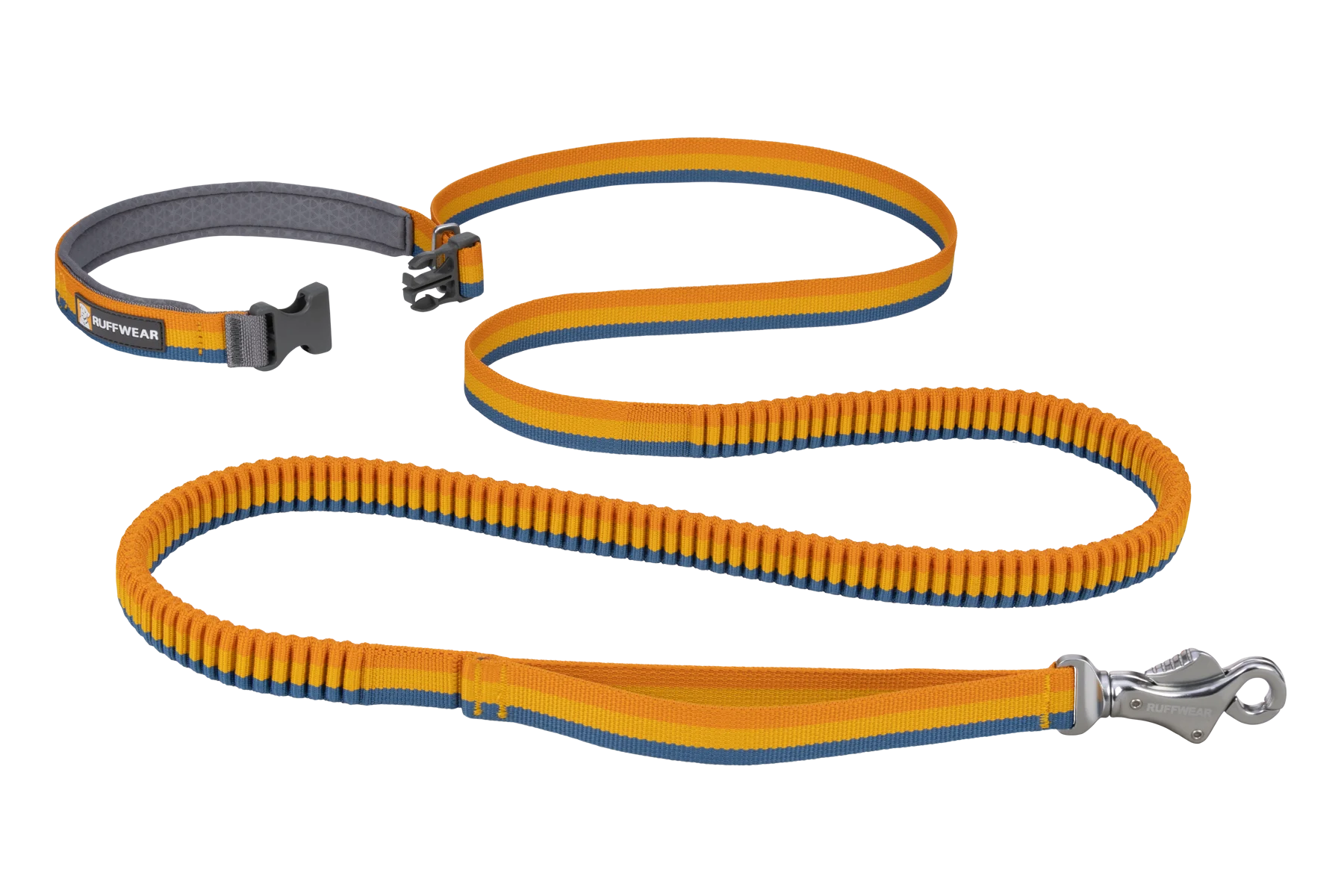
Best Rope Dog Leash: Climbing-Rope & Braided Picks (2026)
A rope leash handles large-dog pulling differently to flat nylon: the round cross-section spreads force across your whole palm, not one narrow strap-edge. Here are the two rope leashes worth buying, one climbing-rope, one braided, with the full breakdown of what separates kernmantle construction from twisted cord and why the clip type matters more than the rope type.
Most dog leashes are flat nylon webbing. That’s fine for a 20-pound dog who doesn’t pull hard. Put the same leash on a 70 or 90-pound dog who pulls on every walk, and the strap concentrates all of that force along a narrow edge across your palm. Over a 45-minute walk, or over years of daily walks, that adds up. A rope leash is a different tool: the round cross-section distributes the same force across your whole grip, the way a climbing rope does in a belayer’s hand. The result is a leash that is genuinely more comfortable to hold under sustained pulling force. Below we break down the two types of rope leash (climbing-rope vs braided nylon), rank our top two picks, and explain exactly what to look for in construction, diameter, clip design and length, so you pick the right rope leash once rather than cycling through cheap twisted-cord versions that fray and fail within a year.
Best rope dog leashes: our top 2 picks
Both picks are verified rope-style leashes (climbing-rope and braided nylon). Every buy button goes to a live listing, prices are last-checked, tap through for the current price.
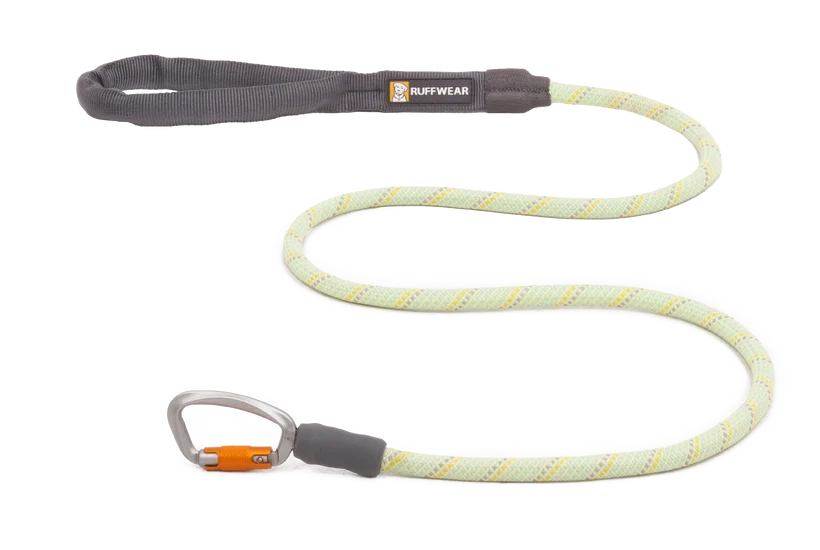
Ruffwear Knot-a-Leash™ Rope Dog Leash
The Knot-a-Leash is the only rope dog leash that is actually built like climbing rope. Most “rope leashes” are just twisted nylon cord with a snap clip. The Knot-a-Leash uses kernmantle construction, the engineering standard of real climbing ropes: a braided outer sheath (the “mantle”) over a load-bearing inner core (the “kern”). The sheath takes the abrasion, UV and moisture so the core stays intact; that’s why climbing rope lasts years of hard use while twisted cord frays and weakens in months. The round profile, thicker and more uniform than flat webbing, means the rope lies across your entire palm grip rather than biting across one narrow edge when a large dog pulls. The swiveling carabiner clip is a genuine upgrade from a wire-gate snap: it requires a deliberate two-motion open (swing gate + push) so it won’t accidentally pop open when your dog lunges sideways, and the swivel means the rope doesn’t corkscrew and kink under an active dog’s constant direction changes, a common failure point on non-swivel rope leashes. Reflective strands are woven into the rope itself, not stuck on as a strip, so they won’t peel or fade with washing. An accessory loop on the handle lets you clip a waste bag pouch or short traffic handle without breaking stride. Available in four colours, two lengths (3.5 ft and 6 ft, order the 6 ft for daily walking), two sizes (standard and small). Backed by Ruffwear’s lifetime warranty.
What we like
- Kernmantle engineering: the same rope structure used in climbing, a braided sheath protects a load-bearing core, not just twisted cord
- Swiveling carabiner requires deliberate motion to open, won’t snap out under the lateral force of a lunging dog
- Rope doesn’t corkscrew under load because the swivel takes the twist out, huge for active or reactive dogs
- Reflective strands woven in at manufacture, won’t peel or fade, unlike stick-on reflective strips
- Lifetime warranty: Ruffwear replaces it if it fails, full stop
The catches
- At ~$29 it’s more than budget rope alternatives, worth it for the kernmantle build quality and lifetime warranty
- Swiveling carabiner takes a deliberate two-step motion to open, intentional but takes a few days to make automatic
- 3.5 ft version is short for daily walking, order the 6 ft unless you specifically want the shorter trail lead
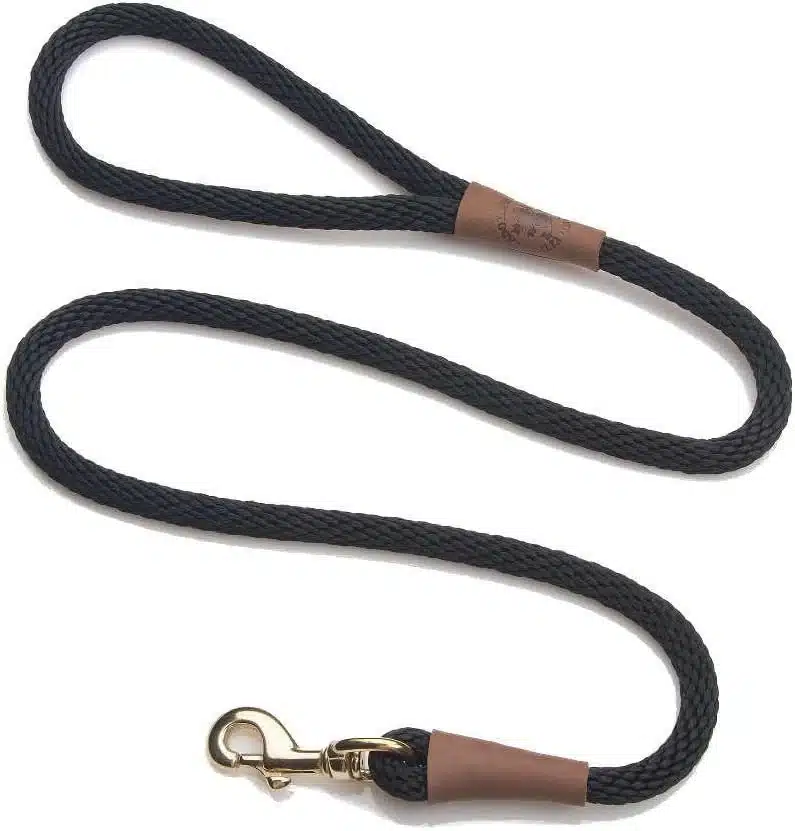
Mendota Pet Snap Leash (Large Breeds). Braided Nylon
Before climbing-rope leashes, there was the Mendota Snap Leash, and for many trainers and experienced large-dog owners, it’s still the benchmark. It’s a braided nylon snap lead in the British style: a 1/2-inch round rope that forms both handle and leash in one continuous piece of braided nylon. The 1/2-inch diameter is the critical spec, it’s sized for large breeds, not the thin 3/8-inch cord that passes for a “rope leash” on budget alternatives. A 1/2-inch rope distributes pull force across a round contact surface in your palm, which is significantly more comfortable than an equivalent-width flat strap when a 70 or 80-pound dog leans into it for an hour of training. The snap clip is a bolt-snap sized for large-dog hardware, a solid sliding-gate design, not a light wire spring that flexes under lateral force. At 6 feet fixed, it’s the professional standard: long enough for a natural loose-lead walk, short enough to reel in quickly and maintain control. Braided nylon vs kernmantle rope: the Mendota is softer and more flexible in the hand (braided nylon is twisted slightly loosely), while the Knot-a-Leash is firmer and more abrasion-resistant (kernmantle sheath). Both feel like rope in your hand rather than strap. For training, obedience work, heel, recall, the Mendota has been the professional trainer’s pick for decades. Made in Wisconsin, USA, since the 1970s. Available in a wide range of colours. At under $25, it’s exceptional value that outlasts a dozen budget “rope” leashes.
What we like
- 1/2-inch diameter is the right size for large breeds, round and grippy, not thin cord that slips
- Bolt-snap clip is solid and sized for large-dog D-rings, far more secure than wire-gate snaps at this price
- Made in Wisconsin since the 1970s: genuine durability and quality, not an overseas copy
- 6-foot fixed length is the professional training standard, the right length for most large-dog work
The catches
- Fixed 6 ft only, no swivel, no carabiner, not adjustable
- Braided nylon absorbs water; air-dry after wet walks, takes longer to dry than kernmantle rope
- Bolt-snap only, correct for daily walking and training, not suitable as a tie-out or tether
Climbing-rope vs braided nylon: the two types of rope leash
“Rope leash” covers two very different constructions, and understanding the difference is the first step to picking the right one:
- Kernmantle (climbing-rope construction). The same engineering used in real climbing rope. A braided outer sheath, the mantle, wraps around a separate inner core, the kern, that carries the load. The sheath takes the abrasion, UV, water and heat; the kern carries the tension. This is why real climbing rope can be used hard for years without the core weakening. The Ruffwear Knot-a-Leash uses kernmantle construction, it’s the only dog leash we’ve found that does. The result is a rope that ages better than braided or twisted alternatives under the daily abuse of a large, active dog. Best for: active dogs, daily hard use, owners who want a leash built to last.
- Braided nylon rope. The classic British-style snap lead: nylon fibres braided together around a central axis, then looped into handle + leash in one piece. Softer and more flexible than kernmantle rope, it drapes more naturally and is easier to coil. The Mendota Snap Leash is the standard: 1/2-inch braided nylon in the exact diameter and construction that professional dog trainers have used for decades. Best for: training work, traditional feel, owners who prefer a softer rope in the hand.
- Twisted/multi-strand cord. The cheapest and weakest “rope leash” construction: individual strands twisted around each other with no sheath protection. These untwist under sustained tension, lose strength faster than braided alternatives, and tend to fray at the ends within months of daily use on a large dog. Avoid for large dogs: the construction is simply not durable enough for the load.
Both our picks, the Knot-a-Leash and the Mendota, meet that bar from different directions. The Knot-a-Leash is built for performance and longevity; the Mendota is built for training tradition and daily professional use. Which is right depends on what you’re doing with the leash.
Why rope is easier on the hand than flat nylon for a large, pulling dog
This is the central argument for a rope leash over flat webbing, and it’s worth understanding properly rather than taking at face value:
The geometry of force. When a dog pulls against a flat nylon strap, the leash contacts your hand along a narrow line, the edge of the webbing. On a 3/4-inch or 1-inch leash, that’s a contact strip of roughly 3/4 to 1 inch across your palm. A 70-pound dog pulling at moderate effort applies perhaps 30 to 40 pounds of sustained tension. All of that force is concentrated along that 1-inch line. Over 45 minutes, your skin and the tendons in your palm are taking repeated micro-stress along that narrow contact point.
A 1/2-inch round rope has a contact area that curves across your palm when you grip it. The rope presses against a larger surface area of skin, roughly 2 to 3 times as much as the same “width” flat strap, because it’s round. The same 40 pounds of tension is spread across more skin and more soft tissue. That’s why rope feels more comfortable under sustained pulling force.
The practical limits. A rope leash does not reduce the force the dog is applying. It only redistributes how that force contacts your hand. If your dog pulls with 60+ pounds of sustained force, the kind you get from a 90+ lb dog that pulls hard on every walk, a rope leash will be more comfortable than flat nylon but will not be comfortable in an absolute sense. At that level, the correct solution is a front-attachment no-pull harness that redirects the dog and reduces the actual pulling force, paired with a rope leash for the reduced-force that remains.
The training case. For formal training work, heel, recall, close-quarter manners, rope leashes have an additional advantage: they give you more tactile feedback through the leash than flat nylon does. The round cross-section is more responsive to small changes in tension, which is why professional trainers have used braided nylon leads rather than flat webbing for decades. The Mendota is the trainer’s rope leash precisely because of this feedback quality.
What rope doesn’t solve. A rope leash is not a pulling solution by itself. It won’t stop your dog pulling, and it won’t fix the fatigue of walking a dog who puts 40 pounds of sustained tension on the line every walk. But for an owner who already has a dog with manageable pulling force and wants a leash that’s more comfortable to hold through the inevitable tugs and reaction-pulls, a rope leash is a meaningful upgrade from flat nylon. Think of it as ergonomic improvement, not a behaviour solution.
Rope leash diameter: the right size for your dog’s weight
Rope leash diameter affects both strength and hand comfort. Here’s a practical guide by dog size, because a rope leash that’s too thin for your dog is both uncomfortable and potentially unsafe:
| Dog weight | Minimum rope diameter | Recommended pick |
|---|---|---|
| Under 30 lb | 3/8 inch | 3/8 to 1/2 inch; more styles available |
| 30 to 60 lb | 1/2 inch | 1/2 inch is the right standard size |
| 60 to 100 lb | 1/2 inch | 1/2 inch braided; kernmantle preferred |
| 100 lb+ | 1/2 inch minimum | Kernmantle rope (Knot-a-Leash) for sustained use |
The 3/8-inch diameter ropes you see marketed as “rope leashes” on budget listings are undersized for a large dog. At 3/8 inch, the rope has a similar contact surface to a narrow flat-webbing strap, you lose the ergonomic advantage of the round cross-section. For a 60+ lb dog, 1/2 inch is the minimum usable diameter: thick enough to contact the full width of your palm grip, strong enough that the rope doesn’t fatigue from being coiled and uncoiled under tension every day.
Beyond diameter: the braid matters. A 1/2-inch twisted cord (multi-strand, unsheathed) is not the same as a 1/2-inch braided rope. The twist loosens under sustained tension and load cycling; the braided construction stays round and retains its strength much longer. If the product description says “twisted” or doesn’t specify “braided” or “kernmantle,” assume it’s the weaker construction.
Swiveling carabiner vs snap clip: which attachment is better on a rope leash?
The clip on a rope leash deserves more attention than it usually gets, because it’s the highest-stress point on the entire system:
- Swiveling carabiner (Ruffwear Knot-a-Leash). A carabiner-style gate that requires a deliberate two-motion action to open (swing gate + push barrel), paired with a swivel that allows the rope to rotate relative to the clip. The locking mechanism means the carabiner won’t accidentally open when your dog’s collar or harness ring pushes against the gate at an angle, which is exactly what happens when a large dog lunges sideways. The swivel means the rope doesn’t develop a corkscrew twist from an active dog’s direction changes, which is a chronic problem on rope leashes with fixed (non-swivel) clips: the rope twists tighter with each circuit until it starts to kink and weaken the outer braid. Best for: active dogs, working dogs, any dog where accidental clip-opening is a concern.
- Bolt-snap hook (Mendota). A solid sliding-gate snap, the gate slides sideways rather than bending, which gives it a much higher load tolerance than a wire-gate snap. It opens and closes in one motion, faster in daily use, and doesn’t require the deliberate two-step of a carabiner. The trade-off is that a bolt-snap has no swivel, so if your dog is very active and changes direction often, the rope will accumulate twist over time (which you manage by untwisting the leash regularly). Best for: training sessions, daily walking, owners who prioritise quick attach/detach over locking security.
- Wire-gate snap. The standard clip on most budget rope leashes. The wire gate bends to open, which means a large dog lunging sideways applies exactly the kind of lateral force that can flex the gate open. Not recommended for large dogs on a rope leash: you’re buying a rope leash for its durability, but then mating it to the weakest clip type. Upgrade the clip before the rope if you have a budget rope leash with a wire-gate snap.
The practical difference: for a calm to moderately active large dog on daily walks, either the swiveling carabiner or the bolt-snap is appropriate. For a reactive, high-energy or very strong dog who frequently lunges and changes direction, the swiveling carabiner of the Knot-a-Leash adds a meaningful safety margin that the bolt-snap alone doesn’t provide.
For both picks: check that the clip fits the D-ring on your harness or collar without rocking. A clip that rocks sideways on the D-ring is more likely to open under off-axis load. If it rocks, the clip is too small for your hardware, a problem with wire-gate snaps on the thick rings of large-dog harnesses.
Rope leash length: which length for daily walking, training and trails
Rope leashes come in the same standard lengths as flat-webbing leashes, but the physical properties of rope affect how each length handles:
- 4 ft. Tighter control, good for hectic city environments, dogs who are still learning loose-lead walking, or anywhere you want your dog very close. On a rope leash specifically, 4 ft gives you a compact, coilable lead that handles well in confined spaces. The trade-off: it’s short for a large, long-striding dog and can feel restrictive on an open path.
- 6 ft. The standard for everyday walking. Long enough for your dog to sniff, explore and walk naturally; short enough to reel in quickly and maintain control. Both our picks are available in 6 ft, this is the length to order unless you have a specific reason for shorter or longer. For training, 6 ft is the professional standard.
- 3.5 ft (Knot-a-Leash short version). Designed for trail use where you want a shorter, more manageable leash on a dog that’s close-heeling. At 3.5 ft it’s also light to pack. Not the right choice for daily park walking, the restriction will frustrate a dog accustomed to a standard 6 ft lead. Order the 6 ft version of the Knot-a-Leash for everyday use.
One rope-specific consideration: rope leashes coil more naturally than flat webbing leashes, which makes them easier to manage on long walks when you’re looping the excess around your hand. Flat nylon webbing stays flat; rope takes the coil shape and stays put. This is a minor but real practical advantage for daily walking.
What rope leashes don’t work as: long-lines (15 to 50 ft). Long training leads in rope exist but rope at that length becomes heavy and unmanageable compared to flat biothane or nylon webbing. For recall training at distance, a flat 20 to 30 ft lead is the practical choice. Our full dog leash guide covers long-lines separately.
When a rope leash isn’t the right choice
Rope leashes have real advantages, but they’re not the universal answer. Here’s where a flat nylon or biothane leash is better:
- Bungee / shock absorption. If your dog is extremely strong or reactive, 90+ lb with sudden lunges that jerk your shoulder, a bungee section is the specific tool you need. Rope leashes have no elastic component. A bungee leash like the Ruffwear Roamer absorbs the jolt of a sudden lunge in a way rope (however comfortable) cannot. Rope is ergonomically better for sustained pulling; bungee is better for sudden high-force impact events. For the most powerful dogs, consider a bungee leash for reactive situations and a rope leash for steady trail walks.
- Wet conditions and swimming dogs. Rope absorbs water more than flat nylon or biothane. A wet rope leash is heavier and dries slowly. For a dog that swims regularly or walks in heavy rain, a biothane leash (waterproof, rubber-coated polyester) is a better choice, it wipes clean in seconds and doesn’t carry water weight. Kernmantle rope handles water better than braided nylon, but biothane still wins in genuinely wet environments.
- Traffic-heavy urban environments where a double handle matters most. Most rope leashes don’t have a second traffic handle near the clip. For a large, reactive dog in a busy city, where you need to shorten the leash instantly to pull your dog close when a cyclist or child appears, a flat nylon double-handle leash (with a padded traffic handle near the clip) is more practical than a single-handle rope leash. Our guide to leashes for large, strong dogs covers double-handle leashes in detail.
- Long recall training lines. As noted above, rope at 20+ ft is heavy and awkward. Flat nylon or biothane is the right material for a training long-line. Our full-spectrum leash guide covers the right materials for long-line work.
Rope vs flat nylon vs biothane: material comparison for large dogs
All three materials are used in quality dog leashes. Here’s how they compare for the specific demands of a large dog:
| Property | Rope (kernmantle/braided) | Flat nylon webbing | Biothane |
|---|---|---|---|
| Hand comfort under sustained pulling | Best, round cross-section spreads load across palm | OK at 1″ width; thinner widths cut into hand | Good, soft and smooth, won’t edge-cut |
| Bungee / shock absorption | None, rope is inelastic | None (except bungee-specific leashes) | None |
| Water performance | Absorbs water, dries in hours | Absorbs water, dries similarly | Best, waterproof, wipes clean instantly |
| Durability / abrasion resistance | Kernmantle: excellent; braided: good; twisted: fair | Quality Tubelok-style: excellent; budget nylon: poor | Excellent, rubber coating resists abrasion and UV |
| Training feedback (tactile) | Best, round rope gives nuanced tension feedback | Good at 1″ width | Good, smooth and consistent |
| Night visibility (reflective) | Depends on product (Knot-a-Leash: yes) | Depends on product | Depends on product |
| Price range | $23-$35 for quality picks | $13-$50 (wide range) | $25-$60 for good biothane |
For most large-dog owners who want daily comfort on an already-manageable puller, a quality rope leash is the upgrade that makes the most difference day-to-day. If wet conditions are the primary concern, biothane edges rope out. If shock absorption is the primary concern, because you have a very strong, reactive dog, a bungee leash addresses the root problem that rope cannot.
For training specifically, the rope’s tactile feedback makes it the professional preference. That’s been true since the Mendota’s British-style snap lead became the standard in obedience training decades ago, and it’s still why most professional trainers reach for a braided or kernmantle rope lead over flat nylon for precision work.
Whatever rope leash you pick, pair it with the right hardware: a well-fitted no-pull harness that attaches at the chest distributes pulling force across the dog’s body and reduces the peak load you feel through the leash by a significant margin. Rope leash comfort + front-clip harness is the combination that makes large-dog walking genuinely manageable on a dog who still pulls.
Complete the rope-leash walking setup
Rope dog leash questions: honest answers
What is a rope dog leash?
A rope dog leash is a lead made from round rope rather than flat nylon webbing. The round cross-section distributes pulling force across your entire palm grip rather than concentrating it along a narrow strap edge, which makes rope more comfortable than flat nylon when a large dog pulls with any sustained force. “Rope leash” covers several different constructions: kernmantle rope (a braided outer sheath over a load-bearing inner core, the same engineering as real climbing rope, used by the Ruffwear Knot-a-Leash); braided nylon (braided fibres, softer and more flexible, the traditional trainer’s snap lead style used by the Mendota); and twisted cord (cheaper, weaker, not recommended for large dogs). A quality rope leash in 1/2-inch diameter with a solid clip is significantly more durable and comfortable than a budget twisted-cord “rope” leash in 3/8 inch.
Are rope leashes better than nylon webbing for large dogs?
For hand comfort under sustained pulling force, yes, a quality rope leash is better than flat nylon webbing for most large dogs. The round cross-section of the rope distributes the pulling load across a larger area of your palm than a flat strap does, which reduces the edge-cutting fatigue you get on a long walk with a dog who pulls regularly. The improvement is most noticeable with 1/2-inch or larger braided or kernmantle rope compared to 3/4-inch flat nylon. Where flat nylon may be better: if you need a bungee section (rope leashes don’t have one), a double traffic handle, or a waterproof material for a swimming dog (biothane handles water better than rope). For daily walking with a large dog who pulls moderately, rope is the ergonomic upgrade most worth making.
What diameter rope leash is best for a large dog?
For a dog over 40 lb, 1/2-inch diameter is the minimum for a rope leash to give you the ergonomic benefit over flat nylon. At 3/8 inch, the rope is too narrow to meaningfully spread force across your palm, the contact area is similar to a thin flat strap. The Mendota Snap Leash comes in 1/2-inch diameter specifically sized for large breeds. The Ruffwear Knot-a-Leash uses kernmantle rope that is roughly equivalent in contact surface to 1/2-inch braided. For dogs over 80 lb who pull strongly, kernmantle rope (the Knot-a-Leash) is more durable long-term than braided nylon at the same diameter because the sheath protects the load-bearing core from daily wear.
What is a kernmantle rope dog leash?
A kernmantle rope dog leash uses the same construction as real climbing rope: a braided outer sheath (the mantle) wraps around a separate, continuous inner core (the kern) that carries the load. The sheath handles abrasion, UV, moisture and surface wear; the kern carries the tension. This two-part construction is why climbing rope stays strong through years of hard use while simpler twisted or braided ropes weaken from surface abrasion damaging the load-bearing fibres. The Ruffwear Knot-a-Leash is the only dog leash we know of that uses genuine kernmantle construction, it’s why we rank it first for durability and long-term performance on large, active dogs. The trade-off: kernmantle rope is stiffer than braided nylon and a little less flexible in the hand, which is why some trainers prefer the softer feel of traditional braided leads like the Mendota.
What is the difference between a rope leash and a braided leash?
In common usage, “rope leash” and “braided leash” often mean the same thing, both refer to a round-cross-section lead as opposed to flat nylon webbing. The distinction matters when you look at construction: braided refers specifically to fibres braided around a central axis with no separate inner core (the Mendota snap lead is this type); kernmantle rope (which is also braided on the outside) has a separate load-bearing inner core that the outer braid protects, a more complex and durable construction (the Ruffwear Knot-a-Leash). “Twisted cord” is a third type often labelled as a “rope leash” in budget listings: strands twisted around each other with no braiding. Twisted cord is the weakest construction and is not recommended for large dogs. In practice: buy a leash that specifies braided or kernmantle in at least 1/2-inch diameter, and avoid products that only say “rope” without specifying the construction.
Are rope leashes safe for dogs that pull hard?
Yes, a quality rope leash in 1/2-inch braided or kernmantle construction with a solid clip is safe for large, strong dogs who pull. The key specs to check: (1) Clip type, avoid wire-gate snaps on a rope leash for a large puller; use a bolt-snap (Mendota) or a swiveling carabiner (Knot-a-Leash) that won’t open under lateral force. (2) Diameter, 1/2 inch minimum for a dog over 40 lb; under that, the rope doesn’t have the contact surface to be comfortable or the cross-section to resist wear. (3) Construction, braided or kernmantle, not twisted cord. What a rope leash does not do: absorb the shock of sudden lunges (that requires a bungee section). If your dog generates very high peak forces from sudden reactions, pair a rope leash with a front-clip harness to reduce the peak load, rather than relying on the rope alone.
Can I use a rope leash for training?
Yes, rope is actually the traditional training leash material. Professional obedience trainers have used braided nylon snap leads (like the Mendota) for decades specifically because the round rope gives better tactile feedback through the leash than flat nylon webbing. You can feel small changes in tension, a subtle pull, a slight slackening, more clearly through a rope lead than through a flat 1-inch nylon strap. This feedback matters in heel work, recall training and loose-lead walking exercises where you’re communicating through leash pressure. The Mendota Snap Leash at 6 feet fixed is the pick for training specifically. The Knot-a-Leash also works for training but the swiveling carabiner is slower to attach and detach than a bolt-snap, which matters if you’re running multiple exercises with clip changes. For recall training at distance (15 to 30 ft), a flat nylon or biothane long-line is more practical than rope at that length.