 Dog Gear, Sized Right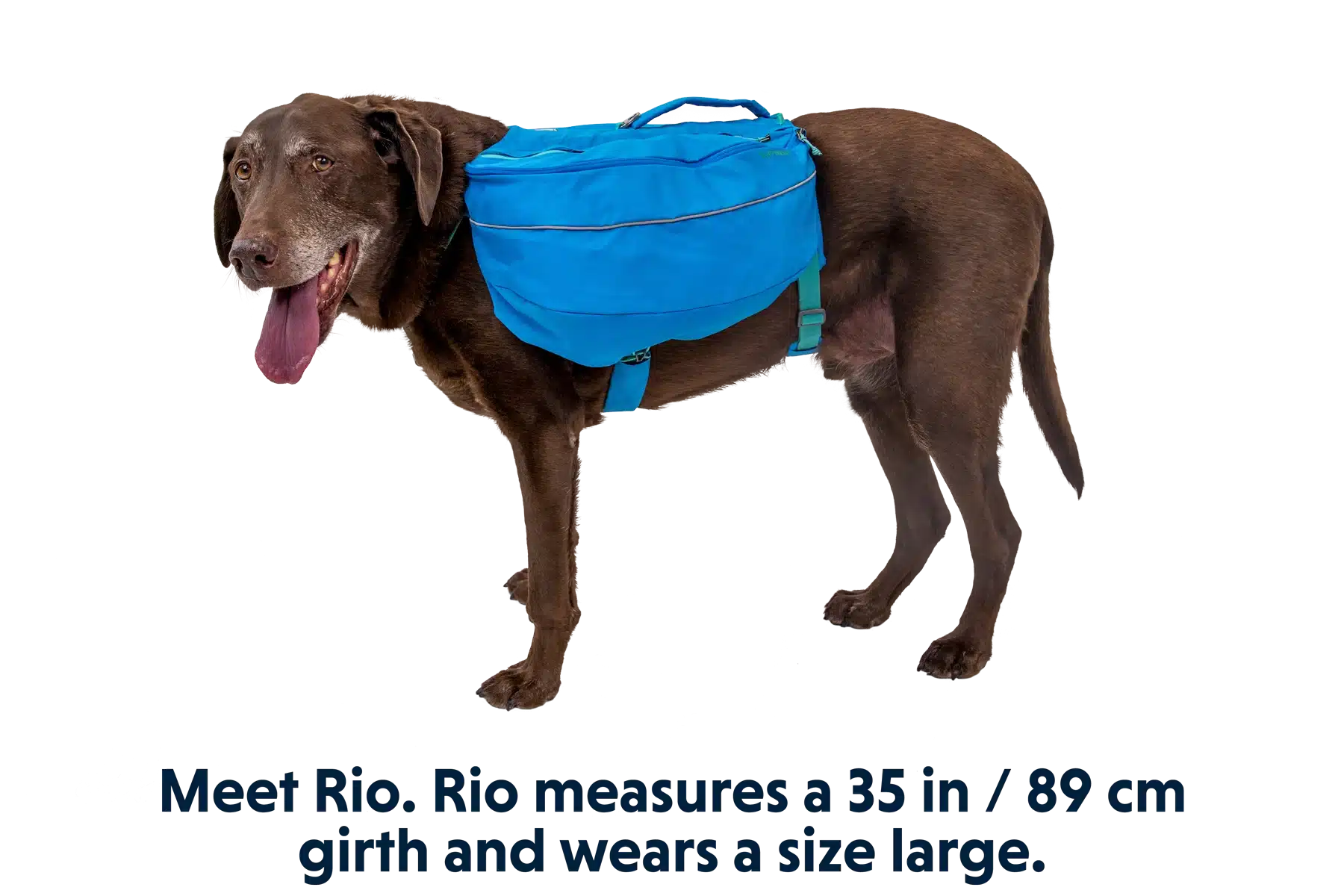
Best Dog Backpacks for Hiking: Saddlebags Your Dog Carries (2026)
Hiking saddlebags your dog wears and carries, the definitive picks for trail dogs who carry their own water and gear, with a complete fit guide and the load rules that actually matter on the mountain.
Search “best dog backpack for hiking” and you’ll find two completely different products: packs that carry the dog (the dog rides inside) and packs the dog wears (the dog carries gear on trail). This guide covers the second type, saddlebag hiking packs your dog wears. If you need a carrier backpack where the dog rides inside because they’re small, senior or need a rest mid-hike, that’s our separate dog backpack carrier guide. Here we cover the saddlebag intent only: verified picks for fit, trail-ready dogs, with the load percentages, fit guide, breed sizing and conditioning protocol to use them safely. Ruffwear makes the gold-standard options; we also cover the best budget pick.
The best dog hiking backpacks (saddlebags)
All three are saddlebag packs the dog wears, not carriers. The dog carries water, treats and trail supplies; you carry nothing extra. All picks are verified in stock. Prices last-checked, tap through for live price.
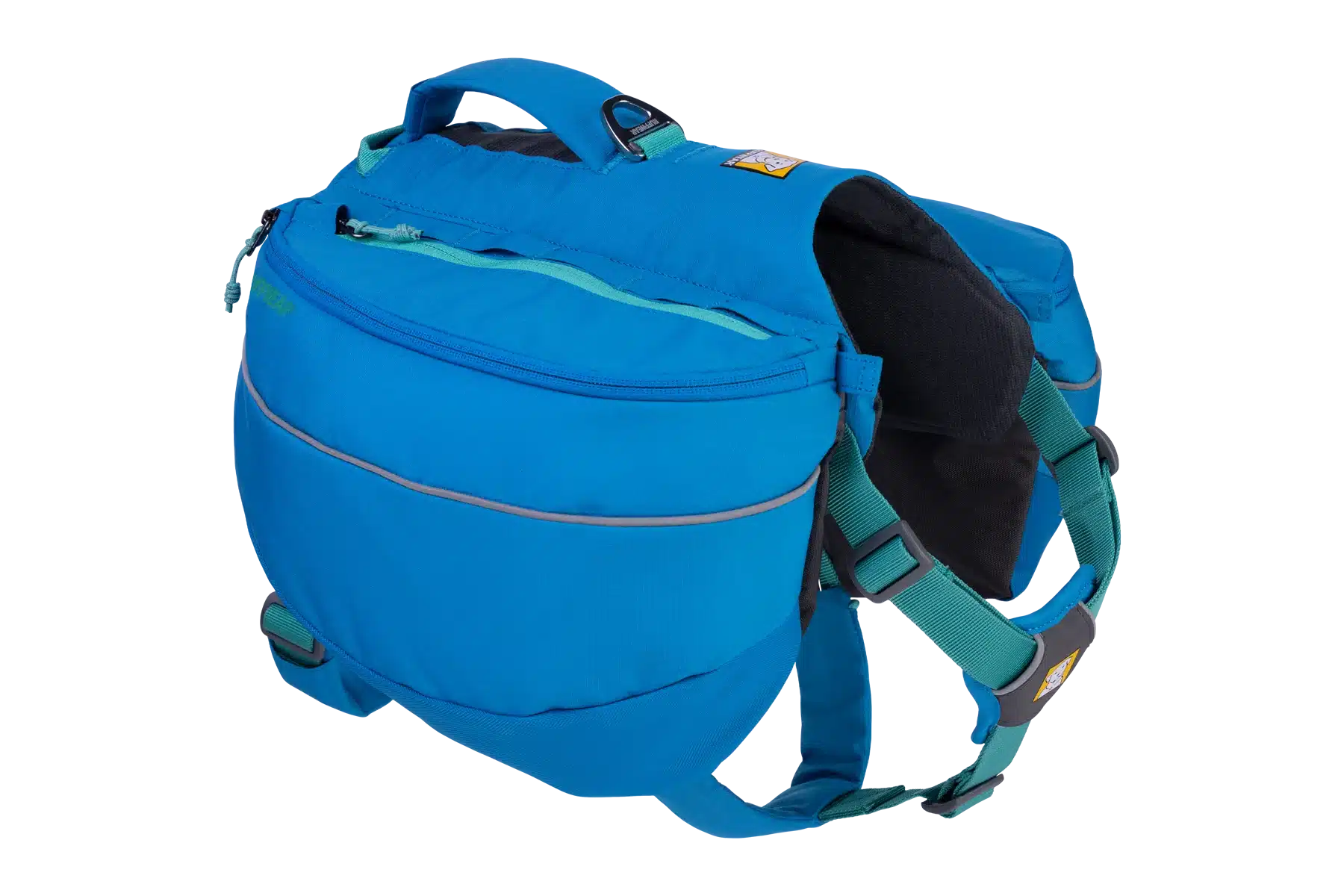
Ruffwear Approach™ Dog Pack
The Ruffwear Approach Pack is the benchmark hiking saddlebag for fit, medium-to-large trail dogs. It is a torso harness with two radial-cut saddlebags attached, the bags sit flush against the dog’s flanks without swinging or catching on brush, and the passive compression system cinches the bags inward as they empty, so the load stays balanced from the first mile to the last. Four compression straps let you dial in the fit tightly against the dog’s torso on rough terrain, and the padded sternum and belly straps lock the pack in place on switchbacks and scrambles. A top handle is built into the spine for quick lifts over obstacles or across stream crossings, and a leash attachment ring sits at the back so the dog can hike tethered without a separate harness. Total bag volume runs across four sizes (XXS through L/XL), enough for a litre of water per side, trail snacks and a small first-aid kit on a full day hike. At around $60, it undercuts the Palisades Pack while covering the majority of day-hike scenarios for dogs weighing 15 to 100 lb depending on size. If you hike a few times a month with a healthy, fit medium or large dog, this is the pack to buy.
What we like
- Passive compression keeps the load balanced as bags empty, no flopping or lopsided feel mid-hike
- Four compression straps let you cinch the fit tightly for rough ground, stream crossings and scrambles
- Top handle for quick lifts over obstacles; leash ring means no separate harness needed
- Radial-cut bags sit flush against the flanks, don’t swing, snag or unbalance the dog on narrow trail
- Best value in the Ruffwear saddlebag range, more capacity than the Front Range Day Pack at a lower price
The catches
- Not a separate harness platform, dogs already measured for the Front Range harness may need re-measuring
- A full overnight kit pushes the bag capacity; step up to the Palisades Pack for multi-day trips
- Reflective trim is minimal on earlier colourways, add a beacon clip if hiking in low light
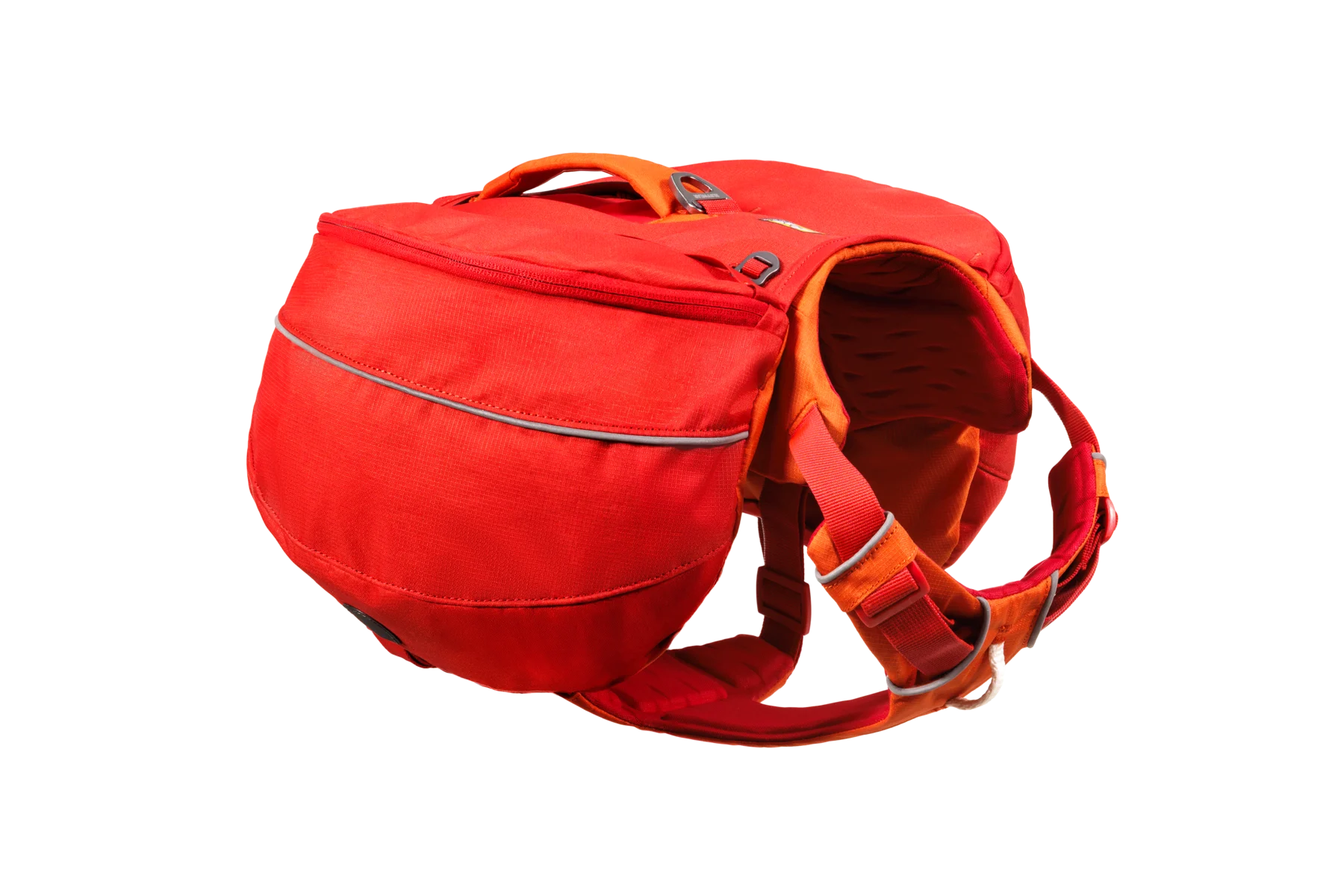
Ruffwear Palisades™ Pack
The Ruffwear Palisades Pack is the step-up from the Approach: Ruffwear’s flagship hiking saddlebag designed for multi-day backpacking trips with dogs who can genuinely carry a meaningful share of the day’s kit. The defining feature is the modular carry system, the two saddlebags are removable and can be supplemented with the optional Ruffwear Approach Pack saddlebags to expand total volume, making this the most configurable pack in the range. The spine-load transfer system channels weight from the bags toward the dog’s back and hips rather than torquing the shoulders, important at higher load percentages. A padded chest piece and four compression straps lock the harness in place, and the dual-density foam back panel reduces pressure points on long carries. Like the Approach Pack, a top handle and leash ring are standard. It fits dogs with a girth of 13 to 42 inches across XS to XL sizes, covering dogs from roughly 15 lb to 100 lb-plus. At around $130, it’s a premium outlay, but for owners who take dogs on two- or three-day trails, the modular system and higher capacity earn the price.
What we like
- Modular saddlebags are removable, configure for a light day hike or a full overnight kit, same pack
- Spine-load transfer system channels weight toward the hips rather than the shoulders, better for heavy loads
- Dual-density foam back panel reduces pressure points on long multi-day carries
- Top handle, leash ring, four compression straps and a padded chest piece all included as standard
- Expandable with Approach Pack saddlebags for maximum volume on extended backpacking trips
The catches
- Premium price at ~$130, if you only day-hike, the Approach Pack covers you for less
- More complex harness fit than the Approach Pack; allow time for the first fitting session
- The removable bags add small setup complexity on quick morning starts
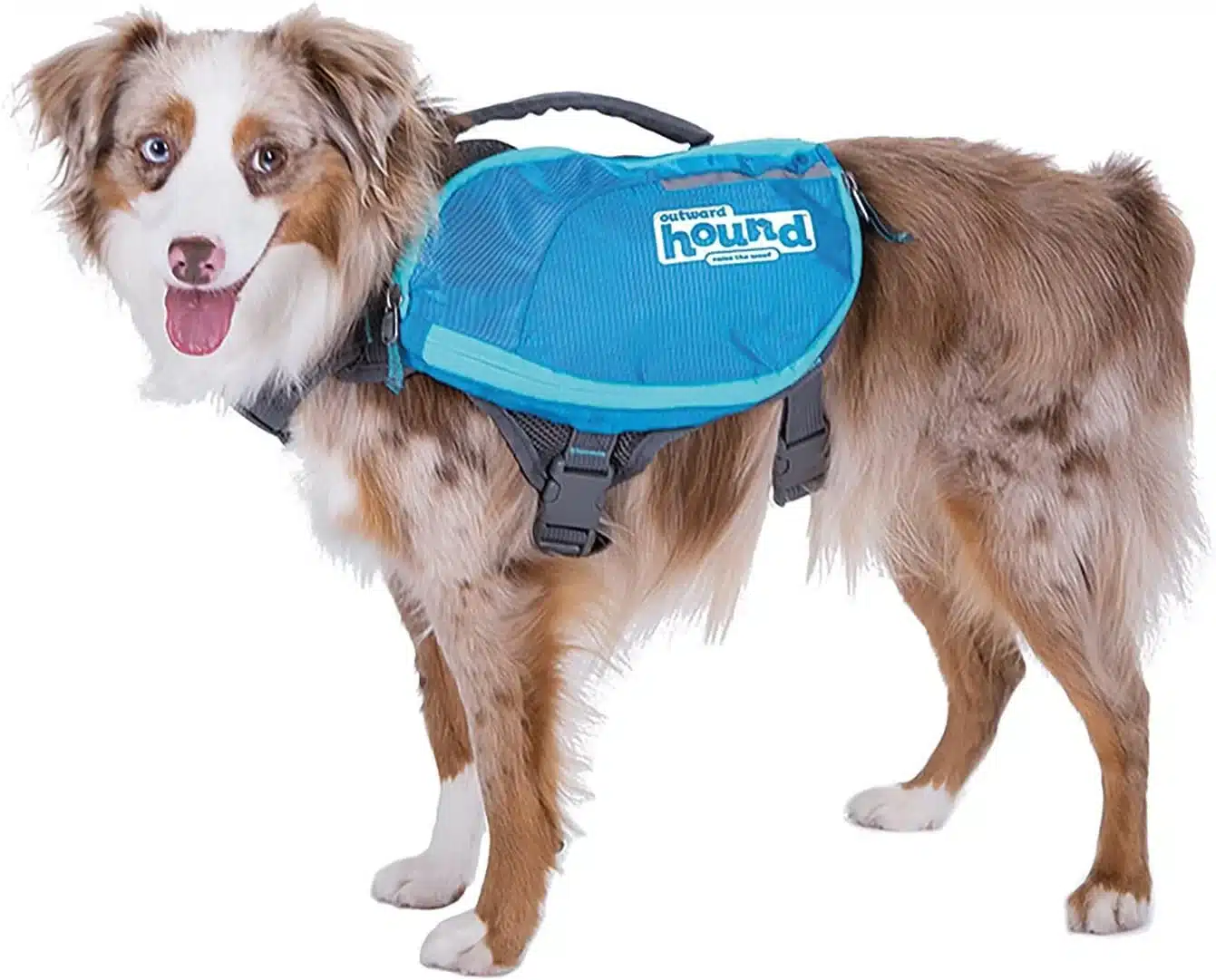
Outward Hound DayPak Dog Saddlebag
Not every hike needs a $60-130 Ruffwear pack, and the Outward Hound DayPak is the pick for owners who want their dog to carry a basic trail kit, treats, a folding water bowl, waste bags, without spending heavily. It fits with an adjustable mesh body and a simple buckle system: no fiddly straps, easy to put on before the trailhead and take off at the car. The breathable mesh is the DayPak’s real advantage over cheaper solid-panel alternatives, it keeps the dog cooler in warm weather, which matters on a summer day hike. It comes in Small, Medium and Large to fit dogs roughly 15 to 80 lb (size by girth, not by breed). The saddlebags carry a small water bottle per side plus snacks and waste bags, a genuine trail-useful load. It won’t match the Ruffwear packs for build quality, compression or load stability on technical terrain. But at around $33, it’s an excellent first pack for a dog who hasn’t worn one before, or a backup for the family’s second dog on a day trip.
What we like
- Most affordable verified hiking saddlebag here at ~$33, a real trail pack, not a novelty
- Breathable mesh body keeps the dog cooler than solid-panel packs on warm hikes
- Simple buckle adjustment: fast to put on and take off, good for dogs new to wearing a pack
- Available in three sizes to cover most trail dogs from 15 lb to 80 lb
The catches
- No compression system, bags can shift slightly as they empty; re-adjust the buckle mid-hike
- Build quality is budget-level, expect one to two seasons of regular hiking, not years of hard use
- Total bag volume is modest; a small water bottle and snacks per side is the practical carry limit
Saddlebag vs carrier backpack: two different products that share a name
Before anything else: the phrase “dog backpack for hiking” describes two completely different products. Getting this wrong means buying a pack your dog, or you, can’t use.
- Saddlebag packs (dog wears the pack, carries gear). The dog wears the pack like a harness vest with two side bags. You carry nothing extra, the dog carries their own water, treats, waste bags and trail supplies, lightening your load. This is the intent this guide covers. Best suited to healthy, fit medium-to-large dogs who can cover the full route under their own power. Ruffwear’s Approach and Palisades Packs are the benchmark; Outward Hound’s DayPak is the budget entry point.
- Carrier backpacks (human carries the dog). The dog sits or lies inside a bag that you wear on your back. Designed for small dogs, senior dogs with joint issues, injured dogs, or any dog who needs a rest mid-hike. We cover those in detail in our separate dog backpack carrier guide. If your dog needs to ride, not carry, that’s the guide to read.
The bodyweight load rule: how much should a hiking dog carry?
The widely-cited guideline is that a healthy adult dog can carry up to 25% of their own body weight in a saddlebag pack. That figure is the ceiling for a well-conditioned working dog over a short carry, not the target for a day hike.
In practice, 10 to 15% of body weight is a better day-hike starting point, and the realistic carry for most trail dogs once you account for the water they’ll drink down during the hike. You don’t need to maximise the load to get the benefit: a dog carrying their own water, snacks and waste bags already saves you real weight and gives the dog a job to do.
| Dog weight | Day-hike load (10-15%) | Maximum carry (25%), conditioned dogs only |
|---|---|---|
| 20 lb (9 kg) | 2 to 3 lb, treats, a small bottle, bags | 5 lb |
| 40 lb (18 kg) | 4 to 6 lb, a litre of water, snacks, first aid | 10 lb |
| 60 lb (27 kg) | 6 to 9 lb, full day-hike kit or a light overnight | 15 lb |
| 80 lb (36 kg) | 8 to 12 lb, a full overnight kit for a strong, fit dog | 20 lb |
Load the bags evenly, side to side. Uneven loading creates a constant lateral pull on the spine. If you’re carrying a single water bottle, put half the water in each bag. This matters more the heavier the total load.
How to fit a dog hiking backpack: measuring girth, checking clearance and avoiding rub
Saddlebag packs are measured by girth, the circumference of the dog’s torso at its widest point, directly behind the front legs, not by weight or breed name. Take a tape measure before you buy and compare to the brand’s specific size chart; the fit accuracy is much higher than any weight-based guide.
Fitting steps
- Measure girth with the dog standing square. Wrap the tape around the widest point of the ribcage, behind the front legs. Note the measurement in inches.
- Check elbow and shoulder blade clearance. Once the pack is on, the bottom edge of the bags should clear the elbows as the dog walks normally. If the bags touch the elbows at a walk, the pack is too low, adjust the shoulder strap or size up.
- The girth strap (belly strap) should be snug, not tight. You should be able to slide two fingers underneath. Too loose and the bags will swing on rough ground; too tight and it restricts the dog’s breathing and stride.
- Watch the dog walk. Normal gait means short, free strides. Short-striding, stumbling, head-lowering or repeated shaking of the pack means the fit is wrong, the load is too heavy, or both.
- Check for rub spots after the first two or three hikes. The front-leg armpits and the area behind the elbows are the most common friction points. A small rub caught early is easy to manage with a neoprene patch or a Ruffwear Brush Guard; left unchecked it becomes a sore.
Ruffwear saddlebag sizing quick reference
| Size | Girth (in) | Typical breeds |
|---|---|---|
| XS | 13 to 17″ | Miniature Schnauzer, Corgi, small Basenji |
| S | 17 to 22″ | Border Terrier, Jack Russell, Shih Tzu |
| M | 22 to 27″ | Beagle, Cocker Spaniel, Staffordshire Bull Terrier |
| L | 27 to 32″ | Labrador, Golden Retriever, Border Collie, Vizsla |
| XL | 32 to 42″ | German Shepherd, Husky, Weimaraner, larger Retrievers |
Which dogs suit a saddlebag hiking pack, and which don’t
A saddlebag pack is not for every dog. It works best on a healthy, trail-fit adult dog with a back long enough for the bags to sit without interfering with the gait. The dogs that suit it best are the working and sporting breeds designed for exactly this kind of sustained activity: Labrador Retrievers, Golden Retrievers, German Shepherds, Border Collies, Australian Shepherds, Vizslas, Weimaraners, Siberian Huskies and similar medium-to-large, high-energy dogs.
These dogs benefit from carrying their own weight: it burns additional energy proportional to the load, gives the dog a job (which many working breeds need), and means you’re both tired at roughly the same rate by the end of the day, which is usually exactly what you want.
Dogs that suit a saddlebag pack
- Fit, healthy adult dogs of medium-to-large size who hike regularly and can cover the full route without being carried.
- High-energy breeds that need more than a standard walk to reach a calm state, the extra effort of carrying a load helps.
- Dogs with back lengths long enough for the saddlebags to sit between the shoulder blades and the hips without touching the elbows.
Dogs that should not wear a saddlebag pack
- Dogs with joint problems, hip dysplasia, luxating patella, or any orthopaedic history, the lateral load can stress joints that are already under pressure.
- Long-backed breeds (Dachshund, Corgi, Basset Hound), the saddlebag design places lateral weight on a spine already at higher risk of disc problems.
- Small dogs under roughly 15 lb, usually too short in the back for the bags to sit properly without interfering with leg movement.
- Puppies under 18 months whose growth plates haven’t closed, load-bearing at that stage carries developmental risk.
- Senior dogs with reduced mobility, for these dogs, a carrier backpack gets them on trail without the load.
Day hike vs overnight: choosing the right capacity for your hike length
The Ruffwear Approach Pack and the Palisades Pack differ primarily in capacity, modularity and price. Here’s how to choose:
Day hike (out-and-back, up to 8 hours)
The Ruffwear Approach Pack is the right tool. It carries a litre of water per side, trail snacks, waste bags and a small first-aid kit, the practical kit for a full day on trail. The passive compression system keeps the load balanced as the dog drinks through the day, which is the key feature for a moving water load. At ~$60, it’s the best-value pack for day hiking. The Outward Hound DayPak at ~$33 covers lighter day-hike loads (snacks, a small bottle, bags) if budget is the primary concern.
Overnight and multi-day (8 to 48+ hours)
The Ruffwear Palisades Pack is the right tool. Its modular saddlebags carry a meaningfully higher total volume, and the spine-load transfer system is designed to manage the heavier sustained load that comes with carrying overnight camp supplies. The removable bags also allow you to configure the pack lighter for a faster approach day and heavier for a camp-to-camp carry day. At ~$130, it’s a serious piece of kit, and the right one if you do two- or three-night trail trips with your dog.
Conditioning your dog for pack hiking: the gradual load protocol
A dog that hikes regularly is not automatically ready to carry a loaded pack on a long trail. Pack hiking is a distinct physical activity, and introducing it without a conditioning phase is the formula for muscle soreness, gait problems and a dog that refuses the pack on the next trip.
Follow this protocol across two to three weeks before the first real pack hike:
- Week 1, empty pack only. Introduce the pack as a vest with nothing in the bags. Walk two to three times at normal pace and distance. Let the dog get used to the feel and movement. Look for any immediate rub spots. Most dogs accept an empty pack quickly.
- Week 2, one-third target load. Add a small load, roughly a third of your planned day-hike weight. Keep walks at normal length. Watch gait: any stumbling, short-striding, slowing or repeated back-looking is a sign to reduce the load or extend the empty-pack phase.
- Week 3, two-thirds load, increasing distance. Build toward the full planned load while also extending the walk distance toward the planned hike length. By the end of week 3, the dog should be comfortable carrying the target load for two hours without visible gait changes.
Key rules for pack hiking safety
- Always load the bags evenly. If you’re carrying a single 1-litre bottle, split it: 500ml per side. Uneven loading puts a lateral pull on the spine every step.
- Remove the pack for rest and water breaks. Every couple of hours, take the pack off for 10 minutes. Dogs don’t always show they’re tired until they stop.
- Don’t pack a dog in heat. The saddlebag adds insulation and restricts airflow across the flanks. In warm weather, reduce the load or leave the pack at home. Watch for heavy panting, slowing, or reluctance to continue, these are heat signs, not laziness.
- Check the fit after a wet or muddy hike. Waterlogged bags are heavier than expected; a pack that was correctly loaded when dry may be overloaded after a river crossing. Drain the bags and re-weigh if in doubt.
Done correctly, a saddlebag pack is one of the most effective tools for managing a high-energy trail dog. The extra physical effort of carrying the load burns proportionally more energy, a dog who normally needs 15 miles to reach a calm state may need only 10 miles with a correctly loaded pack. That’s a meaningful advantage on a packed summer schedule.
Large-dog specific sizing: why big dogs need saddlebag packs more than small ones
Large dogs. Labradors, German Shepherds, Golden Retrievers, Huskies, Vizslas, Weimaraners, are the dogs saddlebag packs are designed for. They have the back length for the bags to sit correctly, the body mass to carry a meaningful load without being overloaded at 10 to 15%, and the muscle and bone density to handle trail terrain with weight on board.
A 70 lb Labrador can carry 7 to 10 lb of trail supplies comfortably, roughly a full day’s water, food and first-aid kit shared between two hikers. That’s a material saving on a long day with a heavy pack. A 90 lb German Shepherd at 15% carry handles 13 to 14 lb, enough for a solid overnight kit in addition to their own food and water.
Large-dog pack sizing at a glance
| Breed | Typical weight | Ruffwear size | Practical carry (10 to 15%) |
|---|---|---|---|
| Labrador Retriever | 55 to 80 lb | L or XL | 5 to 12 lb |
| Golden Retriever | 55 to 75 lb | L | 5 to 11 lb |
| German Shepherd | 65 to 90 lb | L or XL | 6 to 13 lb |
| Siberian Husky | 45 to 60 lb | M or L | 4 to 9 lb |
| Vizsla | 44 to 65 lb | M or L | 4 to 10 lb |
| Weimaraner | 55 to 90 lb | L or XL | 5 to 13 lb |
| Australian Shepherd | 40 to 65 lb | M or L | 4 to 10 lb |
| Border Collie | 30 to 55 lb | M or L | 3 to 8 lb |
More dog travel and gear guides
Dog hiking backpack common questions
What is a dog saddlebag hiking pack?
A dog saddlebag hiking pack is a harness-style vest your dog wears on the trail with two side bags attached. The dog carries the load, typically their own water, treats, waste bags and trail supplies, while you carry nothing extra. This is different from a carrier backpack, which is a bag you wear with the dog sitting inside. Saddlebag packs are designed for healthy, fit medium-to-large trail dogs who can hike the full route on their own four feet. If your dog needs to be carried, the right product is a carrier backpack, not a saddlebag pack.
How much weight can a dog carry in a hiking backpack?
The commonly-cited guideline is a maximum of 25% of the dog’s own body weight for a fit, conditioned adult dog. For day hikes and for dogs new to pack hiking, 10 to 15% of body weight is a safer, more comfortable starting point and the realistic load for most trail days (a litre of water, snacks and a small first-aid kit typically falls in this range). In practical numbers: a 40 lb dog carries 4 to 6 lb comfortably; a 60 lb dog carries 6 to 9 lb; an 80 lb dog carries 8 to 12 lb. Always load the bags evenly, split the weight side to side to avoid lateral pull on the spine. Dogs with joint problems, hip dysplasia or back conditions should not carry a pack at all.
What size dog hiking backpack do I need?
Dog hiking saddlebag packs are sized by girth, the circumference of the dog’s torso at its widest point, directly behind the front legs. Measure your dog standing square, then compare to the brand’s size chart. For Ruffwear: XS fits 13 to 17 inch girth; S fits 17 to 22 inches; M fits 22 to 27 inches; L fits 27 to 32 inches; XL fits 32 to 42 inches. Do not size by weight or breed name, two dogs of the same breed and similar weight can differ by a full size depending on body shape. The tape measure is more accurate than any weight-based guide.
Is the Ruffwear Approach Pack or the Palisades Pack better for day hiking?
For day hikes, the Ruffwear Approach Pack is the better choice at around $60. It carries a full day-hike kit (a litre of water per side, snacks, first aid), has a passive compression system that keeps the load balanced as the dog drinks through the day, and is the better value for the use case. The Palisades Pack at ~$130 is designed for overnight and multi-day trips where its larger volume and modular removable bags justify the higher price. If you only day-hike, buy the Approach Pack. If you do two- or three-day backcountry trips with your dog, the Palisades Pack is the right tool.
How do I get my dog used to wearing a hiking backpack?
Introduce the pack gradually over two to three weeks. Week 1: put the pack on with empty bags for short walks, no load, just getting the dog comfortable with the feel and movement. Week 2: add a light load (about one-third of your planned day-hike weight) and watch the dog’s gait carefully, short-striding, stumbling or back-looking means the load is too much too soon. Week 3: build toward the full planned load while extending the walk distance toward your planned hike length. By the end of week 3, the dog should be comfortable at the full load for two hours. Never rush this phase, a dog that has a sore or unhappy first pack experience will be harder to fit on subsequent hikes.
Can large dogs wear hiking saddlebag packs?
Yes, large dogs are actually the ideal candidates for saddlebag hiking packs. Breeds like Labrador Retrievers, Golden Retrievers, German Shepherds, Huskies, Vizslas and Weimaraners have the back length for the bags to sit correctly, the muscle mass to carry a meaningful load, and the energy levels that benefit from the additional effort. A 70 lb Labrador can carry 7 to 10 lb comfortably, enough for a full day’s water and snacks for both dog and human. Ruffwear’s packs run to XL size (32 to 42 inch girth) specifically to accommodate large breeds. The main precaution for large dogs is to measure girth accurately rather than guessing by weight, a large-chested Labrador can wear a different size than a slimmer Labrador of similar weight.
What should I put in my dog’s hiking backpack?
Load the bags with items the dog will use or that are easily replaced if lost, not your camera or car keys. Practical contents for a day hike:
- Water, a collapsible bottle or a portion of your day’s water supply, split evenly between the two bags
- Trail treats, high-value rewards for recall and rest stops
- Folding water bowl, lightweight silicone bowls weigh almost nothing and are essential for stream-free sections
- Waste bags, always
- Small first-aid supplies, a few bandages, antiseptic wipes and tick remover if you’re in tick country
Avoid anything fragile, irreplaceable or that would shift the balance if the dog runs or shakes. Load each side to roughly equal weight before you start, and redistribute as you remove water during the hike to keep the load balanced.