 Dog Gear, Sized Right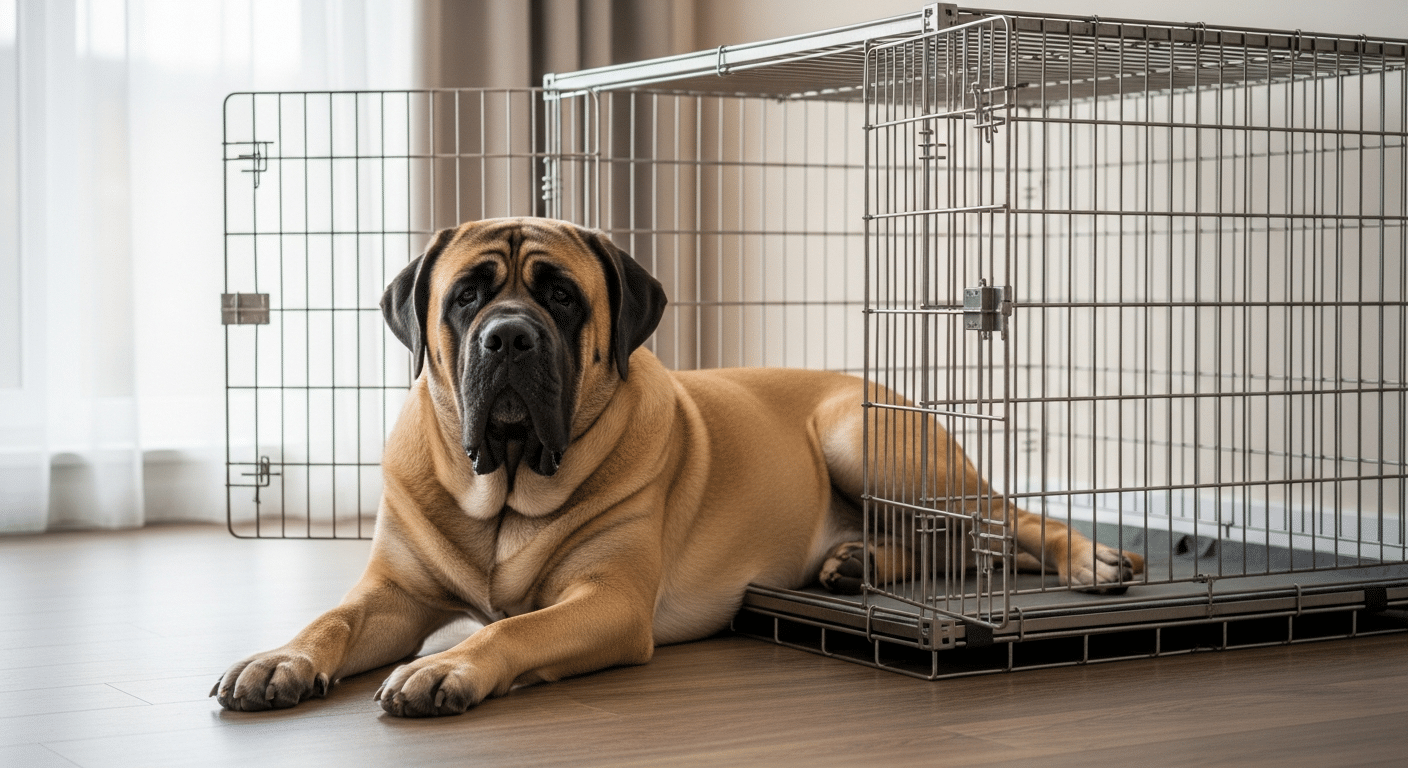
What Size Crate Does a Mastiff Need?
Short answer: a Mastiff is a giant breed, so it needs the biggest crate made, a 54-inch (3XL) crate is the standard maximum and the right size for most adult Mastiffs, while the largest English Mastiffs need an oversized XXL crate or go without one. Here’s how to size it honestly.
If you’re asking what size crate a Mastiff needs, here’s the honest answer: the Mastiff is a giant breed, so it needs the largest crate made, a 54-inch (3XL) crate is the standard off-the-shelf maximum and the right size for the majority of adult Mastiffs. A few of the biggest English Mastiffs measure out of even a 54″, and for those dogs you’re into oversized / XXL territory, or, as many Mastiff owners decide, no crate at all. Getting the mastiff crate size right starts with a hard truth most guides skip: this dog can hit 160 to 230 pounds, and the crate industry simply wasn’t built around dogs that size, so you’re choosing the biggest thing on the shelf and checking it actually fits. Below we cover the breed numbers, a size-by-age chart, how to measure your own dog, whether crates even come big enough, when a giant doesn’t need crating at all, and our verified-in-stock picks. Want the number in seconds? Run him through our dog crate size calculator.
Best crates for a Mastiff, ranked
Sized for a 100 to 230 lb giant and verified in stock. The Impact 3XL is the biggest, strongest crate made; the MidWest 54″ is the largest standard wire crate and the value pick; the BOLDBONE steel XXL is the escape-proof option for an anxious or destructive giant. Tap through for the live price.
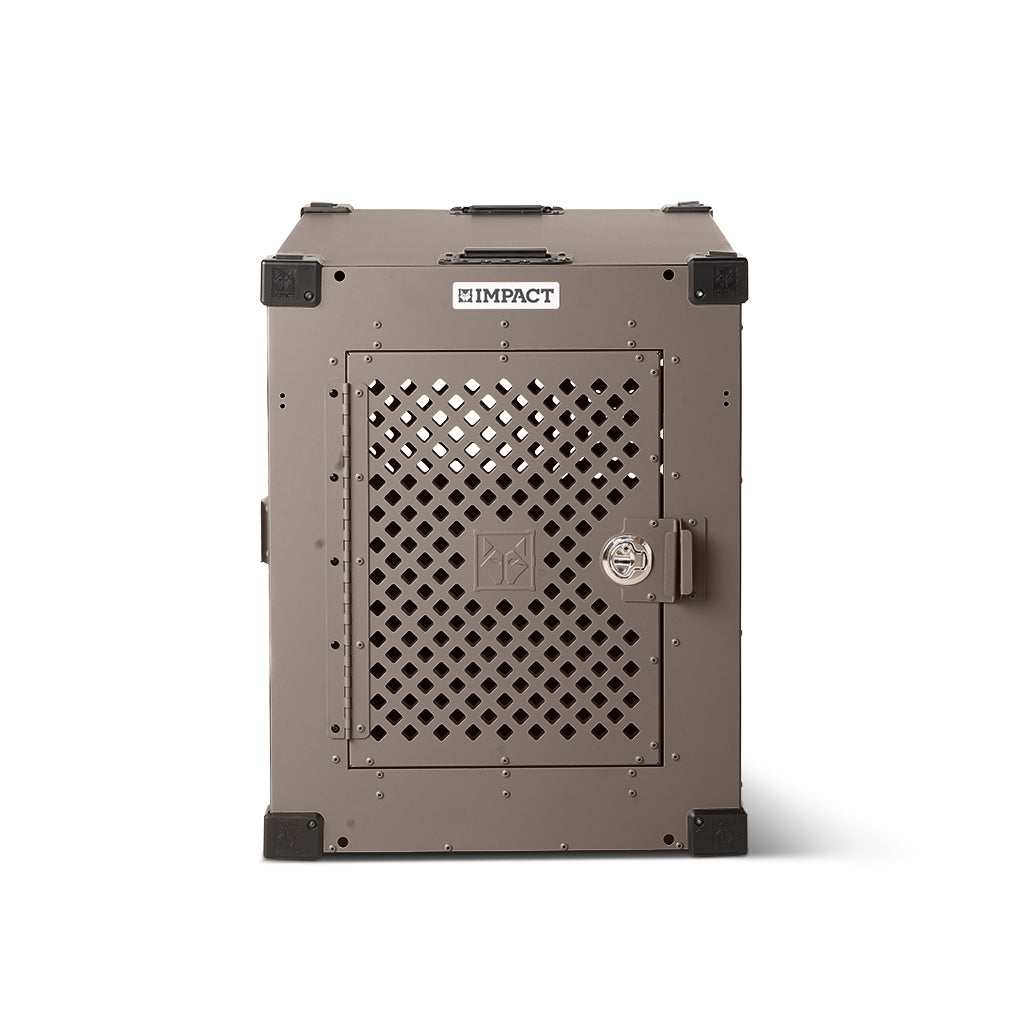
Impact Stationary Dog Crate (54″ / 3XL)
When the dog is a 120 to 230 lb Mastiff, a flimsy wire crate is a non-starter, you need the largest, strongest crate built, and Impact’s Stationary is it. The biggest size runs about 54.5″ L × 35.5″ W × 42″ H, the top of what’s made off the shelf, and the welded aircraft-grade aluminum walls won’t bend, chew or break, even under a giant. The solid sides create the calm, den-like space a Mastiff settles into, and it’s crash-tested for travel. It’s a serious investment, but for a dog this big it’s the one crate that genuinely fits and holds him.
What we like
- Comes in a 54″/3XL, the largest size offered, the right footprint for a giant Mastiff
- Welded aluminum a 200 lb dog can’t bend, chew or break out of, genuinely escape-proof
- Solid walls give the calm, den-like security a Mastiff actually wants
- Crash-tested for the car and backed by a lifetime warranty (with the dog-damage add-on)
The catches
- By far the priciest pick, it’s an investment for the dog’s whole life
- Heavy and stationary; it stays where you put it
- Even the 3XL is at the edge of what fits the very largest English Mastiffs (measure first)

MidWest 54″ Drop-Pin Crate (Giant Breeds Over 100 lbs)
If you want the biggest standard wire crate at a fraction of the aluminum price, this is it. MidWest literally markets it “for Giant Breeds Over 100 lbs.” At 54″ L × 37″ W × 45″ H it’s the largest mainstream off-the-shelf crate made, and the right size for the majority of adult Mastiffs. Reinforced drop-pin construction is sturdier than a folding crate, with double doors and a leak-proof slide-out pan. For a calm, settled Mastiff, and most are, this is plenty of crate.
What we like
- The 54″ is the largest mainstream wire crate, the right size for most adult Mastiffs
- Reinforced drop-pin build is sturdier than an everyday folding wire crate
- Double doors and a leak-proof slide-out pan keep daily life and clean-up easy
- A fraction of the price of a premium aluminum crate, great for a calm, settled giant
The catches
- Still a wire crate, the very largest English Mastiffs can outgrow even 54″ length
- A rare destructive or anxious Mastiff could bend the wire; go steel or aluminum instead
- Big, heavy footprint, make sure you have the floor space before you order
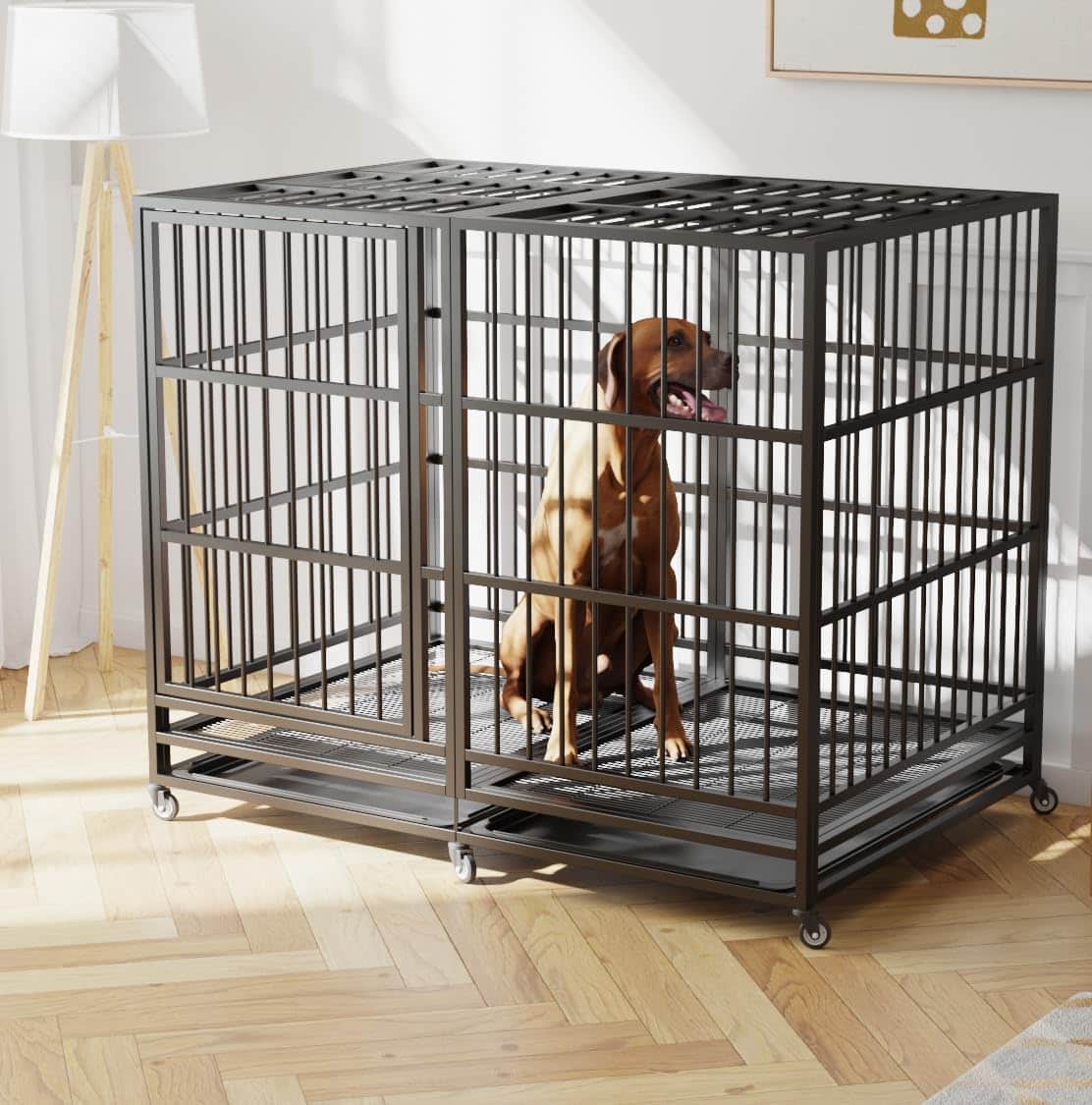
BOLDBONE 54″ Heavy-Duty Steel Crate (XXL)
Most Mastiffs are gentle, low-energy couch giants, but if yours is young, anxious or has ever tested a crate, step up to welded steel without paying aluminum money. This BOLDBONE XXL uses a 20-gauge reinforced steel frame with half-inch tubes, dual anti-collision slide-bolt latches and a powder-coated finish, built to hold a 90 lb+ dog that leans, chews or shoulders the door. At roughly 54″ L × 30″ W × 46″ H it rolls on lockable casters with removable trays, so a heavy crate still moves and cleans easily.
What we like
- Reinforced 20-gauge steel and half-inch tubes stand up to a powerful, determined giant
- Dual anti-collision slide-bolt latches resist a clever Mastiff nosing the door open
- Lockable wheels mean a heavy steel crate still rolls out of the way and cleans easily
- Far cheaper than aircraft-grade aluminum if you just need real escape-proofing
The catches
- Overkill for the typical calm, gentle Mastiff that’s never tested a wire crate
- Heavy steel, assembly and moving it take effort despite the wheels
- Width is narrower than the MidWest 54″; confirm your dog can turn comfortably
What size crate does a Mastiff need? (quick answer)
For a full-grown Mastiff, you want the biggest crate you can buy, in practice a 54-inch (3XL) crate, which is the largest size most manufacturers make. A 54″ crate runs roughly 54″ long × 37″ wide × 45″ tall inside, and that’s the right footprint for the majority of adult Mastiffs: enough length for a giant body to lie out flat, enough height to stand without ducking, and enough width to turn around. That stand-turn-stretch test is the whole point of sizing a crate, and with a Mastiff, the challenge isn’t choosing between sizes, it’s finding one big enough.
Here’s the honest breakdown:
- 54″ (3XL) crate, the standard maximum, and the right size for most adult Mastiffs (roughly 120 to 180 lb).
- 48″ (2XL) crate, fits some smaller female Mastiffs and other mastiff-type breeds at the lighter end (~100 to 130 lb), but most adults outgrow it.
- Oversized / XXL (beyond a standard 54″), for the very largest English Mastiffs (200 lb+, 30″+ tall) who measure out of a 54″. These exist, but options are genuinely limited (more on that below).
- 36 to 48″ crate (or a 54″ with a divider). Mastiff puppies, while they’re still growing into that giant frame.
How big does a Mastiff get? (the numbers that decide crate size)
You can’t size a crate without knowing how big the dog actually gets, and the Mastiff, the English Mastiff in particular, is one of the largest dog breeds on earth by sheer mass. These are the breed numbers that drive the decision:
- English Mastiff males: roughly 160 to 230 lb, standing 30 inches or more at the shoulder. The heaviest dogs ever recorded were English Mastiffs.
- English Mastiff females: roughly 120 to 170 lb, standing 27.5 inches and up.
- Other mastiff-type breeds (Bullmastiff, Cane Corso, Dogue de Bordeaux, etc.): typically 100 to 170 lb, large to giant, but a step down from the English Mastiff.
- Body length: nose-to-base-of-tail figures of 40 to 48+ inches are common on a big adult.
Those numbers are exactly why a Mastiff lands on the biggest crate made. A 54″ crate’s ~45″ of interior height clears the breed’s 27 to 32″ shoulder with room to stand, and its 54″ length suits most adults, but a 200 lb-plus English Mastiff with a 48″+ body length is right at the edge, which is when you start looking at oversized / XXL options. Because the Mastiff is so massive rather than tall-and-leggy, it’s the dog’s overall bulk, length and width to turn and stretch, that decides the size, not head height. For the full sizing system across every large breed, see our best dog crate for large dogs guide.
Do crates even come big enough for a Mastiff? (the honest answer)
This is the question almost every Mastiff guide skips, so here it is straight: the off-the-shelf crate industry was not built around 200-pound dogs. The standard ladder of crate sizes tops out at 54 inches (3XL), that’s the biggest size MidWest, Impact and almost every mainstream brand make. For the majority of adult Mastiffs, a 54″ is genuinely big enough. But for the very largest English Mastiffs, a 54″ is the ceiling, not the comfortable answer, and your options narrow fast.
What’s actually available when 54″ isn’t enough:
- 54″ (3XL), the practical maximum for mainstream crates (wire, aluminum and heavy-duty steel all top out here). This covers most Mastiffs.
- Oversized / XXL heavy-duty crates from specialist makers, some go to roughly 60″, but selection is thin, they’re expensive, and they take up a serious chunk of a room.
- A custom or commercial kennel, at the extreme, some giant-breed owners use a built or modular kennel run rather than a crate at all.
So the realistic plan for a giant Mastiff is: buy the largest quality 54″ crate, measure your dog against it honestly, and only chase an oversized option if he genuinely measures out of a 54″. And, importantly, many Mastiff owners conclude their gentle, low-energy adult simply doesn’t need a crate at all once house-trained (we cover when that’s the right call below). Don’t assume you’ve failed if no 54″ crate quite fits a 230 lb dog; you’ve hit the real limit of the product category, and there are good alternatives. The crate size calculator will tell you whether your dog fits a standard size or needs to go oversized.
Mastiff crate size by age (puppy to giant adult)
Mastiffs grow astonishingly fast and finish enormous, so the crate that’s right at 10 weeks is hopelessly small by 8 months, and the giant adult crate is far too big for a puppy in potty training. Here’s the size to use at each stage, and where to set the divider if you’ve bought the 54″ adult crate up front:
| Age | Approx. weight | Crate size | Divider / setup |
|---|---|---|---|
| 8 to 10 weeks | ~25 to 40 lb | 36″ (or 54″ divided down hard) | Divider set so he can just stand, turn & lie down |
| 3 to 4 months | ~50 to 80 lb | 42 to 48″ (or 54″ divided) | Slide divider back ~one section |
| 5 to 7 months | ~90 to 130 lb | 48 to 54″ (divider easing back) | Open most of the 54″ crate |
| 8 to 18 months | ~130 to 180 lb | 54″ | Divider removed, full crate |
| Adult (most Mastiffs) | 120 to 180 lb | 54″ (3XL) | Full 54″ crate |
| Largest English Mastiffs | 200 to 230 lb | Oversized / XXL | Measure first, may exceed a standard 54″ |
The weights are approximate. Mastiffs vary enormously, and a 230 lb male is a very different animal from a 120 lb female, so always let the measurements beat the age. The point of the table is the path: a divider-equipped 54″ crate covers you from puppyhood right through to a full-grown 180 lb adult, and only the very largest dogs ever need to look beyond it. A young puppy still needs its space kept snug, because a too-big crate is the number-one reason puppy potty training stalls. Read why in our companion guide on whether a dog crate can be too big.
How to measure your Mastiff for a crate
With a giant breed, measuring isn’t optional, breed averages span a 100-pound range, and the difference between “a 54″ fits” and “you need oversized” comes down to your individual dog. Grab a tape measure and take two numbers:
- Length: measure from the tip of the nose to the base of the tail (where the tail meets the body, not the tail tip). Then add 2 to 4 inches.
- Height: measure from the floor to the top of the head while the dog is standing. Then add 2 to 4 inches.
Match those two numbers to the crate’s interior dimensions, not the outside box, manufacturers list both, and on a big crate the difference can be several inches. The crate is correctly sized when your Mastiff can:
- Stand up fully without crouching or ducking his head;
- Turn around in a complete circle without squeezing;
- Lie down stretched out on his side with his legs extended.
For most Mastiffs, a 54″ crate (≈45″ interior height, 54″ long) clears all three. But here’s the giant-breed reality check: if your dog’s nose-to-tail-base length plus 2 to 4 inches runs past about 54″, a standard crate won’t fit him properly and you’re into oversized / XXL territory, or rethinking whether he needs a crate at all. When you’re between sizes, always size up, a cramped crate is genuinely unkind to a dog this large, and it’s far easier to shrink a big crate with a divider than to stretch a small one. Skip the math entirely with our dog crate size calculator, which converts your measurements into a recommended crate size instantly and flags when a dog needs to go oversized.
Does a Mastiff need a heavy-duty or escape-proof crate?
Here’s where the Mastiff surprises people. You’d assume a 200-pound dog needs fortress-grade steel, but the Mastiff is famously calm, gentle and low-energy, a couch-loving giant rather than a high-drive escape artist. Many adult Mastiffs settle happily into a quality wire crate like the MidWest 54″ and never test it. The breed’s temperament often matters more than its size when it comes to build quality.
That said, the sheer power is real: if a Mastiff does decide to lean, chew or push on a crate, a 150 lb dog applies enormous force, and a flimsy wire crate won’t survive it. So size the crate first, then make the strength call honestly based on your dog. Go heavy-duty (welded steel like the BOLDBONE, or aircraft-grade aluminum like the Impact) if your Mastiff is:
- A young, under-exercised or still-growing puppy in the chewing phase, teething giants can do real damage.
- Anxious or separation-prone, a panicking Mastiff can bend wire or pop a simple latch through sheer mass. Solid-walled, den-like crates lower arousal and remove the motivation to break out.
- A proven chewer or escape artist, if he’s already bent or wrecked one crate, stop buying wire; steel or aluminum is cheaper than a third replacement.
When crating a giant Mastiff isn’t practical (and that’s okay)
Let’s be honest about something the crate-selling guides won’t tell you: not every adult Mastiff needs, or even uses, a crate. A crate that fits a 200-pound dog is a piece of furniture the size of a small dining table, it dominates a room, costs real money, and a calm, fully house-trained Mastiff may simply have no need for one. Plenty of experienced Mastiff owners crate-train through puppyhood and then retire the crate entirely.
Crating still makes sense for a Mastiff when you need it for:
- Puppy house-training and safe confinement, this is where a crate earns its keep, and where a divider-equipped 54″ pays off.
- Recovery from surgery or injury, vets often require strict crate rest, and a giant needs a giant crate to do it safely.
- Travel, a crash-tested crate (like the Impact) is the safest way to move a giant in a vehicle.
- A dog that genuinely feels safer in a den, some Mastiffs love their crate as a retreat; leave the door open and let them choose it.
If your adult Mastiff is house-trained, settled and trustworthy loose, a comfortable orthopedic bed and a baby-gated space may serve better than wrestling a 54″+ crate into your living room. The point is to make the decision deliberately, not to assume a giant must be crated. (And whatever you choose, a giant breed needs a properly sized, supportive bed, see our best dog bed for a Mastiff guide.)
So, what’s the best crate size for your Mastiff?
Putting it together: buy a 54-inch (3XL) crate for the large majority of adult Mastiffs, it’s the biggest mainstream size made and the right footprint for most of the breed. Reach for an oversized / XXL option only if you have one of the very largest English Mastiffs (200 lb+, 30″+ tall) who genuinely measures out of a 54″. Start a puppy in that same 54″ crate with the divider set tight, and slide it back as he grows so you never re-buy. Always let your dog’s actual nose-to-tail length and standing height override generic weight charts, with a breed this variable, the tape measure wins.
Then make two honest calls. First, how heavy-duty? Most Mastiffs are gentle giants that do fine in a quality wire crate; only a young chewer, an anxious dog, or a proven escape artist needs welded steel or aircraft-grade aluminum. Second, does your adult even need a crate? A settled, house-trained Mastiff may be happier with a big orthopedic bed and a gated space than a crate the size of a sofa. Get those calls right and you’ve done better than most owners, and far better than the guides that just shout “buy the biggest crate.” Confirm his exact size with our crate size calculator, then pick from our ranked crate buyer’s guide. And if you’re kitting out a Mastiff from scratch, our Mastiff gear guide covers the harness, bed, chew toys and crate together.
Size it right in two clicks
Mastiff crate size: common questions
What size crate for a Mastiff?
A 54-inch (3XL) crate is the right size for the large majority of adult Mastiffs. It runs roughly 54″ long × 37″ wide × 45″ tall inside, the biggest size most manufacturers make, which lets a giant Mastiff stand, turn around and lie out flat. Smaller females and lighter mastiff-type breeds (~100 to 130 lb) may fit a 48″ (2XL), while the very largest English Mastiffs (200 lb+, 30″+ tall) can measure out of a standard 54″ and need an oversized / XXL crate. A puppy can start in a 36 to 48″ crate, but it’s smarter to buy the 54″ adult crate and use a divider to keep the space snug while he grows. Always measure your individual dog, the breed spans a 100-pound range.
Is a 54 inch crate big enough for a Mastiff?
For most Mastiffs, yes, a 54-inch crate is the right size and the biggest standard crate made. Its roughly 54″ length, 37″ width and 45″ interior height fit the majority of adult Mastiffs, letting them stand without ducking, turn around fully and lie stretched out. The exception is the very largest English Mastiff: a 200 lb-plus male with a 48″+ body length can measure out of a 54″, and for him you’d need an oversized / XXL crate from a specialist maker, or, as many owners decide, no crate at all once he’s house-trained. The way to be sure is to measure him: nose to base of tail, and floor to top of head while standing, add 2 to 4 inches to each, then match the crate’s interior dimensions.
Do Mastiffs need a crate?
Not necessarily as adults. A crate is genuinely useful for a Mastiff puppy, for house-training and safe confinement, and for vet-ordered crate rest, travel, or a dog that likes a den. But the Mastiff is a calm, gentle, low-energy breed, and many owners crate-train through puppyhood and then retire the crate entirely once the dog is house-trained and trustworthy loose. A crate that fits a 200-pound dog is the size of a small dining table, so it’s worth deciding deliberately rather than assuming a giant must be crated. If you skip the crate for an adult, give him a properly sized orthopedic bed and a gated space instead. For puppies, recovery and travel, though, a correctly sized crate is the right tool.
What size crate does a Mastiff puppy need?
A young Mastiff puppy needs only a small space, about a 36″ crate at 8 to 10 weeks, so it can stand, turn and lie down but not have so much room that it potties in one corner and sleeps in the other, which derails house-training. But Mastiffs grow shockingly fast, so rather than buying a puppy crate you’ll outgrow in weeks, the better move is to buy the adult 54″ crate and use the divider panel to wall off the extra space now, sliding it back as the puppy grows. You’ll be moving that divider often, a Mastiff can pack on weight weekly, but you buy one crate for the dog’s whole life and the space is always the right size.
What is the biggest dog crate you can buy for a Mastiff?
The biggest mainstream crate is a 54-inch (3XL), which is where wire crates (like the MidWest 54″ “for Giant Breeds Over 100 lbs”), heavy-duty steel crates, and premium aluminum crates (like the Impact 3XL) all top out. For the majority of Mastiffs that’s plenty. If you have one of the very largest English Mastiffs that measures out of a 54″, you’re into oversized / XXL territory, some specialist makers go to roughly 60″, but selection is thin and the crates are large and expensive. At the extreme, some giant-breed owners use a built or modular kennel run instead of a crate. The realistic plan is to buy the largest quality 54″ crate, measure your dog against it, and only chase oversized if he genuinely doesn’t fit.
Do Mastiffs need a heavy-duty or escape-proof crate?
Often less than you’d think. Despite the size, the Mastiff is a calm, gentle, low-energy breed, and many adults settle happily into a quality 54″ wire crate like the MidWest and never test it, so don’t over-buy out of size anxiety. That said, the power is real: if a Mastiff does lean, chew or push on a crate, a 150 lb dog applies enormous force and a flimsy wire crate won’t survive it. Go heavy-duty, welded steel or aircraft-grade aluminum, if your Mastiff is a young chewer, anxious or separation-prone, or a proven escape artist. For those dogs, a solid-walled den-style crate also lowers anxiety and removes the motivation to break out, and it outlasts the cost of replacing bent wire crates. For a calm, crate-trained adult, a quality wire crate is fine.