 Dog Gear, Sized Right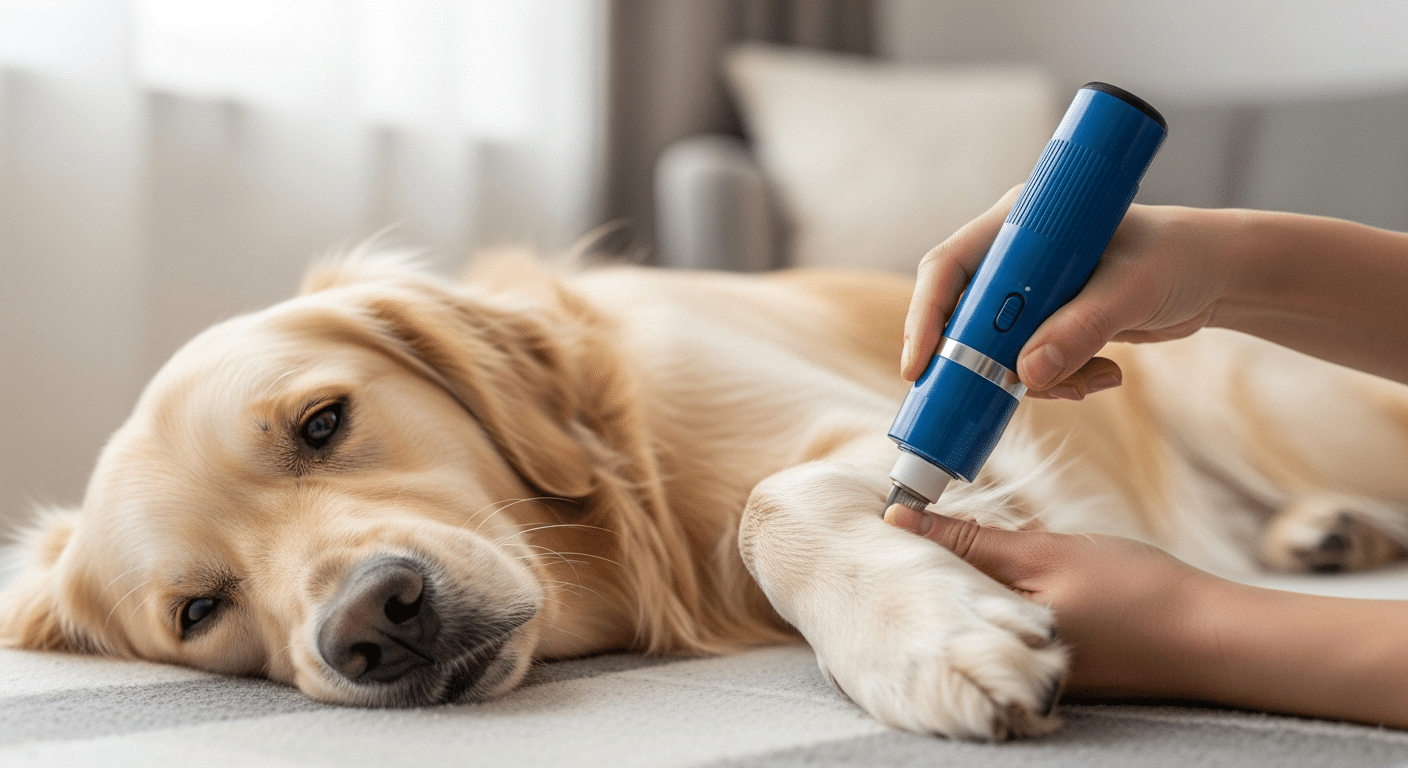
Best Dog Nail Grinders (Quiet & Low-Stress)
Most dogs don’t hate having their nails done, they hate the noise and the buzz. The right quiet, low-vibration grinder turns a wrestling match into a calm, treat-and-grind routine. Here are the best dog nail grinders for low-stress trims, from the quietest pick for anxious dogs to the most powerful for big, thick nails, with an honest grinder-versus-clipper verdict and exactly how to use one safely.
A dog’s overgrown nails aren’t just a cosmetic problem, left too long they splay the toes, throw off the dog’s gait, and over time strain the joints and even reshape the paw. Yet nail day is the chore most owners dread, because most dogs fight it. Here’s the thing almost nobody says out loud: in our experience the dog usually isn’t scared of the trim itself, but of the noise and the vibration of a buzzing tool against a sensitive paw. Get those two things right, a genuinely quiet, low-vibration grinder and a calm, gradual method, and a grinder becomes the lowest-stress, safest way to keep nails short, because unlike clippers it files the nail down a little at a time and makes it far harder to hit the quick. Below we rank our top picks for quiet, low-stress trimming, settle the grinder-versus-clipper debate, and walk through every spec that matters, noise, speed, ports, the quick, and how to choose for a little dog or a giant breed, plus exactly how to teach a nervous dog to sit happily for the buzz.
The best dog nail grinders for quiet, low-stress trims
Ranked for a calm, low-stress trim, from the quietest pick for an anxious dog to the most powerful for big, thick nails. Each is a real, currently-listed product; prices are last-checked, so tap through for the live price.
Casfuy 6-Speed Dog Nail Grinder
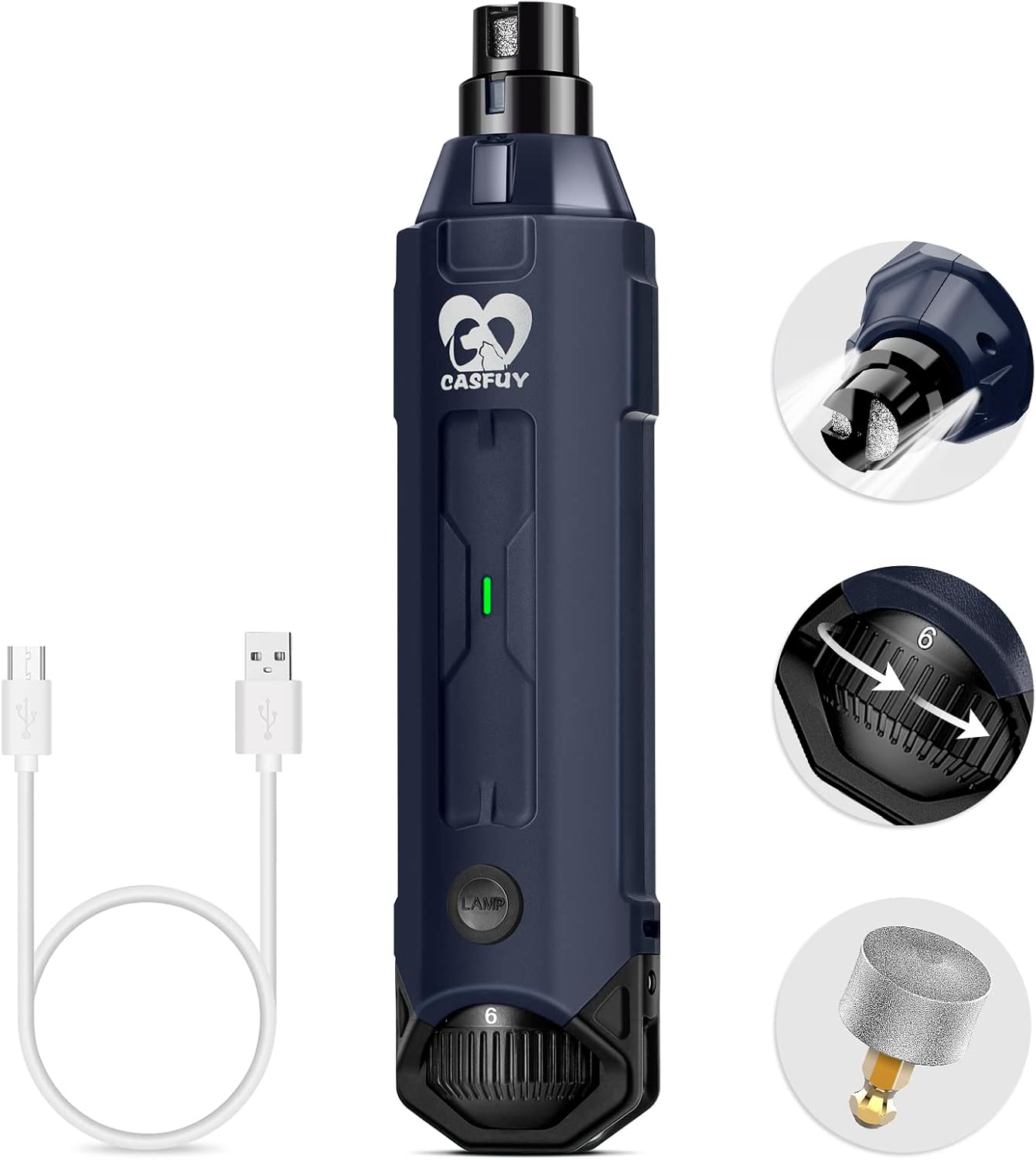
If you want one grinder that handles a Labrador’s thick nails as happily as a terrier’s and doesn’t cost a fortune, this is it. The Casfuy runs a diamond-bit drum at six speeds from roughly 7,000 to 12,000 rpm, genuinely powerful for a pet grinder, which is exactly what a big dog with thick, hard nails needs, while the lower speeds keep things gentle for a puppy or a small dog. It stays quiet (about 45 dB) with low vibration, the two things that actually scare dogs, and it has two LED lights so you can see the quick as you work. The three-port cap shields the spinning drum and holds the nail at a consistent angle, a small, large and a fully-open opening for any nail size. USB-rechargeable with a couple of hours of runtime, it’s the grinder we’d hand to most owners, and the one that earns its keep on a heavy-coated giant breed.
What we like
- Genuinely powerful, the 12,000 rpm diamond drum chews through a big dog’s thick nails without stalling
- Stays quiet (~45 dB) and low-vibration, the two things that actually frighten an anxious dog
- Six speeds span puppy-gentle to giant-breed, so it suits little and large in one tool
- Two LED lights plus a three-port cap make it easy to see the quick and hold a steady angle
The catches
- The most powerful speed is louder than the lowest, start low and only step up for thick nails
- The whole-paw runtime is good, not enormous; charge it the night before a big trim session
- No replaceable trimmer head, it’s a pure grinder, which for most owners is exactly the point
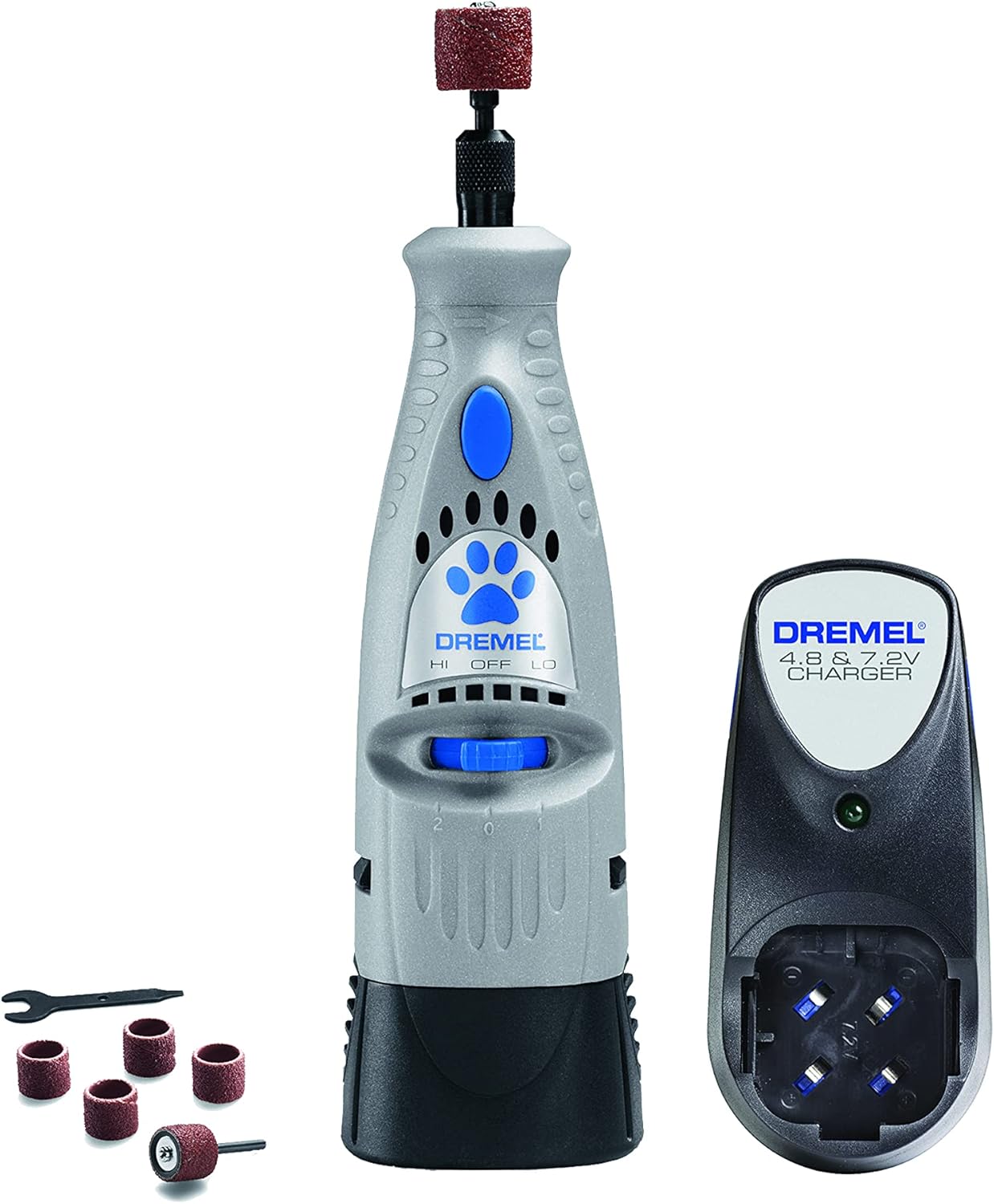
Dremel 7300-PT 4.8V Pet Nail Grinder
Before the wave of pet-branded grinders, owners reached for a Dremel, and the 7300-PT is the pet-specific version, still the one many groomers swear by. It’s a cordless 4.8V rotary tool with two speeds, 6,500 and 15,000 rpm, and it ships with five sanding drums, so instead of a fixed diamond bit you swap in a fresh, coarse abrasive band whenever the old one wears smooth. That makes it the most versatile grinder here and the longest-lived: the body outlasts everything, and replacement bands cost pennies. The high speed has real power for thick, large-breed nails; the low speed is gentle enough for careful work near the quick. It has no LED and no multi-port guard, so it asks a slightly steadier hand than the Casfuy, but if you want the tool that lasts a decade and don’t mind buying drums, the Dremel is the connoisseur’s pick.
What we like
- Built like the tool brand it is, the body lasts for years, far beyond the typical pet grinder
- Swappable sanding drums mean a fresh, sharp abrasive whenever you want, for pennies
- 15,000 rpm high speed has genuine power for thick giant-breed nails
- Trusted by professional groomers, the long-standing reference grinder
The catches
- No LED light or multi-port guard, so it asks a slightly steadier hand than guarded pet grinders
- Louder at its high speed than the quiet pet-specific models, fine for confident dogs, less so for the nervous
- You’ll buy replacement sanding bands over time (cheap, but a small ongoing cost)

Hertzko Electric Dog Nail Grinder
The Hertzko is the grinder we’d point a first-timer to: it does the basics well and nothing it doesn’t need to. It’s a USB-rechargeable grinder with two speeds and a three-port cap (small, medium and large openings) that both shields the spinning bit and guides the nail to the right spot, the feature that gives a beginner confidence. The motor is quiet and low-vibration, so most dogs settle quickly, and the cordless body is light and easy to hold for a whole-paw session. It doesn’t have the Casfuy’s six speeds or top-end power, so for a 120 lb giant with very thick nails we’d size up to one of our top two, but for a small-to-medium dog, a puppy, or anyone trimming nails for the first time, it’s an easy, affordable, well-rated place to start.
What we like
- Dead simple to use, the three-port cap guides the nail and shields the drum, ideal for a first-timer
- Quiet, low-vibration motor that most dogs accept quickly
- Light, cordless and well-balanced for a comfortable whole-paw session
- Friendly price and a strong track record with thousands of owners
The catches
- Two speeds and modest top-end power, size up to the Casfuy or Dremel for a giant breed’s thick nails
- No LED light, so trim in good daylight to spot the quick on dark nails
- Best for small-to-medium dogs and puppies rather than the heaviest large breeds
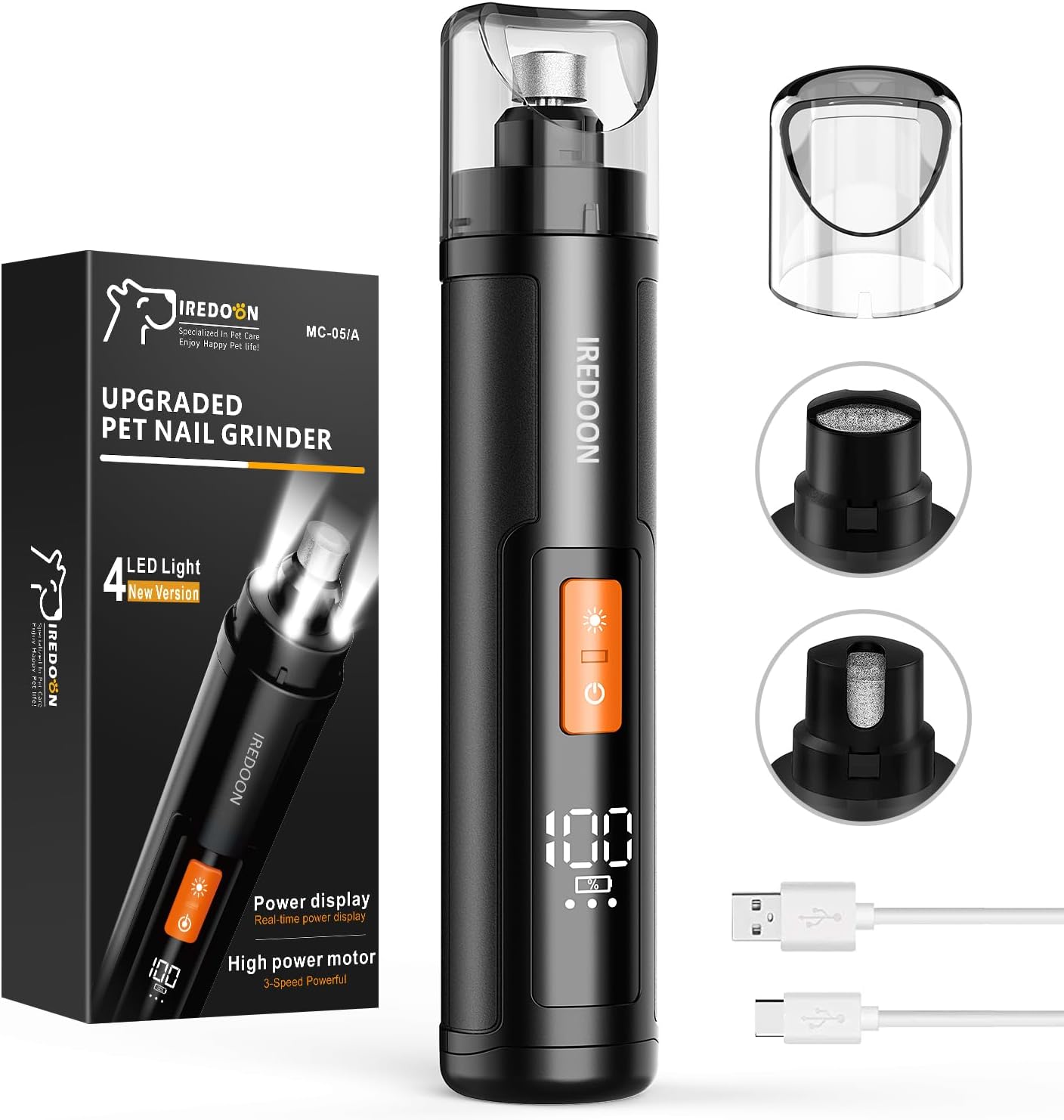
IREDOON 3-Speed Super-Quiet Nail Grinder
If your dog bolts at the buzz, this is the grinder to try. The IREDOON is engineered first and foremost to be quiet, around 40 dB, about as hushed as a pet grinder gets, with deliberately low vibration, the combination that keeps a noise-sensitive or anxious dog from panicking. It has three speeds, a transparent dust cap, and four LED lights that ring the bit so you can clearly see the quick even on dark nails, plus a small power display so you’re never caught with a flat battery mid-paw. It’s rated for small to large dogs, though for the very thickest giant-breed nails the higher-powered Casfuy has more grunt. For the dog who has learned to fear the noise of a louder tool, and for the owner who wants the calmest possible trim, the quiet really does change the whole experience.
What we like
- About as quiet as a grinder gets (~40 dB) with low vibration, the pick for a fearful or noise-sensitive dog
- Four LED lights ring the bit so you can clearly see the quick, even on black nails
- Battery power display means no surprise flat battery halfway through a trim
- Three speeds and a guarded cap make it easy and forgiving to use
The catches
- Quiet comes slightly at the cost of top-end power, step up to the Casfuy for the thickest giant-breed nails
- A pure grinder (no clipper head); pair with clippers if you like to clip-then-smooth
- Three speeds rather than six, so less fine control than our top value pick
Why a grinder is the low-stress way to do nails
If nail day in your house involves a cornered dog, a dropped clipper and a lot of treats just to get one paw done, you’re not alone, and a grinder is usually the fix. The reason comes down to how each tool works. A clipper takes the nail off in one sudden snap: there’s a pinch of pressure, sometimes an alarming crack, and one wrong move buries the blade in the quick (the living, blood-and-nerve core of the nail). A grinder instead files the nail down gradually, a fraction of a millimetre at a time, so you can creep right up to the quick and stop the instant you see it, no sudden bite, no guesswork.
That gradual action does three things owners love. It leaves a smooth, rounded edge instead of the sharp corners a clipper produces (kinder on your floors, your furniture and your shins). It’s far safer around the quick, which is the single biggest fear most people have about doing nails at all. And, done with the right tool, it’s the calmest for the dog, because there’s no startling snap, just a steady buzz they learn to tune out. The AKC notes that grinding can be gentler and gives more control near the quick, which is exactly why so many owners switch. The catch, and it’s the whole reason this guide is about the quiet ones, is that a grinder makes a noise and a vibration a clipper doesn’t. Solve that, and you’ve solved nail day.
Dog nail grinder vs clipper: which is better?
This is the question everyone asks, and the honest answer is “it depends on your dog”, but a grinder wins for most people. Here’s the straight comparison:
| Nail grinder | Nail clipper | |
|---|---|---|
| Noise | Buzzes, the thing that scares many dogs (choose a quiet, low-vibration model) | Silent, the better choice if your dog specifically fears noise |
| Risk to the quick | Low, files gradually, so you can stop the moment you near the quick | Higher, one snap can cut into the quick, especially on dark nails |
| Finish | Smooth, rounded edges, no snags or scratches | Sharp corners until they wear down |
| Speed | Slower, a few seconds per nail | Faster, one quick snip per nail |
| Thick / large nails | Excellent, a powerful grinder eats through thick nails a clipper struggles to close on | Big nails can need a heavy-duty clipper and real hand strength |
| Dark nails | Best, grind slowly and watch for the quick (an LED helps a lot) | Risky, you can’t see the quick to avoid it |
| Mess | Makes fine dust and a slight burning-keratin smell | Clean, the clipping just drops |
So which should you buy? Choose a grinder if your dog has thick or dark nails, if you’ve ever cut the quick with clippers and lost your nerve, or if your dog is anxious about the snap of clippers. Choose clippers if your dog is specifically terrified of noise and no amount of training settles them, or you just want the fastest possible job. And here’s the move plenty of experienced owners make: use both. Clip the bulk of the nail off fast, then run the grinder over the end for a few seconds to smooth and round it. Best of both worlds, speed from the clipper, a safe, snag-free finish from the grinder.
Noise and vibration: the spec that matters most for an anxious dog
If you take one thing from this guide, make it this: for a nervous dog, quietness and low vibration matter more than any other feature. A grinder that howls at a high pitch and buzzes hard against the paw will teach your dog to fear the tool no matter how gentle you are, and once a dog has learned that fear, it’s slow to undo. A quiet, smooth grinder lets the dog habituate in a couple of sessions.
- Aim for under 50 dB. A grinder rated under 50 decibels counts as quiet for the category; the calmest models, like our IREDOON pick, run around 40 dB, closer to a quiet conversation than a power tool. Our Casfuy value pick sits around 45 dB. Cheap, unbranded grinders are often the loudest.
- Vibration matters as much as the noise. A dog feels the buzz through its paw, and heavy vibration is unsettling on its own. The better motors are deliberately balanced for low vibration, it’s worth seeking out, and it’s why a well-made grinder feels so different from a bargain-bin one.
- Lower speed = quieter. Almost every grinder is loudest at its top speed. For everyday maintenance on normal nails, the lowest or middle speed is plenty and noticeably quieter, save the high speed for genuinely thick nails.
None of this matters for a bombproof dog who’ll sleep through anything, if that’s you, buy on power and build. But if your dog is sound-sensitive, this is the spec to chase, and it’s exactly why our list leads with the quietest options.
Speed, power and grit: matching the grinder to the nail
Grinders trim with a spinning abrasive head, and the right amount of power depends entirely on how thick your dog’s nails are.
- Speed (RPM) and variable settings. More speed means faster cutting and more power for thick nails, but also more noise. A grinder with multiple speeds (our Casfuy has six; the Dremel two; the IREDOON three) lets you run quiet and gentle for a small dog and crank it up for a giant breed. A single-speed grinder is a compromise. Pet grinders run anywhere from about 7,000 rpm up to the Dremel’s 15,000 rpm high setting; rotary tools go higher still.
- The grinding head, diamond drum vs sanding band. Most pet grinders use a diamond-coated drum (like the Casfuy and IREDOON) that lasts a long time and grinds smoothly. The Dremel instead uses replaceable sanding bands, coarse abrasive sleeves you swap out when they wear, which keeps the grit fresh and is part of why a Dremel lasts for years. Both work well; the diamond drum is lower-maintenance, the sanding band is renewable.
- Power for thick nails. A weak grinder will stall or bog down on a big dog’s thick, hard nails, frustrating for you and unpleasant for the dog as the head drags. For a large or giant breed, prioritise a grinder with a strong motor and a high top speed (the Casfuy and the Dremel). A small or toy dog needs the opposite: gentle, quiet, low.
Ports, guards and LED lights: the safety features worth having
Beyond the motor, a few design features make grinding safer and easier, especially for a beginner:
- Nail-size ports. Many pet grinders come with a protective cap that has one to three openings, small, medium and large. You poke the nail through the right-sized port, which both shields the spinning drum (so it can’t catch fur) and holds the nail at a consistent angle against the grit. It’s a genuinely useful training-wheels feature for new users; experienced owners often grind with the cap off for full control. Our Casfuy and Hertzko picks have three ports.
- LED lights. On dark or black nails you can’t see the quick, which is the scary part. A ring of LED lights around the bit (the IREDOON has four; the Casfuy two) shines through the nail and helps reveal the quick as a darker dot, so you know when to stop. Genuinely helpful, not a gimmick.
- A guard to keep fur out. The classic grinder mishap is long fur catching in the spinning head and yanking, startling and painful. The port cap helps; on long-haired dogs, also hold the fur back or slip the paw through an old sock with the nails poking out.
- Battery and power display. Cordless is the norm now and far easier than a corded tool tethered to the wall. A battery/power display (like the IREDOON’s) saves you from a grinder dying mid-paw, which is its own small stressor for a dog who’s finally settled.
Best nail grinder for large dogs (and the smallest dogs)
The right grinder for a 130 lb Mastiff is not the right grinder for a 6 lb Chihuahua, and matching the tool to the dog is half the battle.
- Large & giant breeds (thick, hard nails): prioritise power and top speed. A weak grinder bogs down on a Rottweiler or Great Dane’s nails. Go for the Casfuy (12,000 rpm diamond drum) or the Dremel 7300-PT (15,000 rpm high speed), both have the grunt to file a thick nail quickly before the dog gets bored, and an open or large port to fit a big nail.
- Medium dogs (Labs, Spaniels, Collies): almost any quality grinder here works. A mid-power, multi-speed model like the Casfuy or Hertzko is the sweet spot.
- Small & toy dogs (and puppies): you want quiet and gentle over raw power. The IREDOON (super-quiet, low vibration) and the lighter Hertzko are ideal; run them on a low speed and use the small port. Tiny nails grind down in seconds.
- Anxious or noise-sensitive dogs of any size: noise trumps everything, start with the IREDOON at ~40 dB and build confidence with the training routine below.
If you own both a little and a large dog, as plenty of our readers do, a multi-speed grinder like the Casfuy covers the whole household: low and quiet for the small one, high and powerful for the big one.
Dremel vs pet-specific grinders: do you need the brand?
Almost every “best grinder” conversation eventually comes down to Dremel versus the pet-branded grinders (Casfuy, Hertzko, IREDOON and the rest). Both can give a great trim, they just suit different owners.
- A Dremel (like the 7300-PT) is a proper rotary tool built by the brand that invented the category. It’s the most durable and the most versatile, swappable sanding bands, real power, a body that lasts a decade, which is why professional groomers reach for one. The trade-offs: it’s usually louder, has no LED or guided port, and you buy replacement bands over time.
- Pet-specific grinders are designed around the dog, not the workshop. They tend to be quieter and lower-vibration, come with LED lights and guided ports, are cheaper, and use a long-life diamond drum you never replace. The trade-off is they’re generally less powerful and less rugged than a Dremel, though our Casfuy pick closes most of that gap.
The bottom line: if you want the last grinder you’ll ever buy and don’t mind a bit more noise, get the Dremel. If you want the calmest, easiest, cheapest trim, especially for an anxious dog or a beginner, a quiet pet-specific grinder like the Casfuy or IREDOON is the smarter buy. You do not need to pay for the Dremel name to get great nails; you’re choosing between rugged versatility and quiet convenience.
How to introduce a grinder to a nervous dog
The grinder is only half the job; the other half is teaching your dog the buzz is nothing to fear. Rush it and you’ll create a dog who runs at the sound for life. Go slow over a week and most dogs end up dozing through it. The method is simple desensitisation paired with treats:
- Day 1, just the object. Leave the (switched-off) grinder out where your dog can sniff it, and feed treats near it. No paws, no pressure. You’re teaching “this thing means good stuff.”
- Day 2, the sound, at a distance. Turn it on across the room, treat, turn it off. Repeat. Gradually bring the running grinder closer over several short sessions, always pairing the sound with something delicious. A quiet, low-vibration grinder makes this stage dramatically easier, there’s simply less to fear.
- Day 3 to 4, touch, no grinding. With it running, gently touch the back of the grinder (not the bit) to a paw, then a treat. Build up to holding a paw calmly while it buzzes.
- Day 5+, one nail. Grind a single nail for one second, treat, and stop while your dog is still relaxed. End every session on a win, better one calm nail than ten stressed ones. Build to a full paw, then all four, over the next few sessions.
- Lather, rinse, repeat. Keep sessions short and upbeat, use high-value treats (chicken, cheese) saved only for nail time, and never punish a flinch. Calm and gradual beats fast and forced every time.
For a dog who’s already been frightened by a loud grinder or a clipper-quick incident, start even slower and consider switching to the quietest grinder you can find, sometimes a fresh, near-silent tool is enough to reset the association.
How to grind your dog’s nails safely
Once your dog is comfortable, the trim itself is quick and easy. The goal is short nails that don’t touch the floor when the dog stands, and avoiding the quick:
- Grind little and often. Take off a small amount each time and trim every 1 to 2 weeks. Frequent light grinding keeps the quick receding, so you can keep nails shorter over time without ever hitting it. Long gaps let the quick grow out toward the tip.
- Hold the paw steady and go in stages. Support the paw, isolate one nail, and grind the tip first, then gently round the underside and edges. On light nails, stop when you see a pale circle appear at the centre of the cut end; on dark nails, grind in tiny increments (an LED helps) and stop at the first sign of a darker dot, that’s the quick approaching.
- Pulse, don’t lean, watch for heat. Touch the drum to the nail for 2 to 3 seconds at a time, then lift off. Continuous grinding builds friction heat that the dog feels through the quick; short pulses keep the nail cool. Don’t press hard, let the grit do the work.
- Keep fur clear. Hold long fur back or use the port cap so nothing catches in the spinning head.
- Keep styptic powder on hand. If you ever nick the quick, a dab of styptic powder (or cornflour in a pinch) stops the bleeding fast. It happens far less with a grinder than with clippers, but it’s good insurance.
Nails are one piece of keeping a dog comfortable and well-groomed. Once they’re sorted, our full guide to grooming a dog at home covers the rest of the routine, the right deshedding tool keeps the coat under control, and a good dog dryer finishes a bath properly. The whole kit lives in our best dog grooming tools hub.
Build your home-grooming kit
Dog nail grinders: common questions
Is a grinder or clipper better for dogs?
For most dogs and most owners, a grinder is the better, lower-stress choice. Because it files the nail down gradually rather than cutting it in one snap, it’s much harder to hit the quick, it leaves a smooth, rounded edge, and it handles thick and dark nails far better than clippers. Clippers are the better pick if your dog is specifically terrified of noise (clippers are silent) or you want the fastest possible job. Many owners use both: clip the bulk off quickly, then grind the tip smooth. The main thing a grinder asks of you is to choose a quiet one and spend a few days helping a nervous dog get used to the buzz.
Are nail grinders quieter than people think, and are they good for anxious dogs?
It depends entirely on the model. A cheap, unbranded grinder can be loud and buzzy, the thing that scares dogs. But a quality quiet grinder runs under 50 dB, and the calmest, like the IREDOON, are around 40 dB with deliberately low vibration, closer to a quiet conversation than a power tool. For an anxious or noise-sensitive dog, that quietness is the single most important feature, and a quiet grinder paired with a few days of treat-based training is usually calmer than the sudden snap of clippers. Run it on a lower speed for everyday trims, since every grinder is loudest at its top setting.
What is the best nail grinder for a large dog with thick nails?
For a large or giant breed with thick, hard nails, prioritise power and a high top speed, a weak grinder simply bogs down and drags. Our pick is the Casfuy 6-Speed: its diamond drum spins up to about 12,000 rpm and files a thick nail quickly before the dog loses patience, with a large/open port to fit a big nail and six speeds so you can dial it up. The Dremel 7300-PT is the other strong choice, with a 15,000 rpm high speed and swappable sanding drums. Avoid the lowest-powered mini grinders for a Mastiff, Rottweiler or Great Dane, they’re built for small nails and will struggle.
How do I get my dog used to a nail grinder?
Go slow and pair every step with treats. Start by leaving the switched-off grinder out and feeding treats near it. Next, turn it on across the room, treat, and gradually bring the running grinder closer over several short sessions. Then touch the back of the grinder (not the bit) to a paw with treats, and finally grind one nail for one second and stop while your dog is still calm. Build up to a full paw, then all four, over a week. Keep sessions short and upbeat, use high-value treats saved only for nail time, and end on a win. A quiet, low-vibration grinder makes the whole process far easier because there’s less for the dog to fear.
How do I avoid hurting the quick when grinding?
Grind little and often and stop early. Take off a small amount each session and trim every 1 to 2 weeks, which keeps the quick receding so you can maintain shorter nails safely. Grind the tip first in short 2 to 3 second pulses (continuous grinding builds heat the dog feels). On light nails, stop when a pale circle appears at the cut end; on dark nails, go in tiny increments, an LED grinder helps you spot the darker dot of the quick, and stop at the first sign of it. Keep styptic powder on hand to stop bleeding instantly if you do nick it, though it’s far less likely with a grinder than with clippers.
Do you need a Dremel, or is a pet-specific grinder fine?
You don’t need a Dremel to get great nails. A Dremel (like the 7300-PT) is a proper rotary tool, the most durable and versatile option, with swappable sanding bands and real power, which is why groomers use one; the trade-offs are more noise, no LED or guided port, and ongoing band costs. A pet-specific grinder (Casfuy, Hertzko, IREDOON) is designed around the dog: quieter, cheaper, with LED lights and guided ports and a long-life diamond drum, at the cost of a little power and ruggedness. For an anxious dog or a beginner, a quiet pet-specific grinder is the easier, calmer buy; for the last grinder you’ll ever own, get the Dremel.
How often should I grind my dog’s nails?
Most dogs need their nails done every 1 to 2 weeks. A good rule of thumb: if you can hear the nails clicking on a hard floor, or they touch the ground when the dog stands squarely, they’re too long. Grinding little and often is better than occasional big trims, it keeps the quick receding so the nails stay genuinely short, and short, frequent sessions are far less stressful for the dog than a rare marathon. Dogs that walk a lot on pavement wear their nails down naturally and may need it less often; dogs on soft ground or carpet need it more.