 Dog Gear, Sized Right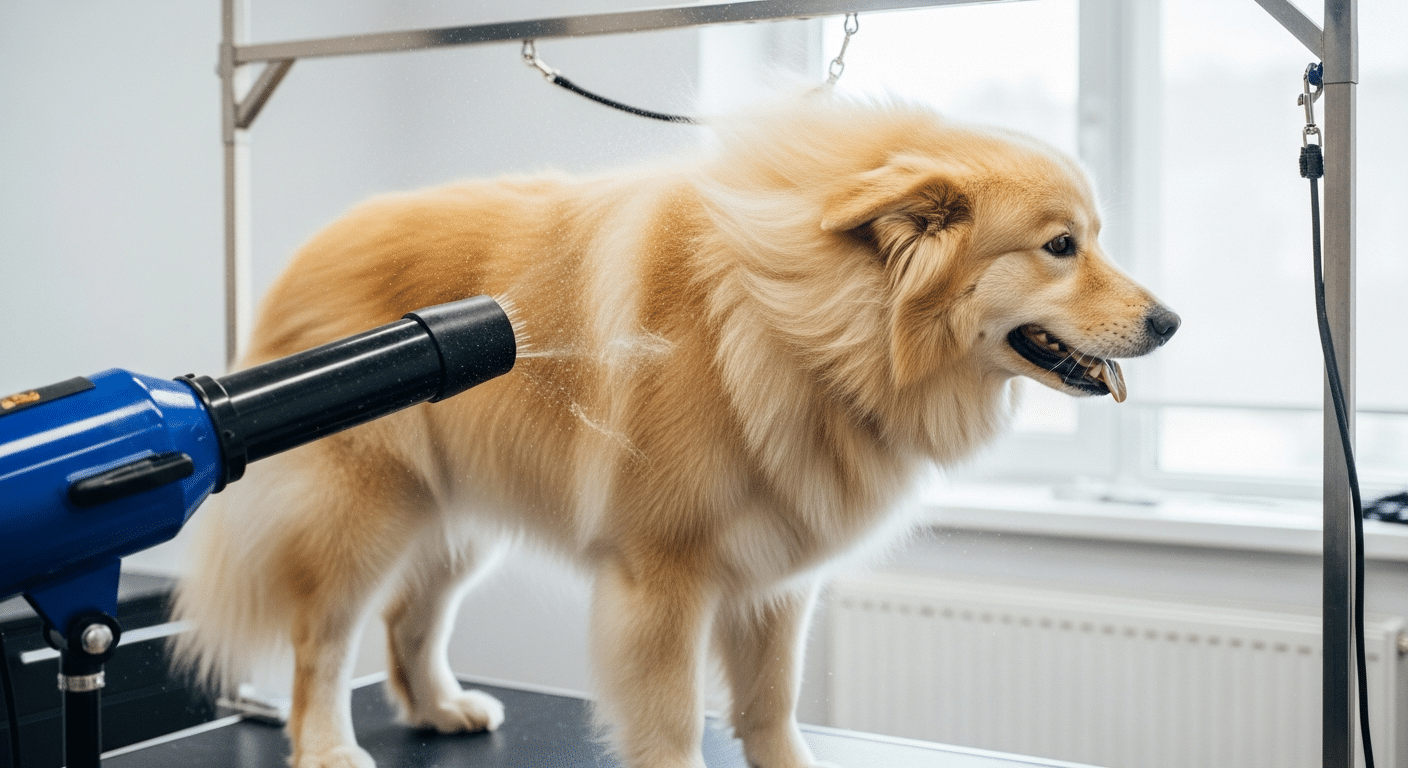
Best Dog Dryers (High-Velocity Force Dryers)
A high-velocity force dryer is the single tool that turns drying a wet, double-coated dog from a 90-minute towel-and-shiver ordeal into a 15-minute job, and it blows out the loose undercoat while it’s at it. These are the four force dryers we’d buy, ranked, with a plain-English guide to CFM, motor power, heat safety and noise so you can match the right machine to your dog.
If you’ve ever spent an hour towel-drying a soaked Golden, Husky or Shepherd and still ended up with a damp, matting dog, a high-velocity force dryer is the upgrade that changes everything. Unlike a human hair dryer, which dries with dangerous heat, a force dryer uses a powerful stream of air to physically blow the water out of the coat, and in the process it blasts out the loose dead undercoat, so it doubles as a deshedding tool. Below are the four best dog dryers we’d actually buy, the high-velocity pick for most owners, the best-value home force dryer, a clever 2-in-1 dryer-vacuum and a safe heat-free starter, plus an honest buying guide covering CFM and airflow, motor HP, heat versus heat-free safety, noise for anxious dogs, and double-coat blowouts, so you can buy once and buy right.
The 4 best dog dryers (high-velocity force dryers), ranked
Each pick is verified in stock and chosen for airflow, build quality, heat safety and value. Prices are last-checked, tap through for the live price.
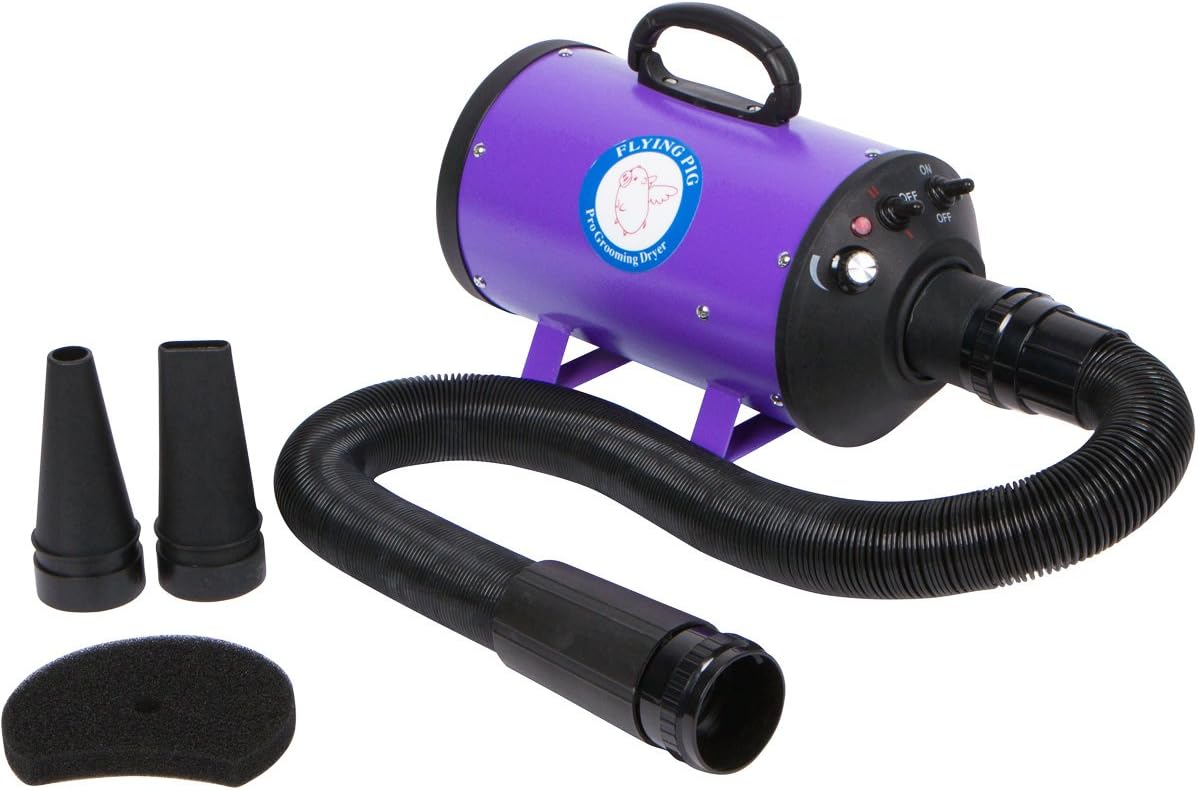
Flying Pig High Velocity Dog Dryer
If you want the dryer that transforms drying a big, double-coated dog, the Flying Pig High Velocity Dryer is the one we point most owners to, and it’s the high-velocity pick that keeps winning editorial round-ups. Its 1,400-watt motor pushes around 240 CFM of airflow at roughly 28,000 FPM, which is enough force to literally blow the water out of a thick coat and blast the loose dead undercoat with it, cutting drying time by up to 70% versus a regular pet dryer. Unlike the plastic-cased competition at this price, it has a powder-coated steel shell that takes daily abuse, a long flexible hose, and stepless variable speed plus selectable heat (off / low / high) so you can start gentle to settle a nervous dog and warm the air on a cold day. It ships with the round and flat nozzles you need for a proper double-coat blowout, and it runs off a standard household outlet.
What we like
- Around 240 CFM of high-velocity airflow, blows water and loose undercoat out of a thick double coat fast
- Powder-coated steel shell is far more durable than the plastic cases on most dryers at this price
- Stepless variable speed lets you start slow to acclimate an anxious dog, then ramp up for the blowout
- Selectable heat (off / low / high) plus a 10 ft hose and the nozzles you need, all on a standard outlet
The catches
- It’s a genuine force dryer, so it’s loud, expect ~75-85 dB and introduce a nervous dog to it slowly
- Heavier and bulkier than a budget handheld; it’s a stay-in-one-place grooming tool, not a travel dryer
- The included heat is handy but, like all high-velocity dryers, the real drying power is the airflow, not the warmth

SHELANDY 3.2HP Pet Hair Force Dryer
The SHELANDY 3.2HP is the force dryer we recommend to most home owners, and it’s the budget pick the big editorial guides keep landing on too. For well under $80 you get a 2,400-watt, 3.2 HP motor with stepless variable speed (airflow roughly 65-135 mph) and a genuinely useful adjustable heat setting, the warm air is a real plus for short-coated dogs that get cold after a bath, while you keep it cool for a double-coat blowout. It dries a typical short-coated Lab in around 10-12 minutes, comes with four nozzles (including a wide flare and a focused condenser), and at roughly 6-7 lb it’s light enough to be manageable. It’s not as built or as powerful as the Flying Pig, but for the price it’s the easiest force dryer to recommend for a home with one or two dogs.
What we like
- Outstanding value, a real 2,400-watt force dryer for the price of a basic pet dryer
- Adjustable heat is a genuine benefit for thin- or short-coated dogs that shiver after a bath
- Stepless speed dial means you can ease a nervous dog in at low power, then turn it up to dry
- Four nozzles cover everything from a general dry to a focused undercoat blowout; light enough to handle
The catches
- Less airflow and a less rugged build than the Flying Pig, fine for a home, not for all-day pro use
- Still loud, as every force dryer is; don’t point the heated air at the skin for long in one spot
- A single very dense double coat (Newfie, Pyr) will take longer than it would with a pro 4HP+ machine

XPOWER B-2 2-in-1 Pet Dryer & Vacuum
The XPOWER B-2 (from B-Air’s sister brand) is the smart choice if you want one machine that does two jobs. It’s a 2 HP, two-speed force dryer that reverses into a pet vacuum, so the same unit dries the dog and vacuums up the loose hair and dander you just blew off, plus the bed and the car. The airflow is real (it’s a true force dryer, not a glorified hair dryer) but more modest than the bigger machines, which makes it a great fit for small-to-medium dogs, lighter or single coats, and apartments where a 240-CFM pro dryer would be overkill. It’s compact, comes with multiple attachments, and is the most genuinely useful under-$120 grooming tool here for the right dog.
What we like
- Two tools in one, a real force dryer that reverses into a vacuum for hair, dander, beds and the car
- Compact and lighter than the big pro machines; ideal for apartments and small-to-medium dogs
- True forced air (not a heated hair dryer), so it actually blows water off rather than baking it dry
- The most versatile pick for a single-coat or lighter-shedding dog where a 240-CFM dryer is overkill
The catches
- Less airflow than the Flying Pig or a 3.2HP+ machine, slower on a dense, heavy double coat
- No heat element; it’s an ambient-air force dryer, so a short-coated dog may want a towel-dry first on a cold day
- The vacuum side is handy but it’s not a replacement for a proper household vacuum on big jobs

B-Air Bear Power BPD-1 (2 HP)
B-Air more or less created the consumer pet force-dryer category, and the Bear Power BPD-1 is its trusted 2 HP entry model. Its standout feature is also its safest: it has no heating element, the only warmth comes from the motor itself, so the air is gentle and there’s no way to burn or scorch your dog’s skin, which makes it a reassuring first force dryer for an anxious owner or a sensitive dog. At about 7.8 lb it’s light and portable, with high-impact ABS housing, a low setting for puppies, cats and small dogs and a high setting for thicker coats, and it comes with a set of interchangeable nozzles. It’s the most basic dryer here on raw airflow, but as a safe, well-made, genuinely portable starter force dryer it earns its place.
What we like
- Heat-element-free, the only warmth is from the motor, so it physically cannot scorch skin (the safest option)
- Light (~7.8 lb) and portable, with simple low/high speeds, an easy, unintimidating first force dryer
- From B-Air, the brand that pioneered the consumer pet force dryer; well-built ABS housing and good support
- Genuinely useful airflow for small, medium and moderately-coated dogs, with a set of nozzles included
The catches
- Lowest airflow of the four, a big, dense double coat will dry slowly compared with the Flying Pig
- No adjustable heat, so a cold, short-coated dog won’t get the warm-air bonus the SHELANDY offers
- Stock can be intermittent on some colors; we link the variant that was in stock at last check
What is a high-velocity force dryer (and why it beats a regular dryer)?
The reason a force dryer feels like cheating is simple: it dries with air, not heat. A human hair dryer or a basic warm-air pet dryer heats the water until it evaporates, slow, and hot enough to risk burning skin or damaging coat. A high-velocity (HV) force dryer instead pushes a concentrated, fast stream of air that physically forces the water off and out of the coat, the way a leaf blower clears a driveway. It’s dramatically faster, it can’t cook your dog, and on a double coat it blasts out the loose dead undercoat at the same time, which is why groomers swear by them.
There are three broad types of dog dryer, and it’s worth knowing which one you’re actually shopping for:
| Type | How it works | Best for |
|---|---|---|
| High-velocity / force dryer | A powerful air mover (little or no heat) that blows water off the coat and blows out loose undercoat | Double coats, heavy shedders, fast drying, what this guide is about |
| Stand / cage dryer | Hands-free warm air on an adjustable arm or in a cage; gentle, low airflow | Pros drying multiple dogs, or finishing/fluffing a coat, not fast water removal |
| Handheld / kennel dryer | Small, often heated, like an upgraded human dryer | Small dogs, touch-ups and travel, too weak for a big double coat |
For a large or double-coated dog, the high-velocity force dryer is the one that’s genuinely worth owning. The rest of this guide is about choosing the right one. It’s also one piece of a kit, see our full best dog grooming tools guide for how a dryer fits alongside a deshedder, a nail grinder and the basics.
CFM and airflow: the number that decides how fast it dries
If you only compare one spec between dryers, make it CFM (cubic feet per minute) of airflow, it’s the single best predictor of how fast a force dryer will get your dog dry. CFM is the volume of air the dryer moves; more air moving means more water carried away per second. You’ll also see an air-speed figure quoted in FPM (feet per minute), m/s or mph, speed is what strips the water droplets off each hair, while CFM is what shifts the volume. The best dryers have both; don’t be wowed by a huge speed number on a machine that moves very little air.
| Airflow class | Roughly | What it suits |
|---|---|---|
| Entry / budget | ~85 CFM (e.g. ~2,400 W home dryers) | Small to medium dogs, single or light coats; fine for one or two dogs at home |
| Strong home / prosumer | ~200-240 CFM (e.g. the Flying Pig) | Large and double-coated dogs; the sweet spot for a serious home groomer |
| Professional | 240 CFM-plus, often dual-motor 4-6 HP | All-day grooming, the densest coats, multiple dogs |
The honest takeaway: for a big double coat, aim for the 200-240 CFM bracket, that’s where drying time genuinely collapses. For a small or single-coated dog, a ~85 CFM home dryer is plenty and easier to handle. Buying more airflow than your dog needs just means a heavier, louder, pricier machine.
Motor power, HP and home electrics: what HP and watts really tell you
Dryer marketing leans hard on horsepower (HP) and watts, and they do matter, but mostly as a proxy for airflow, not as the headline. A higher-HP motor generally moves more air, but HP figures aren’t standardized across brands, so two “3 HP” dryers can perform differently. Treat HP and watts as a rough guide and let CFM be the tie-breaker.
- 2 HP / ~1,400 W, entry force dryers (B-Air Bear Power, XPOWER B-2). Great for small-to-medium dogs and lighter coats.
- 3.2 HP / 2,400 W, strong single-motor home dryers (SHELANDY). Handles most dogs, including many double coats, at home.
- 4-6 HP, often dual-motor, professional machines for the densest coats and all-day use; more than most home owners need.
One spec the marketing rarely mentions but that genuinely matters at home: amperage and your outlet. The biggest pro dryers can draw 15-20 amps, which can trip a standard 15-amp household circuit, especially if something else is on the same breaker. Every dryer in our picks runs happily on a normal household outlet, but if you’re tempted by a big dual-motor pro machine, check the amp draw against your circuit before you buy. Power you can’t plug in is no power at all.
Heat vs heat-free: the dog-dryer safety question that matters most
This is the part most “best dog dryer” lists skim over, and it’s the most important for your dog’s safety. Heat is what damages coat and burns skin, airflow is what dries. The whole point of a force dryer is that it dries with moving air, so it needs far less heat (or none) than a human hair dryer. There are three approaches, and understanding them keeps your dog safe:
- Heat-free (motor-warmed air only). Dryers like the B-Air Bear Power have no heating element, the only warmth is the gentle heat the motor naturally sheds. They physically cannot scorch skin, which makes them the safest option and a great first dryer for a sensitive dog.
- Adjustable / selectable heat. Dryers like the SHELANDY and Flying Pig add a real heating element with an off / low / high control. The warm air is a genuine benefit for a thin- or short-coated dog that gets cold after a bath, but it’s also where the risk lives, so use the lowest heat that works and never park hot air on one spot.
- Human hair dryers. Don’t. They run far hotter than a dog’s skin can safely take, dry slowly, and are the most common cause of dryer burns. A dog’s comfortable air temperature tops out well below a human dryer’s “warm” setting.
Whatever you buy, the safe-use rules are the same: keep the air moving, never hold heat on one patch, keep the nozzle a hand’s-width off the skin, and never aim the airflow at the face, ears or genitals. Good dryers add overheat protection so the machine shuts down before it can hurt your dog, but the habits matter more than the feature.
Noise and anxious dogs: introducing a force dryer the right way
Force dryers are loud, most sit around 75-85 dB, roughly a vacuum cleaner, and the noise plus the blast of air is genuinely frightening to a dog that’s never met one. A bad first experience can make every future groom a battle, so the introduction matters as much as the machine. (A handful of newer models advertise ultra-quiet ~43-50 dB operation; they’re worth a look if you have a truly sound-sensitive dog, usually at the cost of some airflow.)
Here’s how to acclimate a nervous dog, which is exactly why variable speed is a feature worth paying for:
- Start it across the room on the lowest speed so your dog hears it without feeling the air, and pair it with treats and a calm voice.
- Introduce the airflow on the body first, chest, back, hindquarters, never starting at the head.
- Ramp the speed up gradually over several sessions; a stepless dial (SHELANDY, Flying Pig) lets you dial in exactly as much as your dog tolerates today.
- Protect the ears. Keep the air off the ears and face entirely, and many groomers tuck a little cotton in the ears to muffle the noise on very anxious dogs.
- Keep early sessions short and end on a good note, even if the dog isn’t fully dry yet.
Done patiently, most dogs come to tolerate and even enjoy the force dryer, and a variable-speed machine is what makes that gentle on-ramp possible.
The double-coat blowout: a force dryer is also a deshedding tool
The hidden superpower of a high-velocity dryer is that it doesn’t just dry a double coat, it blows the loose dead undercoat right out of it. For breeds like the Husky, German Shepherd, Golden Retriever, Samoyed, Newfoundland and any other double-coated dog, a “blowout” with a force dryer during a shed removes more dead coat in minutes than a brush does in an hour, and it dramatically cuts the hair that ends up on your floors and furniture.
How to do a proper blowout:
- Bathe and rough-towel first. A clean, damp coat releases far more loose undercoat than a dry one, the water helps the dead hair let go.
- Fit the focused (condenser) nozzle for the most concentrated blast, and work with the lie of the coat, section by section, lifting the dead undercoat out as you go.
- Get into the shedding zones, hindquarters, “trousers”, neck ruff and tail, where dead undercoat packs in densest.
- Pair it with a deshedding tool. The dryer loosens and ejects the bulk; a deshedder cleans up what’s left. Together they’re unbeatable in shedding season, see our best deshedding tool for dogs guide for the right brush to pair.
Do it outdoors or in a bathroom you can sweep, a real blowout produces an astonishing cloud of fur. And once the hair is off the dog, it still has to come off everything else; for that, a good vacuum is the other half of the job (our best vacuum for dog hair hub covers it). A force dryer plus a deshedder plus a pet-hair vacuum is the complete shedding-season toolkit.
Nozzles and attachments: what each one is for
Most force dryers ship with a small set of interchangeable nozzles, and using the right one makes a real difference. You don’t need many, three or four covers everything:
- Condenser / concentrator nozzle (narrow cone). Focuses the air into a tight, fast jet, this is your blowout and water-stripping nozzle, and the one you’ll use most on a double coat.
- Wide / flare nozzle. Spreads the air over a larger area for a gentler general dry and for finishing, good for short coats and for settling a nervous dog.
- Crevice / slim nozzle. Reaches tight spots, between toes, around the face area (used carefully and never aimed at the face) and into dense ruff.
- Comb or rake head (on some models). Combs the coat as the air blows, helping lift and straighten while you dry, handy for fluffing and for working out undercoat.
Build quality counts here too: a steel-shell dryer like the Flying Pig and a long, flexible hose make a force dryer far nicer to live with than a short-corded plastic box. If you’re assembling a full at-home grooming setup rather than just buying a dryer, our how to groom a dog at home guide walks through the whole routine, and the best dog nail grinder guide covers the one job most owners dread.
Best dog dryers & force dryers: common questions
Are force dryers safe for dogs?
Yes, used correctly, a high-velocity force dryer is safer than a human hair dryer, because it dries with moving air rather than high heat, so it can’t cook your dog’s skin the way a hot dryer can. The safest option is a heat-free dryer (like the B-Air Bear Power, which has no heating element, only gentle motor warmth). If your dryer has a heat setting, use the lowest that works. The non-negotiable safe-use rules are: keep the air moving and never park heat on one spot, keep the nozzle a hand’s-width off the skin, introduce the noise and airflow gradually to a nervous dog, and never aim the air at the face, ears or genitals. Look for overheat protection as a backstop, but the habits matter most.
What CFM do I need in a dog dryer?
CFM (cubic feet per minute of airflow) is the spec that decides how fast a force dryer dries, so match it to your dog’s coat. For a small or single-coated dog, an entry dryer around 85 CFM (a typical ~2,400-watt home machine) is plenty. For a large or double-coated dog, a Husky, Shepherd, Golden, Samoyed or similar, aim for the 200-240 CFM bracket (like the Flying Pig); that’s where drying time genuinely collapses and you can do a proper undercoat blowout. Professional 240-plus CFM dual-motor machines exist but are more than most home owners need. Remember CFM (air volume) and air speed in FPM/mph are different things, you want a healthy figure for both, not a huge speed number on a low-airflow machine.
What is the best dog dryer for a double coat?
For a double coat you want a true high-velocity force dryer with strong airflow, because the high-velocity air both dries the dense coat fast and blows out the loose dead undercoat as it goes, it doubles as a deshedding tool. Our top pick for double coats is the Flying Pig High Velocity Dryer (around 240 CFM, steel shell, variable speed and heat); the SHELANDY 3.2HP is the best-value option that still handles most double coats at home. For the blowout, bathe and rough-towel first (a damp coat releases more undercoat), fit the focused condenser nozzle, work section by section into the shedding zones, and pair the dryer with a deshedding tool to clean up what’s left.
Are high velocity dog dryers worth it?
For anyone with a large, double-coated or heavy-shedding dog, yes, a high-velocity dryer is one of the most worthwhile grooming purchases you can make. It cuts drying time by up to 70% versus a regular pet dryer, prevents the damp, matting coat that towel-drying leaves behind, and blows out loose undercoat so you shed far less hair around the house. A good home force dryer costs roughly the same as one or two professional grooming visits and then pays for itself. For a small, short-coated dog that towels off in minutes, it’s more of a nice-to-have than a necessity.
How loud are high velocity dog dryers?
Most high-velocity dryers run around 75-85 decibels, about as loud as a vacuum cleaner, and the noise combined with the blast of air can frighten a dog that’s never used one. That’s why variable speed matters: start the dryer on its lowest setting from across the room, pair it with treats, introduce the airflow on the body (never the head), and ramp it up gradually over several sessions. Keep the air off the ears and consider tucking a little cotton in them for a very sensitive dog. A few newer models advertise ultra-quiet operation around 43-50 dB if noise is a serious issue for your dog, usually trading away some airflow.
Can I use a human hair dryer on my dog?
It’s best not to. Human hair dryers run far hotter than a dog’s skin can safely tolerate, a dog’s comfortable air temperature is well below a human dryer’s “warm” setting, so they’re the most common cause of dryer burns, and they dry slowly because they rely on heat rather than airflow. They also can’t blow out a double coat the way a force dryer does. If a human dryer is all you have, use the cool or no-heat setting only, keep it moving and well off the skin, and never aim it at the face or ears. For any regular drying, especially a double-coated dog, a proper heat-free or low-heat force dryer is both faster and far safer.
Can I use a force dryer on a puppy?
Yes, gently. Puppies acclimate to a force dryer more easily than adults if you make the first experiences calm and positive, so it’s actually a great age to introduce one. Use the lowest speed and no or minimal heat (a heat-free dryer like the B-Air Bear Power is ideal), keep sessions short, start the air on the body rather than the head, keep it well off the face and ears, and pair the whole thing with treats. Build up the speed over several sessions rather than blasting a puppy on day one. A patient introduction now pays off with a dog that tolerates grooming for life.
Do professional groomers use force dryers?
Yes, high-velocity force dryers are standard equipment in virtually every grooming salon, because they dry dogs faster, blow out loose undercoat and produce a cleaner finish than warm-air dryers. Pros typically run more powerful machines (4-6 HP, often dual-motor) for all-day use across many dogs. For home use you don’t need that much power: a strong single-motor dryer like the Flying Pig (~240 CFM) or the SHELANDY 3.2HP gives you the same fundamental benefit, fast, heat-light drying and undercoat blowout, without the salon-grade size, noise and electrical draw.