 Dog Gear, Sized Right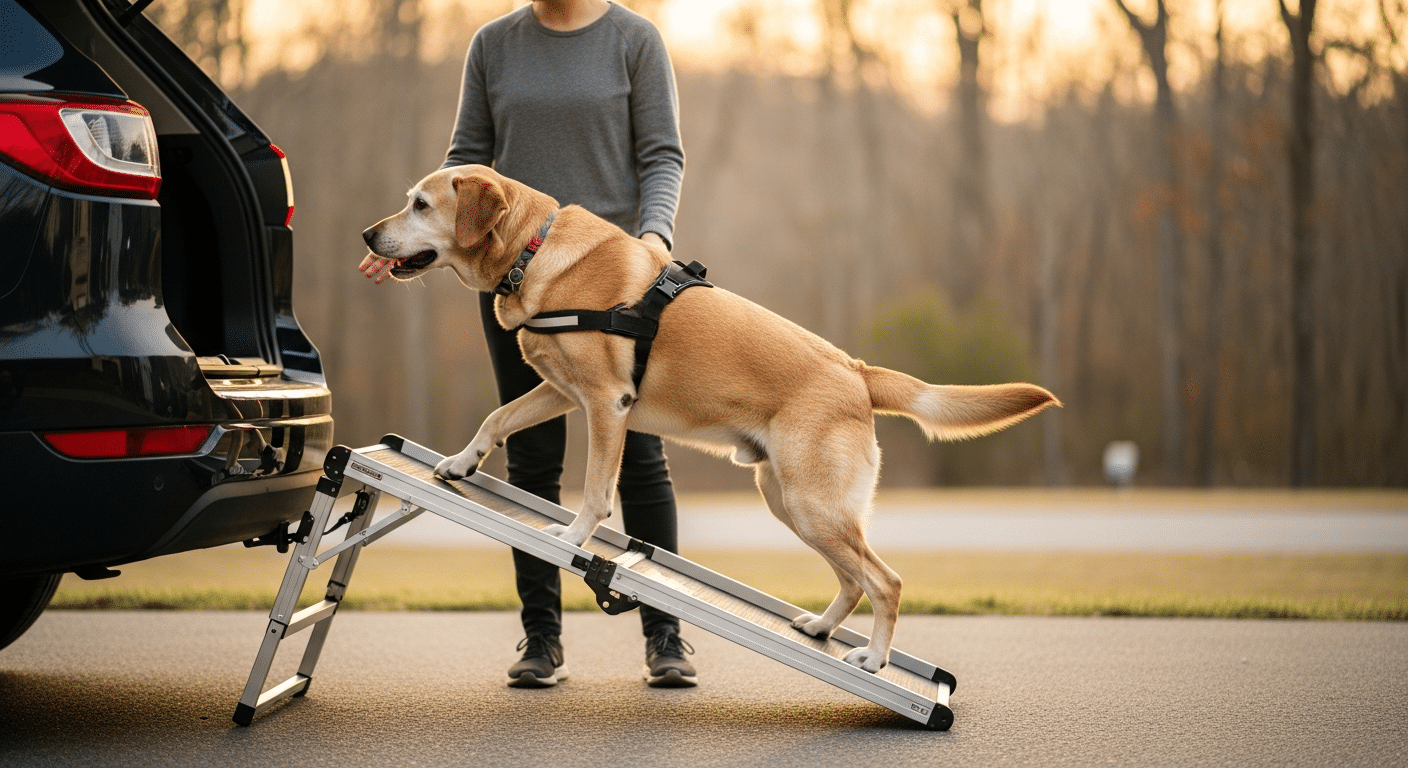
Best Dog Car Ramps (for Large & Senior Dogs)
The right car ramp ends the daily lift, and protects your big or senior dog’s hips, elbows and spine every time they get in the car. Here are the best dog car ramps for large and senior dogs, sized for SUVs and trucks, with honest picks and exactly how to choose by your dog’s weight and your vehicle’s height.
Watching a big dog launch themselves into the back of an SUV, or hesitate, miss, and crash back down, is hard on both of you. For a large or senior dog, every one of those jumps drives a shock through hips, elbows and the spine, and over the years it adds up to the joint wear that ends a dog’s comfortable mobility early. A good dog car ramp turns that jarring leap into a calm, even walk, saves your own back from the 80-pound lift, and is one of the single best things you can buy for an arthritic, post-surgery or giant-breed dog. But ramps are not one-size-fits-all: the right one depends on your dog’s weight and your vehicle’s height. Below we rank our top picks, then walk through exactly how to choose, ramp type, weight capacity, length and incline, traction and stability, with the large-and-senior-dog angle front and centre, plus how to get a nervous dog to actually use it.
The best dog car ramps for large & senior dogs
Ranked for big, heavy and older dogs getting into SUVs and trucks. Each pick is a real, currently-listed product, prices are last-checked, so tap through for the live price.
PetSafe Happy Ride Telescoping Dog Ramp
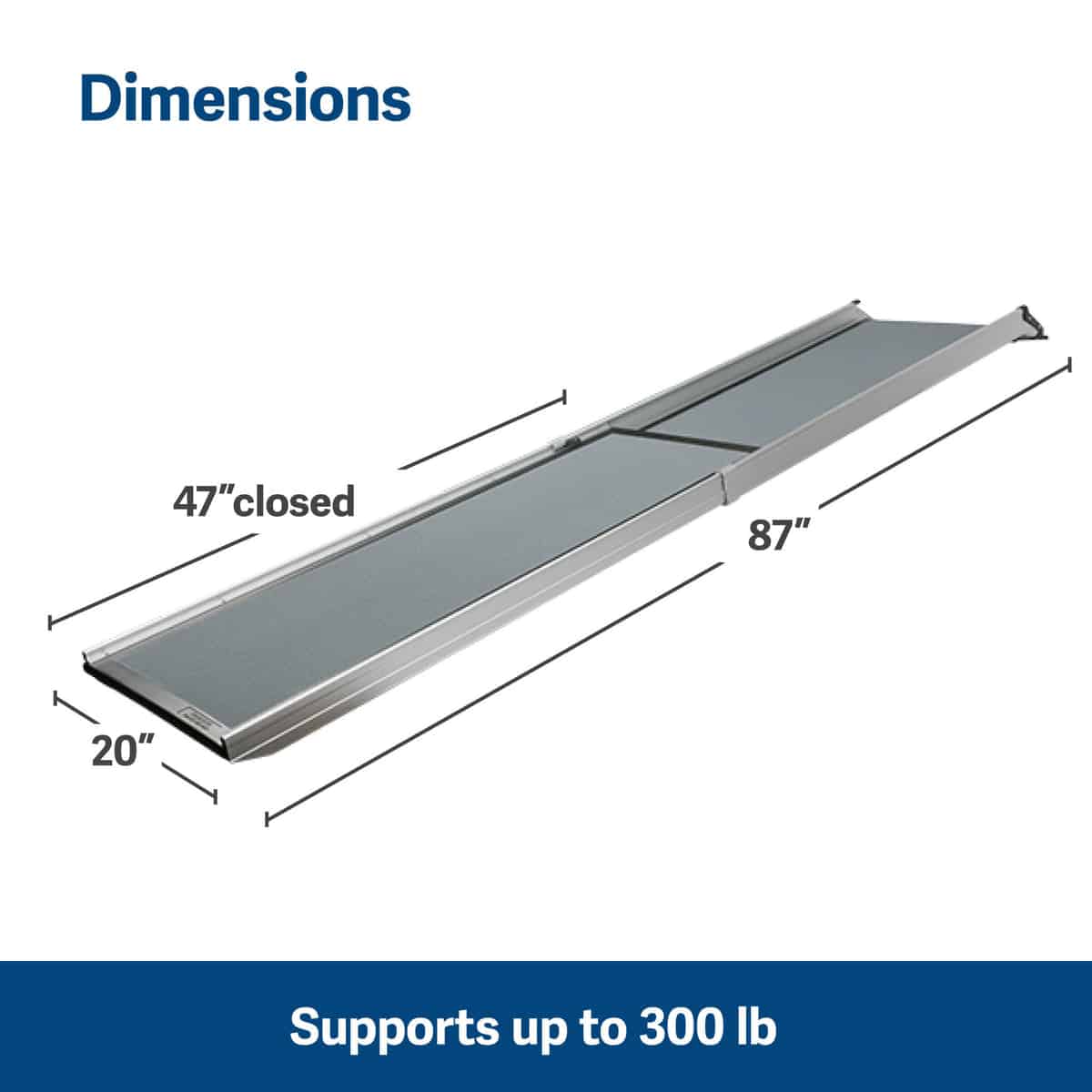
If you have one large or senior dog and want the ramp that just works, this is it. The telescoping aluminum design slides out anywhere from 39 to 72 inches, so you set the exact length your vehicle needs, short and stable for a sedan, long and gentle for an SUV or a lifted truck. It’s rated to 400 lb, comfortably the highest capacity here, which matters for a 90 to 130 lb dog who is also leaning and scrabbling on the way up. The high-traction surface plus raised side rails give a nervous or arthritic dog the confidence to walk it without veering off the edge, and at about 13 lb it’s light enough to lift in and out of the boot one-handed. It collapses to roughly half its length and locks shut for storage. For most large- and giant-breed owners, it’s the best balance of capacity, reach and weight on the market.
What we like
- Highest weight capacity here (400 lb), the safe choice for a 100 lb+ dog who leans and pushes off going up
- Telescopes 39 to 72 in, so you dial in a gentle incline for a tall SUV or truck instead of a steep, scary angle
- Raised side rails keep a wobbly senior or anxious dog from stepping off the edge
- Light aluminum (~13 lb) and locks closed, easy to lift and store even for an older owner
The catches
- Telescoping ramps are firm, not cushioned, fine for a ramp, but it’s a ramp, not a step
- At full 72 in it takes a moment to set the length and click it locked
- Surface is grippy but flat; a very timid first-timer still needs a few minutes of treat-training to trust it
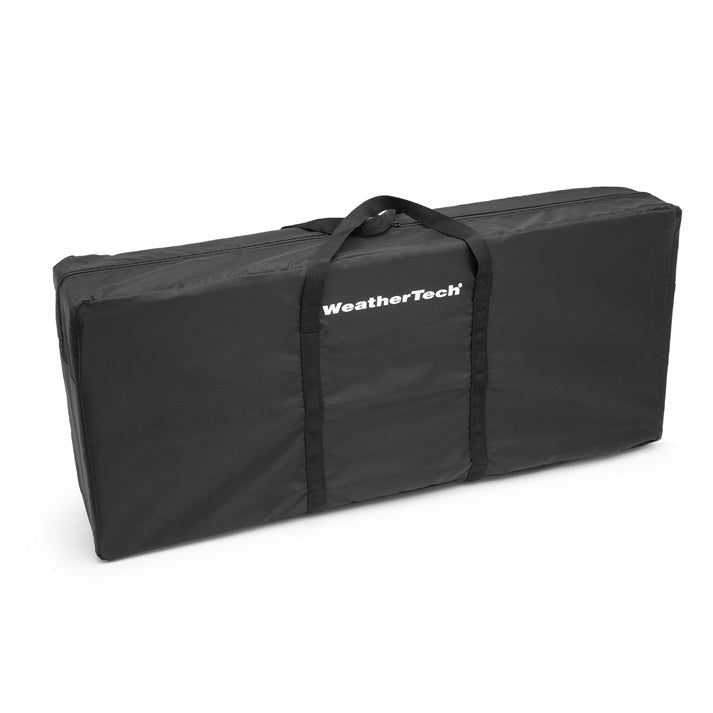
WeatherTech PetRamp
WeatherTech builds the floor liners that survive muddy boots for a decade, and the PetRamp is cut from the same cloth: a single fold-in-half panel of proprietary USA-made resin on a stainless-steel hinge, rated to 300 lb. What sets it apart is the traction, the molded high-grip surface is the most confidence-inspiring here for a dog that slips on smoother ramps, and rubber feet on both ends bite the pavement and grip the tailgate so it doesn’t shoot out from under the dog. It’s 67 inches unfolded for a kind incline into an SUV and folds to a tidy 33.5 inches. At about 16 lb it’s a touch heavier than the others, which is the trade-off for how rugged and stable it feels underfoot. If you want a ramp that will outlast the car, this is it.
What we like
- The grippiest surface in the test, the best pick for a dog that hesitates or slips on slicker ramps
- Rubber feet on both ends lock it to the ground and the tailgate so it can’t slide while the dog is on it
- Built like WeatherTech’s liners, proprietary resin on a stainless hinge, basically indestructible
- Folds in half to 33.5 in with a built-in carry handle
The catches
- Heaviest here at ~16 lb, still manageable, but you feel it more than the aluminum PetSafe
- Premium price; you’re paying for the durability and the made-in-USA build
- A single fold means it’s still 33.5 in folded, bulkier in a small boot than a tri-fold
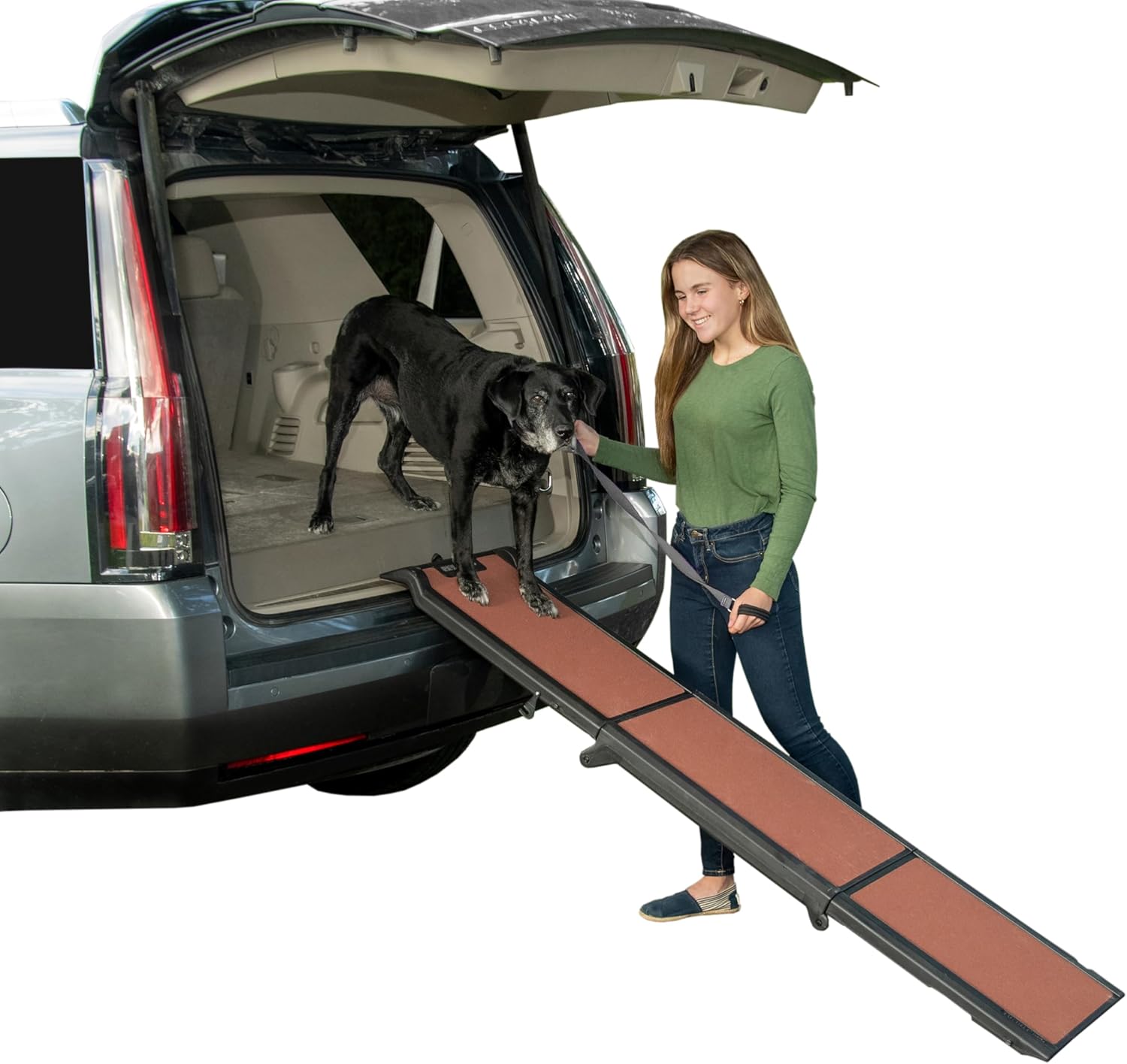
Pet Gear Travel Lite Tri-Fold Ramp
When you want a ramp that disappears into the boot and doesn’t cost much, the Pet Gear Travel Lite Tri-Fold is the value champion. It folds into three panels, so its full 71-inch length collapses to a compact, easy-to-carry block at just 15 lb. The surface is a soft, carpeted non-slip tread that many dogs, and senior dogs in particular, find gentler underfoot than hard plastic, and it includes rubber grippers and a safety tether to clip it to the vehicle. The catch is the 200 lb capacity: ideal for a Lab, a Golden, a senior medium or two smaller dogs, but we’d size up to the PetSafe for a 120 lb-plus giant. For most large-breed owners on a budget, it’s the most portable, most easily stored ramp on the list.
What we like
- Tri-fold folds to the smallest stored size here, slips behind a seat or in a packed boot
- Carpeted tread is soft and warm underfoot; gentle on arthritic paws and easy on the dog’s confidence
- Lightest practical ramp (~15 lb) with a carry handle, easy for an older owner to handle
- Best value, and it includes a safety tether to anchor it to the vehicle
The catches
- 200 lb capacity, fine for Labs/Goldens/senior mediums, but size up for a 120 lb+ giant breed
- Carpet tread holds dog hair and mud; it needs the occasional vacuum or shake-out
- Three hinges mean a touch less rigid than the WeatherTech single-fold under a big, bouncy dog
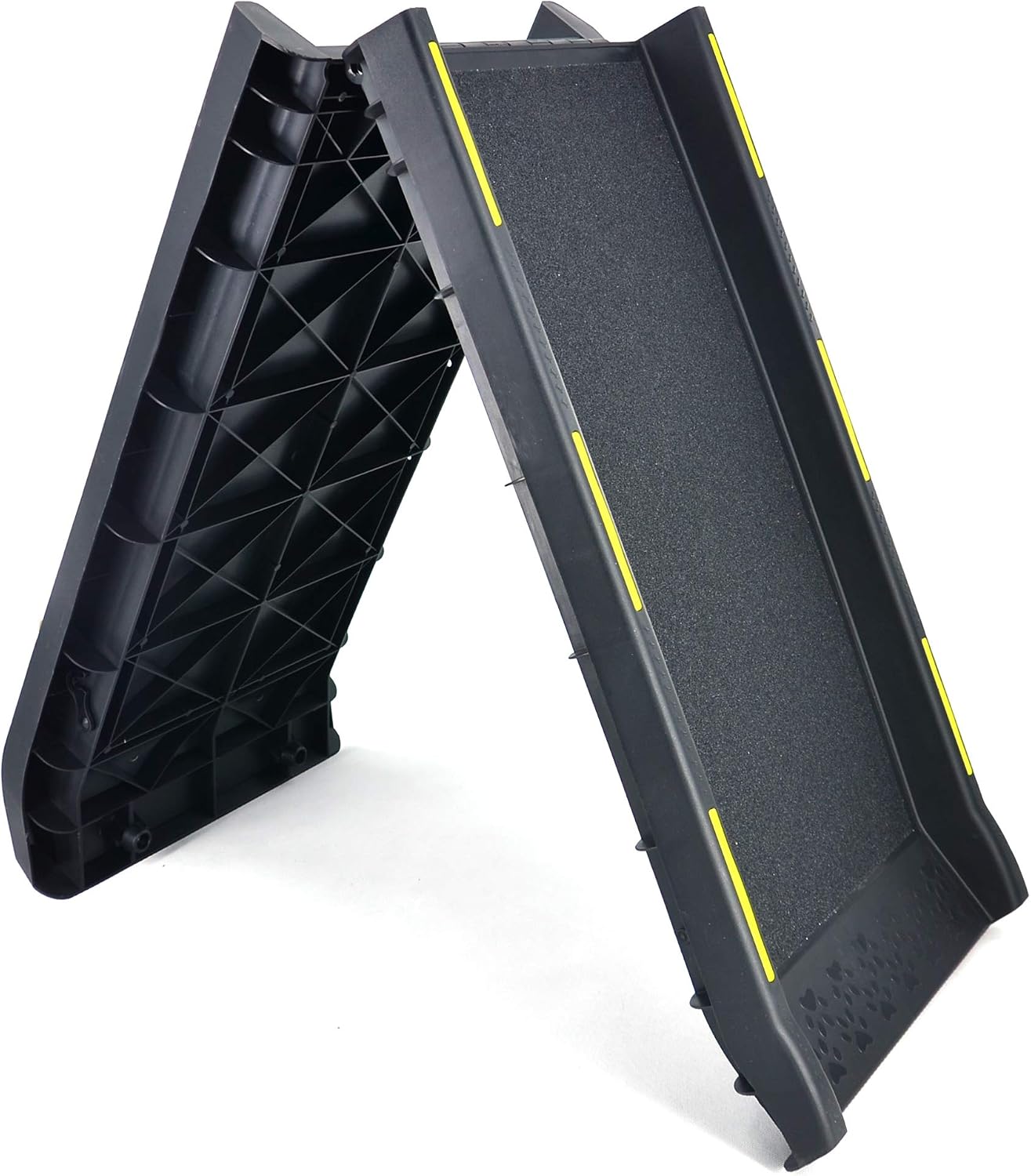
Bi-Fold Pet Ramp (Heavy-Duty, with Safety Tether)
If you’ll use the ramp every single day, same dog, same SUV, in and out at the park and the vet, the friction of a multi-step telescoping or tri-fold ramp adds up. This bi-fold ramp is the answer: it folds in half and snaps open in one motion, so it’s the fastest to deploy here. It runs 62 inches long and 15.5 inches wide with a high-traction walking surface, supports 200 lb, and at just 10 lb it’s the lightest ramp on the list. It has rubber feet on both ends to stop it sliding and a safety tether to anchor it to the vehicle. It’s the simplest, no-fuss daily driver for a large dog up to about 100 lb, just step up to the 400 lb PetSafe if your dog is heavier or you want the longest possible reach.
What we like
- Fastest to set up, folds in half and snaps open in one motion for daily in-and-out
- Lightest ramp here (~10 lb), so it’s effortless to move and store
- Generous 15.5 in width and high-traction surface give a big dog room to walk it squarely
- Includes both rubber feet and a safety tether for a price well under the premium ramps
The catches
- 200 lb capacity and 62 in length, best for dogs up to ~100 lb and standard SUVs, not lifted trucks
- Folded in half it’s longer than a tri-fold’s stored size
- Lightweight build is brilliant for daily use but feels less tank-like than the WeatherTech
Why a ramp matters most for a large or senior dog
For a small or young dog, jumping into the car is no big deal. For a big or senior dog, it’s a repeated impact injury waiting to happen. A 90-pound dog leaping down from a tailgate lands the equivalent of several times their body weight through the front legs, straight into the shoulders, elbows and wrists. Going up, they scrabble and twist, loading the hips and the lower spine. In a young dog the joints absorb it; in a senior, an arthritic, a post-surgery or a giant-breed dog prone to hip and elbow dysplasia, every jump grinds away cartilage that doesn’t come back.
A ramp replaces that jarring leap with a controlled, even walk on the dog’s own four legs, spreading the effort instead of spiking it through one joint. For an older dog it’s often the difference between still coming on the trip and being left behind. And it’s not only the dog you’re protecting, hoisting an 80 to 120 lb dog in and out by hand is how plenty of owners hurt their own backs. The vets at the AKC note that managing joint stress is central to keeping an arthritic dog comfortable, and reducing repeated impact is a big, easy part of that. A ramp is one of the cheapest, highest-impact pieces of mobility gear you can buy for a large dog.
Ramp types: telescoping, folding, bi-fold and tri-fold
Nearly every dog car ramp is one of four designs. The differences matter most for storage, how fast it deploys, and how rigid it feels under a big dog:
- Telescoping. The ramp slides out like a ladder, so you set the exact length your vehicle needs, short and stable for a sedan, long and gentle for a truck. The most adjustable type and usually the strongest (our 400 lb top pick is telescoping). It collapses to about half its length for storage.
- Bi-fold. A single hinge folds the ramp in half. It’s the fastest to open, snap and go, and typically the lightest, which makes it the best everyday-use ramp. Folded, it’s still half the ramp’s full length.
- Tri-fold. Two hinges fold the ramp into three panels, giving the most compact stored size, it shrinks to a small block that hides behind a seat. The trade-off is slightly less rigidity and usually a lower weight rating than a telescoping ramp.
- Single-panel folding (fold-in-half resin). A rigid moulded panel that folds once. Often the most durable and grippiest (our WeatherTech pick is this type), at the cost of a little extra weight.
Weight capacity: match it to your dog (the 150+ lb question)
This is the spec people get wrong, and it’s the one that matters most for a large dog. A ramp’s rating isn’t just your dog’s standing weight, a dog pushes off, leans and bounces on the way up, so the real load can briefly be far higher. Always size the capacity well above your dog’s actual weight.
- Up to ~100 lb dog (Labrador, Golden, senior Boxer, two small dogs): a 200 lb ramp is fine, that’s the Pet Gear tri-fold and the bi-fold above.
- 100 to 130 lb dog (Shepherd, big Lab, Rottweiler, Ridgeback): step up to 300 lb, the WeatherTech PetRamp, for a comfortable safety margin.
- 130 lb and up (Great Dane, Mastiff, Saint Bernard, Newfoundland): go straight to the 400 lb PetSafe telescoping ramp. For the heaviest giant breeds, capacity is non-negotiable, a ramp that flexes or fails under your dog is worse than no ramp at all.
If you have a 150 lb-plus dog, the highest-rated telescoping ramp is the only one we’d trust, and you’ll want the longest length you can get for a gentle incline (more on that next). When in doubt, buy more capacity than you think you need, it costs a little more and removes any worry.
Length and incline: the difference between an SUV and a truck
The single biggest comfort factor for a senior or arthritic dog is the incline, how steep the climb is. And incline is just maths: the taller your vehicle and the shorter the ramp, the steeper (and scarier) the angle. The fix is a longer ramp.
- Sedan or low hatchback (~20 to 25″ loading height): almost any ramp gives a gentle slope; a shorter ramp is fine and easier to store.
- SUV / crossover / minivan (~28 to 34″): aim for a ramp of at least 60 to 70 inches so the angle stays kind on the joints. This is the sweet spot for most folding and telescoping ramps.
- Tall truck, lifted SUV or 4×4 (36″+): you need a long telescoping ramp, 72 inches or more. Our top PetSafe extends to 72″, and PetSafe’s extra-long telescoping version reaches 87 inches specifically for high trucks. A short ramp on a tall truck creates a steep, frightening climb a senior dog simply won’t do.
Width matters too: the ramp should be a few inches wider than your dog’s shoulders and hips so they can walk it squarely without a paw slipping off the edge. Most quality ramps run 15 to 20 inches wide; for a broad-chested big dog, lean toward the wider end and toward ramps with side rails like the PetSafe.
Traction and stability: keeping a nervous dog safe
A ramp is only as good as its grip and how firmly it stays put. For a senior or anxious dog, a single slip is enough to make them refuse the ramp forever, so this is where not to cut corners.
- High-traction surface. Look for a moulded high-grip surface, a sandpaper-style tread, or a carpeted walking surface. Carpet (like the Pet Gear) is soft and warm underfoot and gentle on arthritic paws; moulded grip (like the WeatherTech) is the most durable and easiest to hose clean. Both beat a smooth ramp, which a dog’s claws skate on.
- Rubber feet at both ends. The ramp must not shift when the dog steps on. Good ramps have rubber feet or grippers at both ends, one gripping the ground, one resting securely on the tailgate. A ramp that slides out from under a dog is the classic accident.
- Side rails. Raised side rails (on the PetSafe) keep a wobbly senior or a distracted dog from stepping off the edge. Worth seeking out for a dog with poor balance or failing eyesight.
- A safety tether. Several ramps include a strap that clips to the vehicle’s rear latch so the ramp can’t slide away from the tailgate. Cheap, and a real margin of safety for a big dog leaning on it.
Whatever ramp you choose, set it on level ground where you can, and on uneven ground keep a hand near your dog’s harness for the first few uses until they’re confident.
Ramp vs stairs vs steps: which is right for your dog?
Pet shops sell steps and stairs alongside ramps, and for a car, and especially for a large or senior dog, a ramp is almost always the better choice. Here’s the honest comparison:
| Option | Best for | The catch for a big/senior dog |
|---|---|---|
| Ramp | Large & senior dogs; joint & spine protection; tall SUVs/trucks | Needs length to stay gentle; takes more floor space than steps |
| Stairs / steps | Small dogs onto a bed or low couch; tight spaces | Each step still loads the joint with an up-and-down motion, the opposite of what an arthritic dog needs; harder for a dog with hip dysplasia or a long back |
| Combination step-ramp | Owners who want both, indoors | A compromise, usually shorter, so a steeper ramp angle than a dedicated long ramp |
The principle is simple: a ramp gives one continuous, gentle slope the dog walks up in a natural gait, while stairs ask the joint to flex and bear weight at each step. For the dogs this guide is about, big, heavy, ageing, arthritic, post-surgery, or long-backed, the smooth incline of a ramp is far kinder. Steps make more sense for a small dog getting onto furniture, where the height is low and the dog is light. For the car, choose the ramp.
How to get a nervous dog to use a ramp
The most common ramp complaint isn’t the ramp, it’s a dog who won’t set foot on it. A wobbly or noisy ramp is unfamiliar and a little scary, but almost every dog learns it in a few short sessions. Don’t force it; build confidence:
- Start flat and on the ground. Lay the ramp flat (not angled) on the floor or lawn and let your dog sniff it and step on it for treats. No height, no pressure, just “this surface is safe and good things happen here.”
- Lure across, then raise it. Once they’ll walk the length of the flat ramp for treats, raise one end a little, onto a low step first, then the tailgate. Reward every successful pass and keep sessions short and upbeat.
- Use high-value treats and a calm voice. Save the good stuff (chicken, cheese) for ramp practice so the ramp becomes the best thing in the dog’s day.
- Steady, don’t lift. For the first real uses, walk alongside with a light hand near the harness to reassure, but let the dog do the walking so they build trust in their own footing.
- Make it grippy and stable. A ramp that slides or feels slick will set training back; choosing one with a good high-traction surface and rubber feet (above) makes the whole process easier.
Within a week of short, positive sessions, most dogs trot up the ramp without a second thought, and your senior dog gets a calm, joint-friendly way into the car for years to come.
Caring for your ramp and your travelling dog
A ramp is one piece of a comfortable car setup. To keep it working and your dog safe on the road:
- Keep the surface clean. Carpeted ramps collect hair and mud, shake or vacuum them; moulded-resin ramps hose clean in seconds. A grippy, clean surface is a safe surface.
- Store it where you’ll use it. A ramp left in the garage is a ramp you’ll skip. Folded, all four of our picks live happily in the boot or behind a seat, the tri-fold and bi-fold take the least room.
- Pair it with restraint. A ramp gets your dog in safely; a crash-tested car harness or seatbelt, a booster seat for smaller dogs, or a cargo barrier keeps them safe once you’re moving. Our full guide to traveling with your dog ties the whole setup together.
- Planning a longer trip? If you’re heading away and need someone to watch the dog, dog boarding alternatives walks through the options beyond a kennel.
Get the ramp right for your dog’s weight and your vehicle’s height, spend a week teaching them to love it, and you’ve removed one of the biggest daily strains on a large or senior dog’s joints, and your own back.
Build the rest of your dog’s car setup
Choosing a dog car ramp: common questions
What size ramp do I need for an SUV?
For a typical SUV, crossover or minivan (a loading height of roughly 28 to 34 inches), aim for a ramp at least 60 to 70 inches long so the incline stays gentle on your dog’s joints. A good rule of thumb is that the ramp should be about twice the loading height for a kind angle (around 18 to 27 degrees). For a tall truck or lifted SUV (36 inches or more) you’ll want a long telescoping ramp of 72 inches or more, a short ramp on a tall vehicle creates a steep climb a senior dog won’t attempt. The telescoping PetSafe extends to 72 inches and an extra-long version reaches 87 inches for high trucks.
What is the best dog ramp for a large dog?
For a large dog, prioritise weight capacity and length. Our overall pick is the PetSafe Happy Ride Telescoping ramp: it’s rated to 400 lb (the highest here), telescopes from 39 to 72 inches so you set a gentle incline for any vehicle, has raised side rails to keep a big dog on track, and weighs only about 13 lb. For a 100 to 130 lb dog the 300 lb WeatherTech PetRamp is a superb, ultra-durable alternative with the best traction. Match the capacity well above your dog’s actual weight, because a dog pushes off and leans on the way up, the real load is higher than their standing weight.
Is a ramp or stairs better for a senior dog?
For a senior or arthritic dog getting into a car, a ramp is almost always better than stairs. A ramp gives one continuous, gentle slope the dog walks up in a natural gait, spreading the effort evenly. Stairs ask the joint to flex and bear weight at every single step, the up-and-down motion that’s hardest on hips, elbows and a long back. Steps make sense for a small dog getting onto a low couch or bed, where the height is small and the dog is light, but for a large or ageing dog and the height of a car, choose the ramp.
What weight capacity do I need in a dog ramp?
Choose a capacity comfortably above your dog’s weight, because a dog pushes off, leans and bounces going up, so the brief load is higher than their standing weight. As a guide: a 200 lb ramp suits dogs up to about 100 lb (Labs, Goldens, senior mediums); a 300 lb ramp covers 100 to 130 lb dogs (Shepherds, Rottweilers); and a 400 lb ramp is the safe choice for giant breeds over 130 lb (Great Danes, Mastiffs, Saint Bernards). When in doubt, buy more capacity than you think you need, a ramp that flexes under a big dog is worse than no ramp at all.
How do I get my dog to use a ramp?
Build it up gradually. Start with the ramp flat on the ground and let your dog sniff and step on it for high-value treats, no height, no pressure. Once they’ll walk its full length flat, raise one end a little at a time (a low step, then the tailgate), rewarding every pass. Keep sessions short and upbeat, walk alongside with a light hand near the harness to reassure, and make sure the ramp has good traction and rubber feet so it doesn’t slip and scare them. Most dogs are trotting up confidently within a week of short, positive sessions.
Are folding or telescoping dog ramps better?
It depends on how you’ll use it. Telescoping ramps adjust to any length, are usually the strongest, and are best for tall trucks and giant dogs where you need maximum reach and capacity. Bi-fold ramps open fastest (one fold) and are lightest, making them the best everyday ramp. Tri-fold ramps collapse to the smallest stored size, ideal for a packed boot, though usually with a lower weight rating. A single-fold resin ramp (like the WeatherTech) is the most durable and grippiest. For most large- or senior-dog owners we’d start with the telescoping PetSafe for its capacity and adjustable length.
Will a dog ramp damage my car or fit in the boot?
No, quality ramps are designed to protect your car, not harm it. They rest on the tailgate with rubber feet that grip without scratching, and a safety tether stops the ramp sliding against the paintwork. For storage, all four of our picks fold down: a tri-fold collapses to the smallest block (behind a seat), a bi-fold folds in half, and a telescoping ramp shrinks to about half its length and locks shut. Even the larger ramps sit comfortably in most SUV boots, and storing it in the car is the trick to actually using it every day.