 Dog Gear, Sized Right
Best Dog Car Barriers (SUV & Backseat)
The best dog car barriers keep your dog safely in the back, out of the front seats, out of the footwell, and from becoming a projectile in a stop. Here are our top picks for SUVs, cargo areas and back seats, plus how to choose the right type for your vehicle and your dog.
A loose dog in a moving car is a real hazard, to the dog and to you. A barrier that wanders into the front seat is a distraction, and in a sudden stop an unrestrained dog becomes a projectile that can hurt itself and everyone in the car. A good dog car barrier fixes both problems at once by keeping your dog contained in the back. But “car barrier” covers several very different products, a rigid metal cargo barrier for an SUV is a completely different thing from a net barrier that walls off the back seat of a saloon. Below are our top picks for each situation, all real products we’d actually fit, followed by a plain-English guide to barrier types, vehicle fit and large-dog containment so you buy the right one the first time. Every buy button goes to a live listing.
The best dog car barriers, ranked
Four barriers that cover every common situation. SUV cargo, behind the front seats, and back-seat / sedan. Each goes to a live listing; we re-check on updates.
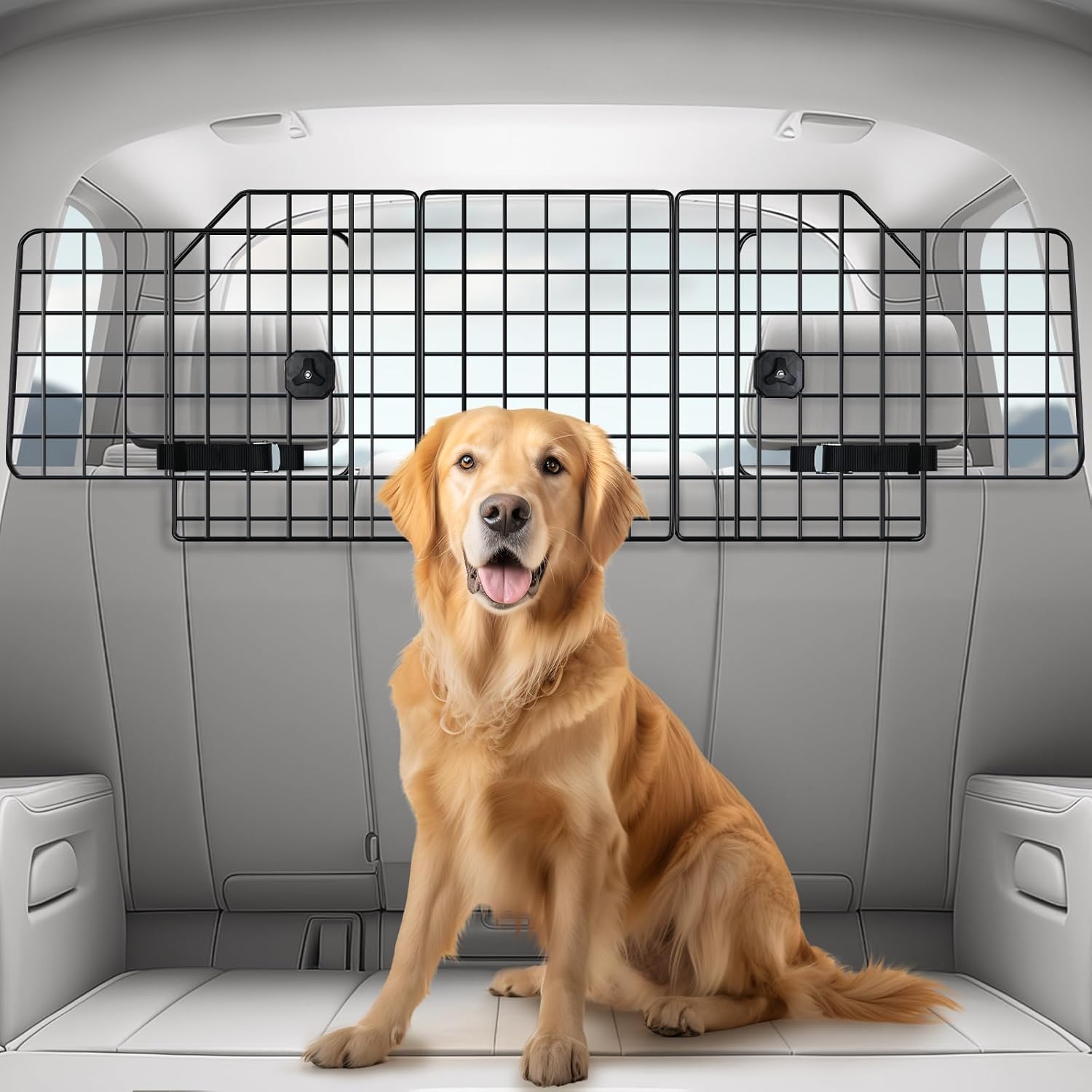
rabbitgoo Dog Car Barrier for SUVs
If you drive an SUV and want the dog kept firmly in the back, this is the one we’d buy. The rabbitgoo is a proper heavy-duty wire-mesh barrier, a folding main panel (about 35.8″ wide) plus two side panels that expand the coverage out to roughly 59.8″ wide, so it seals the gaps either side of the headrests that a flat barrier leaves open. The steel mesh is tight enough that a determined dog can’t squeeze through or claw its way out, and the height keeps a big dog from clambering over the seatbacks into the cabin. It installs tool-free, unfold it, clip the side panels on, and strap it to the headrest posts, and the whole thing triple-folds flat to about 17″ when you want your boot back. For a Lab, a Shepherd or anything bigger, this is the most reassuring barrier on the list.
What we like
- Wire mesh + side panels close the gaps a flat barrier leaves, hard for a big dog to squeeze through or jump over
- Adjustable from ~35.8″ to ~59.8″ wide, so it fits most SUVs, vans, jeeps and hatchbacks
- Tool-free install in three steps; triple-folds to ~17″ when you want the cargo space back
- Rust-proof steel stands up to a dog that paws or leans on it
The catches
- Designed for SUV-style vehicles, it won’t span the cabin of a saloon/sedan (use the High Road net for that)
- Like all headrest-strap barriers, fit depends on your seats having removable headrests with posts
- Takes a minute to get the side panels squared up the first time
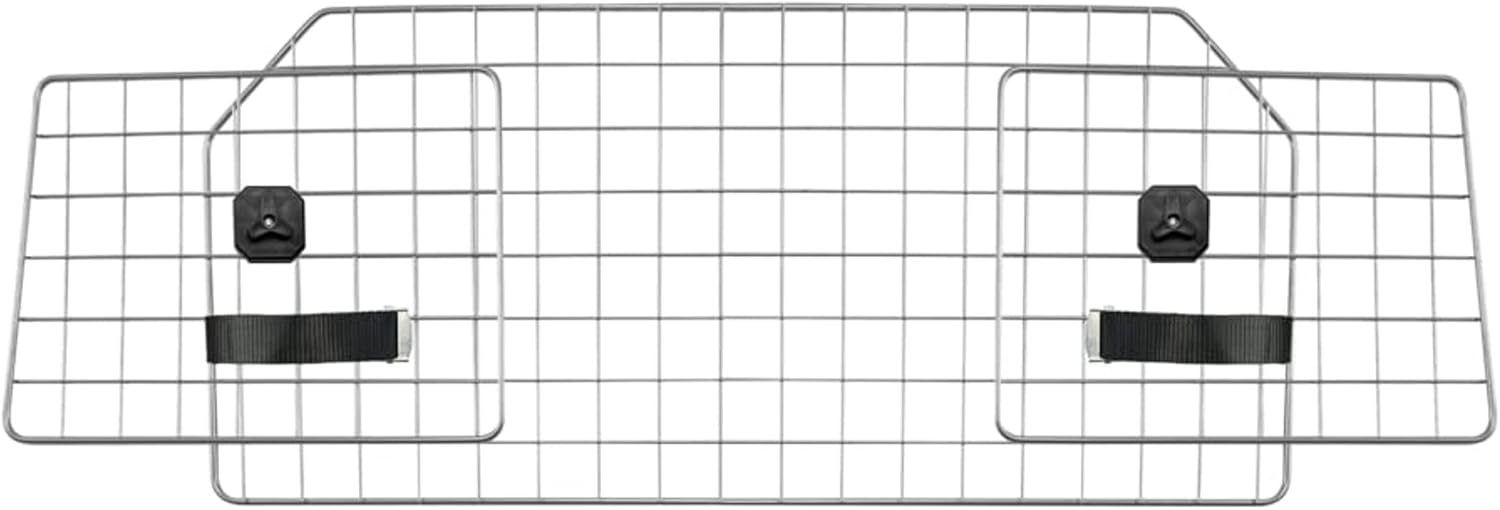
Jumbl Heavy-Duty Adjustable Car & SUV Dog Barrier
When people picture a “car dog barrier” they usually mean this: a rigid steel-wire grid that sits behind the front seats and turns your cargo area into a contained kennel zone. The Jumbl is the one we’d pick, about 35.5″ long and 16″ high with adjustable straps that let it telescope to fit nearly any car, SUV or hatchback, and it goes in and out without tools or hardware. The wire construction is stiffer and more cage-like than a fabric net, so it shrugs off a dog that leans, paws or pushes against it, and it keeps your pet safely away from the driver and passengers, no nose in your ear at 60 mph. It’s the sensible middle ground: tougher than a net, cheaper and simpler than a full custom partition.
What we like
- Stiff steel grid resists a dog leaning, pawing or pushing, more solid than a fabric net
- Adjustable straps telescope to fit most cars, SUVs and hatchbacks without tools
- Keeps the dog behind the front seats and out of the driver’s space
- Affordable for a genuine metal barrier
The catches
- A single rigid panel can leave gaps at the sides on wider vehicles, check the width against your cabin
- Less tall than the rabbitgoo, so a very athletic large dog could attempt to go over it
- Headrest-strap dependent like most barriers in this class
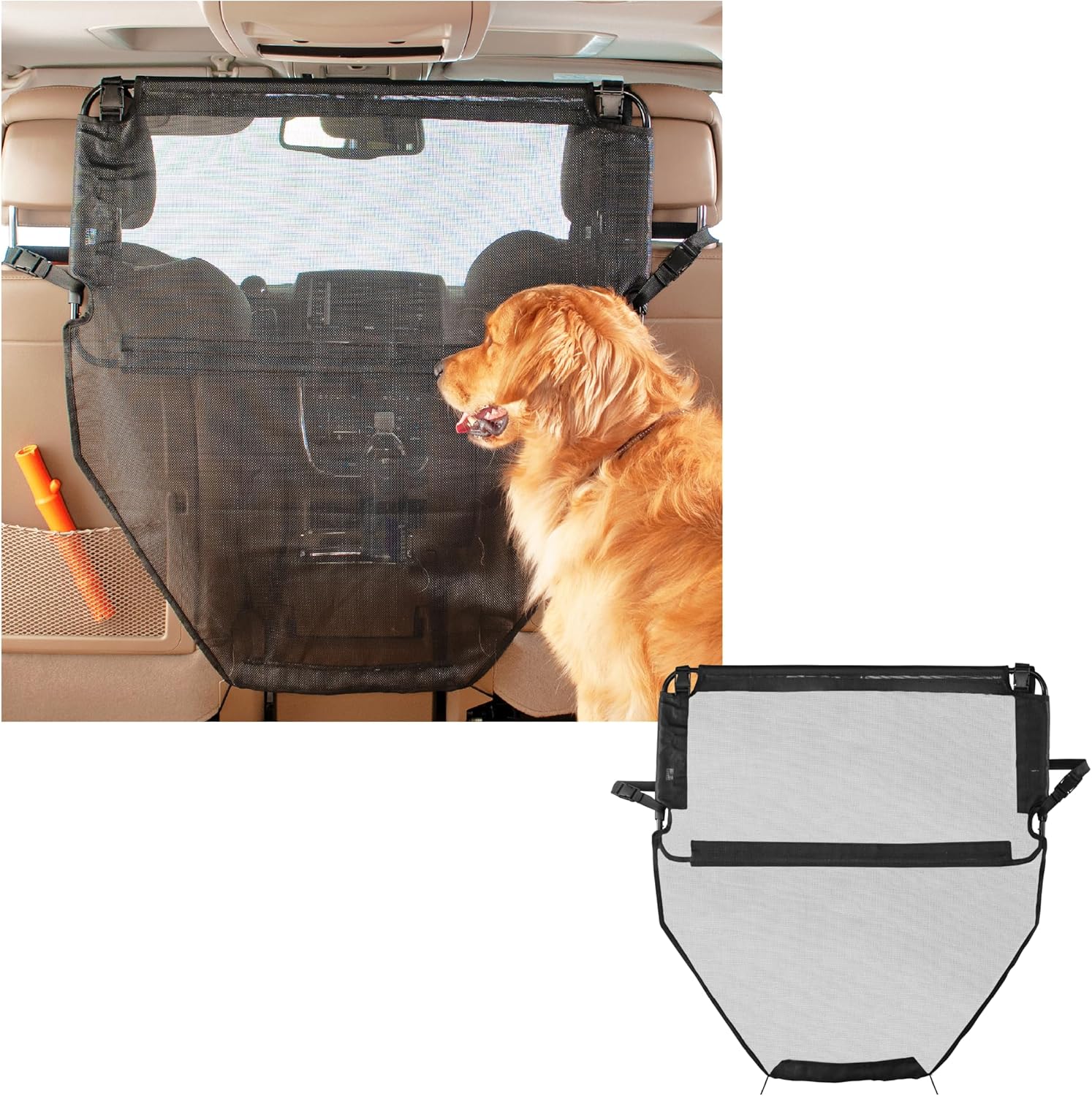
High Road Back Seat Barrier for Dogs
If you don’t drive an SUV, or you simply want to keep the dog on the back seat and out of the front, this is the answer. The High Road Back Seat Barrier is a padded steel frame wrapped in a heavy-duty coated net mesh that stretches across the cabin behind the front seats, blocking the dog from climbing forward into your lap or the footwell. The padded frame is gentler on your seats than bare metal, the mesh is scratch- and tear-resistant, and it fits cars, trucks and SUVs alike. It’s the barrier we recommend for anyone with a back-seat dog who’s tired of a nose appearing over their shoulder, and at the price, it’s the easiest upgrade to a safer, less distracted drive. (We verified this one in stock at about $45 when this guide went live.)
What we like
- Walls off the front seats, ideal for sedans and back-seat dogs, where a cargo barrier won’t help
- Padded frame is kinder to your upholstery than a bare metal grid
- Coated net mesh is scratch- and tear-resistant and keeps the dog visible
- Fits cars, trucks and SUVs; the listing we checked was in stock at the time of writing
The catches
- A flexible net flexes more than a rigid cage if a very large dog throws its full weight at it
- Covers the front-to-back gap, not the cargo area, pair with a cargo barrier in an SUV if you want both zones
- Headrest and seat-frame anchoring means fit varies a little by vehicle
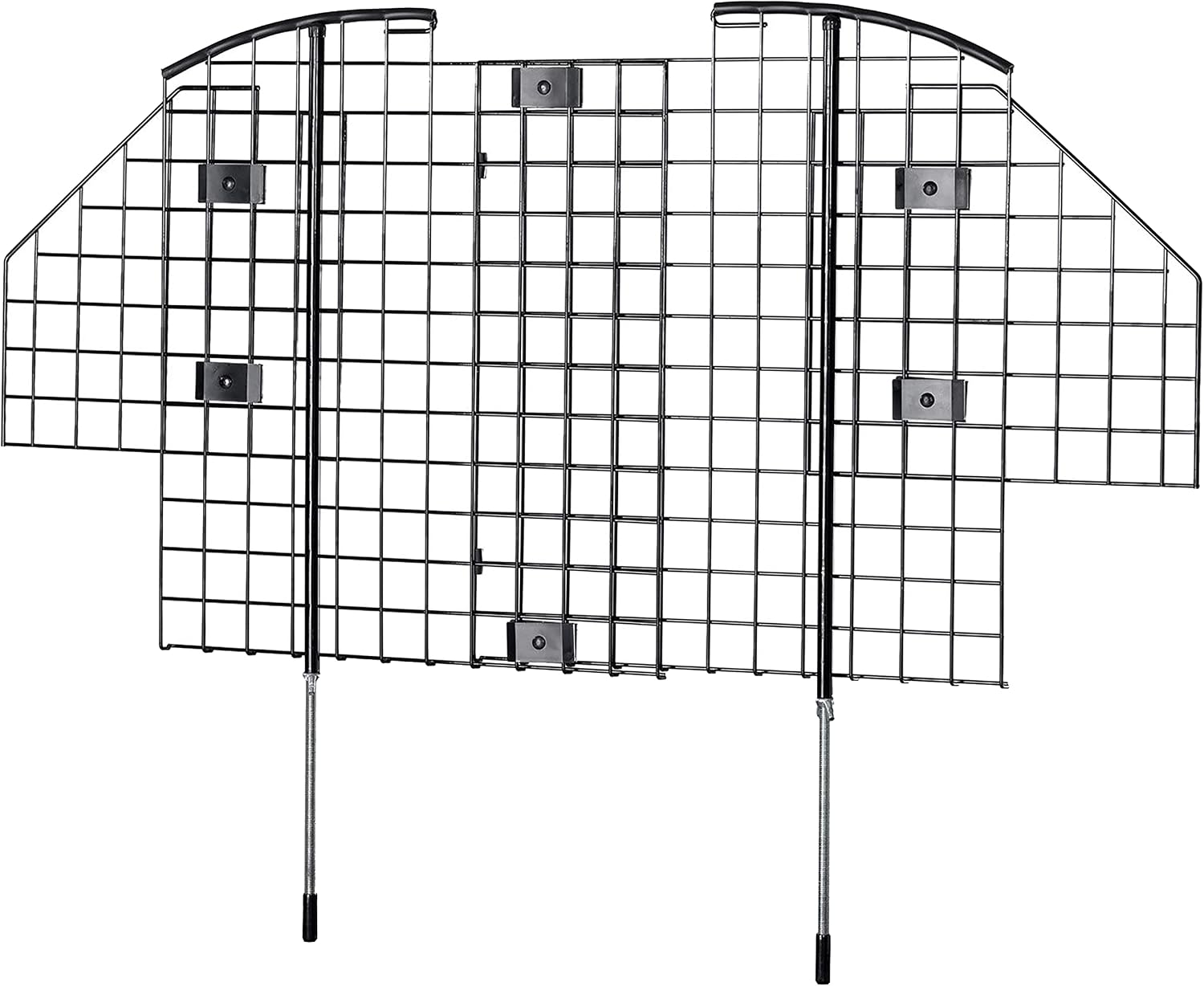
MidWest Wire Mesh Pet Barrier
A long-running favourite for people who just want a plain, affordable metal barrier and nothing fancy. The MidWest Wire Mesh Pet Barrier is made of heavy tubular meshed steel and adjusts from a compact footprint out to roughly 70″ wide and 50″ high, so it spans the back of larger SUVs, vans and hatchbacks. The wide-and-tall expansion is the selling point: it closes the over-the-top and around-the-side escape routes that trip up smaller barriers, which matters with a big or bouncy dog. It’s a no-frills, value pick, not as polished as the rabbitgoo to fit and fold, but hard to beat on coverage for the money.
What we like
- Big expansion range (to ~70″ wide × 50″ high) closes over-the-top and side-gap escape routes
- Heavy tubular meshed steel, properly solid, not a flimsy net
- Long-established, widely-fitted design for SUVs, vans and hatchbacks
- Strong coverage for the price
The catches
- Bulkier and less elegant to install and store than the triple-folding rabbitgoo
- Best suited to taller cargo areas, overkill in a small hatchback
- Fit still depends on your specific vehicle’s dimensions, measure first
Why use a dog car barrier at all?
It’s worth being clear about what a barrier actually does for you, because that decides which type you need:
- It stops the dog distracting the driver. A dog that can reach the front seat, climbing over, leaning on your shoulder, going for the gear stick, is a genuine crash risk. A barrier keeps the cabin to the humans.
- It contains the dog in a crash or hard stop. An unrestrained dog in a sudden stop is thrown forward like any loose object, a 70 lb dog at 30 mph hits with the force of a small motorbike. A barrier keeps that mass out of the front seats, where it could injure both the dog and the people up front.
- It stops door-dash escapes. Plenty of dogs bolt the moment a door opens. A barrier (especially a cargo barrier) buys you a beat to get a lead on before the dog can shoot past you into traffic or a car park.
- It protects your car. Hair, mud and claws stay in the back instead of all over the cabin.
The main types of dog car barrier
This is where most people buy the wrong thing. There are four broad types, and the right one depends entirely on your vehicle and where you want the dog to ride.
- Metal / wire-cage barriers. A rigid steel grid (like the Jumbl) that drops in behind the front seats. The toughest and most escape-proof option, a dog can lean, paw and push on it and it doesn’t budge. Best for medium-to-large dogs and anyone who wants a hard wall.
- Wire-mesh SUV / cargo barriers. Folding steel-mesh barriers (like the rabbitgoo and MidWest) that wall off the cargo area of an SUV, van or hatchback from the back seats. The most secure choice for a big dog, because they expand wide and tall to close the side and over-the-top gaps. Fold flat when you’re not using them.
- Net / mesh backseat barriers. A coated net on a padded frame (like the High Road) that stretches across the cabin behind the front seats. The right answer for sedans, saloons and cars without a separate cargo area, where you want the dog kept on the back seat and out of the front. Lighter and gentler on upholstery than a cage, though it flexes more under a big dog.
- Front-seat / center-console barriers. A small panel or net that just blocks the gap between the two front seats, stopping a dog squeezing through from the back. The least obtrusive option and fine for small, well-behaved dogs, but not real containment for a determined large dog.
If you remember one thing: cargo barriers and cage barriers are for SUVs and big dogs; net backseat barriers are for sedans and keeping a dog on the back seat. Buy for your vehicle shape first.
What is the best dog barrier for an SUV?
For an SUV, you almost always want a folding wire-mesh cargo barrier that seals off the boot from the back seats, that’s the rabbitgoo (our top pick) or the wider-expanding MidWest. Here’s why an SUV is the easy case and what to look for:
- The cargo area is purpose-built for it. An SUV or estate has a separate boot space and headrest posts to anchor to, so a cargo barrier turns it into a contained, ventilated zone with the dog out of the cabin entirely.
- Get the width right. The gaps a dog exploits are at the sides, between the barrier edge and the wheel arches. Choose a barrier with side panels or a wide expansion range (the rabbitgoo goes to ~59.8″, the MidWest to ~70″) so there’s no squeeze-through gap.
- Get the height right. A tall, athletic dog will go over a short barrier. SUV cargo barriers are tall by design; if your dog is a jumper, lean towards the taller MidWest.
- Tool-free fit and folding matter. You’ll take it in and out for shopping and passengers, so a barrier that clips on without tools and folds flat (the rabbitgoo triple-folds to ~17″) earns its keep.
Do car barriers work for big dogs?
Yes, but only the right type, fitted properly. A flimsy front-seat net won’t hold a determined 80 lb dog; a rigid steel cage or a tall, wide wire-mesh cargo barrier will. For big dogs specifically:
- Go metal, not fabric, for the strongest dogs. A steel grid (Jumbl) or steel mesh (rabbitgoo, MidWest) resists a big dog leaning and pawing in a way a soft net can’t. Save the net barriers for back-seat containment, not for holding a powerful dog out of the cargo area.
- Close the escape routes. Big dogs find the gaps, over the top, around the sides, through a slack panel. Choose a barrier tall enough that your dog can’t clamber over and wide enough to seal the sides, and tension the straps so there’s no give.
- Anchor it hard. The barrier is only as good as its mounting. Strap firmly to the headrest posts and, where the design allows, to the seat frame or cargo tie-downs so it can’t be shoved forward.
- Add a restraint for real crash safety. Containment keeps a big dog in the back; it doesn’t stop the dog being thrown within that space in a crash. For a large dog, the gold standard is a barrier plus a crash-tested car harness clipped to a seat-belt anchor.
For our biggest dogs we run the rabbitgoo cargo barrier in the SUV and a harness on the longer motorway runs, belt and braces, literally.
Vehicle fit: getting it right for your car
The single biggest reason a barrier disappoints is fit. A few minutes of measuring saves a return:
- SUV, estate or hatchback with a boot: a cargo barrier (rabbitgoo / MidWest) behind the back seats is the natural fit. Measure the cargo-opening width and the floor-to-roof height.
- Saloon / sedan (no separate cargo area): a net backseat barrier (High Road) behind the front seats is the right tool, a cargo barrier has nothing sensible to mount to.
- Pickup with a covered bed or rear seats: a heavy net or cage barrier behind the front seats; trucks suit the sturdier options.
- Check your headrests. Most barriers strap to removable headrest posts. If your seats have fixed or unusual headrests, confirm the barrier offers an alternative anchor before buying.
- Mind the airflow and the view. Make sure the dog still gets airflow from your vents/AC and that the barrier doesn’t blind your rear-view mirror, the mesh and net options keep the dog visible, which is reassuring on a long drive.
Installation: mounting it so it actually holds
Most barriers are designed to go in without tools, but a few habits make the difference between a barrier that holds and one your dog shoves aside:
- Headrest straps. The most common anchor: loop the straps around the headrest posts (or the headrest itself) and cinch them tight. Push the headrests down afterwards to lock the straps in place.
- Tension / pressure mounts. Some barriers brace between surfaces under tension, useful, but check the tension hasn’t crept loose every few trips, especially after a hot day or a bumpy road.
- Cargo slide-rails and tie-downs. Many SUV cargo barriers can also clip to the boot’s tie-down points; using them stops the barrier being pushed forward by a big dog.
- Eliminate the slack. Whatever the design, the goal is no give. A taut barrier is escape-proof; a loose one is an invitation. Tug-test it hard before you trust it with the dog.
- Re-check it periodically. Straps loosen and clips work free over weeks of use. A ten-second tug before a long trip is cheap insurance.
Done right, a barrier becomes a thirty-second fixture you stop thinking about, the dog learns the back is its space, and the front stays yours.
Barrier, harness, seat or crate, which do you actually need?
A barrier is one of several ways to travel safely with a dog, and they’re not mutually exclusive. Here’s how they compare so you spend on the right thing:
| Option | Best for | Containment | Crash protection |
|---|---|---|---|
| Car barrier (this guide) | Medium-large dogs in SUVs & on back seats | High, keeps the dog out of the cabin | Partial, contains, not a tested restraint |
| Car harness + seatbelt | Any dog on a seat, longer trips | Medium | High when crash-tested |
| Dog car seat / booster | Small dogs who like to see out | Medium | High when crash-tested |
| Travel crate | Dogs who settle in a den; cargo areas | Very high | High with a crash-rated crate |
For most large-dog owners, the sweet spot is a cargo barrier in the SUV for everyday trips and a crash-tested harness on long motorway runs. If your dog is small, a dog car seat may suit better; if you have a senior or short-legged dog, a dog car ramp makes getting in and out safe on the joints. And if your travel question is really “who looks after the dog when I’m away?”, see our guide to dog boarding alternatives.
Dog car barriers: common questions
What is the best dog barrier for an SUV?
For an SUV, the best barrier is a folding wire-mesh cargo barrier that walls off the boot from the back seats. Our top pick is the rabbitgoo Dog Car Barrier for SUVs, which expands with side panels to about 59.8″ wide to close the side gaps, installs tool-free on the headrest posts and folds flat for storage. If you want maximum coverage for a big or jumpy dog, the MidWest Wire Mesh Pet Barrier expands taller and wider (to roughly 70″ × 50″). Whichever you choose, measure your cargo width and floor-to-roof height first, “universal fit” is only a starting point.
Do car barriers work for big dogs?
Yes, as long as you choose the right type and fit it tightly. For a big dog, use a rigid metal cage barrier (like the Jumbl) or a tall, wide wire-mesh cargo barrier (rabbitgoo or MidWest), steel resists a powerful dog leaning, pawing and pushing in a way a soft net can’t. The keys are height (so the dog can’t clamber over), width (so it can’t squeeze around the sides) and a tight anchor to the headrest posts and, where possible, the cargo tie-downs. Remember a barrier contains a big dog but isn’t a tested crash restraint, for real crash safety, add a crash-tested car harness.
What’s the difference between a cargo barrier and a backseat barrier?
A cargo barrier walls off the boot of an SUV, estate or hatchback from the back seats, keeping the dog in the cargo area, it’s the SUV option (rabbitgoo, MidWest). A backseat (or front-seat) barrier stretches across the cabin behind the front seats, keeping the dog on the back seat and out of the front, it’s the option for a sedan or saloon with no separate cargo area (High Road). Pick by your vehicle shape: SUV owners want a cargo barrier; sedan owners want a backseat net. In a big SUV you can even run both.
Are metal barriers better than mesh or net barriers?
It depends on the job. A rigid metal cage is the strongest and most escape-proof, so it’s best for powerful or determined dogs and for anyone who wants a hard wall. Wire-mesh cargo barriers are nearly as tough and fold flat, which makes them the practical SUV choice. Net / fabric barriers are lighter, gentler on your upholstery and ideal for keeping a dog on the back seat, but they flex more, so they’re better for containment than for holding back a big dog’s full weight. Match the material to the dog: metal or steel mesh for strength, net for back-seat tidiness.
How do I install a dog car barrier without tools?
Most barriers go in tool-free in a couple of minutes. Unfold the barrier, loop the straps around your headrest posts (or the headrests themselves) and cinch them tight, then push the headrests back down to lock the straps. Where the design allows, also clip it to the cargo tie-down points so a big dog can’t shove it forward. The golden rule is no slack: tug-test it hard before you trust it, and re-check the tension before long trips, since straps and clips work loose over time.
Is a car barrier enough to keep my dog safe in a crash?
A barrier is containment, not a crash restraint. It keeps the dog out of the front seats and stops it distracting you, which prevents a lot of accidents, but in an actual crash the dog can still be thrown around within its space. For genuine crash protection, pair the barrier with a crash-tested car harness clipped to a seat-belt anchor, a crash-tested dog car seat for small dogs, or a crash-rated travel crate. The Center for Pet Safety publishes independent crash-test results worth checking before you rely on any product for safety.
Will a dog car barrier fit my specific vehicle?
Usually, but you have to check, “universal fit” is a guide, not a promise. Before buying, measure the width where the barrier sits (cargo opening for an SUV, or the cabin behind the front seats for a sedan) and the height (boot floor to roof, or seat to roof), then compare those to the barrier’s stated range. Confirm your headrests are removable, since most barriers anchor to the posts. Reclining or stadium rear seats, very wide cabins and panoramic boots can defeat a barrier, so read the dimensions carefully and keep the packaging until you’ve test-fitted it.