 Dog Gear, Sized Right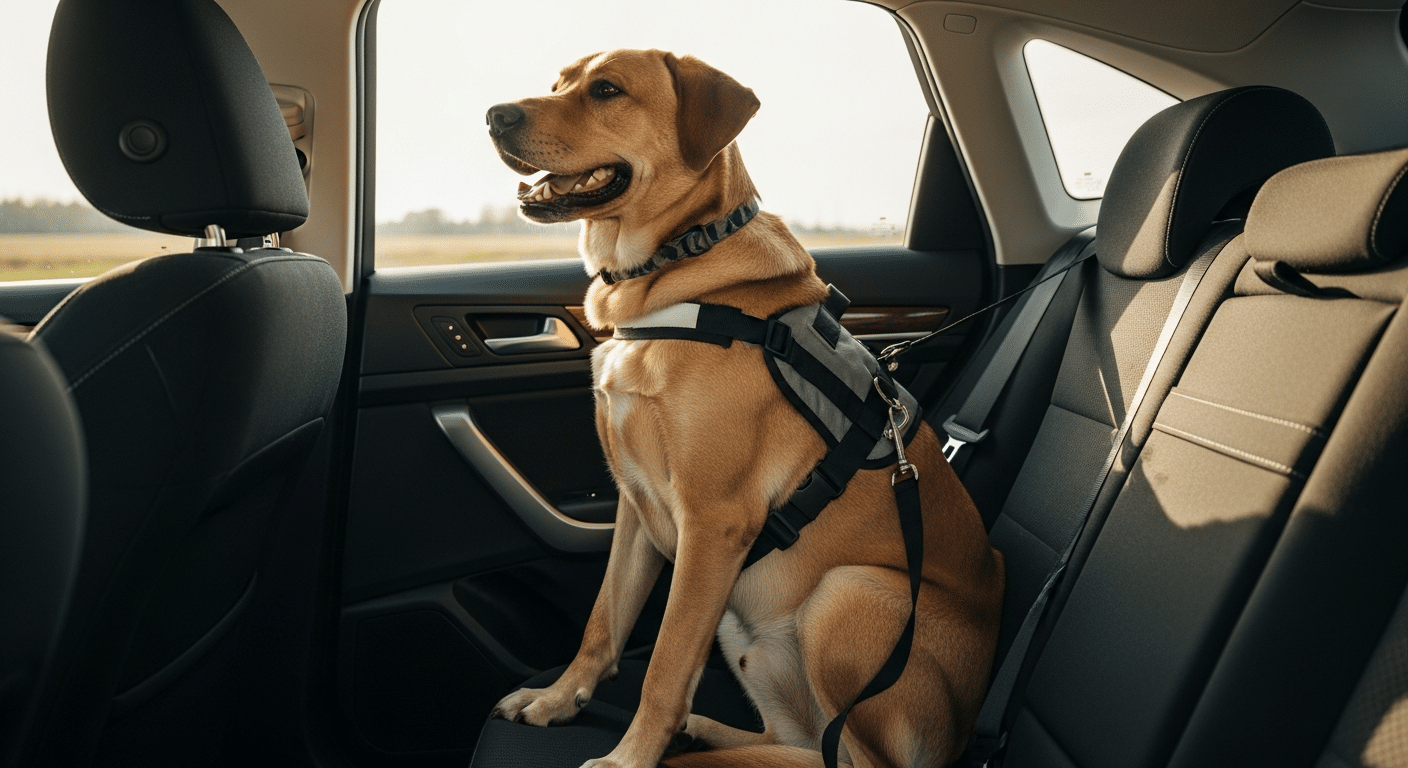
Best Dog Car Harness & Seatbelt (Crash-Tested)
An unrestrained dog is a danger to itself and everyone in the car, and in a crash, a loose dog becomes a projectile. A crash-tested harness clipped into your seatbelt is the safest, most practical restraint for a big dog. Here are the picks that have actually passed independent testing, and how to size one for a large dog.
Choosing the best dog car harness isn’t really about comfort or colour, it’s about what happens in the half-second of a crash. An unrestrained large dog isn’t just a distraction; at 30 mph a 50-lb dog hits with the force of roughly 1,500 lb, turning into a projectile that can injure your dog, you and your passengers. A proper crash-tested dog car harness that anchors to your car’s own seatbelt is the safest and most practical way to restrain a big dog, and for large breeds it usually beats a booster seat (those are really for small dogs). The catch: almost every harness on the shelf claims to be “crash-tested,” but only a handful have actually been put through independent testing. Below we explain what Center for Pet Safety certification really means, give you our three independently tested picks (built and sized for large dogs), and walk through how to measure, fit and use one safely. If you’re planning the whole trip, start with our guide to traveling with your dog.
Our crash-tested dog car harness picks for large dogs
Only harnesses that have actually passed independent crash or sled testing made this list, and every one is sized for a large dog. Verified in stock; tap through for the live price.
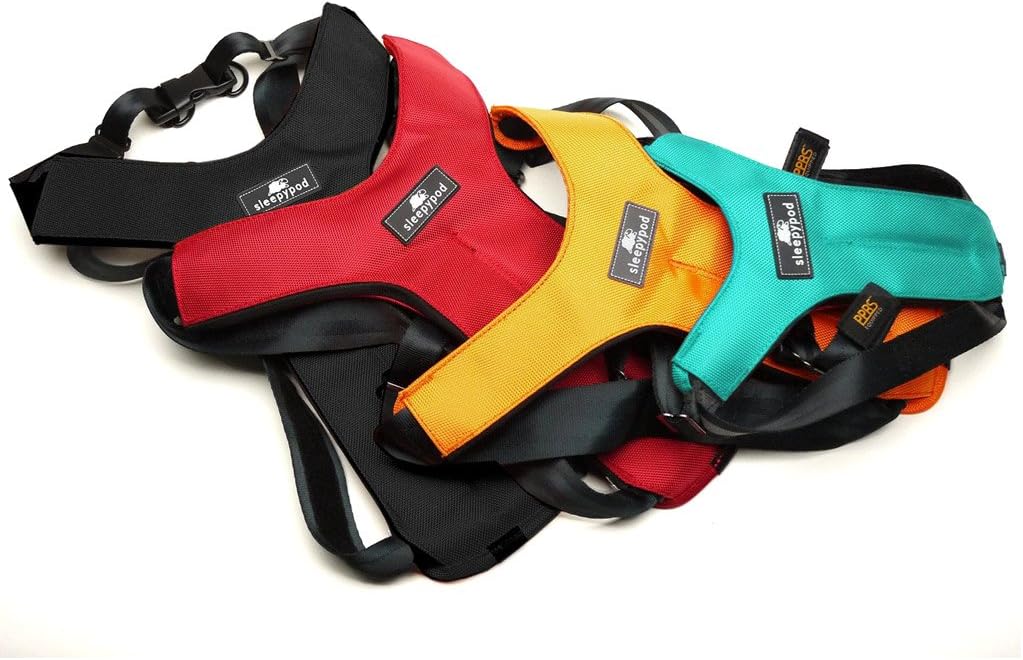
Sleepypod Clickit Sport
If you only remember one name, make it this one. The Sleepypod Clickit Sport is the only car harness in its class to earn an independent five-star certification from the Center for Pet Safety (CPS), the non-profit that crash-tests pet restraints to the same FMVSS 213 dynamic sled standard used for child seats. That matters because almost every harness on Amazon says “crash-tested” in its own marketing; only a handful have actually passed independent testing. Its Infinity Loop webbing and broad energy-absorbing padded vest spread crash forces across your dog’s chest and shoulders, and it anchors with three points of contact using your car’s existing three-point seatbelt, no extra straps, latches or hardware. It doubles as a everyday walking harness. For a large dog you want the Large (rated 75 to 90 lb); Sleepypod also makes the Clickit Terrain and Clickit Range (certified to 110 lb) for deeper-chested big dogs.
What we like
- The only sport harness with an independent 5-star Center for Pet Safety certification, not just a marketing claim
- Energy-absorbing padded vest + Infinity Loop webbing spreads crash forces across the chest, not the neck
- Anchors with your car’s own three-point seatbelt, no extra hardware to fail or forget
- Works as a daily walking harness too, so your dog already knows it before a trip
The catches
- Pricier than a basic harness, but it’s the one independently proven to protect in a crash
- Sizing runs snug; measure girth carefully and check Sleepypod’s chart (Large = 75 to 90 lb)
- Very deep-chested giants may fit the Clickit Range/Terrain better than the Sport
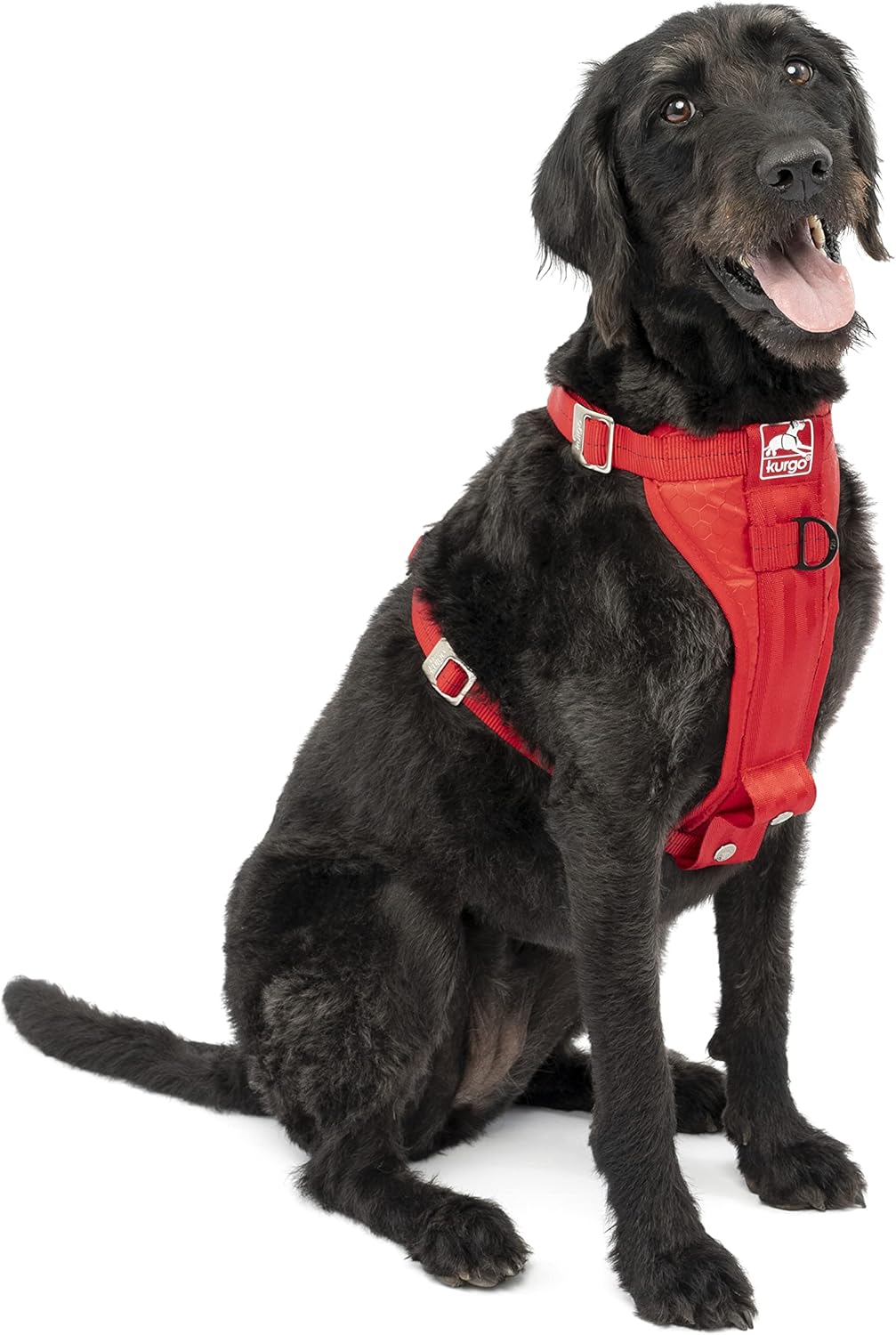
Kurgo Tru-Fit Enhanced Strength
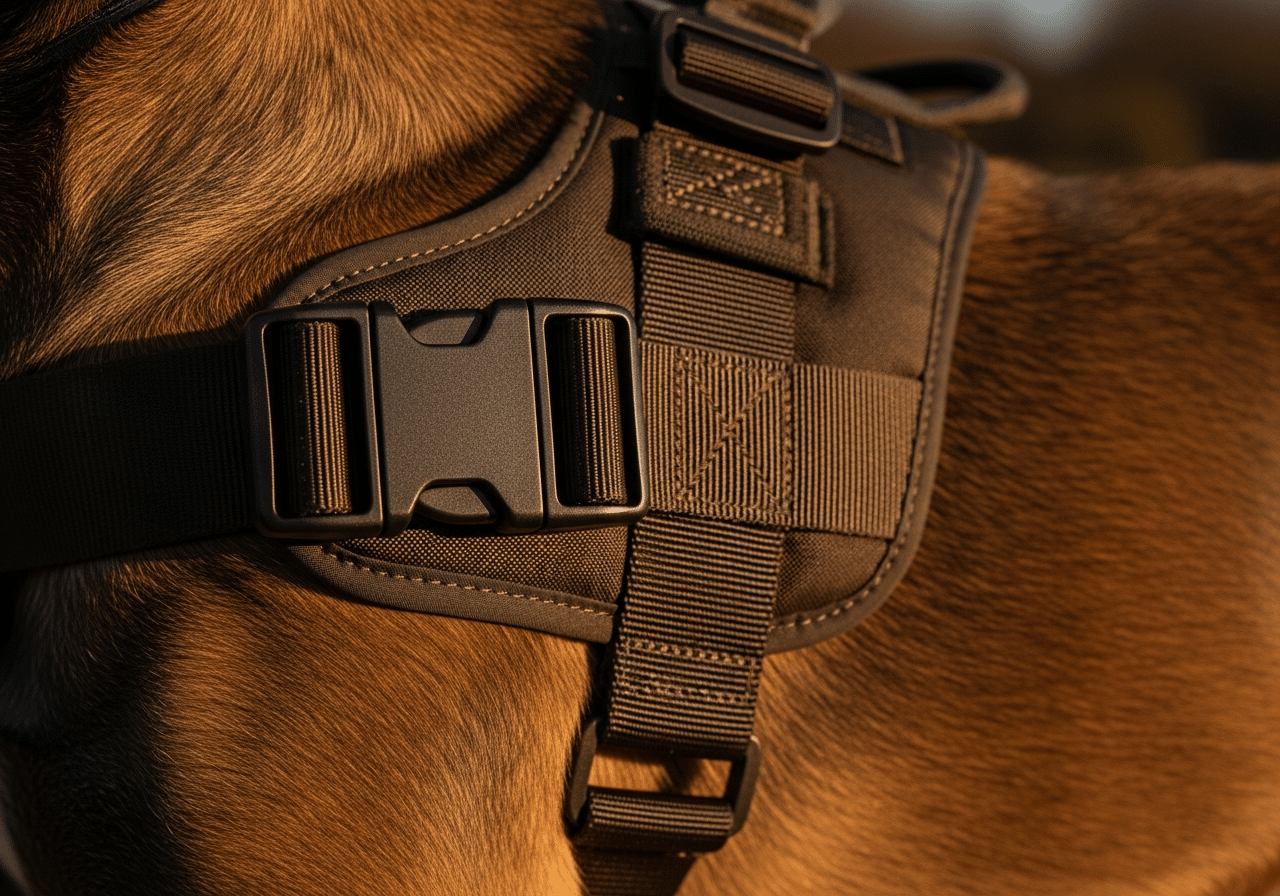
The Kurgo Enhanced Strength Tru-Fit is the best balance of safety and price, which is why it’s the one most big-dog owners actually end up buying. Kurgo had it crash-tested at a university facility to the FMVSS 213 child-restraint protocol for dogs up to 75 lb, and the build backs that up: a broad padded chest plate to spread impact, all-steel nesting buckles (no plastic in the load path), and five adjustment points for a tight, escape-resistant fit on a deep-chested dog. Crucially it includes a seatbelt tether with a steel carabiner in the box, so you clip into your car’s belt loop and go. It has two leash D-rings (a front no-pull ring and a back ring) so it pulls double duty as a walking harness. For a large dog choose the Large (or XL for the biggest); it’s machine-washable and carries a lifetime warranty.
What we like
- Independently crash-tested to the FMVSS 213 child-restraint protocol (dogs up to 75 lb)
- All-steel nesting buckles and a broad padded chest plate, no plastic in the load path
- Comes with the seatbelt tether + steel carabiner, so you don’t buy anything extra
- Front + back leash rings make it a genuine everyday walking + no-pull harness; lifetime warranty
The catches
- Crash-rating tops out around 75 lb, the very largest dogs should size to XL and confirm the weight limit
- Five straps take a minute to dial in the first time (worth it for the fit)
- Not CPS-certified like the Sleepypod, though it is independently crash-tested
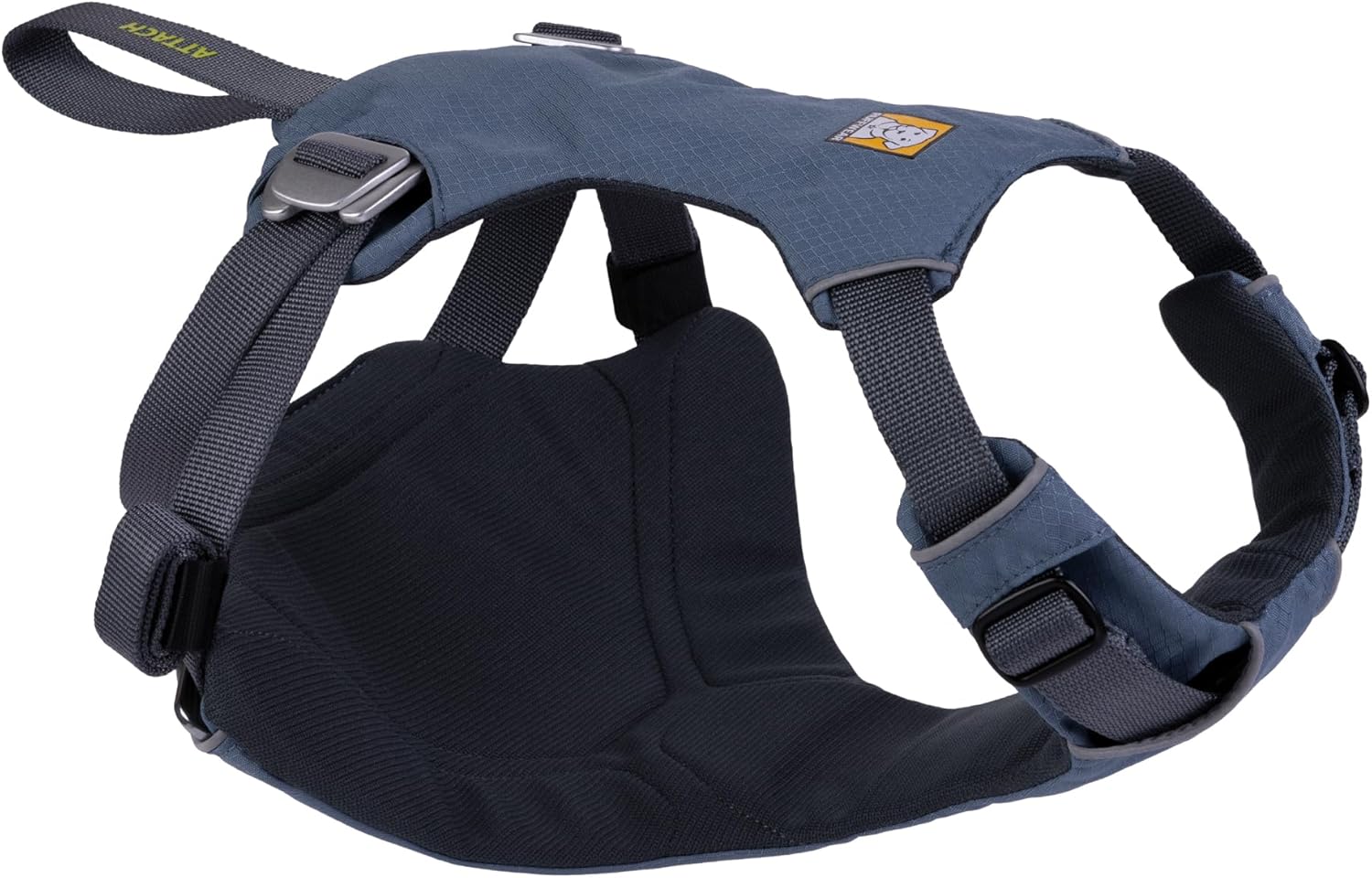
Ruffwear Load Up
Ruffwear’s Load Up is the pick for owners of large, powerful dogs who want bombproof hardware. Every load-bearing part is strength-rated metal, including a forged aluminium side-release buckle and metal slide adjusters, and Ruffwear dynamic-sled (crash) tested it with 25, 45 and 75 lb dog mannequins, with the dog staying upright and on the seat in all three. It uses a single universal seatbelt loop that the car’s belt threads straight through, so there’s no separate tether to lose, and a dense foam-padded, ripstop vest keeps a big dog comfortable enough to sit, stand and sleep on a long road trip. The Large/X-Large fits girths of 32 to 42 inches, covering most large and many giant breeds. It’s a car-restraint harness first (no front no-pull ring), so pair it with a walking harness if you want one tool for both.
What we like
- All-metal, strength-rated hardware (forged aluminium buckle), built for big, strong dogs
- Passed dynamic sled (crash) tests with 25, 45 and 75 lb mannequins staying upright and on the seat
- Single universal seatbelt loop threads the car’s own belt, nothing extra to lose or clip wrong
- Dense padded ripstop vest is comfortable for sit/stand/sleep on long drives; Large/X-Large fits 32 to 42 in girth
The catches
- Premium price, similar to the Sleepypod
- Strength-rated rather than CPS-certified (Ruffwear publishes its own sled-test results)
- Car-restraint focused, no front no-pull ring, so it’s not a no-pull training harness
Why your dog needs a crash-tested harness (not just any harness)
Here’s the uncomfortable truth most product pages skip: in a collision, an unrestrained dog behaves exactly like any other loose object in the car. The Center for Pet Safety estimates that a 10-lb dog in a 50-mph crash generates about 500 lb of force; a large 50 to 80 lb dog generates several times that. That force injures the dog and turns it into a projectile aimed at whoever is sitting in front of it. An unrestrained dog is also a constant distraction while you drive, and a loose dog can bolt out of an open door at the scene of an accident, straight into traffic, or away from rescuers trying to help.
A car harness solves all three problems at once, but only if it’s the right kind. A harness spreads the force of a sudden stop across your dog’s chest and shoulders, the way a seatbelt spreads it across your hips and chest. That’s why a harness is fundamentally safer than clipping a tether to a collar, which would concentrate all of that force on your dog’s neck. But a normal walking harness is not built for crash forces, its stitching, buckles and clip will tear or snap under the load of a real collision, and it was never designed or tested to hold a body in place. To actually protect your dog, the harness has to be tested for it.
What “crash-tested” and CPS certification actually mean
This is the single most important thing to understand before you buy, because the words on the packaging are not all equal:
- “Crash-tested” (self-reported). Any company can run its own test and print “crash-tested” on the box. Some of these tests are rigorous; some are marketing. There is currently no government crash-test standard for pet harnesses the way there is for child seats, so the claim alone tells you very little about who tested it or whether it passed.
- Independently crash- or sled-tested. A step up: the maker pays an accredited lab to run a dynamic sled test, the same kind used for car seats, and publishes the results. Ruffwear and Kurgo, for example, test against the FMVSS 213 child-restraint protocol at university or NHTSA-style facilities and document how the harness performed.
- CPS-certified (the gold standard). The Center for Pet Safety is an independent non-profit that buys harnesses off the shelf, crash-tests them to a published protocol, and certifies only the ones that pass with a star rating. A CPS certification is the strongest signal you can get because it’s independent, standardized and pass/fail. Very few harnesses earn it, the Sleepypod Clickit family is the standout, with a five-star rating.
Harness vs. seatbelt tether vs. crate vs. barrier vs. car seat
“Dog seatbelt” gets used loosely, so it helps to separate the restraint types, because they’re not equally safe, and the best choice depends on your dog’s size.
| Restraint | How it works | Best for |
|---|---|---|
| Crash-tested harness + seatbelt | A tested vest that anchors to the car’s three-point belt and spreads crash force across the chest | The best all-round choice for most dogs, and the top pick for large dogs. Comfortable, lets the dog sit/lie down, doubles as a walking harness |
| Seatbelt tether alone | A short strap that clips the car’s belt to a harness’s D-ring | A convenient add-on, but a tether is not a restraint by itself; it’s only as safe as the harness (and clip) you attach it to. Never clip a tether to a collar |
| Travel crate | A rigid, secured crate the dog rides inside | Excellent protection if the crate is strength-rated and tied down, but bulky, and big dogs need a large vehicle |
| Car / cargo barrier | A grille or net that keeps the dog in the back | Stops the dog distracting you and reaching the front, but does not restrain the dog in a crash. Best paired with a harness |
| Booster / car seat | An elevated seat so the dog can see out, with a clip-in tether | Small dogs only, most boosters are comfort products, not crash protection, and don’t fit large dogs |
For a big dog, the honest answer is a crash-tested harness clipped to the seatbelt, it’s the safest restraint that’s also practical day to day. A car barrier is a great complement (it stops the dog climbing into the front), and a secured crate is the other gold-standard option if you have the space. If you have a small dog, see our best dog car seat guide instead; and if your dog struggles to get into a tall SUV, a dog car ramp saves their joints.
How to measure and size a car harness for a large dog
A car harness only protects your dog if it fits snugly, a loose harness lets the dog move forward in a stop and can let a panicked dog wriggle out. Sizing is by measurement, not by your dog’s breed, so grab a soft tape measure:
- Girth (the key measurement). Measure all the way around the widest part of the ribcage, just behind the front legs. This is the number every maker sizes by, for example, Ruffwear’s Load Up Large/X-Large fits a 32 to 42-inch girth.
- Neck / lower chest. Some harnesses also use a neck or base-of-neck measurement, take it where the harness will sit, not at the collar.
- Weight. Crash ratings are usually given as a weight range or limit (the Sleepypod Clickit Sport Large is rated 75 to 90 lb; the Kurgo is crash-rated to 75 lb). Stay within the tested range, don’t put a 100-lb dog in a harness rated to 75 lb.
- If you’re between sizes, size up and tighten the straps, rather than squeezing into the smaller one.
Deep-chested and barrel-chested big dogs (think mastiffs, boxers, greyhounds) can be tricky to fit, if a standard shape gapes or rides up, look at models made for non-standard proportions, like Sleepypod’s Clickit Range. Getting a secure fit matters even more on a powerful breed; our traveling-with-your-dog guide covers the rest of the road-trip kit once the harness is sorted.
How to use a dog car harness safely on the road
The best harness still has to be used correctly. A few rules turn it from “clipped in” into “actually protected”:
- Use the back seat, never the front. A deploying airbag can seriously injure or kill a dog the same way it can a child. The middle of the back seat is the safest spot.
- Keep the tether short. Connect the harness to the seatbelt (or use the included tether) so the dog can sit, stand and lie down but not reach the front seats or the footwell. A long lead lets the dog build up momentum in a stop, the point of the restraint is to limit travel.
- Clip to the harness, never the collar. All the crash force has to go through the vest across the chest, not a strap around the neck.
- Acclimate before the trip. Let your dog wear the harness around the house and on short drives first so it feels normal. Harnesses that double as walking harnesses (the Sleepypod and Kurgo) make this easy, the dog already knows the gear.
- Check the hardware. Before each trip glance at the buckles, stitching and clip; replace any harness that’s frayed or has been in a crash (like a car seat, it’s a one-crash item).
- Pack water and take breaks. Stop every 2 to 3 hours on long drives, and never leave your dog in a parked car in warm weather. Our travel guide has the full checklist.
What about leaving the dog at home instead?
The safest car ride is sometimes the one your dog doesn’t take. If a trip isn’t dog-friendly, or the drive is long and stressful for an anxious dog, it’s worth weighing the alternatives to hauling them along. An in-home pet sitter or a house-sitting exchange keeps your dog in its own routine instead of a kennel, and can cost less than you’d think. We compare every option (kennels, daycare, sitters, house-sitting and more) in our guide to dog boarding alternatives. When you are bringing the dog, a crash-tested harness is the single most important piece of safety gear in the car.
Plan the whole trip: dog travel & car-safety guides
Dog car harnesses & seatbelts: common questions
Are dog car harnesses crash tested?
Some are, but most aren’t, and the wording matters. There’s no government crash-test standard for pet harnesses the way there is for child seats, so any company can print “crash-tested” on the box after running its own test. The strongest proof is an independent Center for Pet Safety (CPS) certification, which only a few harnesses (notably the Sleepypod Clickit family) have earned. The next-best is a harness that’s been independently sled-tested to the FMVSS 213 child-restraint protocol with published results, like the Kurgo Tru-Fit Enhanced Strength and the Ruffwear Load Up. Treat an unverified “crash-tested” claim with caution.
What is the best car restraint for a large dog?
For most large dogs the best restraint is a crash-tested harness clipped to the car’s seatbelt. It spreads crash force across the dog’s chest and shoulders, lets the dog sit and lie down comfortably, and doubles as a walking harness. Booster and car seats are really for small dogs and aren’t crash protection. Our top pick is the CPS-certified Sleepypod Clickit Sport; the Kurgo Tru-Fit Enhanced Strength is the best value, and the Ruffwear Load Up suits big, strong dogs with its all-metal hardware. A secured travel crate is the other gold-standard option if you have the space, and a car barrier is a good complement.
Is a dog seatbelt harness safer than a crate or a car barrier?
A crash-tested harness and a strength-rated, secured crate are the two restraints that actually protect a dog in a collision, both keep the dog in place and absorb force. A car barrier (grille or net) is different: it stops your dog climbing into the front and distracting you, but it does not restrain the dog in a crash, so the dog can still be thrown around the cargo area. The best setup for many people is a crash-tested harness plus a barrier. Pick the harness or crate for crash safety; add the barrier for control and to keep the dog out of the footwell.
Can my dog wear a regular walking harness in the car?
No, not as a crash restraint. A standard walking harness isn’t built or tested to hold a dog in a collision; its stitching, buckles and clip will tear or snap under real crash forces, and it was designed for steady leash pressure, not a sudden high-energy stop. Clipping a seatbelt tether to a walking harness (or worse, a collar) gives a false sense of safety. Use a harness that’s actually been crash- or sled-tested for car use. Several of our picks (the Sleepypod and the Kurgo) work as everyday walking harnesses too, so you get one tested harness for both jobs.
How do I measure my dog for a car harness?
Measure your dog’s girth, all the way around the widest part of the ribcage, just behind the front legs, because that’s the number every maker sizes by (Ruffwear’s Load Up Large/X-Large, for instance, fits a 32 to 42-inch girth). Take a neck or base-of-chest measurement too if the chart asks for one, and check your dog’s weight against the harness’s crash-rated limit (the Sleepypod Sport Large is rated 75 to 90 lb). If you’re between sizes, size up and tighten the straps. After fitting, you should be able to slide two fingers under any strap, snug enough not to shift, loose enough not to dig in.
Where should my dog ride in the car?
In the back seat, restrained, never in the front. A deploying airbag can kill or badly injure a dog just as it can a child, so the front passenger seat is off-limits. The middle of the back seat is generally safest. Clip the harness to the seatbelt so the tether is short enough that the dog can’t reach the front or the footwell but can still sit, stand and lie down. Large dogs can also ride safely in a secured travel crate in an SUV’s cargo area, ideally behind a barrier.
Do I really need a crash-tested harness, or is any harness okay for short trips?
Crashes don’t wait for long trips, most collisions happen close to home and at low speed, where an unrestrained dog is still thrown with enormous force and can injure itself and your passengers. A short trip to the vet or the park is exactly when a dog is loose in the car. A crash-tested harness costs about the same as a few vet visits and protects on every drive, so it’s worth using every time rather than only on holidays. If budget is the concern, the Kurgo Tru-Fit Enhanced Strength gives you independently crash-tested protection at a fraction of the price of the premium picks.