 Dog Gear, Sized Right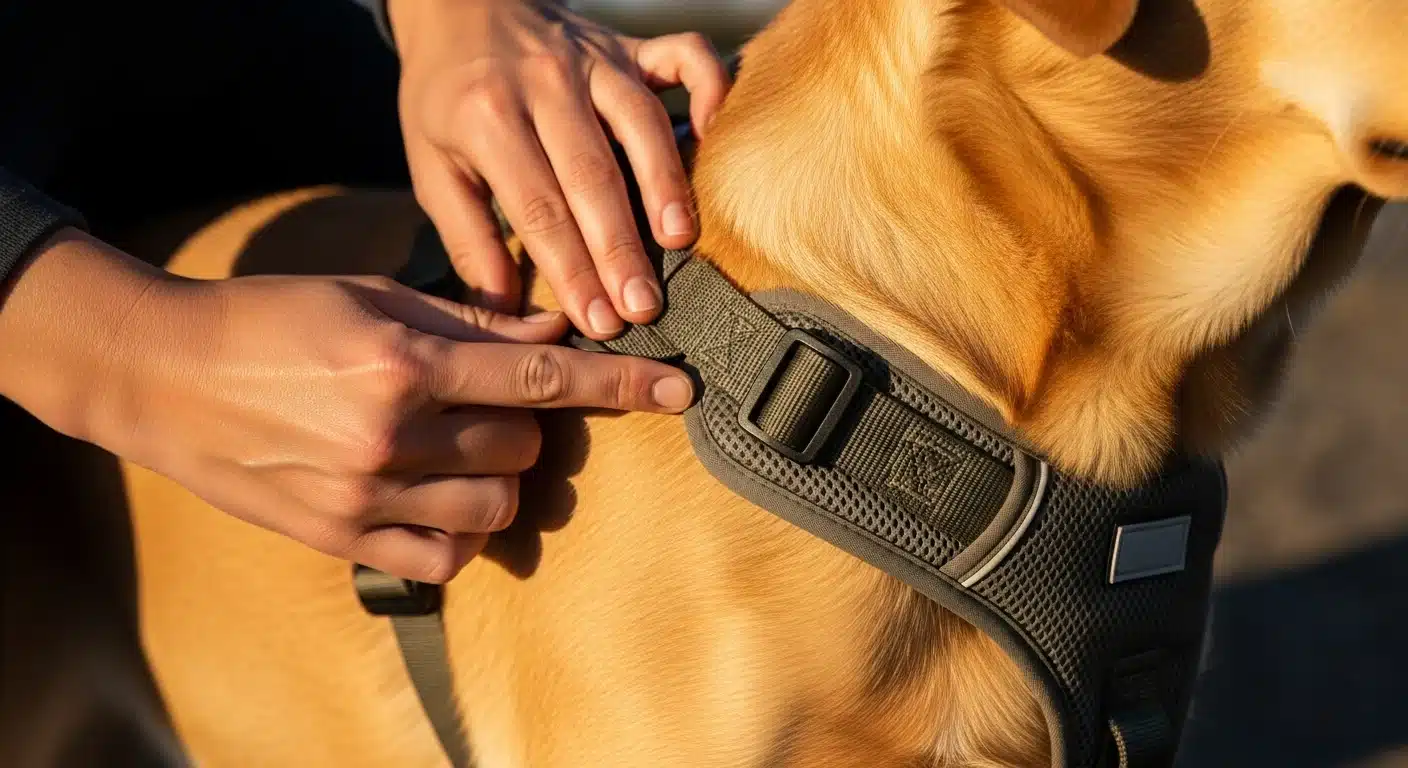
How Tight Should a Dog Harness Be? (Fit Guide)
The two-finger rule, applied at every strap, chest, girth, and neck. What too-tight looks like, why too-loose is just as dangerous, and how to re-check fit as your dog grows.
How tight should a dog harness be? The short answer everyone quotes is the two-finger rule: you should be able to slide two fingers flat under any strap, chest panel, girth band, and neck, but no more than two. That’s the right answer, but it only works if you check every strap, not just the one you buckled last. A harness that passes the girth test and fails the chest is still a poorly fitting harness. Below we explain what the rule actually means at each strap, what too-tight and too-loose each look like in practice, how to adjust every type of harness, and when to re-check fit as your dog’s body changes.
The harness that makes the two-finger rule easy
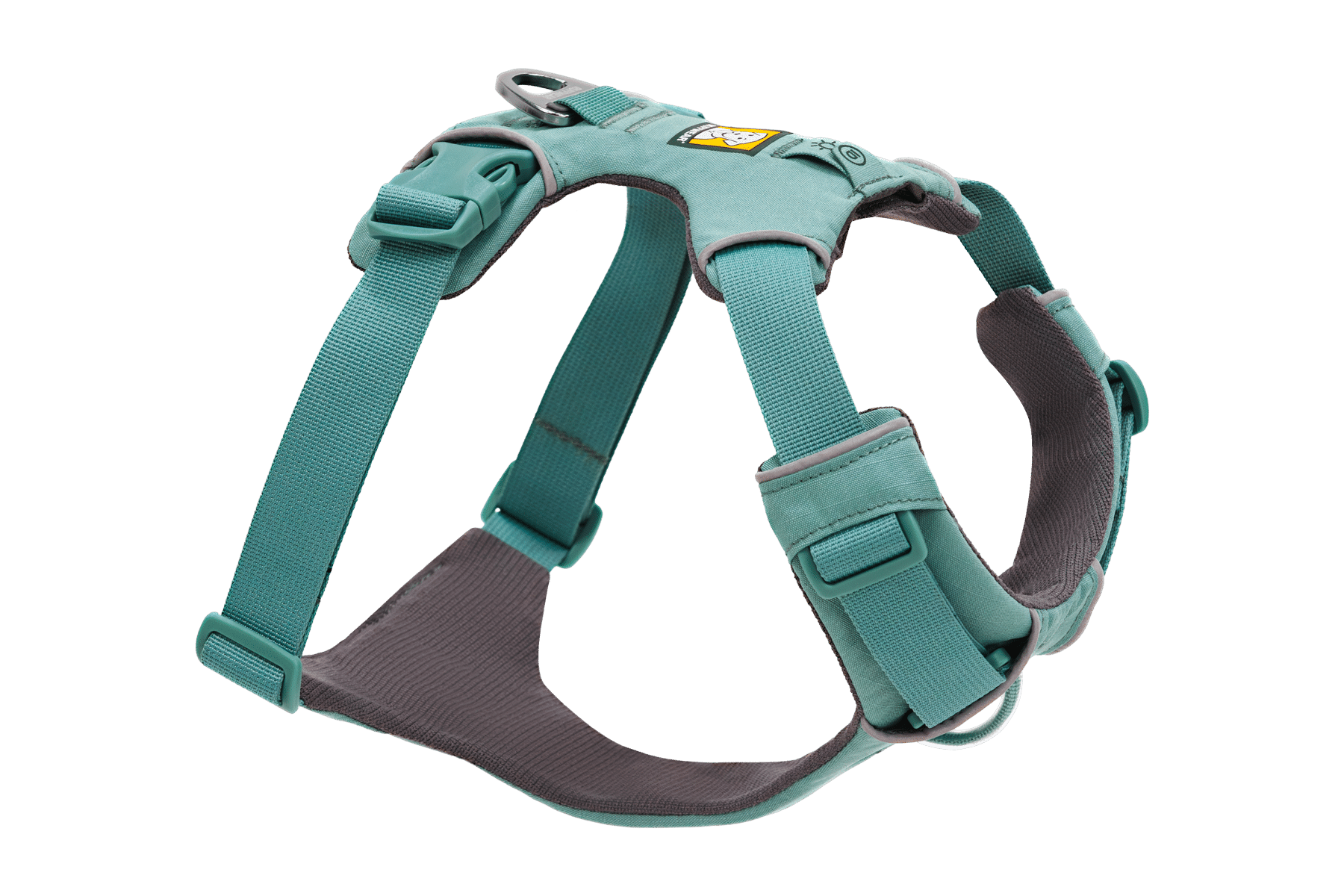
Most fit problems trace back to a harness with too few adjustment points. This one has four, one at every strap, so you can dial in a correct fit independently at the chest, girth, and neck. Verified in stock; tap through for the live price.
Ruffwear Front Range Harness
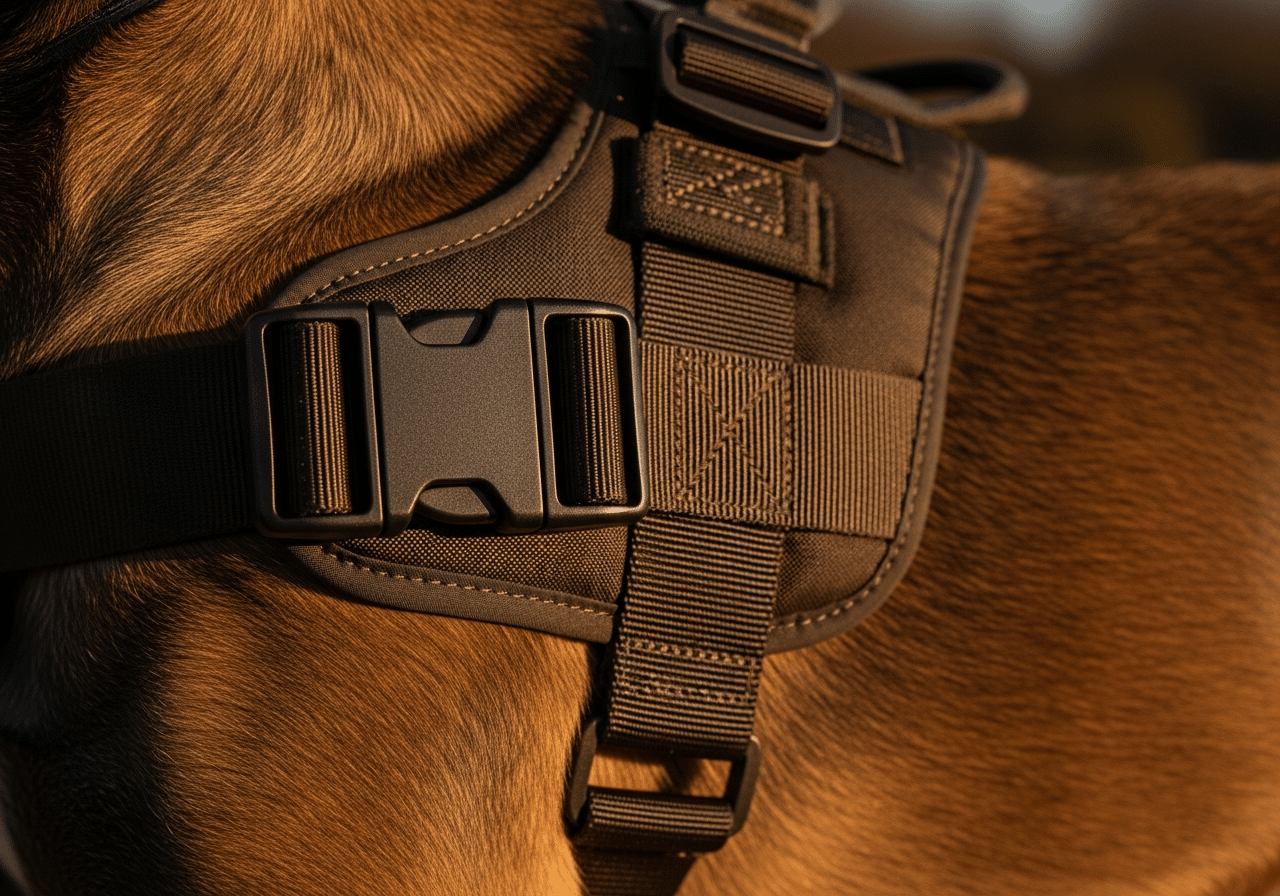
With four independent adjustment points (two on the chest panel, one on the girth strap, one on the neck), the Front Range is the harness that genuinely lets you apply the two-finger rule at every strap without compromise. The wide padded chest panel spreads load off the shoulders even on strong pullers, and the foam-lined girth band sits flush against the ribcage rather than digging in when snugged correctly. It’s the harness we hand to owners who’ve been fighting fit issues on a cheaper single-adjustment harness.
What we like
- Four adjustment points let you nail the two-finger rule at every strap independently
- Wide padded chest panel spreads pressure away from the shoulders, critical for fit-sensitive dogs
- Front and back leash clips suit training and relaxed walks without swapping harnesses
- Foam-lined girth band sits flush at the correct snugness without rolling or digging
The catches
- No top control handle, choose the Web Master if you need a grab point
- Premium price vs. basic single-adjustment harnesses
- Sizing can run small on deep-chested breeds, measure chest girth before ordering
The two-finger rule, and where most owners apply it wrong
The two-finger rule is simple: insert two fingers flat under a strap and slide them around the full circumference. The fit is correct when:
- Two fingers slide through with light resistance, snug but not tight, comfortable for the dog
- You can’t fit a third finger, if you can, the strap is loose enough to cause chafing or an escape
- One finger gets stuck or won’t slide freely, the strap is too tight and should be loosened one notch
The part most owners miss: you need to run this check on every strap individually, not just the strap you fastened last. A typical step-in or vest harness has three independent strap groups: the chest panel (across the sternum), the girth band (behind the front legs), and the neck loop. These are usually sized from a single measurement, “chest girth”, but dogs aren’t uniform cylinders. A barrel-chested Labrador can have a girth that’s perfectly snug while the chest panel hangs loose. A narrow-shouldered Whippet can have the opposite problem. Run two fingers under each strap separately and adjust each one independently.
Checking each strap: chest, girth, and neck
Here’s what correct, and incorrect, fit looks and feels like at each strap on the three main zones:
| Strap / Zone | Correct fit | Too tight | Too loose |
|---|---|---|---|
| Chest panel (across sternum / front of dog) | Two fingers flat; panel sits against the chest without pressing on the point of shoulder or the armpits | Panel digs into armpits; dog shortens stride or holds shoulders stiff; bald spots or red lines behind the armpits after walks | Panel slides left-right or drops forward; rubs with every stride |
| Girth band (behind front legs, around ribcage) | Two fingers flat; band sits about an inch behind the “elbow” crease; moves slightly on a deep breath but doesn’t slide | Labored breathing on exertion; the dog tries to scratch at or rub the band; you can see skin puckering along the strap | Band slides rearward toward the belly; a dog can step backward and back out of the harness entirely |
| Neck loop (if present, on step-in or vest styles) | Two fingers flat; loop sits high on the neck, not down over the trachea or shoulder blades | Dog coughs or gags on leash; loop leaves a ring impression in the coat after a walk | Loop slides down toward shoulder blades; restricts shoulder rotation with every stride |
The girth band behind the front legs is the most important strap to get right. It’s the main load-bearing strap on most harnesses, and if it’s even half an inch too loose, a dog that knows the “back-out trick”, bracing its shoulders, lowering its head, and pulling backward, can slip free. This is how the most common harness escapes happen, and it’s entirely a fit issue rather than a hardware failure.
What too-tight looks like (and why it matters beyond comfort)
A harness that’s one notch too tight isn’t just uncomfortable, it can cause lasting physical problems over time. Here’s what to look for after every walk, not just when you’re putting the harness on:
- Bald spots or redness behind the armpits. The most common pressure point. If the chest panel or girth band sits against the armpit crease, the friction of every stride rubs the hair away over days. Loosen the offending strap one notch and recheck.
- Shortened front stride. A chest panel pressing into the point of the shoulder restricts the natural arc of the front leg. The dog walks with a choppy, shortened step rather than a full extension. Canine physiotherapists cite this as the most common gait issue linked to harness fit.
- Labored breathing on exertion. A girth band locked too tight across the ribcage limits full lung expansion. You’ll notice it on a steep hill or a run, the dog breathes with visible effort and recovers slowly after.
- Post-walk scratching at the harness area. A dog that immediately scratches its chest, armpits or ribcage area after you remove the harness is telling you something was irritating that zone during the walk. Identify which strap corresponds to where it’s scratching.
- Reluctance to put the harness on. If a dog that was previously fine with harness time starts ducking its head or stepping back when you bring it out, that’s a behavioral signal of physical discomfort, usually at the neck loop or chest panel.
The one exception to loosening: if a dog is backing out of the harness, the instinct to tighten the girth is correct, just be sure you still land at two-fingers, not one.
What too-loose causes (chafing AND escapes)
The counterintuitive part: a harness that’s too loose causes more chafing than one that’s snug, because the extra movement lets the straps saw against the skin with every stride. And a loose harness is a safety risk, not just a comfort issue.
Here’s what “too loose” actually causes:
- Strap migration and chafing. A loose girth band doesn’t stay behind the elbows, it slides rearward toward the belly. A chest panel that’s too wide slides side-to-side. In both cases the strap rubs with every step in an inconsistent location, which is far more irritating than even contact from a properly fitted strap.
- Harness escapes. The most dangerous consequence of a loose harness. When the girth band can slide toward the narrower part of the waist, a dog can back straight out. This happens most often in high-arousal moments, a squirrel, a car backfire, another dog, exactly when you need the harness to hold.
- Loss of leash control. A loose chest panel on a front-clip no-pull harness slides off to one side when the dog pulls, meaning the front-clip steering effect disappears. The whole point of a front clip is lost if the panel isn’t sitting on the sternum.
- Back-panel rotation. A loose neck loop lets the whole harness rotate under the dog’s belly, putting the back D-ring on the side or underneath rather than on top, which defeats leash attachment and puts the clip in contact with the dog’s flank.
How to adjust every strap correctly
Fit adjustments are only useful if you know which strap controls which dimension. Here’s how to work through a standard vest or step-in harness from scratch:
- Start fully loosened. Loosen every strap before putting the harness on. Trying to adjust a harness that’s already on a wriggling dog leads to over-tightening by feel. Start loose, put it on, then snug each strap individually.
- Fit the girth band first. It’s the most critical strap for security and the hardest to over-tighten by accident. Snug it behind the front legs (one to two inches behind the elbow crease) until you land on two fingers. Don’t touch it again until you’ve fitted the other straps.
- Fit the chest panel second. Slide it up or down until it sits across the sternum without touching the armpit crease or the point of the shoulder. On most dogs this means the panel’s top edge is level with the top of the shoulder blade. Run two fingers flat across the chest, loosen or tighten as needed.
- Fit the neck loop last (if adjustable). The neck loop should sit high, in the lower third of the neck, not across the throat or down at the base of the neck. Two fingers flat. On harnesses where the neck loop is fixed (not adjustable), check it anyway, a fixed loop that’s too tight is a reason to size up.
- Walk the dog a few steps, then recheck. Harnesses compress slightly under load. After 30 seconds of walking, run the two-finger test again on all three straps. It’s normal to need one more notch of tightening on the girth after the harness settles.
On harnesses with four or more adjustment points (like the Ruffwear Front Range), you have independent sliders on both the left and right side of the girth, letting you compensate for a dog with an asymmetric barrel. Most budget harnesses have a single sliding adjuster shared between both sides, these are harder to fit on any dog that isn’t bilaterally symmetrical.
Harness fit vs collar fit, different rules for different gear
The two-finger rule is the same for both a harness and a collar, but the stakes are different and the failure modes are opposite.
- Collar too loose: the collar slips over the ears. Any slip-free collar wider than the widest part of the skull is an escape risk, especially in breeds with heads narrower than their neck (Greyhounds, Whippets, some Huskies).
- Collar too tight: the collar presses on the trachea and jugular. A collar that’s too tight doesn’t cause immediate choking the way a leash tension does, it applies low-level constant pressure on the airway, which is a welfare issue and can cause long-term damage. The two-finger rule is more critical for collars because there’s no padding and the pressure point is the throat.
- Harness too loose: escape and chafing, as above.
- Harness too tight: shoulder restriction and chafing, as above.
For dogs that pull, a collar transfers all leash force to the neck and trachea, which is why even a perfectly-fitted collar plus a pulling dog is a welfare concern. A harness distributes that same force across the chest and ribcage, which is why fit matters differently on each. More on the comparison in our full dog collar vs harness explainer.
When to re-check fit: growth, coat changes, and weight shifts
A harness that fit correctly in February may be wrong by June. These are the moments to re-run the full two-finger check from scratch:
- After any significant weight change. Even five pounds on a medium dog can tighten a girth band from two fingers to one. Weigh your dog at the vet every six months and re-fit the harness each time.
- At each growth milestone for puppies. A puppy’s chest girth can grow an inch per month during peak growth. If you bought a harness with a “size up” range, re-check every two to three weeks. Most puppies need a new harness size every two to three months in their first year.
- After a seasonal coat change. Double-coated breeds (Huskies, German Shepherds, Malamutes) add measurable girth when their undercoat blows in for winter. A summer fit will be too loose by November, and a winter fit will be too tight after the spring blow. Re-check at each coat transition.
- After surgery or injury. Muscle loss from a cruciate repair, for example, can make a previously correct girth fit loose within a month. If your dog has been inactive, re-fit before returning to walks.
- After any escape. If your dog has backed out of the harness once, it now knows the trick. A proper post-escape fit check often finds the girth was a full notch looser than the owner thought, and the escape is the first symptom, not bad luck.
Build harness fit into your monthly check-in alongside nail length and ear cleaning. It takes 30 seconds per strap and will catch any drift before it becomes a problem. For a step-by-step on putting on the harness correctly each time before you check the fit, see our how to put on a dog harness guide.
Quick-reference fit checklist
Run this check every time you put the harness on, and do the full re-measure check monthly:
- ☑ Girth band: sits 1 to 2 inches behind the elbow crease, two fingers flat, passes the shake test (no more than ½ inch of lateral movement)
- ☑ Chest panel: sits on the sternum, not touching the armpit crease or the point of the shoulder, two fingers flat
- ☑ Neck loop: high on the neck (lower third), not across the throat, two fingers flat
- ☑ Back D-ring: sitting on the dog’s back midline, if it’s slid to the side, the girth or neck strap is loose
- ☑ Walk test: harness doesn’t shift or migrate after 30 seconds of walking; recheck each strap and tighten if needed
- ☑ Visual check after the walk: no red marks, bald spots, or post-walk scratching in the armpit or ribcage area
- ☑ Monthly re-measure: if your dog’s weight has changed or coat has shifted, re-measure chest girth and re-fit from scratch
If you’re starting from scratch, choosing a harness rather than fitting an existing one, our full dog harness roundup walks through which styles have the most adjustment points, which are best for pulling dogs, and which fit the hardest body types.
Dog harness fit: common questions
How tight should a dog harness be?
A dog harness should be tight enough that you can slide two fingers flat under any strap, chest panel, girth band, and neck loop, with light resistance, but not three. This applies to every strap individually, not just the one you fastened last. Too tight restricts shoulder movement and causes chafing; too loose causes chafing from strap migration and, more importantly, allows a dog to back out of the harness.
What is the two-finger rule for dog harnesses?
The two-finger rule means placing two fingers flat (not stacked or pointed) under a harness strap and sliding them around the full circumference. If two fingers slide through with light resistance and a third can’t fit, the fit is correct. If only one finger fits, loosen the strap by one notch. If three or more fingers fit, tighten. Run this test on the chest panel, girth band, and neck loop separately, the rule applies to each strap, not just the harness overall.
Can a dog harness be too loose?
Yes, and a too-loose harness is as problematic as a too-tight one. A loose girth band migrates backward, causing chafing on the belly. A loose chest panel slides side-to-side, sawing against the skin with every stride. Most dangerously, a loose girth allows a dog to use the ‘back-out trick’, bracing its shoulders and pulling backward, to slip free, which typically happens in high-arousal moments like seeing another dog or hearing a loud noise.
How do I know if my dog’s harness is too tight?
Signs a harness is too tight: you can only fit one finger (not two) under a strap; bald spots or red marks appear behind the armpits or ribcage area after walks; the dog has a shortened front stride (chest panel pressing on the shoulder); the dog shows labored breathing on exertion (girth band too tight around the ribcage); or the dog is reluctant to have the harness put on. Check all three straps, a harness can be fine at the girth and too tight at the chest panel.
How often should I re-check my dog’s harness fit?
Re-check at every seasonal coat change (especially for double-coated breeds), after any weight change of more than a few pounds, every two to three weeks during a puppy’s growth phase, after any surgery or period of inactivity, and after any escape attempt. For most adult dogs with stable weight, a monthly two-finger check on all three straps takes 30 seconds and catches any drift before it becomes a problem.
Should a dog harness be tighter than a collar?
The same two-finger rule applies to both, but the failure modes differ. A collar that’s too tight presses on the trachea and jugular, a welfare issue with no padding to buffer it. A harness that’s too tight restricts shoulder movement and causes chafing at the armpits. Neither should be overtightened. A harness that’s too loose, however, is more dangerous than a collar that’s too loose, because a dog can back out of a harness in a way that’s not possible with a correctly buckled collar.