 Dog Gear, Sized Right
Can a Dog Escape a Harness? How to Stop It
Yes, and it happens faster than you’d expect. Here’s why dogs slip out, which harness designs actually prevent it, and what to do if yours is a confirmed Houdini.
Can a dog escape a harness? Absolutely, and it happens with alarming speed. The classic move is the backward pull: the dog plants its feet, drops its weight, and reverses, compressing its shoulders inward until the harness slides right off over its head. It looks almost magical the first time you see it, which is why owners of fearful, reactive, or narrow-chested dogs quickly learn that not every harness is equally escape-proof. The good news is that the right harness design combined with a snug fit makes escape nearly impossible. This guide covers exactly why dogs escape, which design features stop it, and what to do if your dog has already mastered the trick.
Our top pick for escape-resistant fit
This is primarily an explainer, not a roundup, but if you need a harness that’s far harder to escape than most, here’s where we’d start. Verified in stock; tap through for the live price.
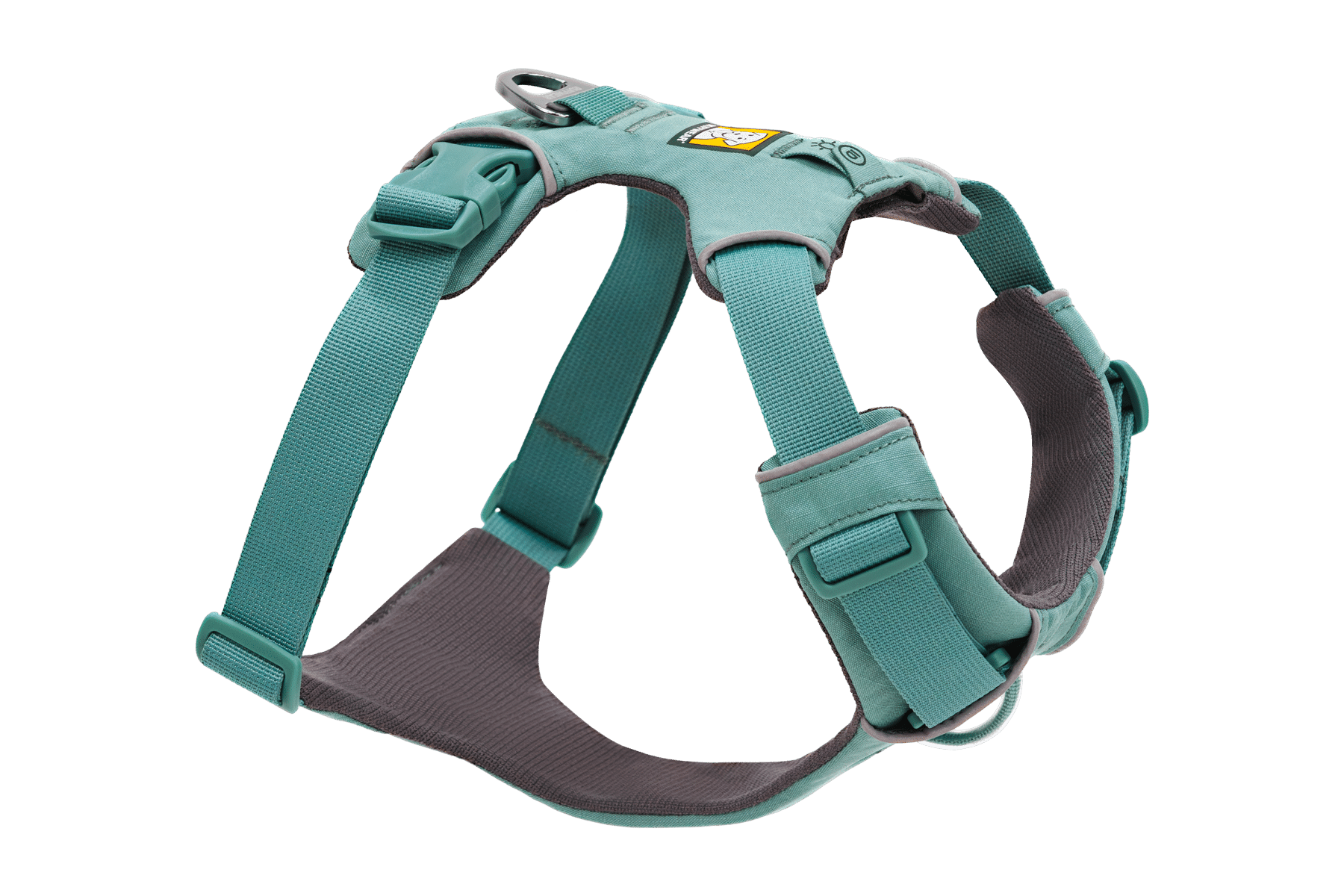
Ruffwear Front Range Harness
The Front Range wraps the dog’s chest and torso with two clip points, front and back, and four adjustment points that let you dial in a genuinely snug fit. That combination of a padded chest piece, aluminium V-ring at the chest, and a load-bearing back clip means a dog has far less leverage to back out than on a simple two-strap harness. For most dogs, a properly fitted Front Range is the end of the harness-escape problem.
What we like
- Four adjustment points let you get a genuinely snug, escape-resistant fit on almost any shape
- Dual-clip (front + back) gives leash options and reduces the leverage a dog needs to back out
- Padded chest and belly panel sits comfortably all day, dogs that hate harnesses often tolerate this one
- Aluminium hardware is light yet strong; won’t corrode
The catches
- Not the gold-standard three-strap design, confirmed Houdini dogs may still need the Web Master
- Sizing runs a little narrow for very barrel-chested breeds; measure carefully
- No handle for lifting or controlling reactive dogs in close quarters
Why dogs can escape a harness: the Houdini backward-pull explained
Most dogs don’t plan their escape, they stumble onto it by accident. A dog that’s scared, reactive, or over-stimulated will often plant its feet and pull away from whatever is frightening it. When the leash goes taut behind them, that backward pressure is exactly what a standard harness is least equipped to resist. Here’s the mechanics:
- Shoulder compression: Dogs’ front shoulders are not locked in place the way a collar sits around a rigid neck. When a dog pulls backward and tucks its elbows, the shoulder blades slide inward and the gap between harness strap and body grows, sometimes by several inches.
- The head-out point: Once the chest strap rides up past the widest point of the shoulders, the dog’s head is the only thing left in the harness. Most dogs discover that tilting their head downward and giving one final pull sends the harness flying off.
- Standard 2-strap design vulnerability: A traditional Y-harness or H-harness with only a chest strap and a belly strap leaves the rearward motion path largely unobstructed. There’s nothing behind the ribcage stopping the whole harness from sliding forward toward the neck and over the head.
This move is most common in fearful and reactive dogs (who practice it every time something startles them), narrow-chested breeds like Greyhounds, Whippets, Italian Greyhounds, and Salukis (where the chest and shoulders are nearly the same width), and puppies and lean dogs whose body proportions make getting a truly snug fit tricky.
The real reasons a harness doesn’t hold (it’s usually fit first)
Before blaming the harness design, rule out the most common culprit: the fit is wrong. A harness that was correctly sized at 30 kg may be loose after a dog loses weight, or it may never have been tightened properly in the first place. Harness manufacturers consistently report that the majority of “escape” complaints trace back to a strap that’s a notch too loose.
The two-finger rule: You should be able to slide two fingers under any strap, no more. If your whole hand slips under, the harness is dangerously loose. If you can’t get two fingers in at all, it’s too tight and will cause chafing. Check this rule after a walk, not just before, movement can loosen straps, and some dogs learn to puff up their chest during fitting and then exhale to create slack.
Beyond fit, the common reasons a harness fails to hold:
- Single-strap behind the ribcage: One belly band can be compressed and slid forward under backward pulling pressure.
- No chest piece or a narrow chest strap: A thin strap at the chest gives a Houdini dog a narrow obstacle to back through rather than a wide panel to resist.
- Stretchy or worn webbing: Nylon degrades with UV and use. An old harness that feels fine to you may give two extra centimetres under load, enough for escape.
- Wrong style for the dog’s body shape: A standard Y-harness that fits a Labrador beautifully may sit wrong on a deep-chested Greyhound. Shape matters as much as size.
Harness design features that actually prevent escape
Once fit is dialled in, harness architecture is what separates a merely-snug harness from a genuinely escape-resistant one. The features that make the biggest difference:
| Feature | Why it helps | Best for |
|---|---|---|
| Third belly strap (rear girth band) | Sits behind the ribcage, well away from the chest strap, a dog backing out must somehow compress both its front AND rear trunk simultaneously, which is anatomically far harder | Confirmed Houdini dogs; any escape-prone breed |
| Padded chest panel (not a thin strap) | A wide, rigid-ish chest piece gives the harness structural “width” that’s harder to compress over the shoulders than a single narrow strap | Narrow-chested sighthound types; slim dogs |
| Martingale element on the dorsal ring | The leash attachment tightens slightly under backward tension, like a martingale collar but on a harness, which closes the fit gap the moment the dog starts to back out | Dogs that test their harness constantly |
| Multiple adjustment points (4 to 6) | More points of adjustment = a more body-contouring fit = less slack anywhere for a dog to exploit | Unusual body shapes; very lean or very muscled dogs |
| Load-bearing handle on the back | Not an escape-prevention feature per se, but lets you physically control or lift a panicking dog that’s about to bolt, stopping the escape attempt before it starts | Reactive or fearful dogs in high-risk situations |
The third belly strap is the single most effective design feature for Houdini dogs. Standard harnesses have a chest strap and a belly strap (which typically sits in the middle of the torso). A three-strap harness adds a second belly band further back, wrapping just in front of the hindquarters. A dog would have to shorten its entire body length to back out of that configuration, which isn’t physically possible.
The Ruffwear Web Master: the gold-standard escape-resistant harness
If you’ve researched escape-proof harnesses for more than ten minutes, you’ve seen the Ruffwear Web Master mentioned everywhere, and the consensus is justified. It’s the design benchmark against which most escape-resistant harnesses are measured, and it earns that status for clear structural reasons:
- Five points of adjustment let you get a genuinely body-hugging fit on almost any dog, including the narrow-chested sighthound types that defeat standard harnesses.
- Two belly straps: one mid-torso, one further back near the hips. That rear strap is the key, it turns “backing out” from a viable escape move into a physical impossibility for virtually every dog.
- A padded grab handle on the back, which lets you physically hold or guide a panicking dog that’s about to lose its mind in traffic or at the vet.
- Reflective trim and a proven build quality that search-and-rescue teams and trail runners trust in serious conditions.
The Web Master is sold directly at ruffwear.com and at outdoor and pet retailers. It’s not cheap, but for a confirmed Houdini dog, particularly one that has escaped other harnesses and knows how, it’s the most reliable hardware-based solution available. (We discuss it here in prose only; our product card below is the Ruffwear Front Range, which is the right everyday escape-resistant pick for the vast majority of dogs.)
Other designs worth knowing about if the Web Master is overkill or wrong for your dog’s shape: the Ruffwear Flagline (similar three-strap architecture, more flexible for different body types), and the Sleepypod Clickit Martingale harness (a martingale mechanism built into the dorsal clip, which tightens gently under backward tension rather than relying purely on static fit).
How to fit a harness so escape is nearly impossible
A $200 escape-proof harness fitted incorrectly will lose to a $30 harness fitted properly. Here’s the fitting sequence that closes off the escape route:
- Measure before you buy. Chest girth is the critical measurement for most harnesses, measure at the widest point of the ribcage, behind the front legs. Neck and back length matter too but chest girth governs fit most.
- Put it on, then check every strap individually. Start from the neck/chest, work backward. Two fingers under each strap, no more, no less.
- Check it after the dog has been moving for 5 minutes. Dogs that puff up during fitting will have loosened everything. Re-tighten if needed.
- Watch the chest strap position. It should sit in the middle of the chest, not so high it rubs the throat or so low it rides to the armpits. The armpits are where rubbing happens, if it’s there, the harness is wrong-sized or needs adjusting.
- Test the resistance yourself by gently pulling the harness backward (toward the tail) with the dog standing still. You should feel immediate resistance from the harness structure, not easy slide.
- Re-check every few weeks. Dogs change weight seasonally, and nylon can stretch or loosen over time. A monthly fit-check is good practice.
What to do if your dog is a confirmed escape artist
If your dog has escaped before, or you’re about to take an escape-prone dog near a road, crowd, or other high-risk situation, use a belt-and-braces approach rather than relying on any single piece of equipment:
- The double-leash method: Attach one leash to the harness back clip and a second short leash (or just a snap clip) to the collar. If the harness slips off, the collar keeps the dog connected. This is the single most important safety upgrade for a known Houdini dog and requires no specialist equipment, just any two clips and your existing collar and harness.
- Use a martingale collar alongside the harness. A martingale collar tightens gently under tension without choking, and paired with the harness means the dog would have to defeat both simultaneously. Pair it with a double-ended leash for maximum redundancy.
- Practice “back-out resistance” in training. Walk toward the dog from behind (mimicking backward pressure on a leash) and reward the dog for staying still rather than reversing. Dogs that have learned that reversing means escape need to unlearn the behaviour, not just be re-harnessed.
- Never leave a Houdini dog unsupervised in a yard with only a harness for control. A dog that’s learned to back out will do so faster than you can react. Physical fencing is the right answer for unsupervised time.
The double-leash method is a particularly good match with the harness designs discussed above. Our guide to collar vs. harness differences covers the full safety picture of using them together.
Breeds most likely to escape a harness (and why)
While any dog can theoretically escape a poorly fitted harness, certain types are dramatically more likely to succeed, and knowing whether your dog is in this group helps you choose the right design from the start:
- Sighthounds (Greyhounds, Whippets, Italian Greyhounds, Salukis, Borzoi): These breeds have a chest that’s nearly the same width as their shoulders. A standard harness that fits the shoulders is loose on the chest; one that fits the chest may be too tight to put on. They need harnesses specifically designed for narrow-bodied dogs, or a snug multi-strap design.
- Fearful and reactive dogs of any breed: Dogs that panic regularly rehearse the escape move every time something frightens them. They essentially practice backing out on every walk, and some become genuinely expert at it. The solution here is both a better harness and behaviour work.
- Puppies: Proportions change fast, and a puppy that grew two centimetres since the last fit check may now have a harness that’s easy to escape. Check the fit weekly on a young dog.
- Lean, muscled dogs (some Pit Bulls, Weimaraners): These dogs can flex their muscles during fitting and create slack that appears when relaxed. A fit check post-exercise, when muscles are less tensed, is especially important.
For any of these types, we’d jump straight to a three-strap or multi-adjustment harness rather than starting with a standard Y-harness and hoping for the best. Check our full harness guide for breed-specific picks across large and giant breeds.
Escape-prevention checklist before every walk
Once you have the right harness fitted correctly, the last piece is a quick pre-walk habit that takes about 30 seconds and dramatically reduces escape risk:
- ☑ Check all straps are at the right tightness, two fingers under each, no more.
- ☑ Check buckles are fully clicked in, a half-seated buckle feels fine in the hand but can release under tension.
- ☑ Confirm the leash clip is fully closed, especially important with spring-snap clips, which can work loose on a spinning dog.
- ☑ If using the double-leash method, confirm both clips are attached, to the harness back ring AND the collar ring.
- ☑ Do a gentle backward pull test, tug the harness toward the dog’s tail while it stands. It should not move more than 2 to 3 cm.
- ☑ Note if the dog seems tenser or more reactive than usual, fireworks season, new routes, or a nervous dog having a hard day are signals to be extra alert and consider avoiding high-traffic areas until fit is confirmed.
For a deeper look at how to fit and put a harness on correctly, see our step-by-step how to put on a dog harness guide.
Harness vs collar: is a harness actually more escape-proof?
It depends on fit and design, a loose harness is dramatically easier to escape than a properly fitted flat collar, because there’s so much more harness to manipulate. But a correctly fitted, multi-strap harness is harder to escape than a flat collar, because flat collars can slip over the head of any dog whose neck and head are similar in circumference (which describes most dogs).
The comparison worth making is harness-against-harness, not harness-against-collar. A snug Y-harness is better than a loose H-harness; a three-strap harness is better than either; a three-strap harness with a double-leash backup to a martingale collar is the gold standard for a dog that’s previously escaped. A flat collar alone is the worst choice for an escape-prone dog.
Our full breakdown is in the collar vs harness differences guide. If you’re also weighing whether to use a front-clip for pulling, our harness roundup covers the full picture.
Keep researching dog harnesses
Dog harness escapes: common questions answered
Can a dog escape from a harness?
Yes. The most common escape method is the backward pull, where a dog plants its feet and reverses, compressing its shoulders inward until the harness slides forward over its head. It’s especially common in fearful dogs, reactive dogs, and narrow-chested breeds like Greyhounds and Whippets. A correctly fitted harness with the right design features, particularly a third belly strap behind the ribcage, makes this move nearly impossible.
What is the most escape-proof dog harness?
The Ruffwear Web Master is widely considered the gold standard for escape-resistant harnesses. Its five adjustment points and two belly straps, one mid-torso and one near the hips, mean a dog would have to physically shorten its body length to back out, which isn’t possible. For most dogs, though, a correctly fitted dual-clip harness like the Ruffwear Front Range (with four adjustment points and a padded chest panel) will stop escape attempts before they succeed.
Why does my dog keep backing out of its harness?
Usually one of three reasons: the harness is too loose (the most common cause), the design is a standard 2-strap model that leaves a clear backward exit path, or the dog has learned through practice that backing out works and now does it intentionally. Check the two-finger rule on every strap first, if you can fit more than two fingers under any strap, it’s too loose. If fit is correct and the dog still escapes, move to a three-strap harness design or use the double-leash method with a backup clip to the collar.
How do I stop my dog from escaping its harness?
Start with fit: apply the two-finger rule to every strap and re-tighten after 5 minutes of movement, since dogs often puff up during fitting. If fit is correct but the dog still escapes, upgrade to a harness with a third belly strap (such as the Ruffwear Web Master or Flagline), which makes the backward-pull move physically impossible. For high-risk situations, add a double-leash backup, one leash on the harness, one clipped to a martingale collar, so the dog is secured even if the harness somehow comes off.
Are sighthounds harder to harness?
Yes. Greyhounds, Whippets, Italian Greyhounds, and similar breeds have a chest circumference close to their shoulder width, which means a standard harness that passes over the shoulders is already nearly loose enough to escape. They need either a harness specifically designed for narrow-chested breeds (with a deeper chest panel), a multi-strap wrap-style harness, or a very precise fit on a highly adjustable design. The double-leash backup is also a sensible precaution for sighthound owners in traffic.
Is it safe to use a collar and harness at the same time?
Yes, and for escape-prone dogs it’s the recommended setup. Clip one leash to the harness back ring and a second clip or short tab to a flat or martingale collar. If the dog escapes the harness, the collar connection keeps it from getting loose entirely. Use a well-fitted martingale collar rather than a flat collar if possible, as it won’t slip over the head under tension. Never use a prong or choke collar for this purpose, the double connection is about backup security, not correction.