 Dog Gear, Sized Right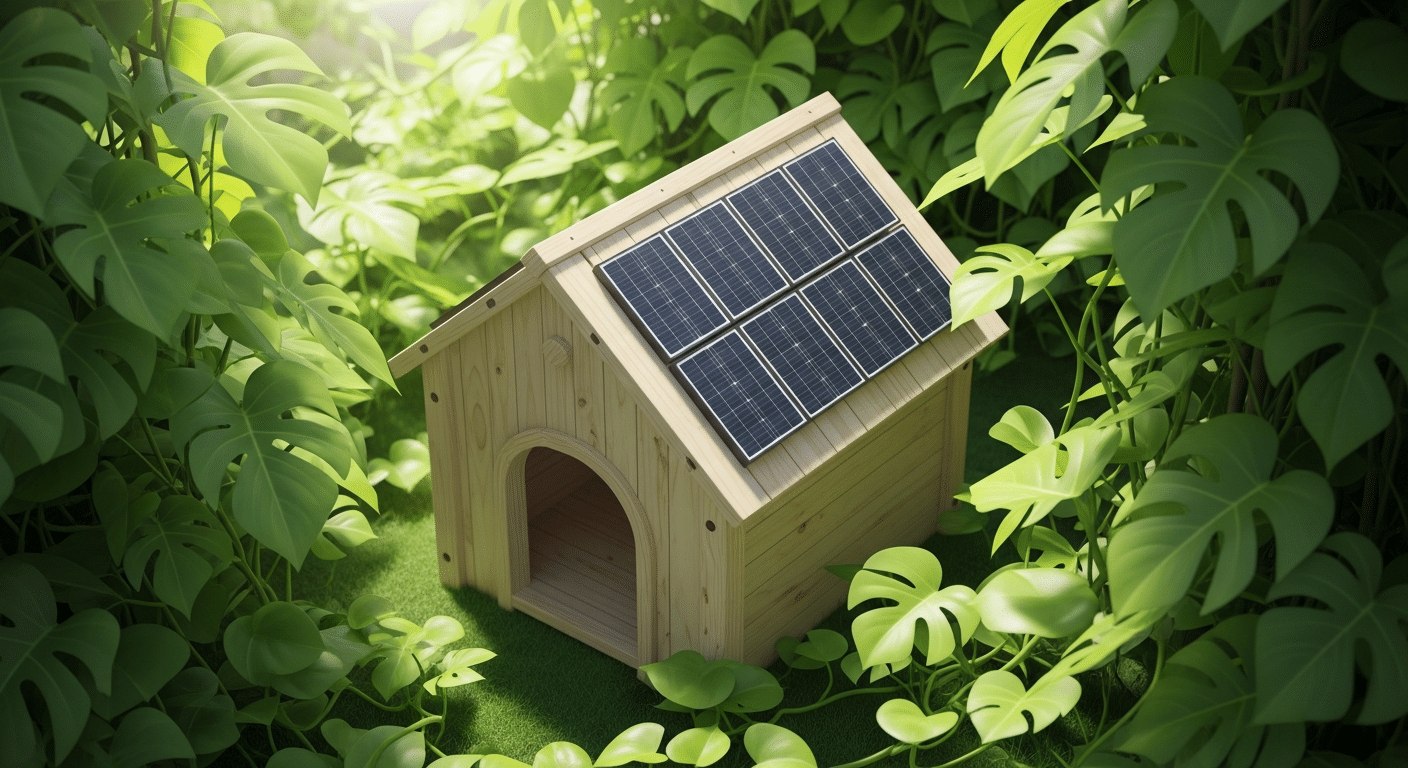
How Solar Heated Dog Houses Cut Your Carbon Pawprint
A heated dog house run on grid power quietly burns fossil fuel all winter. Swap it for sunshine and that warmth becomes emissions-free — here are the actual numbers.
An eco friendly dog house isn’t just a marketing badge — the heat source decides its carbon footprint. A mains-powered heated kennel draws electricity that, on most grids, is still made partly by burning coal and gas, so every warm winter night adds carbon. A solar heated dog house generates that same warmth from a roof panel and a battery, with effectively zero ongoing emissions. This guide does the carbon math: how much CO₂ a grid-heated house emits over a winter, how much a solar setup avoids, and why renewable energy makes the warmth genuinely clean.
Where a heated dog house’s carbon actually comes from
A dog house has no tailpipe, so its footprint is hidden in the wall socket. The carbon comes from the electricity used to run the heat — a heated pad, a low-watt furnace, or a thermostat-controlled heater. That power has to be generated somewhere, and on the average grid a meaningful share still comes from coal and natural gas. So the emissions of a grid-heated house track two things: how many watt-hours it draws over a season, and how dirty the grid that supplies them is.
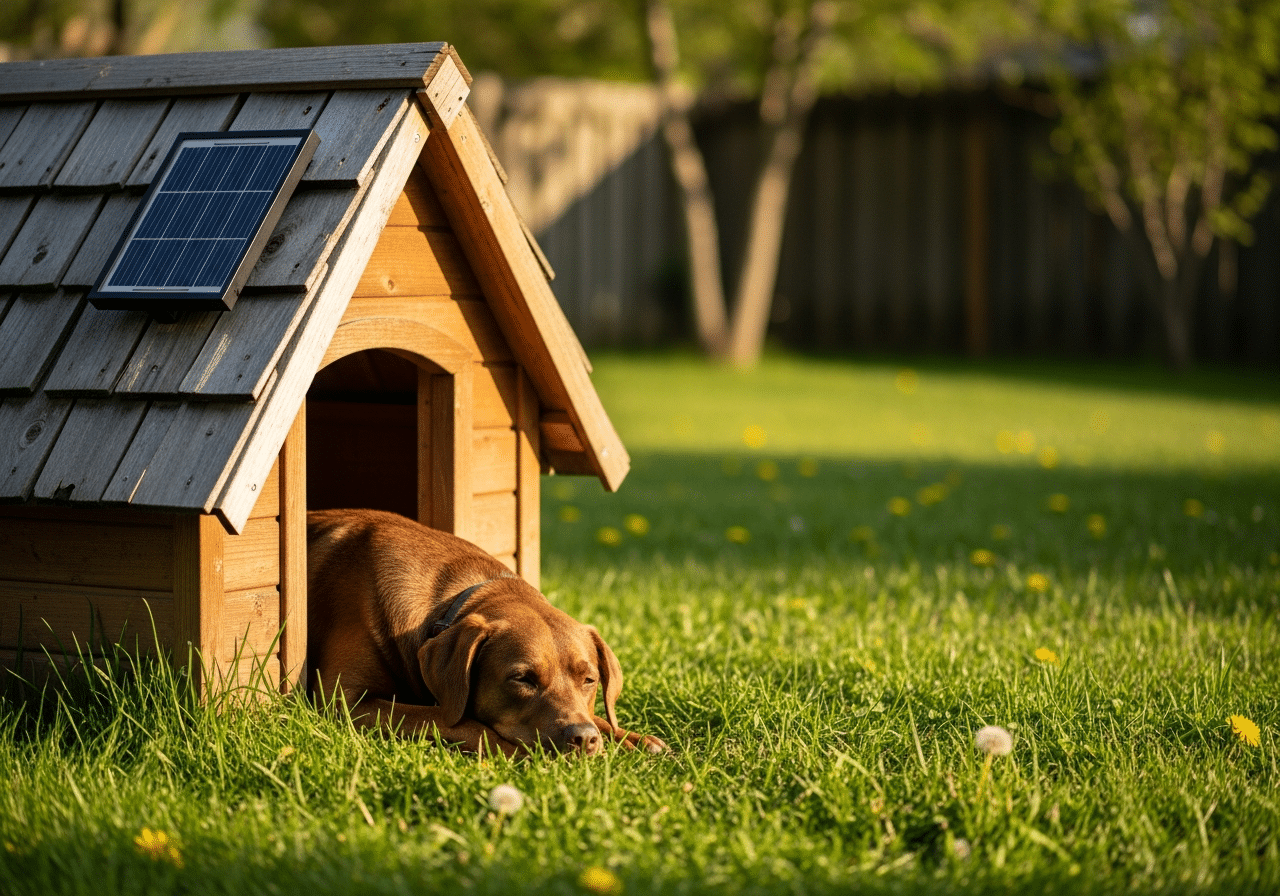
A solar heated dog house breaks that chain. The panel converts daylight directly into the 12V power that runs the pad, and a deep-cycle battery carries it through the night. No fuel is burned to make that warmth, so the carbon attached to it falls to near zero. The same comfort, the same insulation and door flap, the same straw bedding — but the energy behind it is renewable.
The numbers: emissions avoided over one winter
Let’s put rough figures on it. A typical heated dog house draws a low-watt heated pad or heater somewhere between 40W and 80W, cycling on a thermostat through the cold months. Call it an honest average of 1 kWh per day across a four-month winter — about 120 kWh for the season. The U.S. grid emits roughly 0.85 lb of CO₂ per kWh on average, so a grid-heated house quietly puts out around 100 lb (≈46 kg) of CO₂ every winter. Run it for the life of the house and that’s hundreds of pounds of avoidable emissions.
A solar setup supplies those same 120 kWh from the panel, so the carbon avoided is essentially the whole amount. The table below shows how it scales by how hard the heater works:
| Heater draw (winter) | Grid electricity used | CO₂ emitted on grid power | CO₂ avoided with solar |
|---|---|---|---|
| Light (heated pad, mild cold) | ~60 kWh / winter | ~51 lb (23 kg) | ~51 lb (23 kg) |
| Moderate (1 kWh/day, 4 months) | ~120 kWh / winter | ~100 lb (46 kg) | ~100 lb (46 kg) |
| Heavy (larger heater, hard winter) | ~240 kWh / winter | ~200 lb (91 kg) | ~200 lb (91 kg) |
These are estimates, not lab figures — your real number depends on your heater wattage, how cold your winters run, and how clean your local grid is. But the direction is never in doubt: solar-heated warmth is near-zero-carbon, grid warmth is not.
Why renewable energy makes the warmth genuinely clean
The reason the carbon drops to almost nothing is that solar is a renewable energy source: the fuel is daylight, which arrives free and emits nothing when converted. An active solar dog-house system is a small version of the same active solar heating the U.S. Department of Energy describes for homes — a collector (the panel) captures the sun’s energy and a storage medium (the battery) holds it for when it’s needed. The Department of Energy’s guide to active solar heating explains the principle in full.
Because no combustion happens anywhere in that loop, there are no smokestack emissions to attribute to the dog’s warmth. Over the panel’s 20-plus-year life, the small one-time carbon cost of manufacturing it is repaid many times over by the grid power it displaces. That’s the heart of the eco friendly dog house carbon story: it isn’t that solar is slightly cleaner, it’s that the ongoing emissions essentially disappear.
Heating without electricity: the lowest-carbon options
A common question is how to heat a dog house without electricity at all — and the lowest-carbon answers double as the most eco-friendly. They are:
- Passive solar design: a south-facing clear or polycarbonate panel lets winter sun in, and dark thermal mass (painted stone or a concrete floor) stores that heat and radiates it back overnight — zero energy, zero carbon.
- Insulation first: rigid foam in the walls, floor and roof (R-10 to R-15), a raised base and a heavy door flap cut how much heat you need to add in the first place, shrinking any heater’s footprint.
- Straw bedding: deep straw traps body heat and repels moisture — never blankets, which freeze and draw heat away.
Layer an active solar heated pad on top of those and you get reliable warmth with a near-zero carbon footprint. For the full build-out, our eco-friendly solar heated dog houses guide walks through insulation, panels and pet-safe wiring.
Does the carbon saving hold up at night and in winter?
Fair question — the sun isn’t shining when it’s coldest. The answer is the battery. A solar dog-house system charges a 12V deep-cycle battery through the day and discharges it overnight, so the stored renewable energy keeps the pad warm after dark. The panel is sized so that even short winter days bank enough to carry the load, and a timer or thermostat stops the battery being drained.
On a long run of dark, snowy days, a well-designed system rides on stored charge; in a genuinely brutal climate some owners keep a grid backup for safety. Even then the bulk of the season’s warmth is solar, so the carbon saving still stands. The point isn’t perfection — it’s that most of the winter’s heat comes from sunlight instead of fossil fuel. To see the trade-offs against mains power, compare our case for solar heated dog houses.