 Dog Gear, Sized Right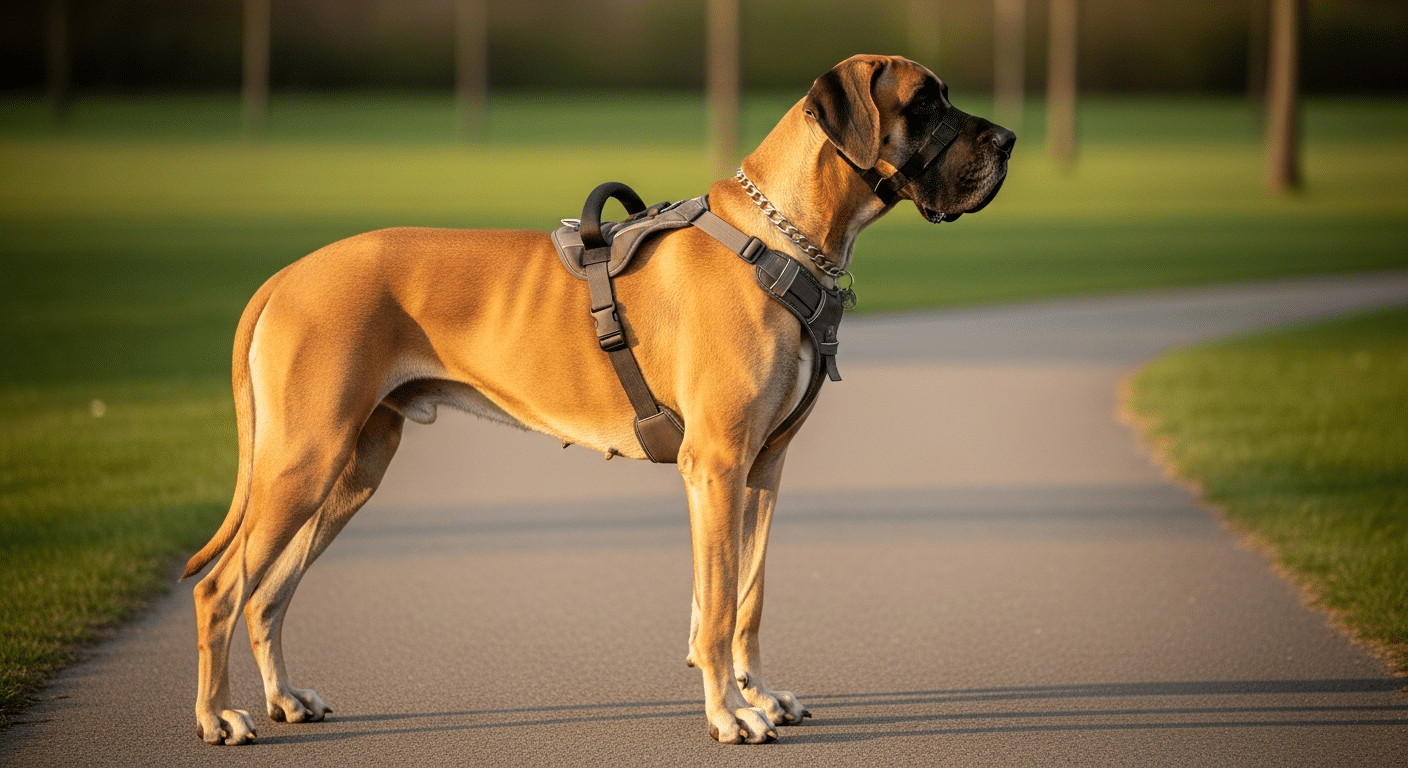
Best Harness for a Great Dane (No-Pull Picks & Sizing Chart)
A Great Dane is about the biggest dog you can put on a leash, 110 to 175 pounds and tall enough to look you in the eye, with a deep chest and a girth that often runs right past a standard XL. They’re calm and gentle, but a dog that big is still immensely powerful, and a flimsy harness with plastic clips won’t survive one. Here are the best heavy-duty, no-pull harnesses for a Great Dane, plus the chest-girth chart, and the XXL truth, every other guide leaves out.
The best harness for a Great Dane has to solve a problem most ‘best of’ lists ignore: sheer size. A Great Dane is a true giant, males commonly run 140 to 175 lb and females 110 to 140 lb, and it’s also one of the tallest breeds there is, carrying that weight high on a long, deep-chested frame. Danes are famously calm and sweet, but ‘calm’ doesn’t mean ‘will never pull’: a 130 lb dog that leans, or lunges the first time it spots a squirrel, can pop a cheap plastic buckle, lean through a thin nylon strap, and out-measure a harness you’d swear was huge. They also have thin, easily-chafed skin that a hard, narrow strap will rub raw. Four things matter most: heavy-duty hardware (metal buckles and D-rings, not plastic), a control handle so you can steady or assist a tall, heavy dog, wide padded panels that spread the load off the airway and protect that delicate skin, and, above all, the right size, because a Great Dane frequently needs an XL, XXL, or even a custom-fit harness. Below we rank three harnesses that nail that brief, then give you the thing competing guides skip: a real chest-girth sizing chart and an honest answer about when your Dane is simply too big for an off-the-shelf size.
The 3 best harnesses for a Great Dane
Ranked for a calm but immensely powerful 110 to 175 lb giant with a deep chest, long frame and delicate skin. Each pick is verified live, tap through for the current price. Crucially: measure your Dane’s chest girth against the chart below before you order, because a Great Dane often needs the largest size or beyond.
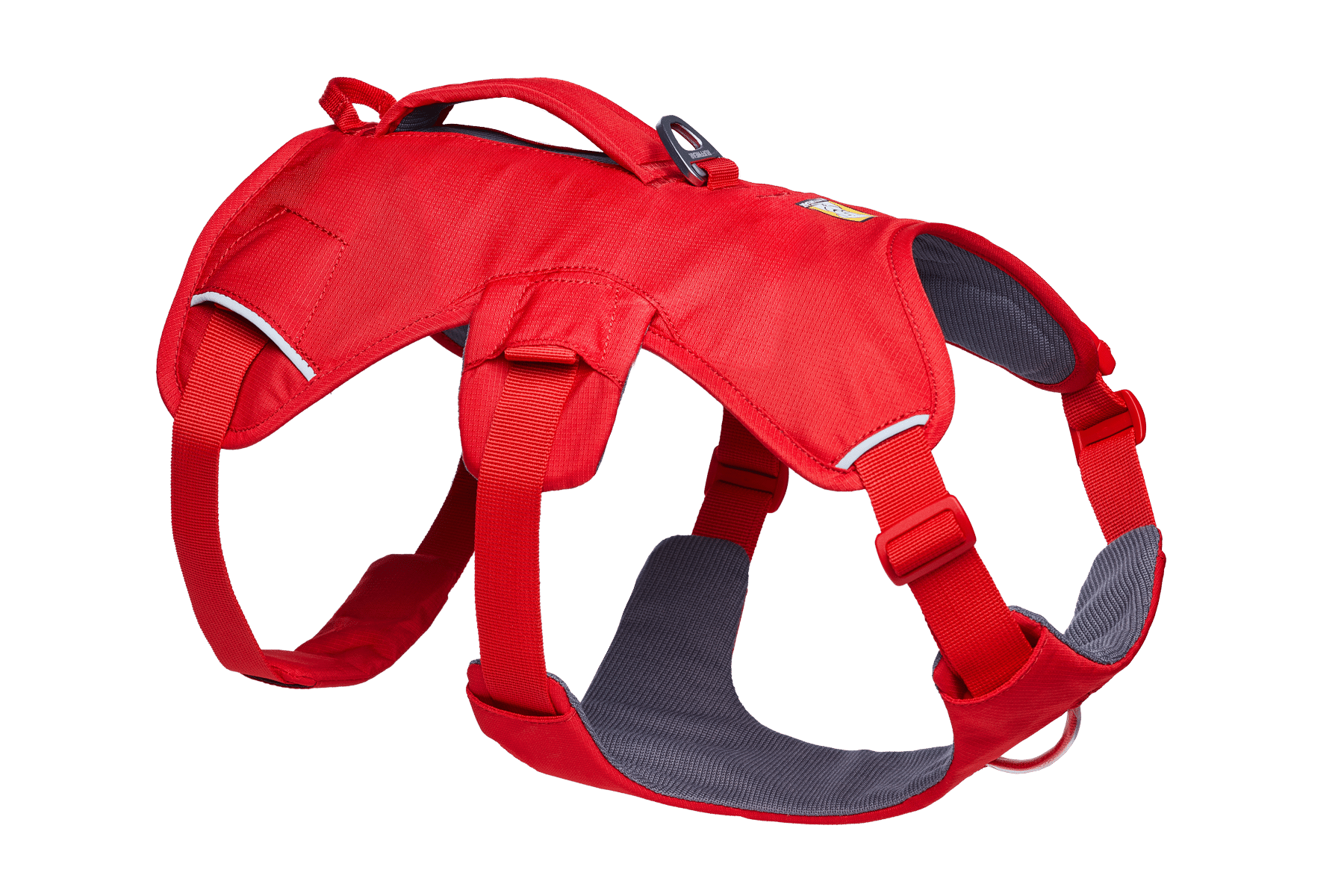
Ruffwear Web Master Dog Harness
For a dog as big and tall as a Great Dane, this is the harness we reach for first. It’s built like mountaineering gear: three sturdy straps wrap a deep chest, four adjustment points dial in a snug, escape-resistant fit, and a reinforced top handle lets you steady or assist a 130 lb dog instantly, invaluable on stairs, in and out of a vehicle, or at the vet, where a Dane’s sheer height matters as much as its weight. The padded straps spread the load across the chest, not the throat, and the smooth lining is gentle on a Great Dane’s famously thin, easily-chafed skin. The largest size (L/XL) fits a chest girth up to about 42 inches, which covers females and many adult Danes, but measure first, because the very biggest males run larger (see the chart and our XXL note below).
What we like
- Reinforced grab-and-lift handle lets you steady or assist a tall 110 to 175 lb Great Dane on stairs, into a car, or at the vet
- Three padded straps and four adjustment points lock onto a deep chest so a powerful giant can’t power out
- Smooth, wide padding spreads the load and is gentle on a Great Dane’s thin, chafe-prone skin
- Skimlinks merchant: routes to ruffwear.com, the highest-paying source for this brand
The catches
- Largest size (L/XL) tops out around a 42″ chest girth, the biggest male Great Danes may exceed it and need an XXL or custom harness (measure first)
- Back-clip only, for a dedicated front no-pull ring, see the ICEFANG or BABYLTRL below
- Premium build can sell out; if it’s restocking on ruffwear.com, the picks below are in-stock alternatives
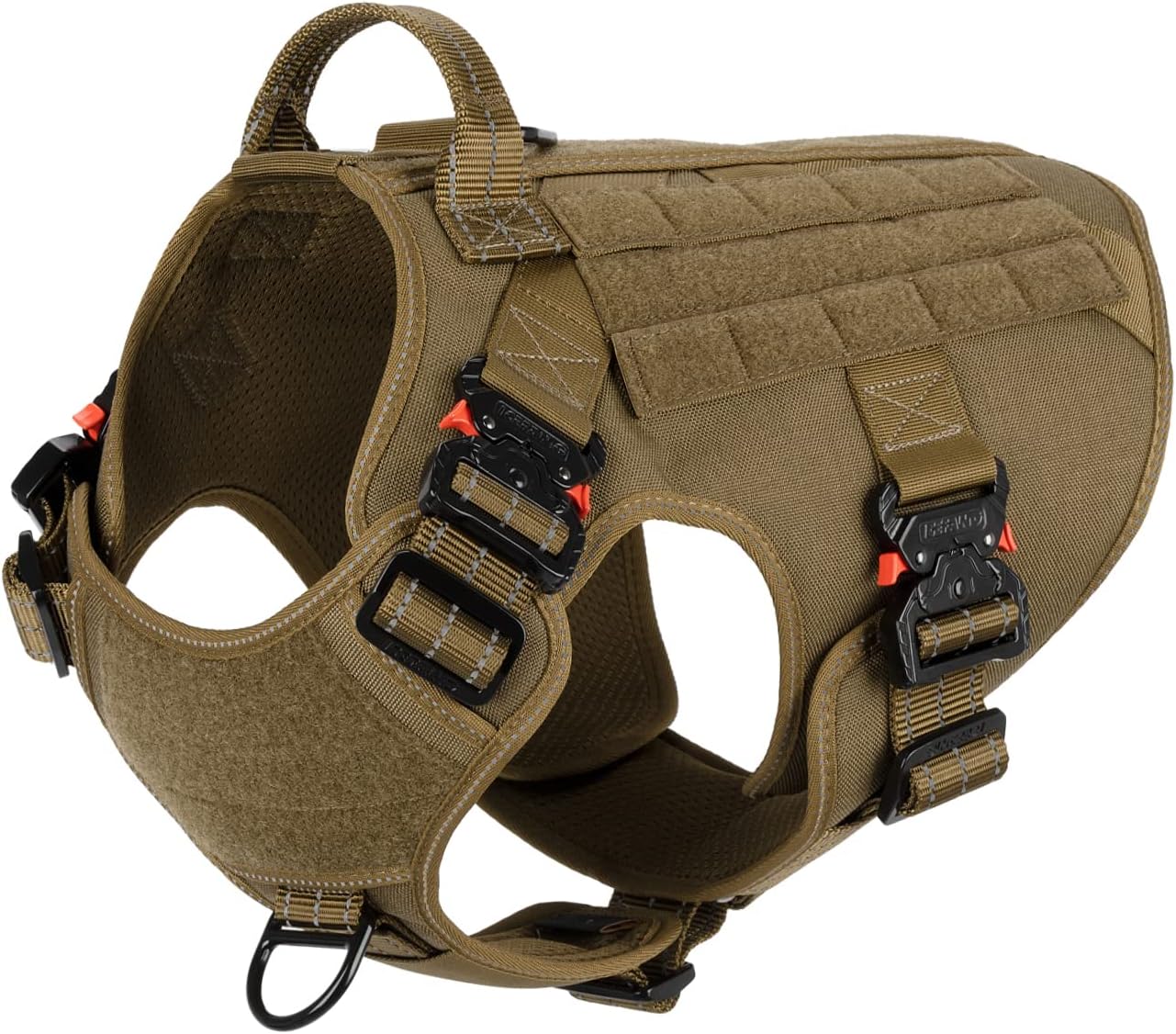
ICEFANG Tactical Dog Harness (XL, 32 to 39″ chest)
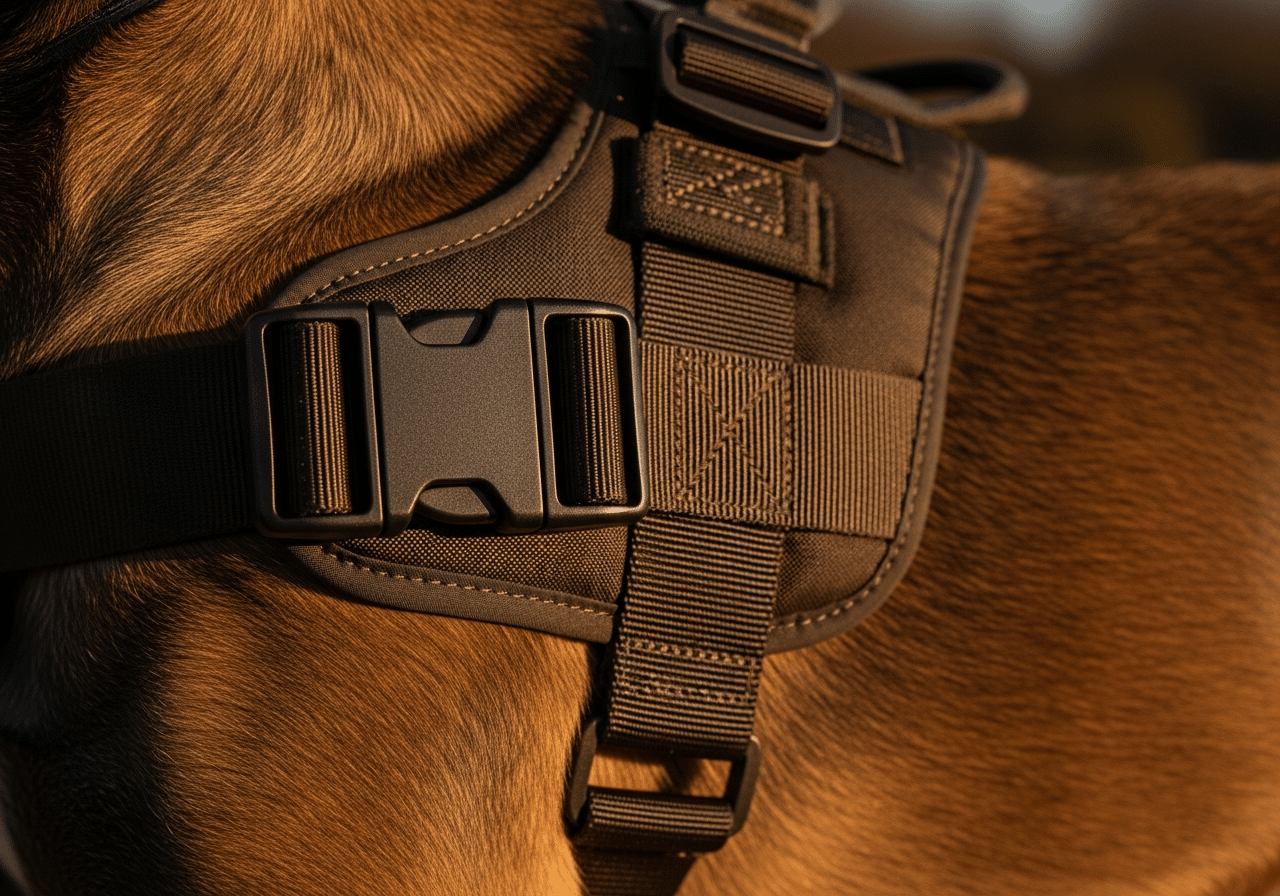
When you want the strongest hardware and maximum control on a Great Dane, this is the pick. It has four metal buckles (not plastic), a front no-pull clip, MOLLE webbing, multiple adjustment points, and a reinforced grab-and-lift handle so you can steady a huge dog in a heartbeat, exactly what you want the first time an otherwise-calm Dane spots a squirrel. The vest-style body wraps a deep chest securely, one of the hardest harnesses here for a giant to back out of. The XL covers a 32 to 39″ chest girth, which fits many Danes; if your dog measures larger, step up to the BABYLTRL XL below or a true XXL/custom build. On a dog this strong, metal hardware isn’t a luxury, it’s what stands between your Dane and a snapped clip.
What we like
- Four metal buckles and metal rings, the strongest hardware here for a powerful Great Dane
- Front no-pull clip plus a grab-and-lift handle for instant control of a tall, lunging dog
- Secure vest-style fit is one of the hardest here for a deep-chested giant to power or back out of
- Wide MOLLE panels spread a Dane’s load comfortably across the chest, off the throat
The catches
- XL tops out at a 39″ chest girth, measure first, because big male Great Danes commonly exceed it
- Heaviest, warmest pick here, a working vest, not a hot-weather harness for a lean-coated breed
- Tactical/MOLLE styling isn’t for everyone; it’s built for control, not minimalism
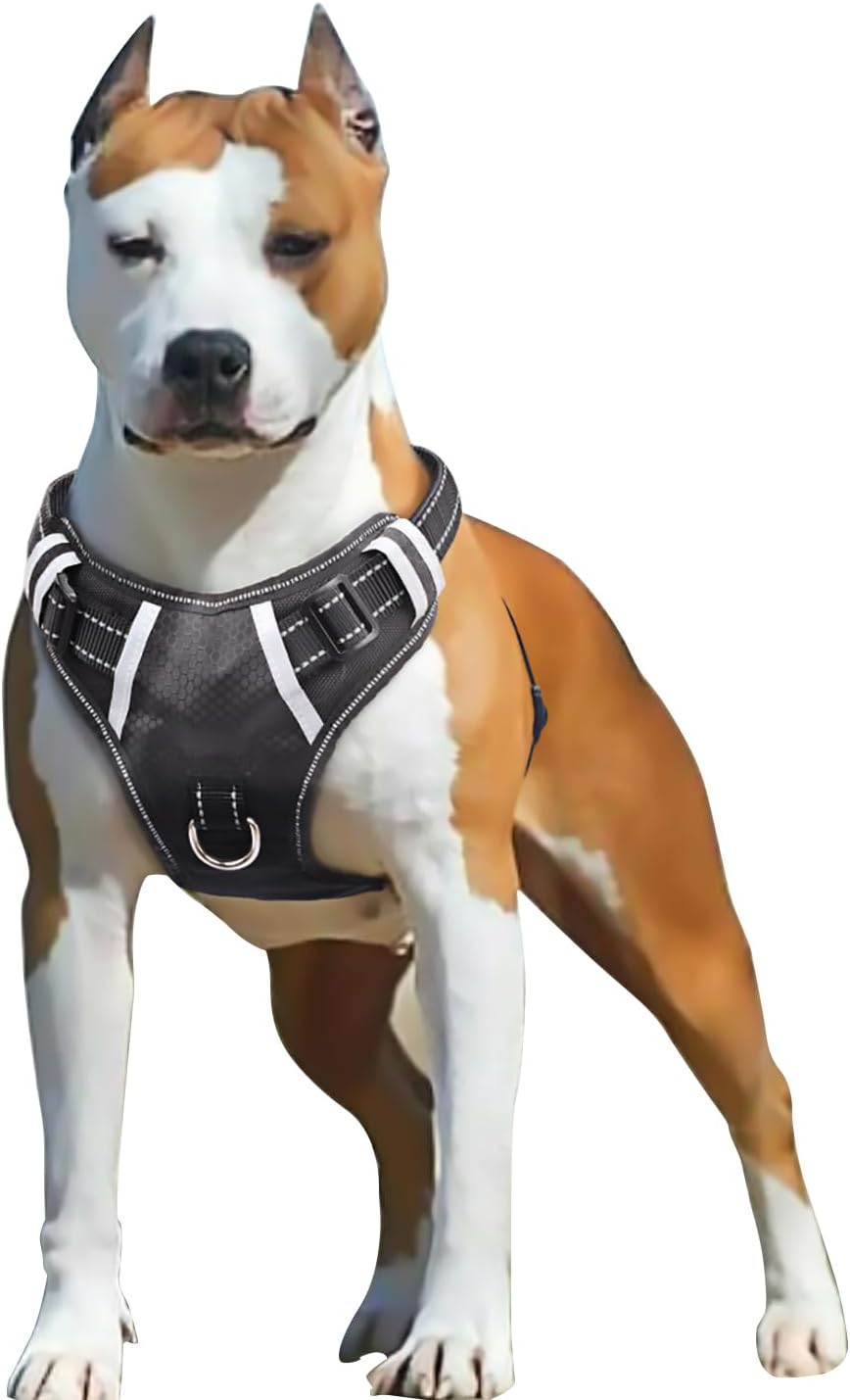
BABYLTRL Big Dog Harness (XL)
The best-value way to get real no-pull control on a genuinely big dog. This is a large-breed-first harness: a soft, breathable padded Oxford vest with front and back leash rings (front clip for no-pull training, back clip for relaxed walks), a sturdy top control handle, and reflective trim for low-light walks. The wide, soft panels are kind to a Great Dane’s delicate skin, and four adjustment points dial in the deep-chested Dane shape. As always with a giant, the catch is size, buy the largest size and check your dog’s chest girth against the brand’s chart, because the very biggest Danes still out-measure most off-the-shelf harnesses. For a Dane it fits, it’s a lot of harness for the money.
What we like
- Designed for big dogs first, soft, wide padded panels that are gentle on a Great Dane’s thin skin
- Front clip for no-pull training plus a back clip and a control handle, at a budget price
- Reflective trim for visibility on early-morning and evening walks with a dark or fawn Dane
- Four adjustment points lock onto the deep-chested Dane shape for a secure, hard-to-escape fit
The catches
- Even the largest size has a ceiling, measure your Dane’s girth, because the biggest males may still need an XXL or custom build
- Plastic quick-release buckles (fine for most Danes; the strongest pullers prefer the all-metal ICEFANG)
- Soft vest body is warmer than a minimalist strap harness, comfortable, but a vest, not a hot-day summer harness
Why a Great Dane needs a heavy-duty harness sized for a giant
This is the part most “best harness” lists gloss over, and for a Great Dane it’s the whole point. A Dane isn’t just a big dog, it’s a giant breed, and one of the tallest dogs alive. Males commonly weigh 140 to 175 lb and females 110 to 140 lb, standing 28 to 34 inches at the shoulder, and they carry that mass high on a long, deep-chested frame. Great Danes are wonderfully calm and gentle by nature, but a dog that size doesn’t have to try to overpower you. Even a relaxed Dane that simply leans can move you; one that decides to surge toward another dog or a squirrel can pop a cheap plastic buckle, stretch a thin strap out of shape, or pull a leash clean out of your hand.
So the build of the harness matters more for a Great Dane than for almost any other dog. The features that separate a great Dane harness from a frustrating one are all about strength, control, comfort, and fit at scale: metal hardware that won’t fail under a giant’s weight, wide reinforced straps that spread that weight (and don’t chafe a Dane’s notoriously thin skin), a grab handle so you can steady or assist a tall, heavy dog on stairs and into vehicles, and, the single biggest issue, a size that actually fits a chest most harnesses were never designed for. A delicate “fashion” harness is simply the wrong tool here.
For background on the breed’s size and gentle build, the AKC Great Dane breed profile is a good primer, but the practical takeaway is simple: a Great Dane needs a harness engineered for a giant, sized to an oversized chest, and built to give you control of a very tall, very strong dog.
Harness or collar for a Great Dane? (the airway issue)
Before the picks, the question every Great Dane owner asks: harness or collar? For walking a dog this big, the answer is a harness, and the reasoning is more pointed for Danes than for most breeds.
Clip a leash to a flat collar and every lean or lunge drives the force of a 130 lb dog straight into the trachea (windpipe) and throat. On any strong dog that risks coughing, gagging, and tracheal irritation, and on a tall giant, the leverage of that long neck only makes it worse. People assume a calm breed like the Dane “doesn’t pull,” and most days that’s true; but it only takes one surprise, a cat across the road, a dropped sandwich, to put the full weight of a giant onto its own windpipe. A well-fitted harness moves all of that load onto the broad chest and shoulders, the part of a Dane built to take it, keeps the airway clear, and gives you a steering point and, with the right harness, a handle to steady a huge dog.
One honest caveat: a front-clip harness fitted too tightly across the shoulders can restrict a dog’s natural front-leg movement, and on a tall, heavy giant, free, comfortable movement matters for the joints. The fix isn’t to avoid front clips (they’re the most effective no-pull tool there is); it’s to fit the harness correctly, snug at the chest and girth, never binding across the shoulder, ideally a Y-front shape that leaves the shoulders free, and to treat the front clip as a training tool you’ll wean off as your Dane learns to walk on a loose leash. The picks below give you both clip options.
What to look for in a Great Dane harness
Once you’ve ruled out a collar for walking, four features separate a great Great Dane harness from one that fails, chafes, or doesn’t fit:
- The right size, first, before anything else. A Great Dane’s chest girth often lands at the very top of a brand’s chart or beyond it. Read the maker’s chest-girth range in inches (not just “XL” or a weight), measure your dog, and be prepared to choose an XXL or a made-to-measure harness. Size is the #1 reason Dane harnesses get returned.
- Heavy-duty, metal hardware. A Great Dane can break or bend cheap plastic clips, so look for metal buckles at best and metal leash D-rings at minimum, plus reinforced (bartacked) stitching at the load points. On a giant, the strength of the hardware is what stands between your dog and a snapped harness.
- A control handle. A sturdy grab-and-lift handle on the back is genuinely useful on a Great Dane, for steadying a very tall dog on stairs, helping an older or arthritic one into a car, or holding a young one in place. It’s a feature you’ll use far more than you expect on a dog this size.
- Wide, padded panels (and a front no-pull clip). Great Danes have thin, easily-chafed skin, and a thin, hard strap will rub it raw and pressure the bony points of a lean dog. Wide, soft, padded panels spread the load comfortably across the chest, off the airway. A front clip adds real no-pull control for a Dane that leans or surges. Wide and padded beats thin every time on a giant.
What size harness for a Great Dane? (chest-girth chart + the XXL truth)
This is the step every other Great Dane harness guide skips, and the one that drives the most returns. Harness size is set by chest girth, not weight. Measure the widest part of the ribcage, just behind the front legs, with a soft tape pulled snug against the coat (not compressing it); also measure the neck at the base. Danes vary, but adults commonly land between 38″ and 52″+ of chest girth, with a neck of roughly 20 to 28″. Here’s the honest part: a great many Great Danes run right past a standard XL. Most popular “best of” harnesses top out around a 39 to 42″ girth, fine for females and smaller Danes, too small for big males. Here’s how that maps to the picks above:
| Chest girth | Typical Great Dane | Size to order |
|---|---|---|
| 32 to 39″ | Female / younger or leaner Great Dane | XL (ICEFANG XL to 39″; BABYLTRL XL; Ruffwear Web Master L/XL) |
| 39 to 42″ | Many adult Great Danes | XL at the top of its range (Ruffwear Web Master L/XL to 42″; check each brand’s chart) |
| 42″+ | Big, deep-chested male Great Danes | XXL or made-to-measure / custom, most off-the-shelf harnesses won’t fit; measure and buy to your number |
Getting the rest of your Great Dane’s gear sized right matters just as much, if you’re kitting out a new dog, our what size crate for a Great Dane guide uses the same measure-first approach, and the best dog bed for a Great Dane guide covers sizing a supportive bed to a giant-breed dog. The full Great Dane gear guide ties the whole kit together.
No-pull front-clip vs heavy-duty handle: which does your Dane need?
Almost every Great Dane harness gives you a front ring, a back ring, or both, and which you use depends on your dog and the walk:
- Front clip (no-pull), use this if your Great Dane pulls or leans, which most do while they’re learning, and which is no small thing on a 130 lb dog. The chest ring rotates a lunging dog back toward you, so pulling stops being rewarding. It’s the everyday training setting, and it’s why the ICEFANG and BABYLTRL both lead with a front ring.
- Back clip with a handle, use this once your Dane walks politely, or whenever you want maximum control through a handle. A back clip is comfortable and doesn’t restrict the shoulders, and on a tall giant the real value is the grab handle beside it, which is exactly what the heavy-duty Ruffwear Web Master is built around.
- Heavy-duty / metal-buckle vest, choose this for maximum control and the strongest hardware. The ICEFANG adds four metal buckles, a metal front ring, a grab-and-lift handle and a snug vest fit. It suits Danes that are powerful, reactive, or simply strong enough to defeat lighter harnesses. The trade-off is weight and warmth.
For most Great Dane owners the honest answer is a harness that gives you both control and a no-pull option, in a size that actually fits. The heavy-duty Ruffwear Web Master leads on build quality and its handle; the ICEFANG adds the strongest metal hardware and a front clip; and the BABYLTRL is the affordable big-dog-first front-clip no-pull for a Dane it fits. If you want to compare the full no-pull field across all big breeds, start at the large-dog harness hub; for handle-equipped tactical builds, see the tactical dog harness guide.
How we chose these Great Dane harnesses
A harness being popular doesn’t make it right for a Great Dane. We ranked on the things that actually matter for a calm, tall, giant breed with delicate skin:
- Fit at giant size. Does the brand publish a real chest-girth range, and does it reach far enough for a Dane? We’re honest about where each pick tops out, and where you’ll need XXL or custom instead.
- Hardware strength. Will the buckles and rings survive a 110 to 175 lb dog? Metal buckles at best, metal D-rings at minimum, reinforced stitching at the load points.
- Control. A sturdy grab handle to steady, hold, or assist a very tall dog, and a front no-pull clip to redirect a Dane that leans or surges.
- Comfort and skin. Wide padded panels that keep load off a Dane’s throat and don’t chafe its thin, sensitive skin on long walks.
- Value for the dog you have. We span a value big-dog vest to a metal-buckle tactical and a premium heavy-duty control harness, because the right harness depends on your Dane’s size and temperament.
How to fit and introduce a harness to a Great Dane
Even the best harness fails if it’s the wrong size, fitted loose, or rushed onto a young dog. Three things make the difference on a Great Dane:
- Buy to your measured girth, not a guessed size. Measure the chest at the widest point behind the front legs and the neck at the base, then check those numbers against the brand’s chart. If your Dane is at the top of a size’s range or beyond, go up a size or to a custom build, a maxed-out harness rides up toward the throat and a giant can lean out of it.
- Fit it snug on the deep chest, then re-check under load. Tighten every point until you pass the two-finger test, then walk the dog and watch for the harness shifting, twisting, or the chest piece riding up toward the airway. Because a Dane is heavy and tall, err on the snug side at the chest while leaving the shoulders and front legs free to move, and check there’s no rubbing in the “armpit” behind the front legs, a common chafe point on a thin-skinned Dane.
- Introduce it with food and patience. Danes are gentle but can be cautious about new gear going over the head, and a tall puppy that grows fast will need re-sizing more than once. Let the dog sniff the harness, feed treats through the head opening, and build up over a few short sessions before a real walk.
Once the harness is dialled in, the rest of the leash setup matters too. A short, sturdy leash gives you the most control over a giant; clip it to the front ring for training walks and the back ring (or hold the handle) for close control. And because young Great Danes can be heavy chewers while teething, keep the leash and harness out of reach between walks, see our best chew toys for a Great Dane guide for safe, giant-sized chews.
Our verdict: the best harness for a Great Dane
Match the harness to your dog, and measure first. For most Great Dane owners, the heavy-duty Ruffwear Web Master is the pick, a genuinely strong, padded harness with a reinforced control handle and four adjustment points that hold a deep chest, steady a tall dog, and stay kind to a Dane’s thin skin, with an L/XL that fits up to a 42″ girth. If you want the strongest metal hardware and a front no-pull clip, the ICEFANG XL brings four metal buckles, MOLLE and a grab handle in the hardest-to-defeat fit here. And for a leaner or female Dane on a budget, the big-dog-first BABYLTRL XL gives you a front clip, a back clip, a control handle and reflective trim at a value price.
Whichever you choose, the rule for a Great Dane is the same: measure the chest girth first, and if your dog runs past a standard XL, as many big males do, go to an XXL or a made-to-measure harness rather than forcing a too-small fit. Your control of a tall giant depends on both the hardware and the size. For the rest of the lineup, browse the large-dog harness hub and the full Great Dane gear guide.
More Great Dane & giant-breed gear
Great Dane harnesses: common questions
What size harness for a Great Dane?
Size a Great Dane harness by chest girth, not weight. Measure the widest part of the ribcage just behind the front legs; adult Danes commonly run 38 to 52″+ of girth with a 20 to 28″ neck. That puts leaner females and younger dogs in an XL, many adults at the top of an XL range, and big deep-chested males in an XXL or a made-to-measure / custom harness, because most off-the-shelf harnesses top out around 39 to 42″. If your Great Dane measures over about 42″, don’t force a too-small XL; buy to your measured number. When you’re between sizes, size up and use the adjusters to cinch it down.
What is the best harness for a giant breed like a Great Dane?
The best harness for a giant breed is one that combines a big enough chest-girth range, metal hardware that won’t fail under the dog’s weight, a control handle, and wide padded panels to spread the load off the airway and protect a Dane’s thin skin. For overall build and control we pick the heavy-duty Ruffwear Web Master (reinforced handle, padded, L/XL to ~42″); for the strongest hardware the ICEFANG XL (four metal buckles, front no-pull clip, handle); and for value the big-dog-first BABYLTRL XL. Above all, measure first, for the very biggest Great Danes the right answer may be an XXL (such as the Blue-9 Balance, which fits up to about 43.5″) or a custom-built harness rather than any standard size.
Is a harness better than a collar for a Great Dane?
For walking, yes. A Great Dane is enormous, and a flat collar drives the force of a 110 to 175 lb dog straight into the trachea and throat, which can cause coughing, gagging and tracheal irritation, and on a tall dog the long neck gives a lunge even more leverage. People assume a calm breed like the Dane never pulls, but it only takes one surprise (a cat, a dropped sandwich) to put a giant’s full weight on its own windpipe. A well-fitted harness spreads that force across the broad chest and shoulders, keeps the airway clear, and gives you a steering point and a handle. Keep a flat collar with ID tags and a microchip on your Dane, but clip the leash to a harness.
What chest girth does a Great Dane have?
Great Danes vary, but adults commonly have a chest girth between 38″ and 52″ or more, measured at the widest part of the ribcage just behind the front legs, with a neck of roughly 20 to 28″. Leaner females and younger dogs sit at the lower end; big, deep-chested adult males reach the top and sometimes beyond. Because the breed is a tall giant built deeply through the chest, always measure your individual dog rather than guessing from weight, and remember that many Great Danes out-measure a standard XL and need an XXL or custom harness.
My Great Dane is too big for an XL harness, what do I do?
You’re not alone, many big male Great Danes exceed the 39 to 42″ chest girth where most XL harnesses top out. Don’t force a maxed-out harness: it rides up toward the throat, gaps at the chest, and a giant can lean out of it. Instead, measure your dog’s exact chest girth and either choose a brand that explicitly publishes an XXL chest-girth range (the Blue-9 Balance fits up to about 43.5″, and big-dog lines run larger), or order a made-to-measure / custom harness built to your dog’s number. Buying to the measurement on your tape, not the letter on a label, is the whole game for an oversized Great Dane.
Are no-pull harnesses good for a Great Dane?
Yes. A no-pull harness has a front leash ring on the chest that turns a lunging dog back toward you instead of letting it lean into the pull, and on a 130 lb dog, that mechanical advantage is exactly what you want while you teach loose-leash walking. Great Danes are calm by nature, but young or excitable ones still pull, and a front clip is the most effective everyday tool for it. Fit it correctly so it doesn’t bind the shoulders (a Y-front helps), use it as a training aid alongside consistent loose-leash practice, and wean off the front clip as your Dane improves. The ICEFANG and BABYLTRL above both offer a front no-pull ring.
How tight should a Great Dane’s harness be?
Snug enough that you can slide two fingers flat under any strap, and no looser. A correctly fitted harness sits square on the chest and doesn’t twist, slide backward, or ride up toward the throat when the dog pulls. After fitting, walk your Dane and re-check, a giant often needs the chest strap tighter than you’d expect so it can’t slide it back, and you should confirm a front-clip harness doesn’t bind the shoulders or rub the thin skin behind the front legs. Too loose and a heavy Dane can lean out of it; too tight and it can chafe a Dane’s sensitive skin or restrict the gait.