 Dog Gear, Sized Right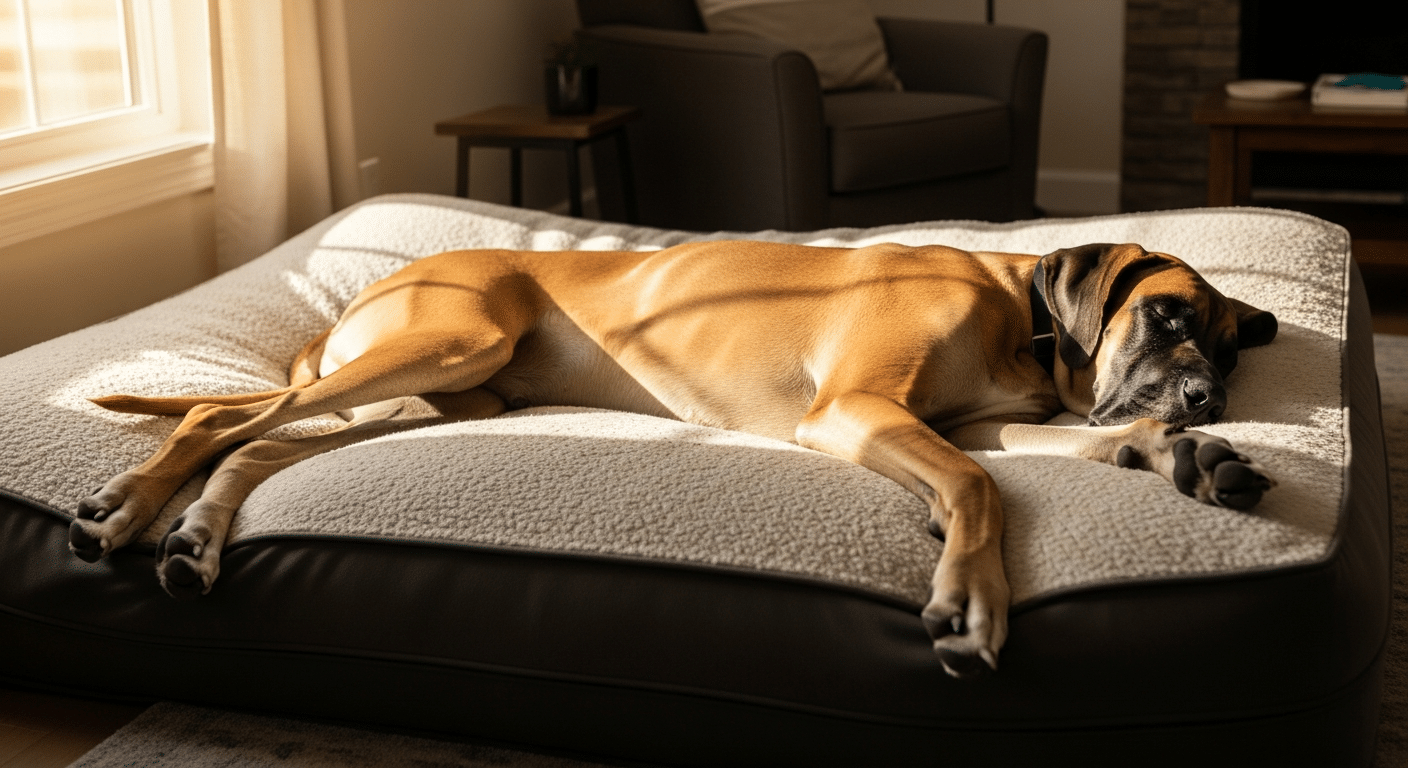
Best Dog Bed for a Great Dane (Giant Orthopedic)
A Great Dane is one of the biggest dogs on earth, 110 to 175 pounds, and that changes everything about the bed. A standard “extra-large” bed is too small and too thin: the foam bottoms out under a Dane’s enormous weight and leaves it on the hard floor. This breed needs the biggest, thickest giant orthopedic bed with high-density foam that won’t flatten. Here’s how to size it right and the three beds we’d actually buy.
Looking for the best dog bed for a Great Dane? Start with the one fact that makes this breed different from almost every other dog: the Great Dane is a giant breed. Females typically weigh 110 to 140 lb and males 140 to 175 lb, standing 28 to 34 inches at the shoulder, among the very largest domestic dogs in the world. That enormous size means two things go wrong with an ordinary bed. First, it’s too small: a Dane stretched out on its side measures 38 to 48 inches nose-to-tail, so a typical “XL” bed leaves half the dog hanging off. Second, and more important, it’s too thin: a 150 lb-plus dog presses an ordinary foam pad flat to the floor, it “bottoms out”, so the dog is effectively lying on tile, no matter what the label says. So the single most important thing for a Great Dane bed isn’t softness, it’s genuine giant sizing plus high-density orthopedic foam thick enough not to compress under enormous weight. Get that right and you protect the joints a Dane is genuinely prone to damaging; get it wrong and you’re re-buying flattened beds every few months. Below we explain why standard XL beds fail a Dane, what foam density and thickness actually do, how to size a giant bed correctly, why orthopedic support matters so much for this breed’s hips and fast-growing frame, which are the biggest beds money can buy, and then the three beds we’d actually put under a Great Dane, a value giant orthopedic, the clinically studied premium flagship, and the toughest option for a destroyer. For everything else your gentle giant needs, see our Great Dane gear guide.
The best dog beds for a Great Dane, ranked
Every pick is a genuinely giant, orthopedic bed we’d put under a 110 to 175 lb Great Dane, sized right and thick enough not to bottom out. Verified in stock; tap through for the live price.
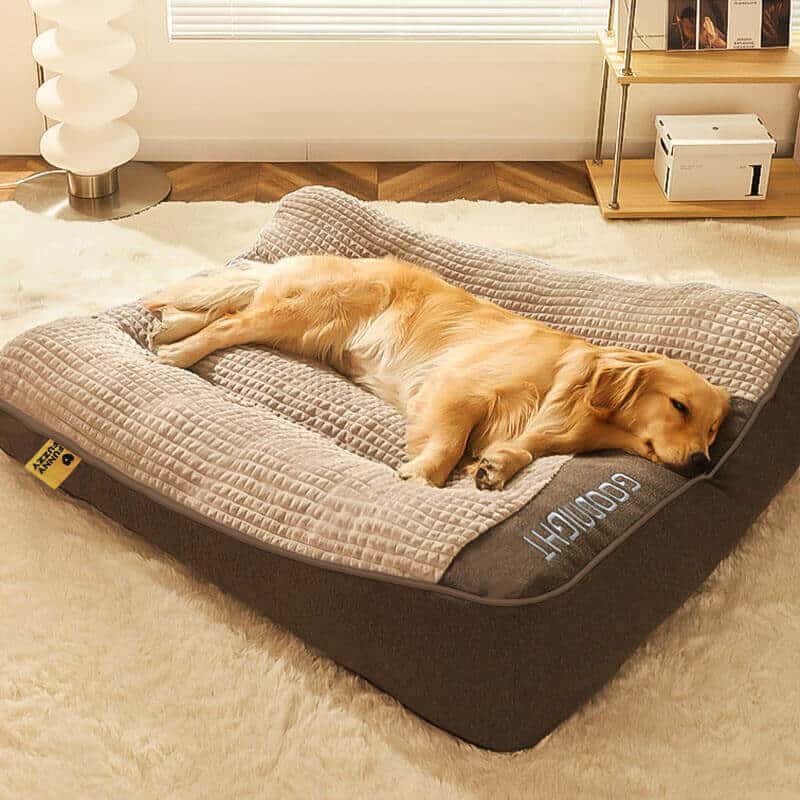
FunnyFuzzy Large Thick Orthopedic Dog Bed
This is the bed we’d put under most Great Danes that don’t destroy bedding. It’s a generous, thick orthopedic mattress with a genuinely supportive high-density foam core, a spine-protecting profile, and a fully machine-washable cover, and it comes in a large enough footprint to give a Dane room to stretch out. The thick foam base keeps a 100 to 175 lb dog genuinely off the hard floor instead of bottoming out the way a thin pillow bed does, which is exactly what prevents the elbow calluses and hygromas giant dogs get. The removable cover zips off for the wash, non-negotiable for a drooly giant, and it badly undercuts the boutique giant beds on price. Buy the largest size available and confirm the dog can lie fully extended on the surface; for a true 150 lb+ Dane that wants even more length, step up to the Big Barker Giant below.
What we like
- Thick, dense foam core keeps a 100 to 175 lb giant off the floor instead of bottoming out
- Spine-protecting orthopedic profile is real preventive joint care for a giant breed
- Entire cover is removable and machine-washable, built for a giant that sheds and drools
- Dramatically cheaper than boutique giant-breed beds without skimping on support
The catches
- Confirm you order the largest size, a tall male Dane needs every inch of length
- A 175 lb senior with arthritis may want the thicker 7-inch slab of the Big Barker Giant
- Not a chew-proof bed, fine for a settled adult, not a determined destroyer
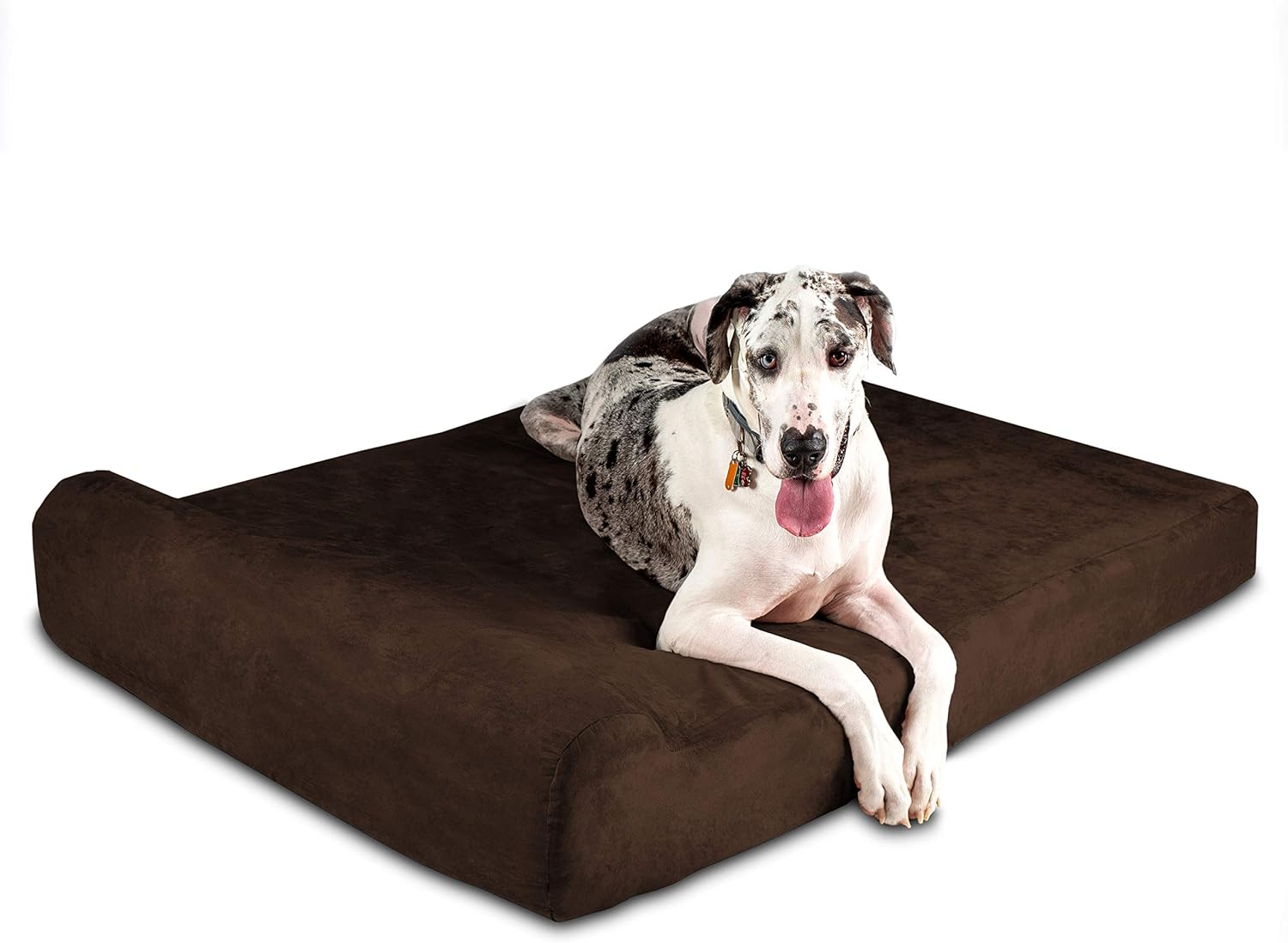
Big Barker 7″ Orthopedic Dog Bed (Giant)
If you have a true giant, a 150 lb+ Dane, a senior, or a dog already showing stiff hips, this is the bed worth paying for. Big Barker built its reputation specifically on large and giant breeds, and the Giant size (60″ × 48″) is sized for exactly this dog. The headline is the foam: 7 inches of layered, high-density therapeutic foam engineered not to flatten under enormous weight, the thing that separates it from every cheap bed that bottoms out in a month. It’s also the one bed here with a published, independent angle: a University of Pennsylvania study found dogs sleeping on a Big Barker showed measurable improvements in joint pain, stiffness and mobility. The cover is microfiber, removable and washable, and the foam carries a long warranty against going flat. It’s expensive, but for a giant breed prone to joint disease, it’s the closest thing to clinical-grade support, and the one bed that reliably survives a Great Dane’s weight for years.
What we like
- 7 inches of layered high-density foam genuinely won’t flatten under a 150 to 175 lb Dane
- Giant 60×48 footprint is sized for a giant breed, not a stretched ‘XL’ built for a Lab
- Backed by an independent University of Pennsylvania study showing reduced joint pain and stiffness
- Removable washable microfiber cover and a long warranty against the foam going flat
The catches
- Premium price, it’s the most expensive bed here by a wide margin
- Microfiber cover isn’t chew-proof; a destructive Dane needs the tougher K9 below
- Big and heavy to move around the house (which is the point, it doesn’t bottom out)
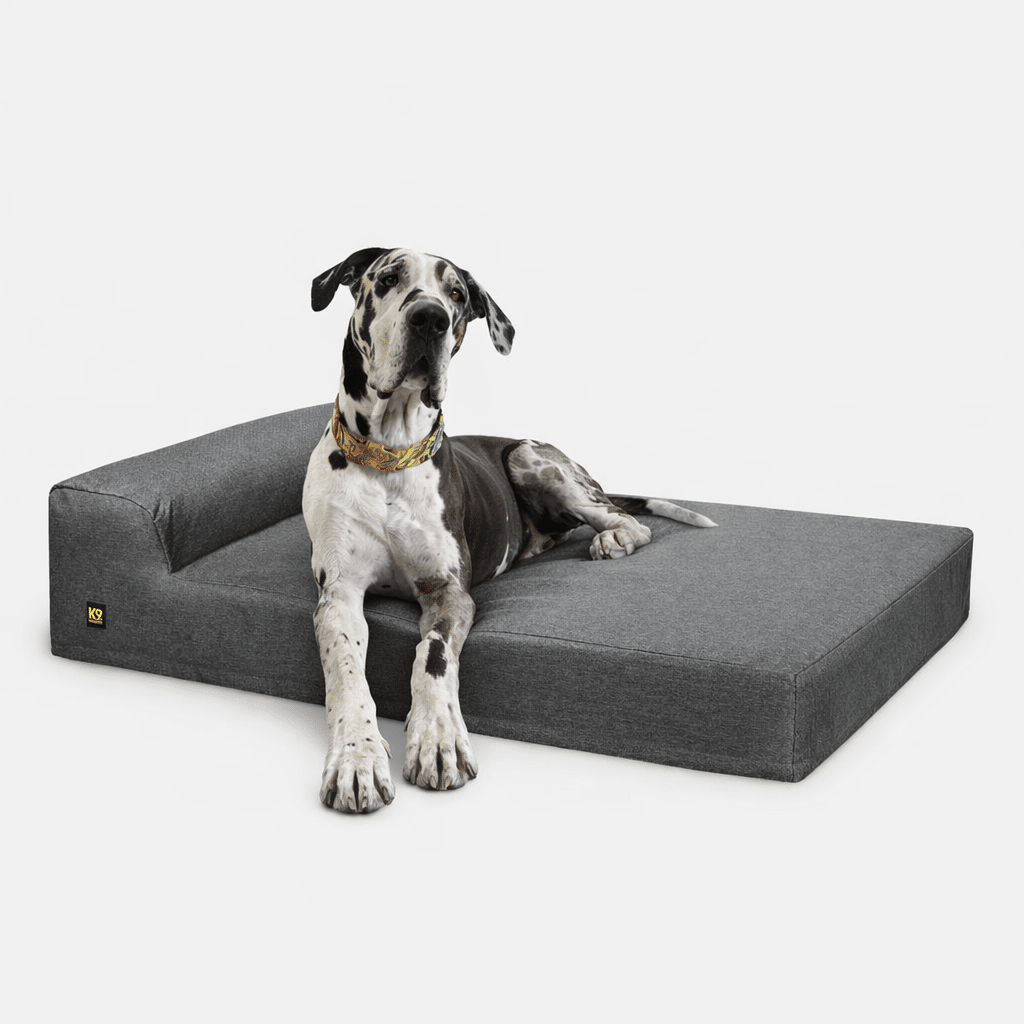
K9 Ballistics Tough Ripstop Giant 7″ Bolster Bed
For the Great Dane that destroys soft beds, the digger, the chewer, the dog that’s already shredded one mattress, this is the giant-breed answer. It pairs 7 inches of orthopedic bolster foam (so you don’t sacrifice the joint support a giant needs) with K9 Ballistics’ tough ripstop ballistic cover, the same chew-resistant fabric they build their toughest beds from, plus a chew-resistant warranty. It’s purpose-built for giant breeds, the company photographs it with a Great Dane on it, so the footprint and the foam are right, and the cover survives the digging and scratching that opens a plush bed in days. The trade-off is honest: it costs about as much as the Big Barker and the tough fabric is firmer and less plush than a microfiber bed. But for a powerful giant that’s hard on bedding, it’s the bed that lasts while still protecting the joints, the rare bed that’s both giant-sized, orthopedic, and genuinely durable.
What we like
- Purpose-built for giant breeds, correct footprint and 7 inches of orthopedic foam
- Tough ripstop ballistic cover survives the digging and chewing that destroys plush beds
- Bolster sides give a Dane a headrest and a sense of being surrounded without losing support
- Backed by a chew-resistant warranty, the company stands behind the durability
The catches
- Premium price, similar to the Big Barker Giant
- Tough fabric is firmer and less plush-soft than a microfiber bed on day one
- A truly relentless destroyer may still need an elevated metal cot (Kuranda) instead
Why a standard XL bed bottoms out under a Great Dane
If you’ve already bought a Great Dane a bed and watched it go flat in weeks, you’re not doing anything wrong, you bought a bed built for a different dog. This is the single most important thing to understand before you spend money, so let’s start here.
Most beds sold as “extra-large” are engineered for a dog in the 70 to 100 lb range, a Labrador, a German Shepherd, a Golden. A Great Dane is not that dog. A male Dane can weigh 175 lb, nearly double, and all of that mass concentrates on the hips and shoulders when the dog lies down. Two things follow:
- The bed is too short. A Great Dane lying fully stretched on its side measures roughly 38 to 48 inches nose to tail. A typical “XL” bed is 36 to 46 inches including the bolster, so the dog’s legs and head hang off the usable sleeping surface. It can’t fully extend, which is the whole point of a bed for a long-bodied giant.
- The foam bottoms out. This is the real killer. “Bottoming out” means the foam compresses completely under the dog’s weight so there’s nothing left between the dog and the hard floor. A 2 to 3 inch pad of ordinary or shredded foam simply cannot hold up 150 to 175 lb, it crushes flat, and now your giant breed is sleeping on tile with a thin sheet of dead foam on top. The bed looks like a bed; it’s functionally the floor.
That’s why “just buy the biggest size of a normal bed” doesn’t work. A bigger footprint of the same thin, low-density foam still bottoms out. What a Great Dane actually needs is a bed engineered for giant-breed weight: a genuinely giant footprint and thick, high-density foam (more on density below) that resists compression under 150 lb-plus. Brands that specialize in giant dogs. Big Barker, Mammoth, K9 Ballistics, Bully Beds, build to that spec and often guarantee the foam won’t flatten for years; a generic big-box “XL” almost never does. The rest of this guide is about how to tell the difference and get the sizing and foam right. The bed is one piece, our Great Dane gear guide covers the crate, harness, toys and the rest of outfitting a giant.
Foam density and thickness: what actually stops the bed flattening
For a Great Dane, foam is the whole game. Two specs decide whether a bed supports your dog or quietly becomes the floor: thickness and density. They’re different things, and a giant-breed owner needs both.
- Thickness. How tall the foam is. For a Great Dane, aim for at least 4 inches of supportive foam, and ideally 7 inches for a heavy, senior or arthritic dog. The thicker the foam, the more compression it can absorb before the dog reaches the floor. Thin 1 to 3 inch pads are fine for a small dog and useless under a giant.
- Density. How much foam is packed into each cubic foot, this is what people miss. A thick bed made of low-density foam still bottoms out, because soft, airy foam crushes flat. Look for high-density foam (around 4 to 5 lb per cubic foot) or foam explicitly described as “medical-grade” or “therapeutic.” Density, not just thickness, is what holds 150 lb up.
- Solid core, not shredded fill. Avoid beds stuffed with loose shredded foam or polyester fill, it packs down fast and goes permanently flat under a giant. A solid orthopedic foam core (or layered support + memory foam) is what you want for a Dane.
- Memory foam vs. support foam. Memory foam contours to the body and relieves pressure points (protecting hips and elbows); firmer support foam resists bottoming out. The best giant beds layer both, a firm high-density base topped with a contouring comfort layer.
- CertiPUR-US certification. A third-party standard confirming the foam is made without certain harmful chemicals, worth having for a dog that spends 12+ hours a day lying on it.
A useful tell when shopping: the giant-breed specialists publish a no-flatten guarantee (Big Barker and Bully Beds warranty the foam against going flat for up to ten years). A brand that will replace the bed if the foam compresses is telling you it’s high-density enough to survive a giant; a generic bed with no such guarantee usually isn’t.
What size bed does a Great Dane need? (go giant, then go bigger)
With most breeds the warning is “don’t buy too big.” With a Great Dane it’s the opposite: almost everyone buys too small. A Dane is a genuinely giant dog, and it needs a genuinely giant bed, the size most brands label “XXL,” “Giant” or “Jumbo,” not the “XL” that fits the rest of the dog world.
Ignore the brand label (one company’s “XL” is another’s “Large”) and size to your dog. The rule: your Great Dane should be able to lie fully stretched out on its side, legs extended, head down, without any part hanging off the edge. To find the number, measure your dog from nose to base of tail while it’s lying stretched, then add 8 to 12 inches to get the minimum bed length. For a full-grown Dane that almost always lands at 54 to 60+ inches long and 40 to 48 inches wide, a true giant bed.
| Great Dane | Typical weight | Recommended bed size | Approx. bed dimensions |
|---|---|---|---|
| Female / smaller adult | 110 to 140 lb | XXL / Giant | ~48 to 54″ L × 36 to 44″ W |
| Male / large adult | 140 to 175 lb | Giant / Jumbo | ~54 to 60″+ L × 44 to 48″ W |
| Senior or arthritic Dane | any | Giant + 7″ foam | ~54 to 60″ L, thickest foam |
| Great Dane puppy (still growing) | grows fast | Buy for the adult size | size to grown dog (60″) |
Three more sizing notes for this breed:
- Don’t downsize to save money. A bed the dog overhangs gets the heavy parts, hips, shoulders, pressing on the hard floor edge, which is exactly the joint loading you’re trying to prevent. The whole bed has to be under the dog.
- Mind the foam and the footprint. A giant footprint of thin foam still bottoms out; thick foam in a too-small footprint still leaves the dog hanging off. A Dane needs both at once, that’s why true giant-breed beds cost more.
- Buy for the adult, not the puppy. Great Danes grow explosively, a Dane puppy can hit 100 lb by six months. Don’t buy a series of beds; buy the adult-size giant bed and let the puppy grow into it.
Orthopedic support: protecting a giant breed’s vulnerable joints
Once the bed is big enough and thick enough not to bottom out, the reason all of this matters comes into focus: orthopedic support for a breed that is genuinely prone to joint disease. A Great Dane’s size is hard on its own skeleton, and the right bed is real preventive medicine.
The breed-specific concerns a supportive bed helps with:
- Hip and elbow dysplasia. Giant breeds are prone to dysplasia, malformed hip or elbow joints that lead to pain and arthritis. A thin or bottomed-out bed forces the dog to lie on hard floor, loading those already-vulnerable joints; a thick high-density orthopedic surface distributes the weight and takes pressure off them.
- Arthritis and stiffness. Many Danes develop arthritis with age, and they age fast for their size. A supportive bed is the difference between a dog that springs up in the morning and one that struggles, the University of Pennsylvania study on giant-breed orthopedic beds found measurable reductions in stiffness and pain.
- Rapid growth and developmental issues. A Great Dane goes from a few pounds to 100+ lb in months. That breakneck growth makes the developing skeleton fragile and is linked to conditions like HOD (hypertrophic osteodystrophy) and Wobbler syndrome. A growing Dane puppy especially benefits from a supportive surface that doesn’t let it sleep crumpled on a hard floor.
- Elbow hygromas and calluses. When a heavy dog repeatedly lies on a hard surface, fluid-filled swellings (hygromas) and thick hairless calluses form on the elbows and hocks. A bed the dog can’t compress flat cushions those bony points so they don’t develop in the first place.
This is why “orthopedic” isn’t marketing fluff for a Great Dane the way it can be for a small dog. A 30 lb terrier is fine on almost anything; a 160 lb Dane is loading its joints with every hour on the floor. The combination that actually protects the joints is the one we keep coming back to: genuinely giant size (so the whole dog is supported), high-density foam (so it doesn’t bottom out), and thickness (4 inches minimum, 7 for a senior). Get those three right and the bed is doing preventive orthopedic work every night.
The biggest beds money can buy (Mammoth, Big Barker Giant, Kuranda)
Because the number-one mistake is buying too small, it’s worth knowing the genuinely giant beds, the ones built at the top end for the largest dogs. If “what is the biggest dog bed?” is on your mind, these are the names that come up.
- Mammoth (giant XXL, up to 72″ × 55″). Mammoth specializes in big-breed beds and its largest giant model runs an enormous 72 × 55 inches, big enough to fit two medium Great Danes, with a high bolster wall (10 to 12 inches) to cradle the head and neck. It’s about as large as a domestic dog bed gets and a strong option for a dog that sprawls or for a multi-Dane household.
- Big Barker 7″ Giant (60″ × 48″). The clinically studied flagship and our premium pick below. The Giant size is 60 × 48 inches with 7 inches of layered therapeutic foam engineered not to flatten, purpose-built for large and giant breeds and backed by an independent University of Pennsylvania study.
- K9 Ballistics Giant 7″ Bolster. Our durability pick, a giant-breed-sized bolster bed with 7 inches of orthopedic foam inside a chew-resistant ripstop cover, for a Dane that’s hard on bedding.
- Bully Beds XXL (60″ × 48″). Another big-breed specialist; the XXL is 60 × 48 with 7-inch orthopedic memory foam and a ten-year no-flatten guarantee, explicitly recommended for the Great Dane.
- Kuranda giant elevated cot. A completely different approach: a chew-resistant aluminum or PVC elevated cot with a taut, off-the-ground surface. There’s no foam to bottom out (or to chew), it stays cool, and it hoses clean, excellent for a destructive Dane or a hot climate. The trade-off is no orthopedic cushioning, so it’s best as a tough secondary bed or paired with a pad for an older dog.
You don’t need the single biggest bed in the world, you need one genuinely sized for your Dane (measure, add 8 to 12 inches) with foam that won’t flatten. But knowing these exist makes the point: a Great Dane’s bed lives in a different size class than a normal dog’s, and the brands above are the ones that actually build it. Our three picks below cover the realistic choices, value, clinical-grade premium, and toughest, without overspending on more bed than your dog needs.
Durability, covers and cleaning for a giant dog
A Great Dane is a lot of dog to keep a bed clean under, so a few construction details separate a giant bed that lasts from one you’ll resent:
- Removable, machine-washable cover. Non-negotiable for a giant. Danes shed, they drool (some more than others), and a 150 lb dog tracks in a lot of dirt. A cover that zips off and goes in the wash beats “spot clean only” every single time, and on a bed this big, you’ll be washing it.
- Waterproof inner liner. A waterproof membrane under the cover stops drool, spills and the occasional accident from soaking into that expensive foam core and turning a pricey giant bed into an odor sponge. Look for it especially on the premium beds.
- Tough or chew-resistant cover for a destroyer. A Great Dane isn’t a notorious chewer like a Pit Bull, but a bored or anxious young Dane can dig and shred, and a giant dog destroys a soft bed fast. If yours is hard on bedding, a ripstop ballistic cover (our K9 Ballistics pick) or an elevated cot (Kuranda) saves you re-buying a $250 bed.
- Non-slip base. A giant dog flopping down or circling will slide a bed across a hard floor. A grippy base keeps it put and reduces stress on the seams.
- Heavy-duty zippers and reinforced seams. The cover takes real load on a bed this size. Strong, often hidden zippers and reinforced or bound seams are what keep the cover serviceable for years.
The cleaning reality: a washable-cover orthopedic bed handles most of what a Dane throws at it, while an elevated cot literally hoses clean in seconds, which is why a cot is such a favorite for drooly, muddy or outdoor giants. If your Dane is also a crate dog, match the bed (or a crate pad) to the crate footprint, our what size crate for a Great Dane guide has the giant dimensions to size against. And for walks and the car, the same go-big-and-sturdy logic applies to the rest of the gear, see our best harness for a Great Dane.
Bed styles compared: thick ortho mattress vs. bolster vs. elevated cot
“Best bed” for a Great Dane comes down to how your dog sleeps and whether it’s hard on bedding. Here’s how the main styles stack up for a giant breed:
| Style | Best for | Watch out for |
|---|---|---|
| Thick orthopedic mattress (high-density foam) | Most Great Danes, sprawlers that want to stretch fully out; the do-everything giant bed | Must be genuinely giant-sized AND high-density, or it bottoms out, our top-pick style |
| Orthopedic bolster bed (raised sides) | Danes that like a headrest and to feel surrounded; seniors who like neck support | The internal sleeping area is smaller than the footprint suggests, measure the flat surface |
| Elevated aluminum/PVC cot (Kuranda) | Destroyers, hot climates, outdoor/yard use, drooly dogs, hoses clean and nothing to bottom out | No orthopedic foam and lets cold air circulate underneath, pair with a pad for a senior |
| Generic big-box “XL” pillow bed | Honestly, not a Great Dane, built for a 70 to 100 lb dog | Too short and the foam bottoms out under a giant within weeks, the bed this guide exists to avoid |
For most Great Danes we’d start with a thick, giant, high-density orthopedic mattress, the FunnyFuzzy for value or the Big Barker Giant for a senior or true 150 lb-plus dog. Choose an orthopedic bolster (our K9 pick) if your Dane likes a headrest or is hard on bedding, and reserve an elevated cot for a destroyer, a hot climate, or as a tough hose-clean secondary bed. The one style to walk past is the generic XL pillow bed, it’s the bed that prompted you to read this guide.
Health and care notes every Great Dane owner should know
A few breed realities make the right bed more than a comfort purchase for a Great Dane:
- Joints age fast. Danes are giant and short-lived for dogs, and arthritis and dysplasia often show early. A supportive orthopedic bed from the start is genuine preventive care, not a luxury for old age.
- Bloat (GDV) is the breed’s biggest killer. Not a bed issue directly, but worth knowing: deep-chested giants like Danes are at high risk of gastric dilatation-volvulus. Many vets advise against vigorous activity right after eating and recommend not feeding from sky-high raised bowls for some dogs, discuss feeding setup with your vet, and never let the bed become a place the dog flops down immediately after a big meal and hard play.
- Elbow hygromas. Heavy dogs on hard floors develop fluid swellings and calluses on the elbows. A bed the dog can’t compress flat, and that the dog actually uses instead of the cold tile, prevents them.
- They feel pressure points hard. All that weight on bony hips, shoulders and elbows means a Dane needs real pressure relief. This is the case for a contouring memory-foam comfort layer over a firm high-density base.
- Buy once, buy right. Giant beds are expensive, and the cheap ones bottom out and get replaced. A single high-density, no-flatten giant bed usually costs less over a few years than a string of crushed “XL” beds, and it actually protects the dog.
How we picked these beds
We started from the breed, not the bed. A Great Dane’s enormous size, 110 to 175 pounds and 38 to 48 inches long stretched out, sets the first two requirements: genuinely giant sizing and thick, high-density foam that won’t bottom out. Only after that come orthopedic joint support, a durable washable cover, and value. We only considered beds that meet those needs and are actually in stock right now, then ranked for the three most common Great Dane situations:
- Best value giant orthopedic for most Danes: the FunnyFuzzy Large Thick Orthopedic Dog Bed, a thick, spine-protecting high-density foam bed with a fully washable cover, at a fraction of the boutique-bed price.
- Best for a senior or 150 lb+ Dane: the Big Barker 7″ Giant, 7 inches of layered therapeutic foam in a 60×48 giant footprint, the only bed here backed by a University of Pennsylvania study, engineered not to flatten under enormous weight.
- Most durable for a Dane that wrecks bedding: the K9 Ballistics Tough Ripstop Giant 7″ Bolster, giant-breed-sized orthopedic foam inside a chew-resistant ballistic cover, with a chew-resistant warranty.
All three are sized for a giant breed and we verified every buy button goes to a live, in-stock listing before publishing. We’d also flag the well-known alternatives you’ll see elsewhere: Mammoth (the largest beds going, up to 72×55, great for a sprawler or two Danes), Bully Beds (a 60×48 XXL with a ten-year no-flatten guarantee), and Kuranda (the chew-resistant elevated cot for destroyers and hot climates). For more dog beds beyond the Great Dane-specific picks, see our full dog bed buyer’s guide.
Best dog bed for a Great Dane: common questions
What size bed does a Great Dane need?
A giant / XXL bed, usually about 54 to 60 inches long and 40 to 48 inches wide, far bigger than a standard XL. A Great Dane is one of the largest dog breeds, typically 110 to 175 lb and 28 to 34 inches at the shoulder, and lies 38 to 48 inches long when stretched on its side. Most owners buy too small. Ignore brand size labels and size to your dog: measure from nose to base of tail while it’s lying stretched, then add 8 to 12 inches for the minimum bed length. That lands almost every adult Dane in the size brands call “Giant,” “Jumbo” or “XXL” (roughly 54 to 60+ inches), not the “XL” that fits a Labrador. Just as important, check the foam: it needs to be at least 4 inches of high-density foam (7 inches for a senior) so a 150 lb-plus dog doesn’t press it flat. For a puppy, buy the adult-size giant bed now rather than re-buying as it grows.
What is the best orthopedic bed for a giant breed like a Great Dane?
The Big Barker 7″ Giant is the standout for a true giant breed, and it’s our pick for a senior or a 150 lb-plus Dane. It pairs a 60×48 giant footprint with 7 inches of layered, high-density therapeutic foam engineered not to flatten under enormous weight, and it’s the only bed of its kind backed by an independent University of Pennsylvania study that found dogs sleeping on it showed measurable reductions in joint pain and stiffness. For most Danes that don’t need to spend that much, the FunnyFuzzy Large Thick Orthopedic bed delivers high-density foam and a washable cover at a fraction of the price, and for a Dane that’s hard on bedding the K9 Ballistics Giant 7″ Bolster puts orthopedic foam inside a chew-resistant cover. The common thread is what makes a bed “orthopedic” for a giant: genuinely giant size, thick (4 to 7 inch) high-density foam that won’t bottom out, and a contouring layer that relieves pressure on the hips and elbows.
What is the biggest dog bed you can buy?
Among mainstream beds, the largest is the Mammoth giant XXL at about 72 × 55 inches, big enough to fit two medium Great Danes, with a tall 10 to 12 inch bolster wall. Other genuinely giant beds include the Big Barker 7″ Giant (60 × 48 inches), Bully Beds XXL (60 × 48 inches), and K9 Ballistics’ giant-breed bolster bed. These sit in a different size class than a normal dog bed, most beds labeled “extra-large” are only 36 to 46 inches and are built for a 70 to 100 lb dog, not a 175 lb Dane. You don’t necessarily need the single biggest bed made, but you do need one genuinely sized for your dog: measure your Dane nose-to-tail while it’s stretched out and add 8 to 12 inches, which usually points to a 54 to 60+ inch giant bed. And remember a big footprint alone isn’t enough, the foam still has to be thick and high-density enough not to bottom out under the dog’s weight.
Why does my Great Dane’s bed keep going flat?
Because the foam is bottoming out, it’s too thin or too low-density to hold up a giant dog’s weight. Most beds, even ones labeled “extra-large,” are engineered for a 70 to 100 lb dog. A Great Dane can weigh 175 lb, and that mass crushes ordinary or shredded foam completely flat, so within weeks your dog is effectively lying on the hard floor with a dead sheet of foam on top. The fix is foam built for giant-breed weight: at least 4 inches (ideally 7) of high-density, solid-core orthopedic foam, roughly 4 to 5 lb per cubic foot, not loose shredded fill. The giant-breed specialists (Big Barker, Bully Beds, Mammoth, K9 Ballistics) build to that spec and many guarantee the foam won’t flatten for up to ten years. A generic big-box bed with no no-flatten guarantee almost always bottoms out under a Dane, which is why buying one good giant bed is cheaper over time than replacing crushed cheap ones.
Do Great Danes need an orthopedic bed?
Yes, more than almost any other breed. A Great Dane is a giant dog that loads its joints with every hour it lies down, and the breed is genuinely prone to hip and elbow dysplasia, arthritis, and developmental problems from its rapid growth (HOD, Wobbler syndrome). A thin or bottomed-out bed leaves all that weight pressing bony hips, shoulders and elbows into the hard floor, which causes pain, elbow hygromas and calluses, and accelerates joint wear. A genuinely orthopedic surface, at least 4 inches of high-density foam, 7 for a senior, in a giant footprint, distributes the weight, cushions the pressure points and takes load off the joints. An independent University of Pennsylvania study even measured reduced joint pain and stiffness in dogs sleeping on giant-breed orthopedic beds. For a Great Dane it’s preventive joint care for a puppy and adult, and real pain relief for a senior.
Is the Big Barker really worth it for a Great Dane?
For a senior, a heavy 150 lb-plus Dane, or one with joint problems, yes, it’s the bed most worth its price. The Big Barker Giant is expensive, but it solves the exact problem that defeats cheaper beds: its 7 inches of layered, high-density therapeutic foam are engineered not to flatten under a giant dog’s weight, and the 60×48 Giant size is genuinely sized for the breed rather than a stretched “XL.” It’s also the only mainstream giant bed backed by an independent University of Pennsylvania study, which found measurable reductions in joint pain and stiffness, and the foam carries a long no-flatten warranty. For a younger, lighter Dane that doesn’t yet have joint issues, the FunnyFuzzy giant orthopedic bed gives you high-density support and a washable cover for much less, and a destructive Dane is better served by the chew-resistant K9 Ballistics Giant. But if you’re going to spend once on the bed that lasts and does the most for the joints, the Big Barker Giant is the one to spend it on.
Are elevated beds good for a Great Dane?
They’re excellent for destroyers, drooly dogs and hot climates, but not the best main bed for a senior. An elevated aluminum or PVC cot (like a Kuranda) has a taut, off-the-ground surface, so there’s no foam to bottom out and nothing soft for a digging or chewing Dane to destroy, it stays cool, and it hoses clean in seconds, ideal for a yard, a hot room, or a Dane that wrecks soft beds. The trade-off matters for this breed, though: an elevated cot has no orthopedic foam, so it doesn’t cushion the vulnerable hips and elbows the way a thick foam bed does, and it lets air circulate underneath, which can be chilly in a cold room. Our take: a cot is a great tough or summer secondary bed, but for a senior or joint-prone Dane indoors, give it a thick high-density orthopedic mattress, or at least add a chew-resistant orthopedic pad on top of the cot so it still gets joint support.