 Dog Gear, Sized Right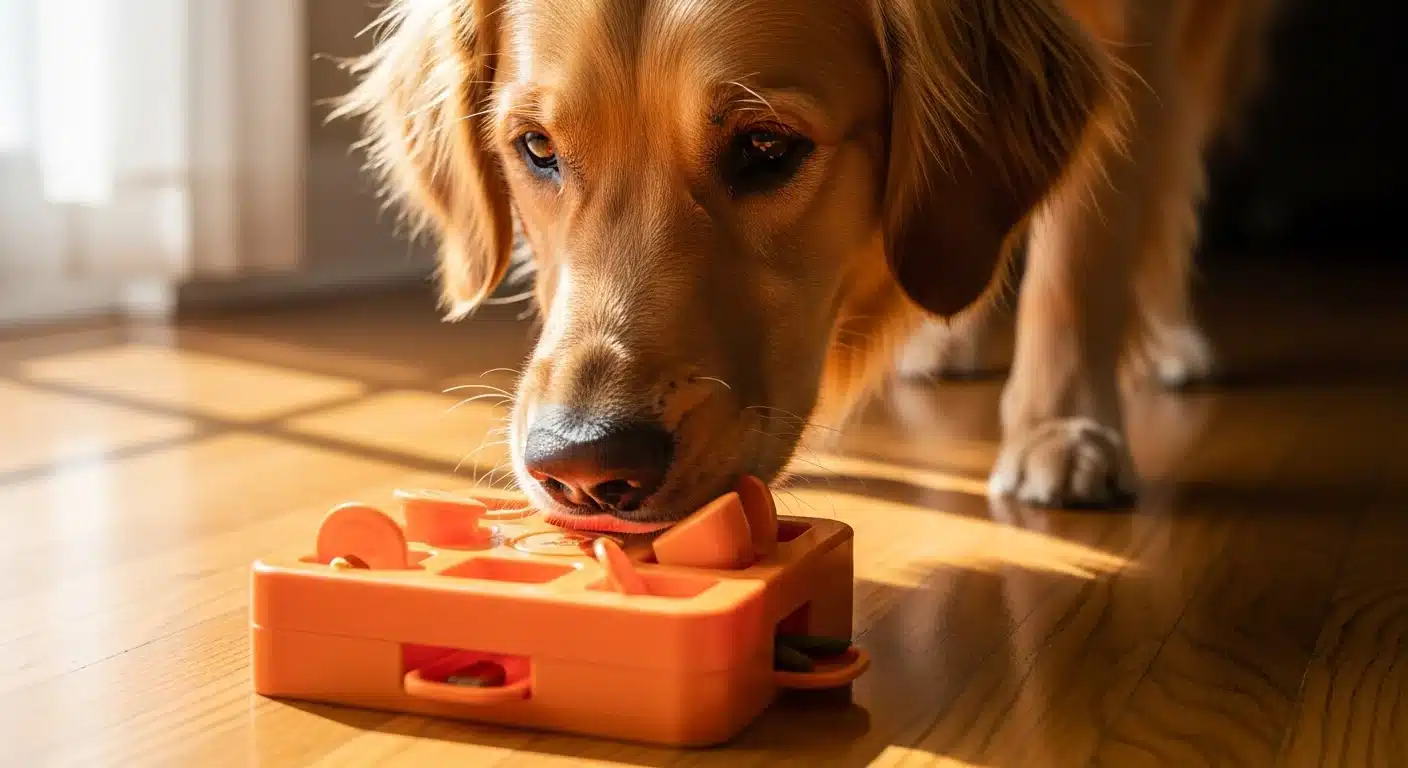
Mental Stimulation for Dogs: Why It Matters and How to Do It Right
A tired dog is a happy dog, but it takes more than a long walk to truly satisfy a dog’s mind.
Physical exercise burns energy, but mental stimulation is what truly settles a dog. A ten-minute scent session or a stuffed puzzle toy can calm a restless dog faster than an extra hour in the yard, because a tired brain is the real goal. This guide covers why mental enrichment matters, the clearest signs your dog needs more of it, the best types of brain-work activities, and how much you actually need to do each day.
Why Mental Stimulation Matters for Dogs
Dogs evolved as working animals. Herding, hunting, tracking, guarding, their brains were shaped by tasks that demanded problem-solving and decision-making every single day. Modern pet life removed those demands, but the cognitive hardware is still there, quietly looking for an outlet.
When a dog doesn’t get enough mental challenge, that energy redirects. It shows up as chewed furniture, compulsive barking, digging, or the 11 pm zoomies after a day spent mostly sleeping. These aren’t “bad dog” behaviors, they’re an intelligent animal self-medicating against boredom.
Research in applied animal behavior consistently shows that cognitive enrichment reduces stress cortisol levels in dogs, lowers reactivity, and improves overall welfare scores. A mentally-stimulated dog is calmer, more trainable, and easier to live with, not because you’ve worn them out, but because their brain has been genuinely engaged.
Signs Your Dog Is Under-Stimulated (Boredom Checklist)
Boredom in dogs rarely looks like a dog simply lying around doing nothing. Most under-stimulated dogs are actively bored, they’re doing something, just nothing you want them to do. Here are the most common signals:
| Sign | What it looks like | What it means |
|---|---|---|
| Destructive chewing | Shoes, furniture, door frames | Dog is looking for jaw-muscle and cognitive outlet |
| Excessive barking or howling | Barking at nothing, demand-barking at you | Self-stimulation; also attention-seeking |
| Digging | Backyard craters, carpet scratching | Natural foraging/den instinct with nowhere to go |
| Restlessness or pacing | Can’t settle, circles the room | Arousal with no discharge route |
| Attention-seeking | Pawing, nudging, dropping toys repeatedly | Dog is explicitly asking for engagement |
| Over-excitement on leash | Lunging, pulling, reactive to everything | Walk is the only stimulation all day, brain floods |
| Lethargy / shutdown | Sleeping 16+ hrs, disinterested in play or food | Depressive-like under-stimulation; vet check first |
The destructive behaviors are the ones owners notice most, but the shutdown pattern, a dog that sleeps all day and shows little interest in anything, is equally concerning and often missed. If your dog was once enthusiastic about toys and play and now isn’t, it’s worth both a vet check and a serious look at their daily enrichment routine.
How Much Mental Stimulation Does a Dog Need Per Day?
Most adult dogs benefit from 20 to 40 minutes of dedicated mental stimulation per day, ideally split across two or three short sessions rather than one long block. The exact amount depends on:
- Breed and working drive. Border Collies, Belgian Malinois, and Australian Shepherds were bred for sustained cognitive work and may need 45 to 60 minutes. Basset Hounds or Bulldogs, breeds selected for lower-key roles, often do fine with 15 to 20 minutes.
- Age. Puppies (under 12 months) tire quickly and can over-stimulate, keep sessions to 5 to 10 minutes several times a day. Senior dogs benefit enormously from gentle enrichment to maintain cognitive health, but watch for fatigue.
- Individual personality. Two dogs of the same breed can have very different appetites for mental challenge. Watch your dog’s signals: a dog that finishes a puzzle in 90 seconds and stares at you wants more; one who walks away mid-puzzle needs an easier level.
A practical starting framework for most adult dogs: a 10-minute food puzzle at breakfast, a 5 to 10 minute training session in the afternoon, and a scent-focused walk in the evening where sniffing is actively encouraged. That’s roughly 25 to 30 minutes spread across the day, achievable without rearranging your life.
Puzzle Toys and Cognitive Games
Puzzle toys are purpose-built enrichment tools that require a dog to manipulate levers, slide panels, or spin components to release hidden food. They’re the most portable, repeatable form of mental stimulation available, no training knowledge required, no outdoor space needed.
Choosing the right difficulty level
Puzzle toys generally come in three difficulty levels:
- Level 1 (Beginner): Simple compartments, wobble feeders, rubber stuffables. Good for puppies, seniors, or dogs new to puzzle toys.
- Level 2 (Intermediate): Multi-step sliders and spinners. Requires the dog to perform two or three actions in sequence.
- Level 3 (Advanced): Combination locks, layered compartments. Designed for breeds with high working drive or dogs that have mastered L2.
Start one level below where you think your dog belongs. Frustration with a too-hard puzzle shuts a dog down; success with an easy one builds the “puzzle mindset” that makes harder ones fun.
The KONG Extreme stuffable
For power chewers, the stuffable rubber toy is the foundation of any puzzle routine. The black KONG Extreme (Large or XL), stuff it with kibble or peanut butter and freeze it to turn chewing into a 20 to 40 minute enrichment puzzle; ~$15, cheap enough to own two and rotate one from the freezer.
Check price on Amazon →DIY food puzzles
No store-bought puzzle needed: a muffin tin with tennis balls covering each cup, a lick mat made from a silicone baking mat, or a snuffle mat made from fleece strips push through a rubber mat all work on the same principle, slow the food, make the dog work for it, engage the nose.
Nose Work and Scent Games
A dog’s nose is 10,000 to 100,000 times more sensitive than a human’s. Scent work taps directly into the cognitive hardware dogs used for tracking, hunting, and detection, it’s the most “natural” form of mental stimulation and also one of the most tiring.
You don’t need a professional nose-work class to start. Here are three at-home scent games that work for any dog:
- The Muffin Tin Game. Place kibble under some cups of a muffin tin, block them all with tennis balls, and let your dog sniff out which cups have food. Rotate the positions each round.
- Which Hand? Hold a small treat in one closed fist, offer both fists to your dog, and let them sniff to find it. When they correctly identify the hand with the treat (nose touch or paw), open it and reward. Simple, but it activates the olfactory system and demands decision-making.
- Hide the kibble. Scatter your dog’s meal across the backyard, in a snuffle mat, or through several rooms of the house. They forage and sniff their way through the entire meal, feeding time becomes enrichment time.
- Scent introductions. A cardboard box stuffed with crinkled paper and a hidden treat is a 30-second prep, and it can occupy a dog for 10 minutes. Add texture layers (fabric scraps, paper bags) to increase difficulty.
For dogs who love this, formal AKC Scent Work trials offer a structured progression through four odors (birch, anise, clove, cypress) and four elements (containers, interiors, exteriors, vehicles). It’s a sport that works for dogs of any size, age, or physical ability, including senior dogs who can no longer manage agility.
Training as Daily Enrichment
Training isn’t just obedience, it’s one of the richest forms of mental stimulation available to a dog because it combines social interaction, problem-solving, pattern recognition, and impulse control simultaneously. A dog who is “working” with their person is a dog whose brain is fully engaged.
You don’t need an hour session. Five minutes of deliberate training is more mentally tiring than thirty minutes of free play, because the dog is actively making decisions and receiving feedback on each one.
High-value training exercises for mental stimulation:
- Trick chains: Teaching your dog a sequence (sit → down → spin → shake) requires them to hold each step in working memory. A three-trick chain is measurably harder than three individual tricks.
- Name recognition games: Lay out five or six toys. Say the name of one specific toy and reward your dog when they retrieve the correct one. Dogs can learn dozens of object names, a Collie in a famous study learned 1,000+.
- Impulse control drills: “Leave it,” “wait,” and stay-with-distractions all demand sustained cognitive effort and are among the most mentally taxing exercises for a dog.
- Shaping: Clicker-based free shaping (rewarding any small movement toward a new behavior without luring) is exceptionally demanding, the dog has to experiment, self-evaluate, and iterate. Even 3 to 5 minutes leaves most dogs ready for a nap.
Environmental and Social Enrichment
Mental stimulation isn’t only about toys and training. The broader environment your dog experiences is also enrichment, novelty, sensory variety, and appropriate social contact all contribute to a well-stimulated brain.
Novelty and exploration
A different walking route, a new park, a pet-friendly store, or even a car ride to a new neighborhood provides a flood of new scent and sensory information that a familiar backyard simply can’t deliver. Vary your dog’s environment regularly, even small changes (a new object in the room, a cardboard box to explore) register as cognitive novelty.
Sniff walks
A standard “heel” walk is exercise but not much enrichment. A “sniff walk”, where the dog sets the pace and can stop to investigate every smell they want, is enrichment. Research shows dogs are more optimistic and less stressed after a sniff walk than after a structured walk of the same duration. Let the leash go slack and follow your dog’s nose.
Social enrichment
Well-managed playdates with dogs your dog genuinely likes, or supervised interaction with dog-friendly humans, provides social cognitive demands, reading body language, communicating, responding, that solo activities can’t replicate. For dogs who are selective or not dog-social, human interaction and training games can fill this role.
Building a Daily Enrichment Routine
The best enrichment schedule is one you’ll actually stick to. Here’s a simple rotating framework that hits all five enrichment categories across a week without requiring major time investment:
| Time of day | Activity | Type | Time |
|---|---|---|---|
| Morning | Food puzzle or scatter feed | Cognitive / food-based | 10 min |
| Mid-day (if home) | 5-min training session | Cognitive / social | 5 min |
| Evening walk | Sniff walk (let them lead) | Sensory / environmental | 20 to 30 min |
| Evening | Frozen KONG or chew | Food-based / oral | 20 to 40 min |
On busy days, compress to the two highest-impact items: a scatter feed or puzzle at breakfast and a frozen KONG in the evening. That’s roughly 30 minutes of enrichment, enough to make a real difference even on a tight schedule.
Rotate puzzle toys every few sessions so they don’t become predictable. Introduce new objects, scents (a towel from a friend’s dog, herbs from the garden), and occasionally try an entirely new activity type. Novelty is itself enrichment.
Mental stimulation for dogs: common questions answered
How much mental stimulation does a dog need each day?
Most adult dogs need 20 to 40 minutes of dedicated mental enrichment per day, split across two or three short sessions. High-drive working breeds (Border Collies, Malinois) may need closer to 45 to 60 minutes. Start with 15 to 20 minutes and add more if your dog is still showing boredom behaviors.
What are the signs that my dog isn’t getting enough mental stimulation?
The most common signs of under-stimulation are destructive chewing, excessive barking or howling, digging, restlessness or pacing, and persistent attention-seeking (pawing, nudging). Some dogs show the opposite, unusual lethargy and loss of interest in play or food, which can also signal insufficient enrichment (or an underlying health issue, worth a vet check).
Can mental stimulation replace physical exercise for dogs?
No, they address different needs. Physical exercise burns calories, maintains cardiovascular health, and conditions muscles and joints. Mental stimulation tires the brain, reduces stress, and satisfies cognitive and instinctual drives. A well-balanced dog gets both. That said, on days when outdoor exercise is limited (bad weather, recovery from injury), a loaded enrichment schedule can meaningfully offset some of the behavioral effects of less exercise.
What is the best mental stimulation toy for dogs?
There’s no single best toy, it depends on your dog’s drive level and chewing strength. For food-motivated dogs of any size, a stuffed rubber toy (like the KONG Extreme for power chewers) frozen with kibble or peanut butter is the single most versatile enrichment tool because it combines jaw exercise, problem-solving, and scent engagement. Puzzle sliders and snuffle mats are excellent complements that add variety.
Is scent work good for mentally stimulating dogs?
Scent work is one of the most effective forms of mental stimulation for dogs because it taps directly into their most powerful sense and mirrors the natural foraging and tracking behaviors their brains evolved for. Even simple at-home nose games, scattering kibble, the muffin-tin game, or hiding treats in a snuffle mat, are measurably more tiring per minute than most physical activities.
How do I start mental stimulation with my dog at home?
Start simple: replace one regular meal with a scatter feed (kibble spread across the yard or a snuffle mat), introduce a basic level-1 puzzle toy, or spend 5 minutes on a new training trick. These require no special equipment beyond what you already have. Once your dog is engaged with basic enrichment, you can layer in more complex puzzle toys, nose-work games, and structured training sessions.
Do puppies need mental stimulation?
Yes, but in shorter, gentler doses. Puppies under 12 months have developing brains and tire quickly; 5 to 10 minute sessions several times a day are better than one long block. Puppy puzzle toys at the easiest level, simple lick mats, and short positive-reinforcement training sessions (sit, name recall) are ideal starting points. Over-stimulation in puppies can cause overtiredness and frustration, so watch for signals that your pup is done.