 Dog Gear, Sized Right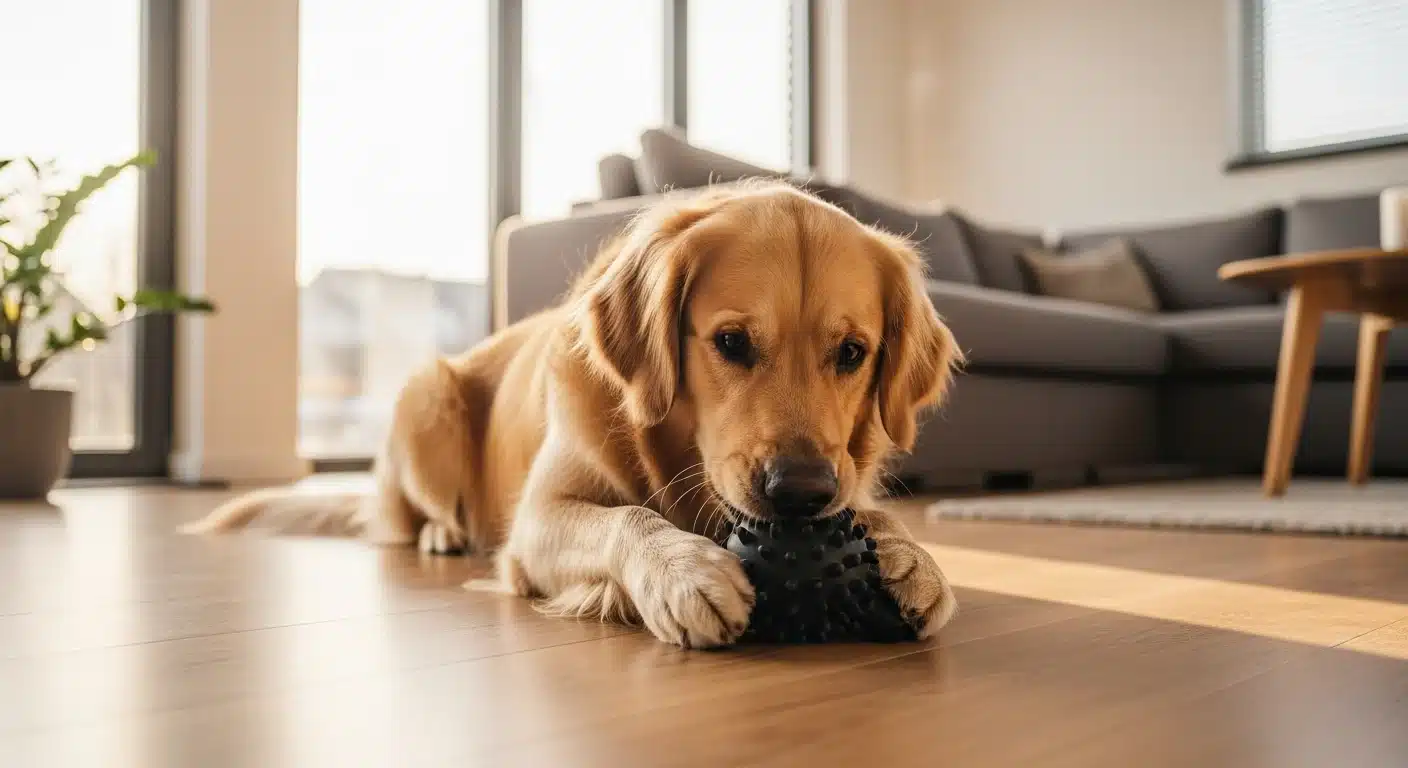
How to Keep a Dog Entertained: 18 Indoor Boredom Busters
Practical enrichment strategies that actually work, from stuffed KONGs to scent games, for every energy level.
A bored dog is a destructive dog, chewed shoes, counter-surfing, relentless barking. The fix isn’t just a bigger walk (though that helps). It’s structured enrichment: activities that tap into your dog’s instinct to sniff, chew, problem-solve, and forage. Here are 18 tactics that actually work indoors, calibrated by breed energy and age, including which ones hold up while you’re at work all day.
Why Dogs Get Bored, and Why It Matters
Dogs evolved as working animals. Even the floppiest couch-potato breed carries the genetic programming of a hunter, herder, or retriever. When that programming has nothing to engage with for eight hours a day, the brain doesn’t idle, it invents its own entertainment, usually at the expense of your furniture.
Research in the Journal of Veterinary Behavior links chronic under-stimulation to persistent anxiety, compulsive behaviors (paw licking, spinning), and reactive outbursts on leash. Enrichment isn’t a luxury, it’s basic welfare.
The good news: dogs aren’t demanding an Olympic training schedule. Studies suggest that 15 to 20 minutes of genuine mental stimulation, puzzle solving, scent work, can leave a dog as tired as an hour of fetch. The key word is “genuine”: rotation, novelty, and challenge matter more than sheer volume.
Signs Your Dog Is Understimulated
Before diagnosing your dog as “bad,” check this list. Dogs signal boredom loudly, you just need to know what to look for:
- Destructive chewing of non-toy items, baseboards, shoes, cushions
- Excessive barking or whining, especially when you leave or return
- Hyper greetings, launching off the ground when you walk in the door
- Counter-surfing or raiding the trash while you’re gone
- Pacing or restlessness, can’t settle even after a walk
- Persistent attention-seeking: nudging, pawing, dropping toys at your feet on repeat
- Over-grooming, licking paws or flanks obsessively
If two or more apply consistently, your dog needs a richer daily routine, not more obedience corrections.
Best Enrichment Toys for Indoor Dogs
The enrichment toy market is full of gimmicks. These categories actually hold up, with practical guidance on getting the most from each.
Stuffable Rubber Toys (the Gold Standard)
No stuffable toy has a longer track record than the KONG. Fill it with kibble, wet food, or peanut butter, then freeze it overnight to stretch a 5-minute sniff into a 20 to 40 minute chewing puzzle. The black KONG Extreme (Large or XL) is the only variant tough enough for power chewers, soft rubber KONGs shred in minutes for breeds like pit bulls, Rottweilers, or Labradors. Stuff it with kibble or peanut butter and freeze it to turn chewing into a 20 to 40 minute enrichment puzzle; around $15, cheap enough to own two and rotate one from the freezer.
Check price on Amazon →Pro tip: own two. One freezes while the other is being worked. A frozen KONG at 8 a.m. is the most reliable “busy at work” tool in the genre. See our picks for the best chew toys for strong chewing breeds if you need something even more indestructible.
Puzzle Feeders and Snuffle Mats
Puzzle feeders swap the bowl for a tray of sliding panels, pegs, or cups. Breakfast becomes a five-minute foraging session. Start with Level 1 (Nina Ottosson style) and step up as your dog solves faster. Snuffle mats hide kibble in fleece strands that mimic grass, triggering the natural scavenging instinct.
Lick Mats
Smear peanut butter, plain yogurt, or canned pumpkin into a rubber lick mat and freeze it. Licking is a natural calming behavior, it activates the parasympathetic nervous system and reduces stress hormones. Lick mats are especially effective for dogs with separation anxiety because the act creates a calm, positive association with alone time.
Long-Duration Chews
Bully sticks, tendons, and raw marrow bones give dogs a sustained outlet for the deeply hardwired chewing drive. Chewing releases endorphins. A quality bully stick can hold a medium-sized dog for 30 to 45 minutes. Always supervise the first use with a new chew type to assess risk for your dog’s size and chewing style.
DIY Enrichment Games You Can Set Up in 5 Minutes
You don’t need to spend money to create meaningful enrichment. These setups use items you already own:
- Muffin tin puzzle: Drop treats into a muffin tin and cover each cup with a tennis ball. Your dog sniffs out the treats and lifts the balls, perfect Level 1 puzzle.
- Towel roll: Lay a towel flat, scatter treats, roll it up tightly. Add knots to increase difficulty as your dog gets faster.
- Cardboard box sniff hunt: Stuff a box with crumpled newspaper and hide kibble throughout. The rustling texture adds sensory novelty.
- Shell game: Three plastic cups, one treat. Shuffle slowly at first, speed up over time. Dogs get surprisingly skilled at this.
- Scatter feeding: Toss the entire meal portion across the lawn or carpet. Sniffing and foraging for each piece can take 15+ minutes.
- Indoor hide and seek: Ask for a sit-stay, hide behind a door, call your dog’s name. Escalate to hiding treats first, then yourself.
- Frozen broth block: Freeze low-sodium broth, kibble, or blueberries in a bowl of water. A frozen lick block takes 20 to 30 minutes to work through, zero cost.
The Toy Rotation Method: More Novelty, Zero New Spending
A toy left on the floor 24/7 becomes invisible to a dog within 48 hours. Toy rotation is the simplest, free trick in enrichment: divide toys into three groups, cycle one group out every 3 to 5 days, keep the others in a closed box or closet.
When the “new” group comes back out, your dog’s reaction mirrors finding brand-new toys, because to them, they effectively are. The result: sustained engagement from ten toys instead of forty.
| Group A (Days 1 to 5 out) | Group B (Days 6 to 10 out) | Group C (Days 11 to 15 out) |
|---|---|---|
| KONG + plush toy | Snuffle mat + rope tug | Puzzle feeder + fleece tug |
| Squeaky ball | Lick mat | Crinkle toy + chew ring |
The only item that stays out permanently: a durable chew (bully stick or chew bone), because chewing is a daily biological need, not a novelty activity. Our guide to durable chew toys covers what to stock for every chew intensity level.
Scent Work: the Most Tiring Enrichment Per Minute
A dog’s nose processes smells roughly 10,000× more efficiently than a human’s. Scent work, asking your dog to use their nose to locate a target, is arguably the most tiring enrichment per minute, because it engages the entire olfactory cortex.
You don’t need a formal nose-work class to start:
- Hide-and-seek with treats: Hide kibble in 5 spots around a room, say “find it,” let the dog work. Progress to trickier spots daily.
- Scent trails: Drag a treat across the floor in a winding path. Your dog follows the trail with their nose rather than eyes.
- Specific scent targeting: Dab a drop of anise oil on a small tin with holes. Hide it. Reward the find. This mirrors AKC Scent Work trials.
- Sniff walks: Let your dog lead and sniff freely for 10 minutes. A “sniffari” is more tiring than the same distance walked at heel.
Research published in Applied Animal Behaviour Science found 20 minutes of nose-work made dogs measurably more optimistic (lower pessimistic bias) than 20 minutes of physical exercise. For anxious or reactive dogs, scent work is often the first tool recommended by behaviorists.
How to Keep a Dog Entertained While You’re at Work
An 8-hour workday is a long time for a dog. Here’s a tested morning-to-evening framework that reduces anxiety and prevents destructive behavior while you’re gone:
- 20-minute pre-work walk or training session. A mentally tired dog settles faster. Even 10 minutes of obedience work (sits, downs, recall) tires a dog more than a casual stroll.
- Frozen KONG at departure. Hand it over as you leave, this creates a positive association with your exit and keeps the dog occupied during the most anxious window (the first 20 to 30 minutes after you go).
- Midday enrichment via a pet sitter or dog walker. A snuffle mat or lick mat dropped in around noon breaks up the day dramatically. This is the biggest unlock for dogs showing stress symptoms.
- A safe, accessible chew item. A bully stick or appropriate chew bone left in a safe zone provides passive enrichment throughout the day.
- Background sound. A radio, TV (DogTV if available), or calming playlist running reduces the anxiety of total silence. Studies show classical music reduces cortisol in shelter dogs; the same principle applies at home.
- A window view. Position a dog bed near a window overlooking the yard or street. Watching squirrels, birds, and passing cars provides hours of passive stimulation at zero cost.
Energy by Breed and Age: Calibrate the Right Dose
Not every dog needs the same enrichment volume. Over-stimulating a low-energy dog creates hyperarousal; under-stimulating a working breed creates destruction. Use this framework as a starting point:
| Category | Daily Enrichment Target | Best Formats |
|---|---|---|
| High-energy working/sporting breeds (Border Collie, Husky, Vizsla, Springer Spaniel) | 90 to 120 min spread across the day | Puzzle feeders, scent work, training games, long-duration frozen KONGs |
| Medium-energy breeds (Labrador, Golden Retriever, Pit Bull, Boxer) | 45 to 75 min spread across the day | KONG rotation, lick mats, toy rotation, DIY sniff games |
| Lower-energy breeds (Basset Hound, Shih Tzu, Bulldog, Pug) | 20 to 40 min across the day | Scatter feeding, snuffle mats, short training sessions |
| Puppies (under 12 months) | Short, frequent bursts: 5 to 10 min × 4 to 6 sessions | Soft puzzles, scatter feeding, socialization novelty |
| Senior dogs (8+ years) | 20 to 30 min, gentle | Lick mats, slow feeder bowls, mild scent games, avoid high-impact |
Breed energy is a starting point, not a fixed rule. A senior Border Collie may need less than a young Basset Hound. Watch your dog after each session: a satisfied dog settles; an over-aroused dog escalates into nipping or zoomies.
A Daily Enrichment Routine That Actually Sticks
Ad-hoc enrichment is better than nothing, but a predictable routine reduces anxiety because dogs know what’s coming. Here’s a simple template for an adult, medium-energy dog:
| Time | Activity | Duration |
|---|---|---|
| 7:00 AM | Walk + 5 min training (sit, down, recall, tricks) | 20 to 30 min |
| 8:00 AM (leave) | Frozen KONG, handed over at departure | 20 to 40 min |
| 12:00 PM | Midday: scatter feeding or snuffle mat (pet sitter visit) | 10 to 15 min |
| 5:30 PM | Evening walk + “find it” scent game in yard | 25 to 35 min |
| 8:00 PM | Chew time (bully stick or lick mat) while you relax | 20 to 30 min |
Total: roughly 95 to 130 minutes of enrichment spread across the day, enough for a medium-energy adult dog. Adjust up for working breeds, down for seniors or low-energy dogs.
You don’t have to nail every slot every day. Consistent morning and evening routines alone make a meaningful difference. The midday session is the biggest unlock, if you can’t do it daily, even two or three times a week reduces stress symptoms noticeably.
Frequently Asked Questions About Dog Enrichment
How long can I leave my dog alone without enrichment?
Most adult dogs manage 4 to 6 hours without major distress, but 8+ hours with zero enrichment is too long for most breeds. A frozen KONG at departure and a midday pet sitter or dog walker significantly reduce stress for dogs left all day.
What’s the best toy to keep a dog busy while at work?
A frozen stuffed KONG is the single most effective “buy me time” toy. Fill with peanut butter or wet food, freeze overnight, hand it at departure. A medium dog will work a frozen KONG for 20 to 40 minutes. Own two so one is always ready.
How do I know if my dog is bored?
Key signs: destructive chewing of non-toy items, excessive barking or whining, hyper greetings when you return, counter-surfing, pacing when calm, and persistent attention-seeking. If two or more apply consistently, your dog needs more enrichment, not more corrections.
Can you over-stimulate a dog with too many toys?
Yes, especially high-arousal toys (squeaky, tug) used back-to-back without a calm break. Over-arousal leads to poor impulse control, nipping, and difficulty settling. Alternate active enrichment (puzzles, play) with passive enrichment (chewing, lick mats) to keep the nervous system balanced.
What DIY enrichment can I make at home?
Top options: muffin tin puzzle (treats under tennis balls), towel roll with treats, frozen broth block, scatter feeding across the lawn, and cardboard box sniff hunt. All are free and set up in under two minutes.
Do older dogs need as much enrichment as puppies?
Senior dogs (8+ years) still need daily enrichment but shorter and gentler, target 20 to 30 minutes per day via lick mats, scatter feeding, and mild scent games rather than the 60 to 90 minutes a young dog needs. Cognitive enrichment is especially important for seniors to slow mental decline.
Is a KONG good for anxious dogs?
Yes. A frozen KONG is one of the most widely recommended tools for separation anxiety. Handing it over at departure creates a positive association with alone time, and the licking/chewing action releases endorphins that promote calm. For severe separation anxiety, pair it with a certified behavior consultant’s protocol rather than relying on it alone.