 Dog Gear, Sized Right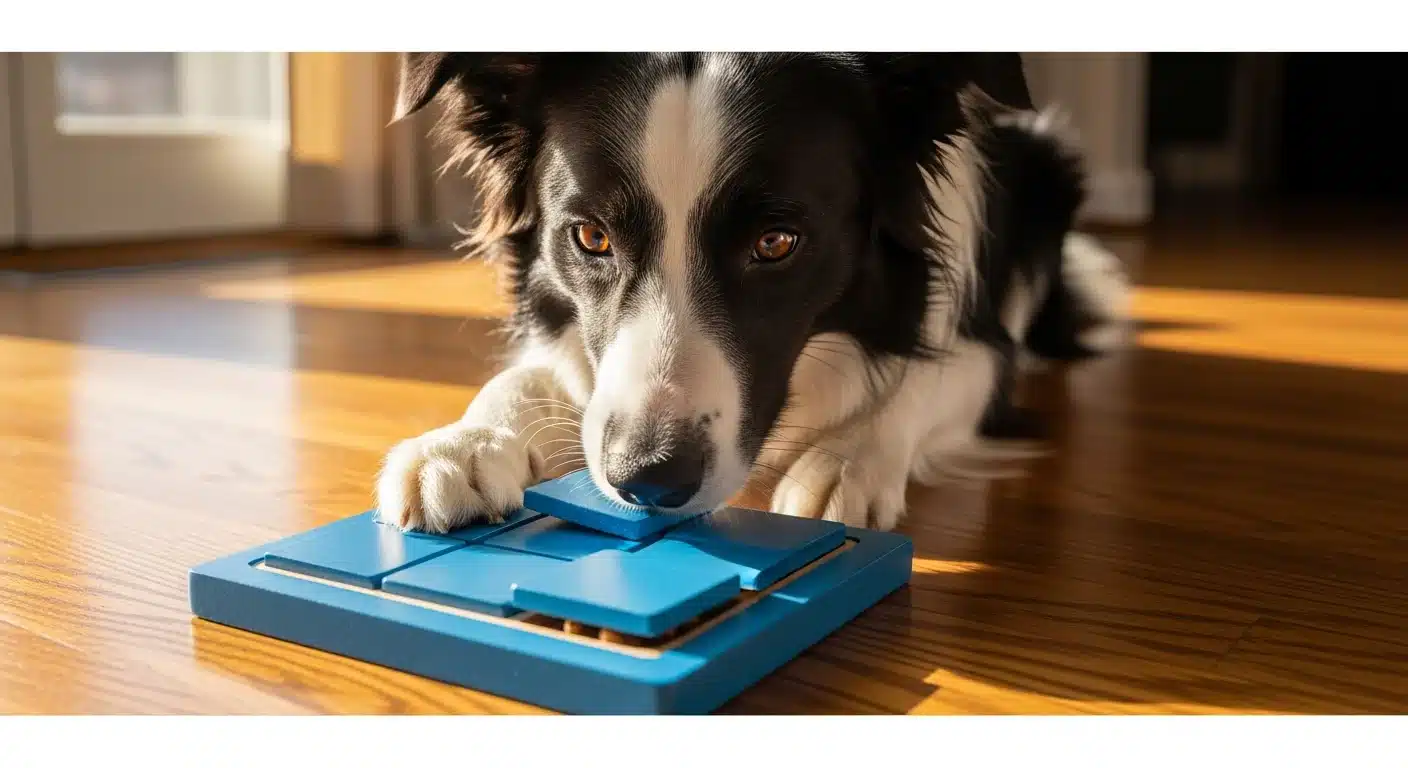
Are Puzzle Toys Good for Dogs? Here’s the Complete Answer
Short answer: yes, but difficulty level and chewer type matter more than most guides admit.
If you’ve seen the videos, a dog methodically sliding panels, flipping lids, and nosing out hidden kibble, you already know puzzle toys look satisfying to watch. But are they actually good for dogs, or just a trend? The answer is a clear yes, backed by neuroscience: puzzle toys activate the brain’s reward circuitry, reduce stress hormones, and channel prey-drive energy into something constructive. The catch is that the wrong difficulty level, wrong toy type, or wrong supervision approach can flip the experience from enrichment to frustration. This guide covers every angle, benefits, how to progress through difficulty levels, supervision rules, choosing by chewer type, and the specific situations where puzzle toys backfire.
What Counts as a Dog Puzzle Toy?
The term gets used loosely, so let’s define it clearly. A dog puzzle toy is any enrichment device that requires the dog to perform one or more problem-solving steps to access a food reward. That encompasses a wide range of formats:
- Stuffable rubber toys (e.g. KONG): The dog licks, chews, and manipulates the toy to extract filling, especially when frozen. The effort scales with how tightly it’s packed and how solid the fill is.
- Sliding-panel puzzles: The dog must push, slide, or flip covers with its nose or paw to reveal hidden treat compartments. These are the classic Nina Ottosson-style boards.
- Snuffle mats: Fabric mats with rubber or felt strips that hide dry kibble, the dog uses its nose to forage through the fibres. Lower cognitive demand, but excellent olfactory enrichment.
- Treat-dispensing rollers and balls: The dog rolls or bats the toy until treats fall out of a hole. Good motion stimulus; modest problem-solving demand.
- Multi-step combination puzzles: Advanced boards requiring a sequence of actions, slide a tile, then lift a lid, then rotate a peg, before food is released. Highest cognitive demand.
All of these deliver some form of enrichment, but they vary significantly in the type and intensity of mental work involved. Understanding the format helps you match the right toy to your dog’s breed drive and chewer profile.
The Science-Backed Benefits of Puzzle Toys
The benefits of puzzle toys aren’t marketing copy, there’s solid neurobehavioural evidence behind them.
Dopamine and the seeking circuit
Dogs (like humans) have a seeking system, a dopamine-driven neural circuit that produces pleasure and motivation during active foraging. When a dog is sniffing, searching, and problem-solving for food, dopamine is being released continuously. This is why puzzle play is inherently satisfying even before the treat is found: the process is rewarding, not just the outcome. Scatter feeding, snuffle mats, and step-solve puzzles all tap into this circuit.
Cortisol reduction and anxiety relief
Studies measuring salivary cortisol in dogs show that structured enrichment activities, including food puzzles, reduce stress hormone levels. For dogs with mild separation anxiety, giving a frozen stuffed toy at departure time reliably occupies the dog during the most anxious window (the first 20 to 30 minutes after you leave) and can meaningfully reduce anxiety-related vocalisation and destructive behaviour.
Confidence building
Dogs that successfully complete puzzle challenges, especially shy or under-socialised dogs, show increased confidence and willingness to engage with novel objects. The successful completion of a challenge builds what trainers call optimism: the dog’s general expectation that engagement with its environment will produce good outcomes. That optimism transfer beyond puzzle play into everyday life.
Reduced destructive behaviour
Destructive chewing, excessive barking, and digging are almost always symptoms of under-stimulated dogs. Puzzle play doesn’t replace physical exercise, but it adds a qualitatively different kind of tiredness, cognitive fatigue, that physical exercise alone doesn’t produce. A dog that has worked through a challenging puzzle for 20 minutes is genuinely mentally tired, not just physically restrained.
Cognitive health across a dog’s lifespan
Emerging research on canine cognitive dysfunction (the dog equivalent of dementia) suggests that mental enrichment throughout a dog’s life may support cognitive resilience as they age. While puzzle toys alone are no guarantee against cognitive decline, they’re part of the broader picture of an enriched, active brain.
Difficulty Levels Explained: Beginner to Expert
The Nina Ottosson difficulty scale, the de-facto industry standard, runs from Level 1 (beginner) to Level 4 (expert). Most good puzzle brands follow a comparable progression.
| Level | What the Dog Must Do | Good For | Signs They’re Ready to Progress |
|---|---|---|---|
| Level 1. Beginner | Single-step discover: lift a cover, flip a flap, tip a cup | All dogs starting out, puppies, seniors, anxious dogs building confidence | Solves it within 30 to 60 seconds without help after 2 to 3 sessions |
| Level 2. Intermediate | Two-step sequence or multiple compartments: slide AND flip; varied cover types | Dogs that have mastered Level 1 consistently | Solves it within 1 to 2 minutes; shows methodical searching rather than random pawing |
| Level 3. Advanced | Multi-step sequences, some compartments blocked by others; requires planning not trial-and-error | Confident solvers with strong food motivation; herding and working breeds | Solves it within 3 to 5 minutes; never gives up or self-rewires into “chew the toy” mode |
| Level 4. Expert | Complex multi-lock sequences; rotating wheels + sliding tiles + lifting covers in order | High-drive working dogs (Border Collies, Belgian Malinois, Poodles) that have completed Level 3 | Sustained engagement without frustration; actively re-attempts when blocked |
The golden rule: always start at Level 1
Even highly intelligent dogs benefit from beginning at Level 1. The first session isn’t about testing intelligence, it’s about establishing the puzzle habit: teaching the dog that this object is interactive, that persistence pays off, and that this isn’t a chew toy. Skipping straight to Level 3 with a smart dog often produces frustration, not success, because the dog hasn’t learned the solve-then-reward feedback loop yet.
How to know when to progress
The benchmark is consistency, not speed. A dog is ready for the next level when it solves the current puzzle in under 60 seconds, across three sessions in a row, without hints or help from you. If you’re still having to point or hint, the dog hasn’t internalized the solution yet, wait another week before stepping up.
The Classic Stuffable Puzzle: Why the KONG Extreme Earns Its Place
Before the sliding-panel puzzle boom, stuffable rubber toys dominated dog enrichment, and for power chewers and strong-jawed breeds, they still reign supreme. The reason is simple: silicone and ABS plastic puzzle boards break under a determined chewer’s jaw; the right rubber doesn’t.
For dogs that chew hard. Labs, Pit Bulls, Cane Corsos, Rottweilers, Belgian Malinois, the black KONG Extreme (Large or XL) is the puzzle toy that survives repeated use. Stuff it with kibble or peanut butter and freeze it to turn chewing into a 20 to 40 minute enrichment puzzle; at around $15, it’s cheap enough to own two and rotate one from the freezer while the other is being worked.
The puzzle mechanic of a KONG differs from a board puzzle, it’s about persistence and paw-jaw coordination to extract filling, but the enrichment effect is equivalent. The dog must actively work to earn the reward, and the frozen fill dramatically slows the extraction, extending the cognitive engagement window.
The black KONG Extreme is formulated from a tougher rubber compound than the classic red KONG, specifically designed for dogs rated as power chewers. For a large or giant breed, always choose Large or XL; a too-small KONG is a swallowing risk.
Choosing a Puzzle Toy by Chewer Type
The single most common mistake is choosing a puzzle toy based on intelligence level alone. Material durability needs to match chewer strength first, a brilliant problem-solver who can destroy a puzzle in two minutes gets zero enrichment and a potential swallowing hazard.
Gentle Nibblers (small breeds, soft-mouthed dogs)
These dogs can use the full range of puzzle materials, plastic, bamboo, silicone, ABS. They’re less likely to chew through or break compartments, so classic board puzzles work well. Focus on matching the intellectual difficulty to the breed’s drive level: a Maltese may be perfectly happy at Level 1 to 2 long-term, while a miniature Poodle or Jack Russell often needs Level 3.
Moderate Chewers (medium breeds, average jaw strength)
Board puzzles in ABS plastic handle most moderate chewers. Watch for signs of chewing the board corners, this is a signal that the puzzle is too easy and the dog is redirecting frustrated energy into chewing. Move up a difficulty level before the toy gets destroyed. Treat-dispensing rubber balls (like the Kong Classic red) are excellent supplements.
Power Chewers (heavy-jawed large breeds, terriers, bully breeds)
This is the group where material choice is critical. For power chewers:
- Natural rubber stuffables (black KONG Extreme, West Paw Toppl), designed for durability; no sharp fragments if cracked
- Zogoflex/TPR compounds, flexible, non-toxic even if small amounts are ingested, tested for aggresive chewers
- Snuffle mats, the rubber backing and fabric strips are low-destruction-risk for most power chewers; check for loose strips that could be torn off
- Avoid: thin plastic board puzzles, hollow plastic balls, toys with small sliding pegs, all break under serious jaw pressure and produce sharp shards
For power chewers who love the mental challenge of a board puzzle, supervised board sessions at Level 2 to 3 (watching that the dog doesn’t start gnawing corners) can work, but the primary enrichment toy for independent use should be a stuffable rubber toy.
Senior dogs and puppies
Seniors often benefit from easier puzzles (Level 1) regardless of their prior experience, cognitive engagement is the goal, not challenge. Puppies under 6 months should stick to Level 1 only, with 5 to 10 minute sessions maximum. A puppy’s jaw strength isn’t reliable yet and overly complicated puzzles produce frustration before they’re developmentally ready.
Supervision and Safety: The Rules That Matter
Puzzle toys are designed to be semi-independent enrichment, but “semi-independent” doesn’t mean unsupervised from day one. Here are the non-negotiable safety rules:
- Always supervise the first 3 to 5 sessions with any new toy. This lets you observe whether the dog treats it as a puzzle (good) or a chew toy (problem), whether frustration builds, and whether the dog can extract parts it shouldn’t be able to.
- Check puzzles before every use for damage. Cracked compartments, chewed pegs, and bent sliders can produce fragments. A puzzle toy that has been chewed on is a puzzle toy that has failed at its job, replace it.
- Size up, not down. A puzzle toy that fits in the dog’s mouth as a single object is too small. All components, especially treat-dispensing balls and stuffable toys, should be too large to be mouthed whole.
- Remove rubber or silicone pieces that detach. Some puzzle toys have small rubber bumpers or gaskets that can pop off. These are not digestible and should be removed from the toy or the toy replaced.
- Limit puzzle sessions to 20 to 30 minutes. Beyond that, cognitive fatigue turns to frustration. Most dogs get the full benefit in 10 to 20 minutes of genuine engagement.
- Never use a puzzle toy as a meal substitute without vet sign-off. Feeding all meals through a puzzle (a practice called “contrafreeloading”) is enriching in principle, but track whether the dog is actually consuming full rations, some dogs undereat when feeding becomes too laborious.
When Puzzle Toys Backfire
Puzzle toys aren’t a universal fix, and several specific scenarios turn a well-intentioned enrichment tool into a problem.
Frustration: the puzzle is too hard
The most common backfire. Signs that a puzzle is beyond the dog’s current level:
- Pawing rapidly and randomly without any strategic pattern
- Vocalising (whining, barking at the toy)
- Giving up within 1 to 2 minutes and walking away
- Redirecting to chewing the toy frame or board
If you see these signs, don’t help, step back a difficulty level. Helping a frustrated dog solve a puzzle reinforces that vocalising or pawing you gets the treat. Instead, swap in an easier toy that the dog can succeed with independently.
Resource guarding
Dogs with food-guarding tendencies may guard a puzzle toy the way they guard a bowl or high-value chew. Symptoms: stiffening when approached, low growl, hovering over the toy, or snapping if you try to remove it. If your dog already guards resources, consult a professional trainer before introducing puzzle toys, an unsupervised puzzle can reinforce guarding patterns. In multi-dog homes, puzzle toys should always be given in separate spaces, one dog per toy, with visual separation if needed.
The “chew the puzzle” problem
Some dogs, particularly power chewers and dogs new to puzzle toys, don’t engage with the solve mechanism and instead just chew the toy itself. This is sometimes boredom (puzzle is too easy), sometimes wrong material match, and sometimes simply that the dog hasn’t been taught that this object is interactive. Solution: start with a stuffable toy where the reward extraction is unmistakably mechanical (the dog has to push its tongue in to get food), rather than a board puzzle where chewing also eventually releases food.
Calorie creep
Puzzle toys are typically used with high-value treats (peanut butter, cheese, wet food) to maintain motivation. If you’re using puzzle toys daily, account for those calories in your dog’s overall daily intake, deduct from the main meal. Obesity is the most common preventable health problem in dogs, and an enrichment habit that adds 200 calories per day will undermine a dog’s long-term health.
Over-reliance and inability to settle
A minority of highly-strung dogs use puzzle toys to stay aroused rather than decompress. If your dog immediately demands the puzzle again the moment it finishes, becomes more restless (not calmer) after a session, or can’t settle until given another puzzle, reconsider the role puzzle play has taken in the routine. Enrichment should produce a calm, satisfied dog, not a dog demanding the next hit.
How Much Puzzle Time Does Your Dog Actually Need?
There’s no universal number, but here are the guidelines that hold up across most dogs and most contexts:
- Session length: 10 to 20 minutes of genuine engagement is optimal. Beyond 30 minutes, returns diminish and frustration risk rises.
- Frequency: Once or twice daily is the typical sweet spot. For high-drive working breeds (Border Collies, Malinois, Huskies), you may need two or three enrichment sessions per day to meet their mental exercise floor. For companion breeds, once daily is usually sufficient.
- Toy rotation: Dogs habituate to a puzzle once they have a solved strategy. Rotate between 2 to 4 different puzzles to maintain the novelty effect. Swap puzzles every 3 to 5 days for high-drive dogs; weekly for moderate-drive dogs.
- Don’t replace exercise: Puzzle toys are enrichment, not exercise. A 20-minute puzzle session does not substitute for a 45-minute walk. For most dogs, the ideal routine is physical exercise first, then enrichment, a tired body and an engaged brain is the combination that produces a genuinely contented dog.
The easiest practical framework: use one puzzle session per day as a scheduled enrichment habit, ideally at a time when you’d otherwise be occupied (working from home, eating dinner, on a call). The dog gets mental stimulation; you get 20 minutes of quiet. Everybody wins.
Puzzle toy questions, answered
Are puzzle toys actually good for dogs?
Yes, when matched to the right difficulty and chewer type. Puzzle toys activate the brain’s dopamine-driven seeking circuit, reduce cortisol (stress hormone), build confidence, and channel boredom-driven energy into constructive problem-solving. The key is starting at the right difficulty level (always Level 1 first) and matching the toy material to the dog’s jaw strength. The wrong difficulty or wrong material turns enrichment into frustration.
How do I know which difficulty level to start with?
Always start at Level 1 regardless of your dog’s breed or intelligence. The first session establishes the puzzle habit, the dog learns that this object is interactive and that persistence releases food. Move to Level 2 when your dog consistently solves the Level 1 puzzle in under 60 seconds across three sessions in a row, without hints from you. Progress through levels the same way.
Are puzzle toys safe for dogs to use unsupervised?
After 3 to 5 supervised sessions with a new toy, most dogs can use a well-matched puzzle toy independently for 15 to 20 minutes. The caveat is material durability: board puzzles and thin plastic toys should always be used with light supervision for power chewers, as they can crack and produce sharp fragments. Stuffable rubber toys (like the KONG Extreme) are the safest unsupervised option for dogs that chew hard.
Can puzzle toys make a dog more anxious rather than calmer?
They can, in specific situations. If the puzzle is too difficult, it produces frustration rather than calm. If the dog has a high-arousal personality and treats puzzle sessions as stimulation rather than decompression, sessions can raise rather than lower arousal. Watch whether your dog is calmer and more settled after a puzzle session, if they’re more demanding or restless, the puzzle is serving an arousal function rather than an enrichment one, and the approach needs adjusting.
Should I use treats or kibble in a puzzle toy?
Both work, the choice affects motivation and calorie management. High-value treats (peanut butter, cheese, wet food) maintain stronger motivation for harder puzzles, but add calories. Using part of the dog’s regular kibble ration in a puzzle is the simplest sustainable approach for daily use, no extra calories, but the dog still gets the enrichment benefit. For very hard puzzles or a dog new to puzzles, step up to higher-value food to maintain engagement.
Are puzzle toys good for senior dogs?
Yes, and there’s a specific reason to prioritise them for older dogs. Cognitive stimulation throughout a dog’s life appears to support cognitive resilience as they age, and may slow the progression of canine cognitive dysfunction. For seniors, keep puzzles at a gentle Level 1 to 2 difficulty (no frustration) and use easy-to-extract fillings. The goal is light mental engagement, not challenge, 10 to 15 minutes is plenty.
How many puzzle sessions per day does a dog need?
For most dogs, one 10 to 20 minute puzzle session per day is sufficient. High-drive working breeds (Border Collies, Malinois, Huskies, working Labradors) often benefit from two or three sessions daily. Rotate between 2 to 4 different puzzles to prevent habituation. Puzzle sessions supplement physical exercise, they don’t replace it. The ideal routine is physical exercise first, then a puzzle session.