 Dog Gear, Sized Right
Do Dogs Really Need a Bed?
The honest answer: most dogs genuinely benefit from one, but it’s not magic, and some dogs will happily ignore the one you bought them.
Do dogs need a bed? Technically, no, plenty of dogs live full, happy lives sleeping on a kitchen tile or the corner of the sofa. But “doesn’t need one” and “wouldn’t benefit from one” are very different things. For most dogs, especially large breeds, seniors, arthritic dogs, thin-coated breeds, and puppies, a good bed offers real, measurable benefits: joint pressure relief, insulation from cold hard floors, a defined safe space that reduces anxiety, and better sleep quality overall. The nuance is that a bed only helps if the dog actually uses it, and some dogs genuinely prefer the cool floor in summer. This guide covers who needs a bed most, what the real benefits are (not marketing copy), the dogs that might reasonably skip it, and how to choose one your dog will actually lie on.
Our top pick for dogs that need joint support
This is an informational guide, not a roundup, but one product genuinely stands out for the dogs who benefit most from a bed. In-stock verified; tap through for the live price.
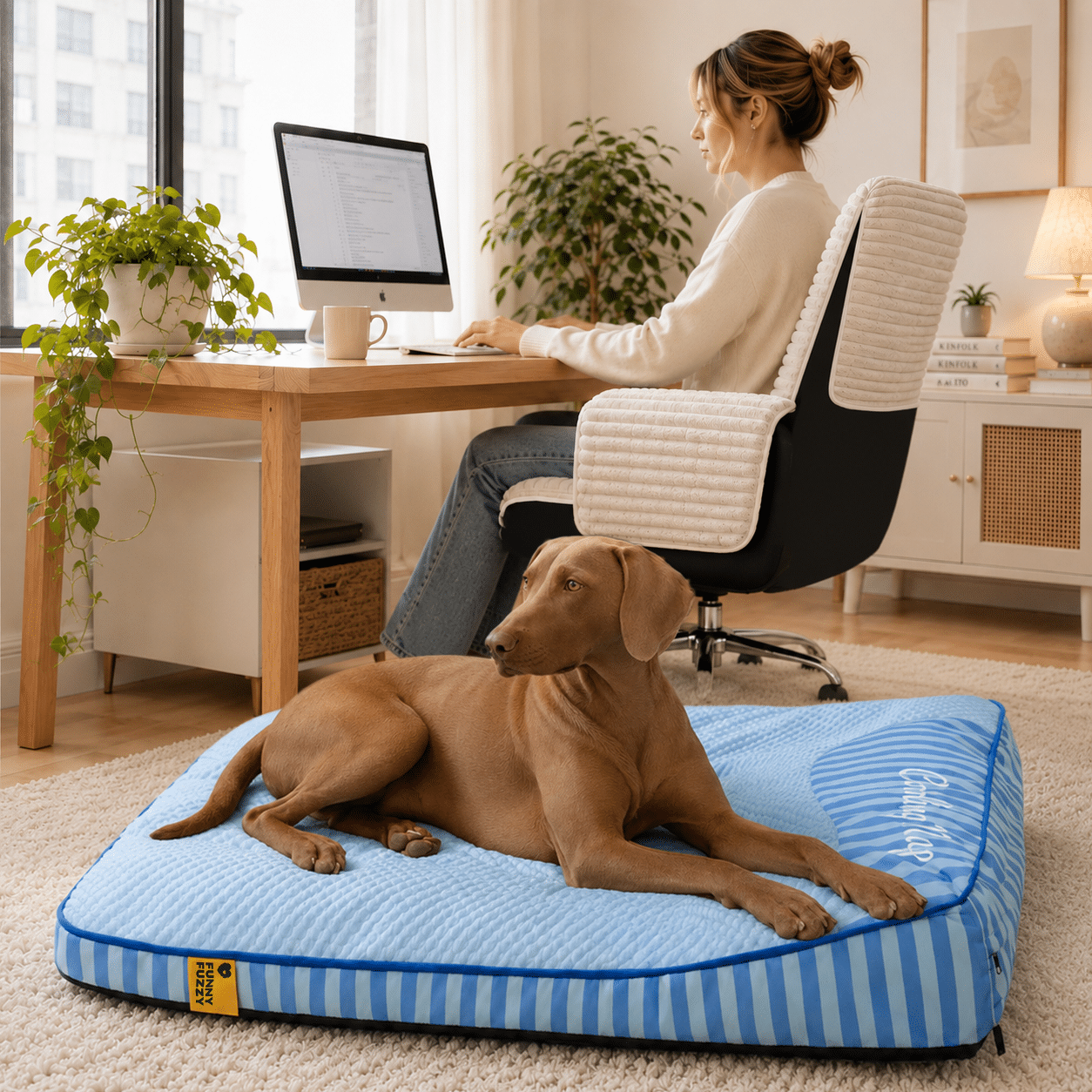
FunnyFuzzy Orthopedic Dog Bed
If you’re going to commit to a dog bed, and for most dogs you should, this is the one to start with. The high-density orthopedic foam holds its shape under large-dog weight, the raised bolster gives anxious or neck-resting dogs a place to settle, and the washable waterproof-backed cover means you can actually keep it clean. It’s the kind of bed that earns the real estate in your living room.
What we like
- High-density orthopedic foam holds up under large-breed weight without bottoming out
- Raised bolster sides give dogs a head rest and a sense of enclosed security
- Removable, machine-washable cover with waterproof backing, actually stays clean
- Available in sizes large enough for genuine large dogs, not just labeled ‘large’
The catches
- Bolster design isn’t ideal for dogs that stretch out flat to sleep
- Higher price point than basic flat mats, though the foam lasts considerably longer
- Some large dogs take a week or two to adopt any new bed, especially if unfamiliar with one
The honest answer: most dogs benefit, but it’s not mandatory
Wild canids sleep on bare ground, dens, leaves, dirt. Your dog’s ancestors didn’t have orthopedic foam. So strictly speaking, dogs don’t need a bed the way they need food, water, and exercise. If your dog sleeps happily on your sofa, your bed, or a warm carpeted floor and shows no signs of stiffness, calluses, or anxiety, they’re probably fine without a dedicated dog bed.
That said, “not strictly necessary” undersells how much a good bed actually helps most dogs. The floor is hard, often cold, and provides no pressure relief for hip joints, elbows, or shoulders, the exact spots that wear down first in large breeds and older dogs. A quality bed isn’t a luxury for most dogs, it’s the difference between eight hours of restorative sleep and eight hours of body weight grinding against tile or hardwood.
The honest position: most dogs benefit from a bed, large and senior dogs benefit considerably, and dogs with joint issues or anxiety benefit a lot. Whether yours needs one depends on their age, size, coat, where they currently sleep, and how they move when they get up in the morning.
Who needs a dog bed most
Not all dogs are equally at risk from sleeping on a bare floor. These are the dogs for whom a bed genuinely matters:
| Dog type | Why a bed matters | What to prioritize |
|---|---|---|
| Large and giant breeds | Body weight concentrates on elbow, hip, and shoulder contact points, a hard floor amplifies joint stress over years | High-density orthopedic foam, large enough to fit fully |
| Senior dogs (7+ years) | Arthritis and joint degeneration are common; getting up off a hard floor becomes painful and does real damage | Orthopedic or memory-foam base, low entry lip, non-slip bottom |
| Dogs with arthritis or hip dysplasia | Pressure relief directly reduces pain and inflammation during long rest periods; vet-recommended for management | Certified orthopedic foam, bolster for head support |
| Thin-coated breeds | Greyhounds, Dobermans, Boxers, Whippets, little insulation from cold floors; chilling disrupts sleep and stresses joints | Foam + plush topper for warmth |
| Puppies | Learning to settle in one place builds good sleep habits and reduces anxiety; starts the “this is your spot” association early | Washable cover (accidents happen), moderate cushioning |
| Anxious dogs | A consistent, defined space acts as a den substitute, a retreat point the dog can go to when overwhelmed | Bolster or donut style for enclosed feeling, familiar scent |
If your dog falls into more than one of these categories, a large senior Doberman, for example, a bed isn’t optional. It’s basic maintenance for their quality of life.
The real benefits of a dog bed (not just comfort)
The marketing version of this section would say “dogs sleep better and feel loved!” The honest version is more specific:
Joint and pressure-point relief
A dog sleeping on a hard floor concentrates their full body weight across a handful of bony contact points, primarily elbows, hips, and shoulders. Over months and years, this leads to calluses (the thickened, rough skin you see on large-dog elbows), and in older or arthritic dogs it compounds joint pain and stiffness. A high-density foam bed distributes weight evenly, reducing peak pressure at each point. A University of Pennsylvania study found orthopedic beds reduced joint pain scores by 21.6% and improved joint function by 17.6% in large dogs with arthritis, numbers worth taking seriously if your dog is already stiff in the mornings.
Insulation from cold hard floors
Concrete, tile, and hardwood conduct heat away from a dog’s body efficiently, fine in summer, problematic in winter or in air-conditioned houses. Thin-coated and lean-bodied dogs (Greyhounds, Boxers, Whippets, Dobermans) lose body heat faster than double-coated breeds, and sleeping cold disrupts the deep REM sleep that matters most for recovery and memory consolidation. A bed provides a layer of insulation that keeps your dog’s temperature stable through the night.
A defined “safe space” and reduced anxiety
Dogs are den animals. They’re wired to seek an enclosed, familiar spot that signals safety. In the wild, that’s a burrow or hollow. In your house, it’s ideally a bed they associate as theirs. A dog with a consistent sleep spot shows measurably lower anxiety markers than one that wanders, because it has a go-to retreat when the household gets busy, guests arrive, or thunder rolls in. This is especially valuable for rescue dogs or anxious breeds, the bed becomes an anchor point.
Better sleep quality
Dogs need 12 to 14 hours of sleep per day (more for puppies and senior dogs), and a meaningful portion of that needs to be deep REM sleep for the same reasons it matters in humans: memory, immune function, mood regulation. Hard, cold, or uncomfortable surfaces interrupt sleep cycles and reduce REM proportion. A well-supported dog sleeps more deeply, wakes more rested, and tends to be calmer and less reactive during the day.
Hygiene and furniture protection
A practical benefit that often gets overlooked: a dog with a dedicated bed concentrates most of their shed fur, dander, and outdoor dirt in one washable location. That’s better for your sofa, your bedding, and for family members with allergies. A machine-washable bed cover can go through the laundry weekly; your sofa cushions cannot.
When a dog might reasonably prefer the floor
Being honest means covering this too. Some dogs actively choose the floor over a bed, and in some cases that’s a reasonable preference rather than a problem to solve:
- Hot weather and warm houses. In summer, a cool tile or hardwood floor is a dog’s natural air conditioning. A dog that sleeps happily on the floor in July isn’t necessarily rejecting their bed, they’re thermoregulating. Double-coated and heavier dogs do this routinely. A cooling elevated bed or a breathable cot-style frame can split the difference.
- Young, healthy, medium-sized dogs on carpet. A fit 3-year-old Labrador on a thick carpet is getting more cushioning than you might think. Not every dog on a carpet floor is suffering. If they move freely, show no morning stiffness, and have no elbow calluses, the urgency is lower.
- Dogs that just haven’t been introduced to a bed properly. Some dogs ignore a new bed simply because no one taught them it’s for sleeping. This is a training gap, not a preference, it’s fixable with a few sessions of “go to your bed” and a treat reward.
The common thread: if a dog chooses the floor in a specific context (too warm, hard carpeted surface available), that’s information to respond to. If a dog sleeps on a hard floor by default because no bed was ever offered, that’s a different situation, and worth fixing, especially as the dog ages.
Orthopedic vs regular dog bed: does the foam type actually matter?
Short answer: yes, but mainly for dogs over 50 lbs and dogs over 7 years old. Here’s why:
A standard polyester-fill or thin-foam dog bed compresses fully under a large dog’s weight. Once compressed, it provides essentially zero pressure relief, the dog is sleeping on the floor with a thin fabric layer between them and it. That’s not meaningfully better than the bare floor.
A genuine orthopedic bed uses high-density foam (ideally 4+ lbs per cubic foot, CertiPUR-US certified) that distributes weight across a larger surface area and maintains its shape under sustained load. The foam doesn’t bottom out, it stays slightly decompressed under the dog’s heaviest points, which is exactly where the pressure relief happens.
Memory foam works similarly but responds to body heat and conforms more closely to shape, good for dogs with arthritis but can run warm, which matters for double-coated or heavy dogs. Orthopedic foam is firmer and cooler. For most large dogs, either beats a standard polyester fill bed significantly.
For small dogs on carpet, a standard well-padded bed is often fine. For anything over 50 lbs, or any dog showing joint stiffness, foam density is the spec that actually matters, not the brand name or the price tag on a thin fill bed.
For a full breakdown of what to look for, see our orthopedic dog bed explainer and the best orthopedic beds for large dogs roundup.
How to pick a dog bed your dog will actually use
The most expensive bed in the world is useless if your dog ignores it. Here’s what actually determines whether a dog uses a bed consistently:
- Size: get one they can fully stretch out on. A bed that’s technically “for large dogs” but forces a big dog to curl or overhang is worse than no bed, it creates pressure at the edges and the dog will abandon it. Measure your dog lying fully stretched nose-to-tail; add 6 to 8 inches.
- Location matters more than the bed itself. Dogs sleep where they want to be, not where you think they should be. Put the bed in the room where they already spend time, usually where the family is. A bed in a back bedroom a dog never visits will go unused.
- Match the style to how they sleep. Stretchers (belly flat, legs out) need a flat mat. Curlers need a donut or bolster. Burrowers need something with sides or a hood. Observe your dog’s natural sleeping posture before you buy.
- Introduce it properly. Don’t just put a new bed down and expect the dog to immediately claim it. Put a worn item of clothing on it (familiar scent), lead the dog to it with a treat, and use “go to your bed” as a cue. Most dogs settle into a new bed within a week if introduced with positive reinforcement.
- Washability is non-negotiable. A bed the dog can’t sleep in because it smells like wet dog and you can’t wash it is eventually a dog-free bed. Look for a removable, machine-washable cover, ideally with a waterproof liner for puppies or senior dogs.
Should your dog sleep in bed with you instead?
Plenty of dogs share their owners’ beds, and there’s no strong evidence that it harms the dog. If everyone sleeps well and you’re happy with it, there’s no medical reason to change it. That said, a few things are worth knowing:
First, a human mattress isn’t the same as an orthopedic dog bed. Most human mattresses are softer than orthopedic dog foam and may not provide the right support for a heavy dog, or may be too soft for a dog with back problems. Second, for dogs with separation anxiety, always sleeping in your bed can make solo sleeping harder when circumstances require it (travel, illness). A dog that has both a comfortable dog bed and is welcome on the human bed is more flexible.
Third, hygiene: fur, dander, and anything your dog walked through outside comes into your bed. For allergy sufferers or light sleepers, this matters. A good dog bed gives you an honest alternative to offer rather than a rule imposed on a dog who’s always slept with you.
If you do want your dog off the bed or sofa, the strategy is positive: make the dog bed more attractive (location, comfort, familiar scent), teach “off” and “go to your bed” consistently, and don’t make the sofa the only warm comfortable option in the room. See our guide to buying a dog bed for large dogs for sizing and feature specifics.
Dog bed types: which style fits your dog
Not all dog beds serve the same purpose. A quick map:
- Flat/mat style: Best for dogs that sleep sprawled flat. Simple, low profile, easy to wash. Weak on joint support unless foam-filled. Fine for young, healthy small-to-medium dogs.
- Orthopedic / memory foam: Best for large breeds, seniors, and arthritic dogs. The core pick if joint health is the priority. Look for CertiPUR-US certified foam and a washable cover.
- Bolster / donut: Best for dogs that curl to sleep or like to rest their head on something raised. The raised sides provide the enclosed “den” feeling that reduces anxiety. The FunnyFuzzy Orthopedic bed mentioned above combines bolster sides with a foam base, a practical hybrid.
- Elevated / raised cot: Best for hot climates and warm houses, or outdoor use. Keeps the dog off the floor entirely, allowing airflow underneath. No insulation from cold, the wrong choice for winter or thin-coated dogs. Big Barker makes a cot-style raised bed worth considering for giant breeds.
- Cooling beds: Gel-insert or phase-change-material beds designed to draw heat away. Genuinely useful for heavy-coated dogs in warm weather. Often combined with an elevated frame. See our best cooling dog beds for large dogs roundup for tested options.
The bottom line: the type of bed matters less than getting the size right, placing it where the dog wants to be, and ensuring the foam or fill is dense enough to actually do something under your dog’s weight.
The bottom line: do dogs need a bed?
Most dogs benefit from one. Large dogs, senior dogs, dogs with joint issues, thin-coated breeds, anxious dogs, and puppies benefit meaningfully, sometimes significantly. “Benefit” here means fewer calluses, less morning stiffness, better sleep, and a defined settled space that reduces stress. Those are real outcomes, not marketing language.
A floor-sleeping dog that’s young, healthy, medium-sized, and on a thick rug isn’t in crisis. But most dogs, especially in the large-breed category, are sleeping on surfaces that aren’t doing their joints any favors over the long run.
If you’re on the fence: get a decent orthopedic or foam-filled bed, put it where your dog already hangs out, and give it two weeks. Most dogs adopt a well-placed, well-introduced bed quickly, and the difference in how they get up in the morning is often noticeable within a few days.
For everything after this guide, how to size one for your breed, which foam holds up, and which beds are actually worth the money, our dog beds hub and the best orthopedic beds for large dogs roundup are the next stops.
Dog beds: common questions answered
Do dogs really need a bed?
Most dogs benefit from one, even if they don’t strictly need it. Large breeds, senior dogs, arthritic dogs, thin-coated breeds, and puppies benefit most, a quality bed provides joint pressure relief, insulation from cold floors, a defined safe space, and better sleep quality. Young, healthy, medium-sized dogs on thick carpet are lower priority, but almost any dog will benefit from a foam bed over a hard floor once they’re past middle age.
Is a dog bed necessary for large dogs?
Yes, more so than for small dogs. A large dog concentrates their full body weight across a small number of bony contact points (elbows, hips, shoulders) when sleeping. A hard floor amplifies pressure at those spots and leads to calluses, joint stiffness, and over time, accelerated joint wear. High-density orthopedic foam distributes that weight evenly. A University of Pennsylvania study found orthopedic beds reduced joint pain scores by 21.6% in large dogs with arthritis, that’s a meaningful clinical difference, not just comfort marketing.
What happens if a dog doesn’t have a bed?
For young, healthy dogs on carpet, often very little in the short term. Over time and especially as dogs age, sleeping on hard floors tends to cause elbow calluses (thickened, rough skin), morning stiffness that worsens with age, disrupted sleep from discomfort, and anxiety from lacking a defined ‘safe spot.’ The effects are cumulative, a dog that slept fine on the kitchen floor at three may struggle noticeably at eight doing the same thing.
Do dogs prefer sleeping on the floor?
Some dogs do, usually for temperature reasons, a cool tile floor in summer is a dog’s natural air conditioning, and even a dog with a comfortable bed will choose the floor when they’re warm. This is normal thermoregulation, not a rejection of the bed. Dogs that consistently choose a hard floor in all seasons are often doing so by default because no better alternative was offered or introduced properly. Most dogs, given a well-placed, correctly sized bed and a proper introduction, will use it regularly.
What type of dog bed is best for large dogs?
High-density orthopedic foam is the priority for large breeds. Standard polyester-fill beds compress fully under a large dog’s weight and provide little pressure relief once flattened. Look for CertiPUR-US certified foam, a removable machine-washable cover, and a size large enough that the dog can stretch out fully without overhanging the edges. Bolster-style beds add raised sides for dogs that curl to sleep or want head support. For hot climates, an elevated cot-style bed improves airflow. Memory foam is an alternative to orthopedic foam and works well for arthritic dogs but runs warmer.
Should I get an orthopedic dog bed?
If your dog is over 50 lbs, over 7 years old, or shows any signs of joint stiffness or arthritis, yes, an orthopedic dog bed is worth the investment. The foam maintains pressure relief under sustained large-dog weight, unlike polyester fill which flattens. For young, healthy small-to-medium dogs, a standard well-padded bed is often sufficient. The main thing to verify regardless of label: that the foam density is high enough to not bottom out under your dog’s weight.