 Dog Gear, Sized Right
Solar vs Electric Heated Dog House: Running Costs
Electric is cheaper to buy; solar is cheaper to run. Here are the real $/month numbers, a solar payback calculation, and which is actually cheapest over five years.
Heating a dog house outdoors comes down to one trade-off: an electric setup costs little to buy but adds to your power bill every month, while a solar setup costs more upfront but runs on free sunshine. To know which is genuinely cheaper for you, you need actual running-cost figures and a payback calculation, not vague claims. Here are both, with a five-year total-cost verdict at the end.
The fast answer: cheaper to buy vs. cheaper to run
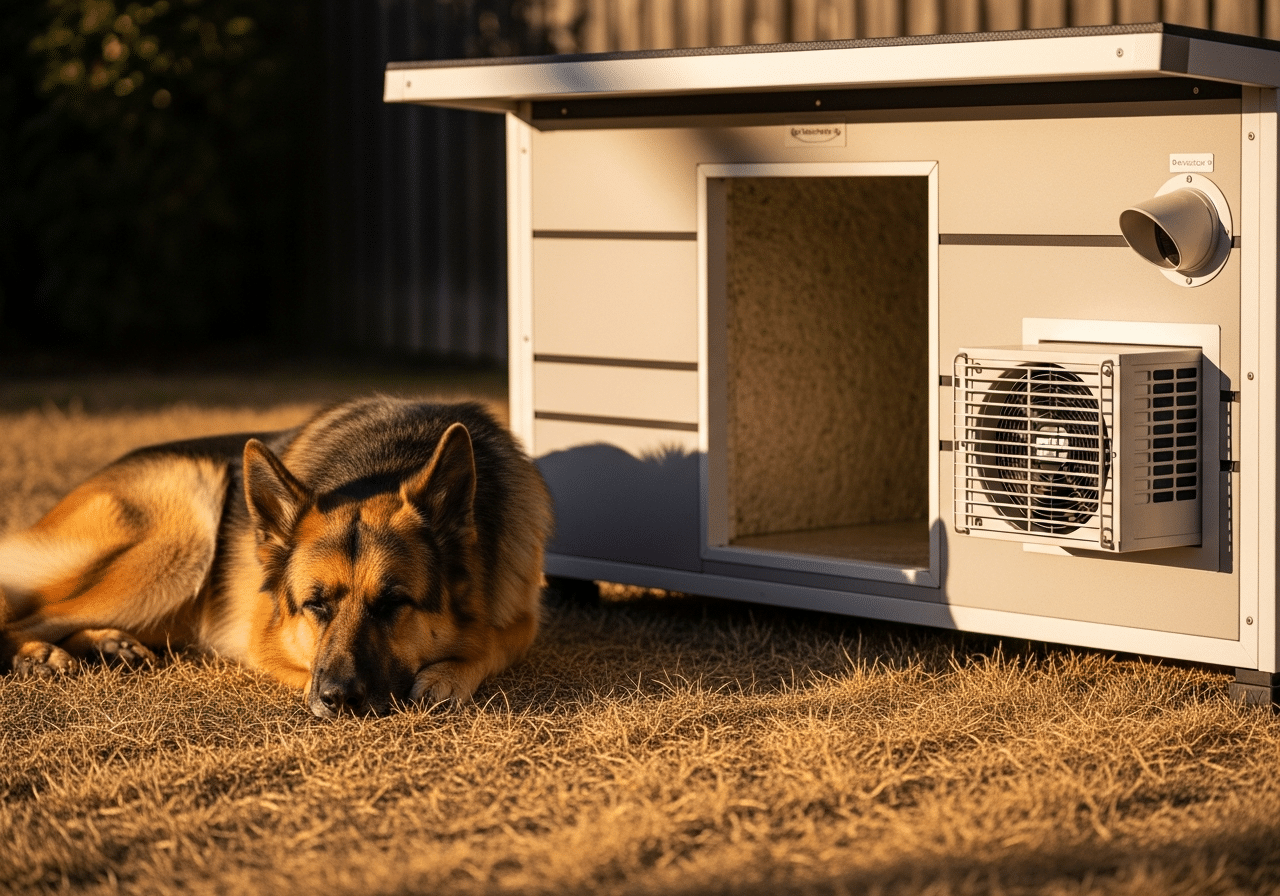
Electric heated dog houses (and heated pads) win on upfront price — you can be warming a dog for $40–$120. Solar heated setups cost more to buy, but the sun is free, so they win on ongoing running cost. The real question isn’t which is cheaper today, it’s how long it takes solar’s higher purchase price to pay itself back. Below we put real $/month numbers and a payback calculation against both, then settle which is cheapest once you total five years of ownership. For the wider pros and cons beyond money, see our solar vs. electric overview.
| Cost factor | Electric heated | Solar heated |
|---|---|---|
| Typical upfront cost | $40–$150 (heated pad or house) | $180–$500+ (panel, battery, heater) |
| Energy source | Grid electricity (metered) | Sunlight (free after install) |
| Running cost / month | ~$3–$15 (see below) | ~$0 in fuel |
| Wiring / outlet needed | Yes — near an outdoor outlet | No — off-grid capable |
| Battery / part replacement | Rare | Battery every ~3–5 yrs ($30–$80) |
| Performance on cloudy days | Constant | Drops — may need backup |
What electric heating actually costs to run per month
Running cost is just three numbers: the heater’s wattage, how many hours a day it’s on, and your electricity rate. The U.S. average is about $0.17 per kWh in 2026. The formula:
watts ÷ 1000 × hours/day × 30 × rate = $/month
Most dog heaters are modest because they’re thermostatic — they only draw power to top up heat, not run flat-out. Here’s what common setups cost at the average rate:
| Heater type | Power draw | Hours/day (thermostat) | Running cost / month |
|---|---|---|---|
| Heated dog pad / mat | 20–40 W | ~8 hrs effective | $0.80–$1.60 |
| Small heated dog house | 60–100 W | ~8 hrs effective | $2.40–$4.10 |
| Large insulated heated house | 150–250 W | ~8 hrs effective | $6.10–$10.20 |
| Heat lamp (non-thermostat) | 250 W | ~12 hrs | $15.30 |
Two things move that bill: insulation (a poorly insulated house runs the heater far longer) and your local rate (California or the Northeast can be double the average, the South often half). Multiply the figures above by your rate ÷ 0.17 to localise them.
Solar payback: how long until the panel pays for itself
Solar’s running cost in fuel is effectively $0 — so its “cost” is the extra you paid upfront, spread over the months it replaces an electric bill. Payback is simple:
(solar price − electric price) ÷ electric $/month saved = months to break even
Worked example for a small house run all winter:
- Solar heated setup: $280
- Comparable electric heated house: $90
- Extra you paid for solar: $190
- Electric running cost it replaces: ~$3.50/mo (heating season ~5 months = $17.50/yr)
- Payback: ~11 years on fuel savings alone for a small house.
Scale the wattage up — a large 200 W insulated house at $9/month — and payback shortens to roughly 2–3 winters, which is where solar genuinely beats the grid on cost. Background on how home solar economics work is well covered by the U.S. Department of Energy.
The hidden costs nobody quotes you
The sticker price isn’t the whole bill. Budget for these on each side:
Solar hidden costs
- Battery replacement — $30–$80 every 3–5 years; the panel itself lasts far longer.
- Backup heat — a string of cloudy days can flatten the battery, so cold-climate owners often keep a heated pad as backup.
- Undersizing — a too-small panel never fully charges; buy more capacity than the heater’s rating.
Electric hidden costs
- Outdoor wiring — a weatherproof outlet or a buried run can cost $150–$600 if one isn’t already nearby.
- Rate creep — electricity prices trend up; today’s $4/month bill won’t stay $4.
- Heat lamps — cheap to buy, expensive to run, and a fire risk; we don’t recommend them.
For choosing the actual unit around your budget and climate, our buyer’s decision guide walks through sizing, insulation and safety.
Cheapest over 5 years: the total-cost verdict
Upfront price plus five winters of running cost (and one battery swap for solar) is the number that actually decides this. Using a small house, ~5-month heating season, average rate:
| Setup | Upfront | 5 yrs running | Battery / extras | 5-year total |
|---|---|---|---|---|
| Heated pad (electric) | $45 | ~$8 | — | ~$53 |
| Small electric house | $90 | ~$88 | — | ~$178 |
| Small solar house | $280 | $0 fuel | ~$60 battery | ~$340 |
| Large electric house | $160 | ~$450 | — | ~$610 |
| Large solar house | $520 | $0 fuel | ~$120 battery | ~$640 |
The pattern is clear:
- Low-wattage, near an outlet: electric is cheapest over five years — the running cost is tiny.
- High-wattage / harsh winter: solar and large electric land neck-and-neck, and solar pulls ahead beyond year five as rates rise.
- No outlet at the doghouse: solar is cheapest of all once you add the wiring an electric setup would need.
Ready to shop? Compare verified models on our heated dog house hub or the solar heated dog house hub.