 Dog Gear, Sized Right
Best Dog Bed for Dogs That Chew (Chew-Proof Options)
The honest guide to beds that survive chewers, what materials actually hold up, when an elevated cot beats a foam bed, and what to do about the chewing itself.
No dog bed is truly indestructible. That’s the hard truth buried in nearly every “chew-proof” roundup: given enough time and motivation, a determined power-chewer can destroy almost any bed on the market. What you can do is buy something that is far more resistant than standard fleece or plush, and, just as importantly, address the reason your dog is chewing in the first place. This guide walks through the materials that genuinely hold up (ripstop nylon, ballistic fabric, aluminium-frame cots), the design features that matter (hidden zippers, tight-fit covers, no exposed seams), the elevated-cot strategy for serious chewers, chew-resistant orthopedic options for dogs that need joint support, and the safety risks of letting destructive chewing go unchecked.
Our top pick for chew-resistant comfort
One verified, in-stock pick at the time of writing. For extreme chewers we recommend elevated cots (discussed in the guide below), they remove the stuffing that dogs actually want to gut. Tap through for the live price.
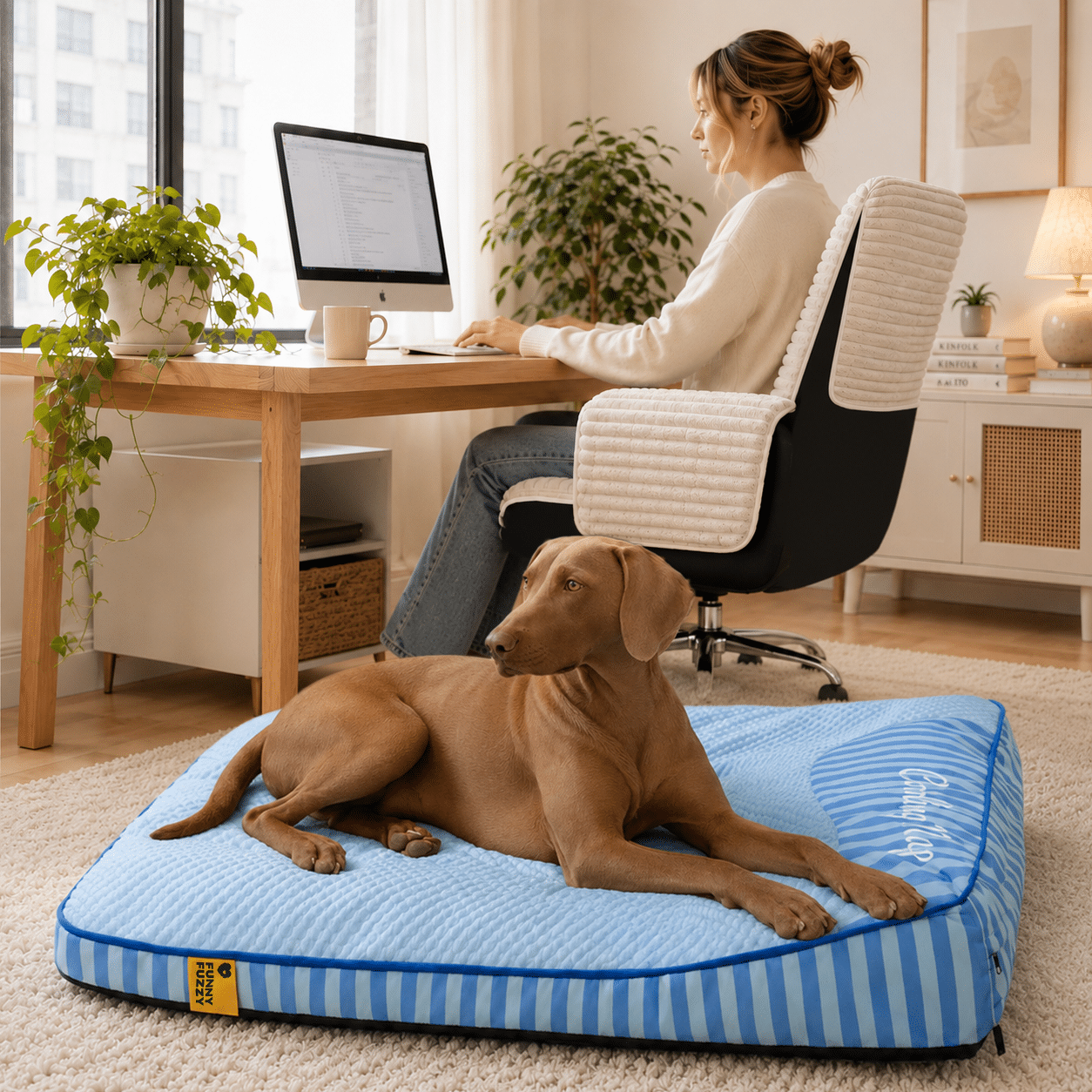
FunnyFuzzy Orthopedic Dog Bed
FunnyFuzzy’s fully orthopedic surround-support bed uses a scratch- and chew-resistant cover that holds up far better than standard fleece or plush surfaces, the dense ripstop-style fabric gives moderate chewers far less to grab and pull than fluffy beds with exposed seams. The thick orthopedic foam base and waterproof liner make it a practical middle ground: genuine joint support without a bed that falls apart the first week. If your dog is an extreme power-chewer, pair it with management strategies (below) or consider an elevated cot instead, but for the vast majority of chewers it outlasts standard beds by months.
What we like
- Chew-resistant cover fabric stands up to moderate scratching and gnawing
- Thick orthopedic foam provides genuine joint support, not just comfort padding
- Waterproof base and machine-washable cover make cleaning easy
- Surround bolster gives anxious dogs a sense of security (addressing a root cause of chewing)
The catches
- Not a match for true power-chewers; a determined dog can eventually work through any foam bed
- Bolster edges can attract gnawing, redirect with chew toys if your dog fixates there
- Larger sizes are bulky; measure your space before ordering
The hard truth: ‘indestructible’ is a marketing word
Walk through any pet retailer’s website and you’ll find beds marketed as “indestructible,” “chew-proof,” or “guaranteed forever.” The honest version: no fabric, foam, or frame has been made that a truly determined dog cannot eventually defeat. K9 Ballistics, one of the most credible names in tough beds, offers a 120-day chew-proof warranty, and that warranty exists precisely because even their ballistic-nylon beds sometimes get breached by extreme chewers. Kuranda elevated cots are used in animal shelters and police dog kennels worldwide, and even they acknowledge that a relentless chewer can damage them over time.
That said, there is a massive gap between a standard £30 plush bed (destroyed in an afternoon) and a ripstop-fabric elevated cot (lasting months or years). The goal of this guide is to help you land in the right place on that spectrum, and to be realistic about what management, training, and addressing root causes can do that no bed alone can.
Why dogs destroy their beds (and why it matters)
Understanding the why is the fastest path to solving the problem. Dogs chew and destroy their beds for distinct reasons, and the fix differs by cause:
- Boredom and excess energy. A dog with unspent physical or mental energy will self-entertain, and a stuffed bed is an irresistible target. The chewing is self-reinforcing: it’s satisfying, it produces results (stuffing!), and it passes time. Fix: more exercise, puzzle feeders, structured training sessions.
- Separation anxiety. Anxious dogs often chew as a coping mechanism when left alone. The bed smells like you; destroying it can be a stress response. Buying a tougher bed helps, but it doesn’t treat the anxiety, that needs a behaviour-based approach (desensitisation, crate training, sometimes veterinary support).
- Prey drive on stuffing. Dogs have an instinct to “gut” soft prey. A bed with polyester fiberfill looks and feels like prey to a high-drive dog: find the seam, pull the stuffing, mission accomplished. This is instinct, not defiance, and it’s exactly why unstuffed or firm-foam beds are a better fit for prey-drive chewers.
- Teething (puppies and adolescents). Chewing relieves discomfort during teething and jaw development. Provide appropriate chew toys and expect some trial and error before a puppy is ready for a decent bed.
- Habit. Once a dog has learned that destroying a bed is fun, it becomes a habit even after the original trigger is gone. Breaking it requires management (not leaving the dog unsupervised with the bed) and redirection to appropriate outlets.
The practical takeaway: a tougher bed buys you time and reduces damage, but it rarely solves the underlying behaviour. Pair the right bed with the right intervention.
What makes a bed genuinely chew-resistant: the materials
Not all “tough” beds are tough in the same way. Here’s what the construction actually means in practice:
- Ripstop nylon and ballistic nylon. Ripstop is woven with a reinforcing grid that stops tears from spreading, even if a dog punctures the fabric, the hole doesn’t grow. Ballistic nylon is even denser, originally developed for military use. K9 Ballistics is the best-known brand built around this material. Both resist puncture and tearing far better than fleece, microfibre, or plush.
- Heavy canvas and PVC-coated canvas. Thick canvas (think 600D or above) is highly resistant to gnawing and can handle dogs that dig and scratch rather than bite through. Kuranda’s elevated beds use a commercial-grade canvas or vinyl that shelters rely on.
- Aluminium frames (elevated/raised cots). An aluminium-frame elevated cot removes most of what dogs actually want to destroy: the stuffing. A taut canvas or nylon mesh surface gives a dog very little to grab, and the frame itself is essentially indestructible. This is the most reliable design for truly extreme chewers.
- Orthopedic foam under a tough cover. A dense memory foam or orthopedic foam base paired with a ripstop-style cover is the middle-ground option: it provides real joint support while being harder to chew than standard foam. The cover quality is everything here, the foam underneath is still vulnerable if the cover fails.
- Hidden or recessed zippers, tight-fit covers. The zipper pull and any exposed seam edge is almost always where a dog starts. Beds with hidden or locking zippers and tight-fit covers (rather than loose removable covers) eliminate the easiest entry point.
The table below compares the main design categories on the dimensions that matter for chewers:
| Bed Type | Chew Resistance | Comfort Level | Best For |
|---|---|---|---|
| Aluminium-frame elevated cot (ripstop or canvas surface) | Very high, no stuffing to gut; frame is metal | Moderate, firm, no cushioning; good airflow | Extreme chewers, warm climates, dogs that shred stuffing |
| Ripstop/ballistic-nylon orthopedic (foam fill, tough outer) | High, cover resists puncture/tearing; foam still vulnerable if cover fails | High, genuine orthopedic support | Moderate chewers who need joint support; seniors, large breeds |
| Heavy canvas flat mat (no fill or minimal fill) | High, minimal stuffing means less prey-drive trigger | Low-moderate, comfort depends on floor surface underneath | Warm-weather dogs, surface chewers, dogs that drag beds around |
The elevated-cot strategy for serious chewers
If your dog is a true power-chewer, we mean the dogs that destroy a ‘tough’ bed in a week, an elevated cot is the most consistently successful design. The logic is simple: remove the stuffing, and you remove 90% of the motivation to chew. A metal-framed raised cot with a taut ripstop or PVC-coated canvas surface gives a dog almost nothing to grab and even less to gut.
Brands like K9 Ballistics (their Chew Proof Elevated Bed uses a welded aluminium frame and ballistic fabric) and Kuranda (used in shelters and police kennels since 1987) are the most proven options in this category. Neither is cheap, quality elevated cots run £80-£150+, but compared to replacing a destroyed foam bed every month, the maths quickly works out.
The trade-off is comfort: an elevated cot is firm, not cushioned. Most healthy dogs adapt fine, and the raised position actually improves airflow, a bonus in warmer months. For older dogs or large breeds with joint issues, however, you may need a different solution (see the orthopedic section below).
Chew-resistant orthopedic options: when your dog needs joint support
Elevated cots are the right answer for extreme chewers, but they’re not the right answer for every dog. A large or giant breed with hip dysplasia, arthritis, or recovering from orthopaedic surgery genuinely needs cushioned support, and an aluminium-frame cot doesn’t provide it. The good news: the chew-resistant orthopedic category has improved significantly.
What to look for in a chew-resistant orthopedic bed:
- A tough outer cover, ripstop, canvas-blend, or at minimum a dense polyester that isn’t loosely woven. Avoid microfibre, velvet, or any textured plush.
- Recessed or lockable zipper, or, better, a cover with no accessible zipper at all.
- Minimal decorative features, no tassels, exposed piping, or freestanding bolster that a dog can separate and chew independently.
- Thick, dense base foam, 3 to 4 inches of high-density memory foam or orthopedic foam is both better for joints and harder to chew through than cheap 1-inch padding.
Our pick for this category is the FunnyFuzzy Orthopedic Dog Bed (reviewed above): its scratch- and chew-resistant cover, thick orthopedic foam, and waterproof base make it a solid middle-ground option for moderate chewers who still need genuine support. It’s not going to survive a determined pit bull who has decided to gut it, but for the vast majority of chewers, dogs that gnaw and scratch rather than full-on dismember, it outlasts standard beds by a significant margin. See our full best orthopedic dog beds for large dogs guide for more options across price points.
Safety first: the real risk of bed destruction
Before we get into buying tips, it’s worth being direct about why this matters beyond the inconvenience and cost of a destroyed bed: stuffing and squeakers are a genuine medical risk.
Polyester fiberfill, memory foam chunks, latex foam, and fabric pieces can all cause intestinal blockages if swallowed, and intestinal blockages are a veterinary emergency. Blockages require either endoscopy or surgical intervention and can be fatal if not caught in time. Small pieces of foam are especially insidious because a dog can ingest a lot of material before you notice.
If your dog actively eats the material it chews out (rather than just shredding and leaving it), this is a higher-priority safety issue than it might appear, and a behaviour consultation or vet conversation is warranted before you spend money on tougher beds alone. In the short term, supervision or crate training when you can’t watch them is the safest approach.
Signs of possible ingestion to watch for: vomiting, loss of appetite, lethargy, constipation or straining. If you see these after a bed-destruction event, contact your vet.
How to reduce chewing before buying a new bed
A tougher bed is a tool, not a cure. Here’s what actually reduces destructive chewing:
- More physical exercise. A tired dog is a significantly less destructive dog. If your dog is chewing from boredom or excess energy, the answer is more walks, runs, fetch sessions, or off-lead time, not just a harder-to-chew surface.
- Mental enrichment. Puzzle feeders, sniff mats, Kong toys stuffed with food, lick mats, training sessions, anything that makes the dog use its brain will burn energy and reduce boredom chewing. Fifteen minutes of focused training often tires a dog more than an hour of wandering.
- Appropriate chew outlets. Give your dog something good to chew: a bully stick, a raw meaty bone, a rubber chew toy. Redirect immediately if you catch them starting on the bed. Consistent redirection over days and weeks changes habits.
- Address separation anxiety properly. If your dog only destroys its bed when alone, that’s separation anxiety, and it needs a structured protocol (gradual desensitisation to departures, not just distraction), not just a tougher bed.
- Management when you can’t supervise. A dog that chews its bed only when you’re not home can’t be retrained if you keep giving it the opportunity. Use a crate, close a door, or remove the bed when you’re out until the habit is under control.
For more on choosing the right bed for a large dog’s needs, including sleep position, orthopaedic considerations, and waterproofing, see our full buying guide for large dog beds.
What to avoid when buying for a chewer
Just as important as knowing what to buy is knowing what to skip:
- Plush and faux-fur finishes. These are designed to feel soft for humans and dogs alike, and they are exactly what a prey-drive dog wants to shred. Avoid any bed with a fluffy, textured, or pile surface if your dog is a chewer.
- Loose, removable covers with standard zippers. A standard zipper pull is a gift to a chewer. Beds with easily accessible zippers get destroyed at the zip long before the fabric itself fails.
- Very low-density foam. Cheap foam (often found in beds under £25) compresses quickly and tears easily. It’s worse for joints and worse for chewers, a double loss.
- Beds that are too big for your space. An oversized bed gets bunched, dragged, and piled, all behaviours that lead to chewing. A right-sized bed that fits snugly in a crate or corner gets repositioned less and chewed less.
- Memory foam with no cover. Bare memory foam is satisfying to chew and produces small, ingestible chunks. Always ensure the foam is inside a secure, tight-fit cover before the dog has access.
Our broader dog beds hub covers the full range of bed types for large dogs, orthopedic, cooling, waterproof, and more, if you want to compare across categories.
The honest summary: matching bed to chewer type
There is no single “best chew-proof bed” because the right choice depends almost entirely on the type and intensity of your dog’s chewing. Here’s the honest match-up:
- Mild/moderate chewer (gnaws edges, occasional surface scratch): A ripstop-cover orthopedic bed like the FunnyFuzzy above is a practical, comfortable choice. Pair it with enrichment and exercise to reduce frequency.
- Prey-drive chewer (guts stuffing, hunts the zipper): Move to an elevated cot with minimal fill, or a heavy canvas mat with no loose edges. Remove the temptation rather than trying to make the stuffing indestructible.
- Extreme/power-chewer (destroys anything in hours): Aluminium-frame elevated cot is your most reliable option. Combine with a behaviour protocol. Accept that no product alone solves the problem.
- Anxious chewer: Address the anxiety, vet consultation, structured desensitisation, possibly medication, before spending on expensive beds. Temporary management (crate, supervision) is safer and cheaper while you work on the root cause.
For more context on what orthopedic support actually means and when your dog needs it, see our explainer: what is an orthopedic dog bed? And for cooling needs in summer, our best cooling dog beds guide is worth a look, many elevated cots double as cooling beds thanks to airflow under the surface.
Chew-proof dog beds: common questions
Is there such a thing as a truly indestructible dog bed?
Honestly, no. No dog bed on the market is guaranteed to survive every dog. Aluminium-frame elevated cots with ballistic-nylon or canvas surfaces come closest, brands like K9 Ballistics offer a 120-day chew-proof warranty on their toughest beds, but a sufficiently determined power-chewer can eventually damage even these. The practical goal is a bed that is far more resistant than standard plush, paired with addressing the reason your dog is chewing in the first place.
What type of dog bed is hardest for dogs to chew?
Aluminium-frame elevated cots with ripstop nylon or heavy canvas surfaces are the hardest to chew because they have no stuffing to gut, the material dogs most want to destroy. After that, beds with ballistic-nylon covers (K9 Ballistics being the best-known), thick canvas flatbeds, and tight-fit ripstop orthopedic covers are the next most resistant options. Avoid plush, faux-fur, or loosely woven covers, these are the first to fail.
Why does my dog keep destroying its bed?
The most common reasons are boredom or excess energy (destructive chewing is self-rewarding), separation anxiety (chewing as a coping mechanism when left alone), prey drive triggered by polyester stuffing (instinct to ‘gut’ soft material), teething in puppies, or an established habit. Buying a tougher bed helps, but it doesn’t address the root cause, more exercise, mental enrichment, appropriate chew outlets, and (for anxiety) a structured behaviour protocol are usually needed alongside the right bed.
Is it safe to let my dog chew its bed?
It depends on whether the dog is ingesting material. Shredding and leaving stuffing alone is less dangerous than eating it, but polyester fiberfill, foam chunks, and fabric pieces can all cause intestinal blockages if swallowed, which is a veterinary emergency. If your dog actively eats the material it chews out, supervise closely, remove the bed when you can’t watch, and speak to your vet. Even dogs that mainly shred should be redirected to appropriate chew outlets, not left to practise the habit.
Are elevated dog cots good for large dogs?
Yes, for most large dogs, especially healthy adults and chewers. An elevated cot removes the stuffing that drives chewing behaviour, improves airflow underneath (a bonus in warm weather), and is easy to clean. The trade-off is that they offer no cushioning, so they may not be ideal for older large breeds with arthritis or joint issues, who benefit from orthopedic foam support. For those dogs, a chew-resistant orthopedic bed with a tough cover is the better balance. See our guide to what an orthopedic dog bed is for more detail.
How do I stop my dog from chewing its bed at night?
First, rule out anxiety: if the chewing happens mainly when you’re asleep or out of sight, that points to anxiety rather than boredom. For night-time chewing specifically: crate train if you haven’t already (most dogs stop chewing in a properly sized crate because the space feels secure); remove the bed from the crate and use a flat, non-stuffed mat instead; ensure the dog gets sufficient exercise in the evening to be genuinely tired by bedtime; and provide an appropriate chew item just before lights out to satisfy the chewing urge. Long-lasting chews like bully sticks or frozen Kongs are particularly effective.