 Dog Gear, Sized Right
Best Robot Vacuums for Pet Hair (Anti-Tangle, Self-Empty)
A robot vacuum is the easiest way to keep on top of a shedding dog, but only if it doesn’t choke on the hair. These are the four robot vacuums we’d actually buy for pet hair, led by the anti-tangle brush and self-empty base that decide whether a robot survives a heavy shedder.
A robot vacuum is the single best gadget for living with a shedding dog: it sweeps up the daily drift of fur off your floors while you’re at work, so you’re vacuuming the carpet once a week instead of once a day. But here’s the catch nobody tells you, dog hair is exactly what breaks a robot vacuum. Long fur winds around the brush roll until it stops spinning, a single dustbin fills in a day with a heavy shedder, and a cheap model just pushes the hair around. So the real question isn’t simply “what’s the best robot vacuum?”, it’s what’s the best robot vacuum for pet hair: one with an anti-tangle brush so it doesn’t seize up, a self-empty base so you’re not emptying a tiny bin twice a day, and enough suction to pull fur out of carpet. Below are the four we’d buy, a tangle-free flagship-killer, the smartest pet-home Roomba, the best-value all-rounder and the best budget self-empty, plus a plain-English buying guide to anti-tangle brushes, self-empty docks, suction, carpet-vs-hardwood and the questions dog owners actually ask. This is one piece of the puzzle; for the full picture see our best vacuum for dog hair hub.
The 4 best robot vacuums for pet hair, ranked
Each pick is chosen for a shedding dog and verified current. Prices are last-checked, tap through for the live price. Anti-tangle brush and self-empty base first, suction and smarts second.
Roborock Q7 M5+
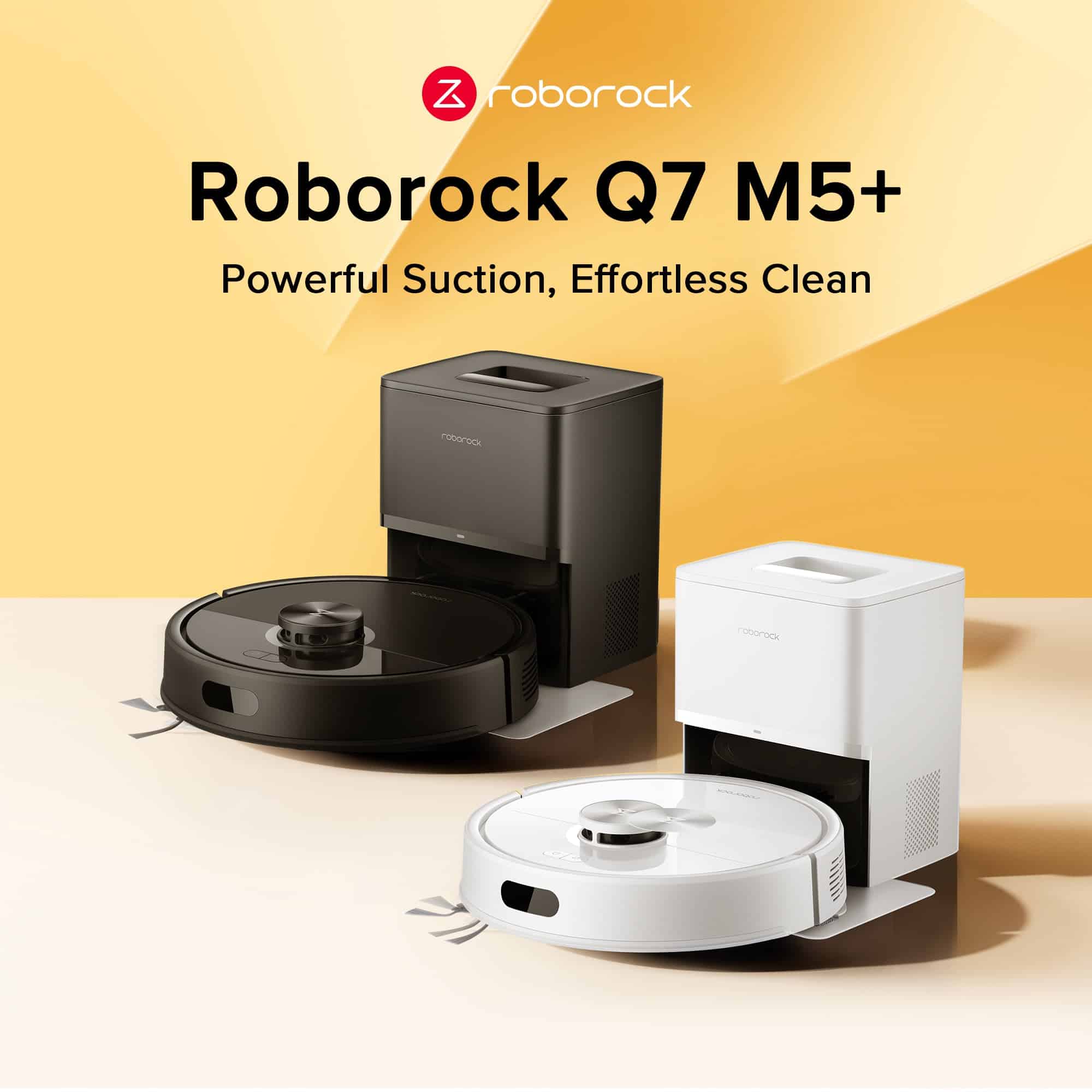
If your single biggest robot-vacuum frustration is dog hair wrapping the brush, the Roborock Q7 M5+ is the one to buy. It runs a genuine Dual Anti-Tangle System, a comb that strips hair off the roller as it spins, plus a tangle-resistant side brush, so a German Shepherd’s worth of fur ends up in the bin instead of cocooned around the brushroll. Back that with 10,000 Pa of suction (genuinely strong for this price bracket), PreciSense LiDAR mapping so it cleans in tidy rows instead of bouncing, and an auto-empty dock that holds 7 to 9 weeks of debris, and you have the most hands-off pet-hair robot we’d recommend to most dog owners. It mops too. For a shedding household, the anti-tangle roller is the feature that actually keeps it running.
What we like
- A real dual anti-tangle brush, the comb strips dog hair off the roller as it spins, the single most useful feature for shedders
- 10,000 Pa suction is genuinely strong for the price and pulls embedded hair out of low-pile carpet
- Auto-empty dock holds 7 to 9 weeks of dirt, so you barely touch it even with a heavy shedder in the house
- LiDAR mapping with no-go zones and room targeting, fence off the dog’s bed and water bowl in the app
The catches
- It’s a vacuum-first hybrid, the mopping is fine for light sealed floors, not a deep scrub
- The dock is tall; you need a bit of clearance to park it
- No onboard camera obstacle-avoidance, so pick up the worst clutter (and supervise around puppy accidents)
iRobot Roomba j7+
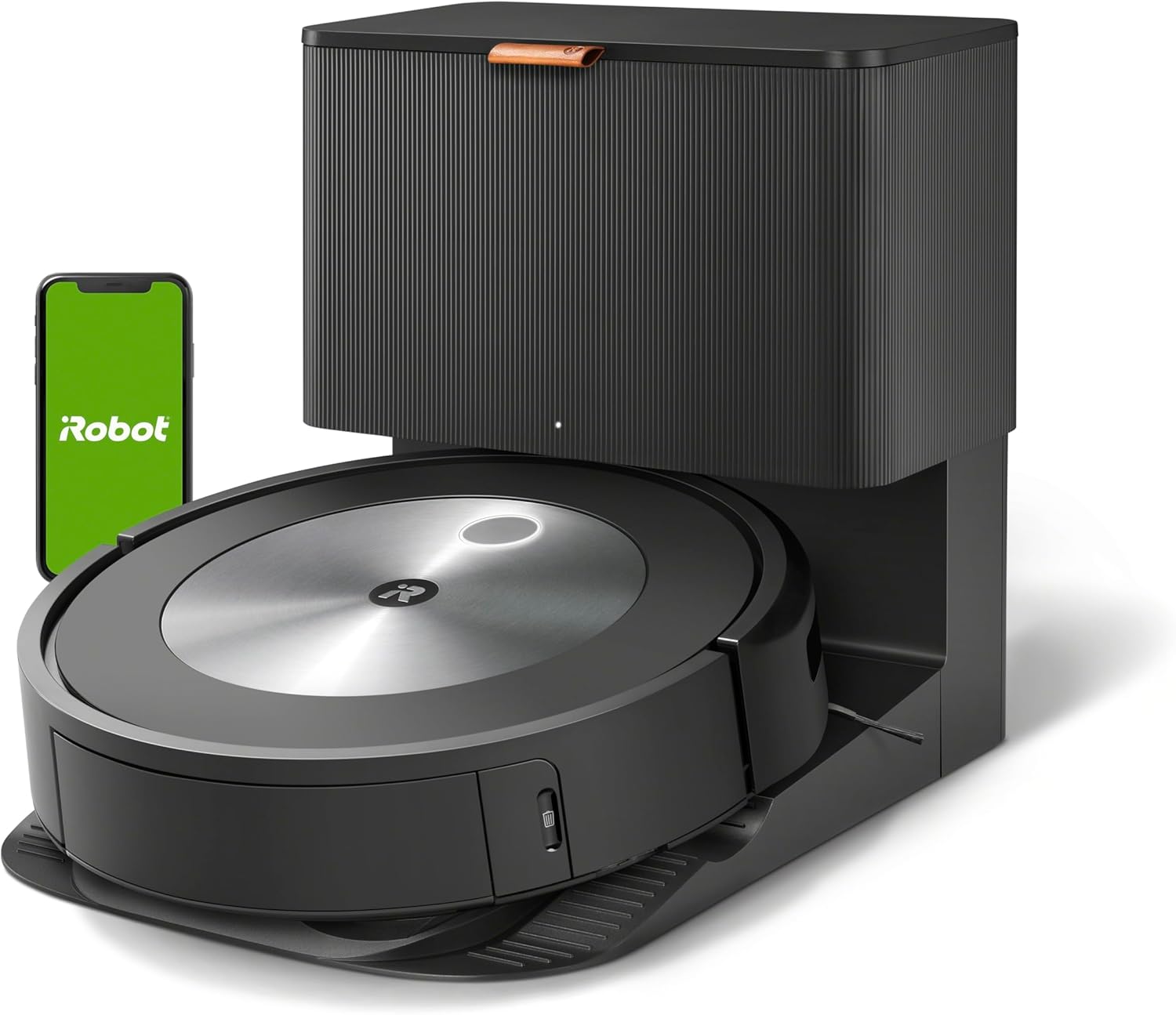
The Roomba j7+ is the pick if you want the easiest app and the smartest obstacle avoidance in a pet home. Its two rubberised multi-surface brushes (no bristles to wind hair around) are far better at resisting clogs than a traditional bristle roller, and the PrecisionVision camera identifies and steers around the things that ruin a robot run, charging cords, socks, and most importantly solid pet waste. iRobot backs that with its P.O.O.P. (Pet Owner Official Promise): if the j7+ runs over dog mess, they replace it. The Clean Base self-empties for up to 60 days. The iRobot app is the most polished in the category, with the best mapping and scheduling.
What we like
- Twin rubber brushes (no bristles) resist hair-wrap and are easy to wipe clean, a smart design for shedders
- Camera avoids cords, socks and, critically, solid pet waste, backed by iRobot’s free-replacement P.O.O.P. promise
- The iRobot app is the easiest to live with: clean maps, room labels, schedules and keep-out zones
- Clean Base empties the robot for up to 60 days, so a shedding dog’s daily hair haul is hands-off
The catches
- The most expensive pick here, you’re paying for the obstacle camera and the app polish
- Vacuum only (no mop on the j7+); step up to the Combo j7+ if you want mopping too
- Some hair can still wind the single edge-sweeping brush, snip it off every couple of weeks
eufy Omni C20
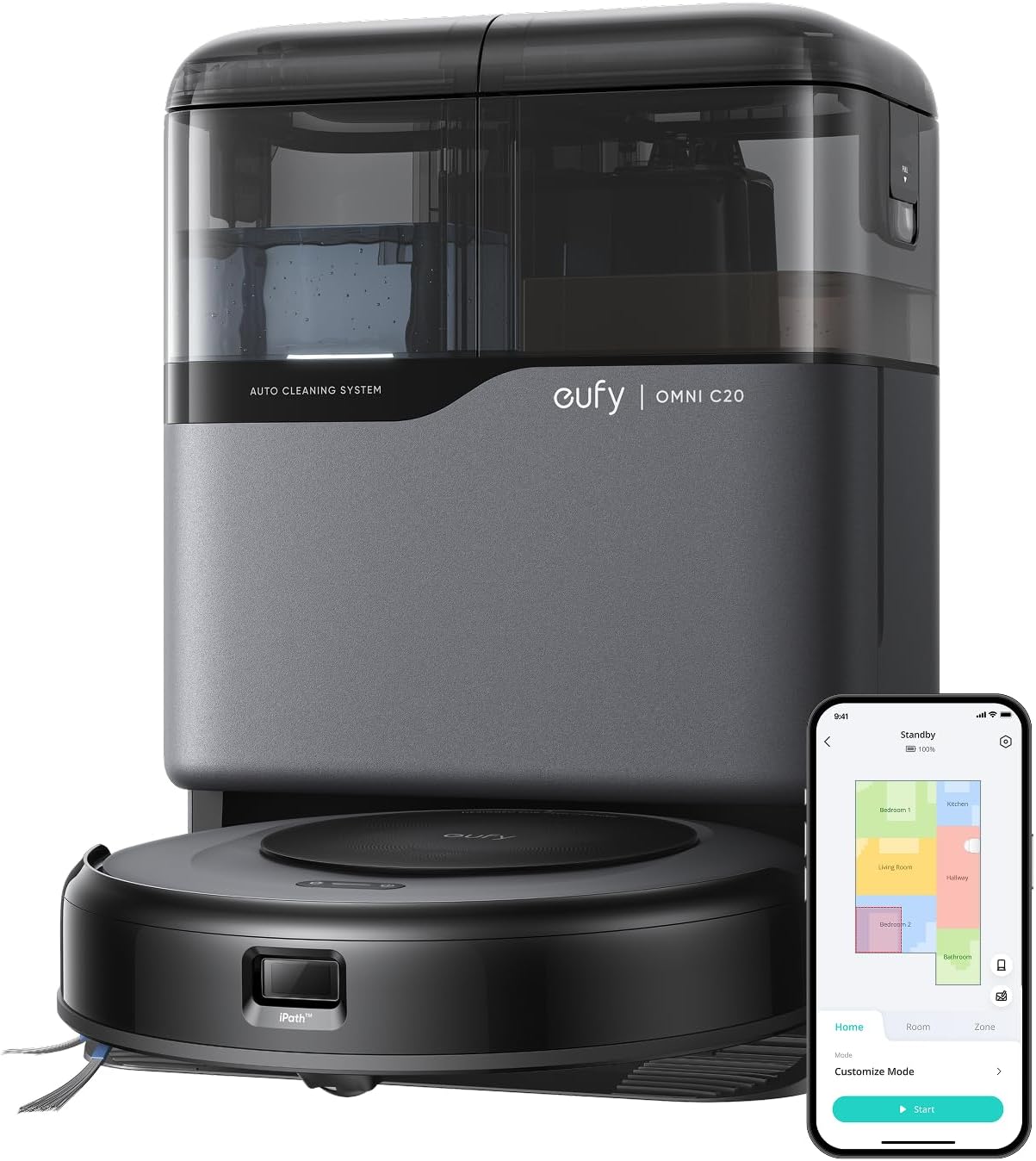
The eufy Omni C20 is the value play: an all-in-one station at a mid-tier price that doesn’t just self-empty, it washes and dries the mop pads too, so the whole machine is close to hands-free. 7,000 Pa of suction is plenty for everyday dog hair on hard floors and low-pile rugs, the ultra-slim 3.35" body ducks under sofas and beds where fur drifts and hides, and the dock holds up to 60 days of debris. It’s the robot to buy if you want a vacuum and a self-cleaning mop for a shedding household without paying flagship money, just know that, like most robots, you’ll want to clip the occasional long hair off the roller.
What we like
- All-in-one station self-empties the bin and washes and dries the mop, about as hands-free as mid-price gets
- 7,000 Pa handles everyday dog hair on hard floors and low-pile rugs without fuss
- Slim 3.35″ height slides under couches and beds, exactly where shed fur collects
- Strong value: flagship-style automation (vacuum + self-cleaning mop) at a mid-tier price
The catches
- Suction trails the Roborock and flagship models on thick or high-pile carpet
- Not a dedicated anti-tangle roller, long-haired breeds will need an occasional brush clean
- The big multi-function dock takes up more floor space than a plain self-empty base
Shark Matrix Plus
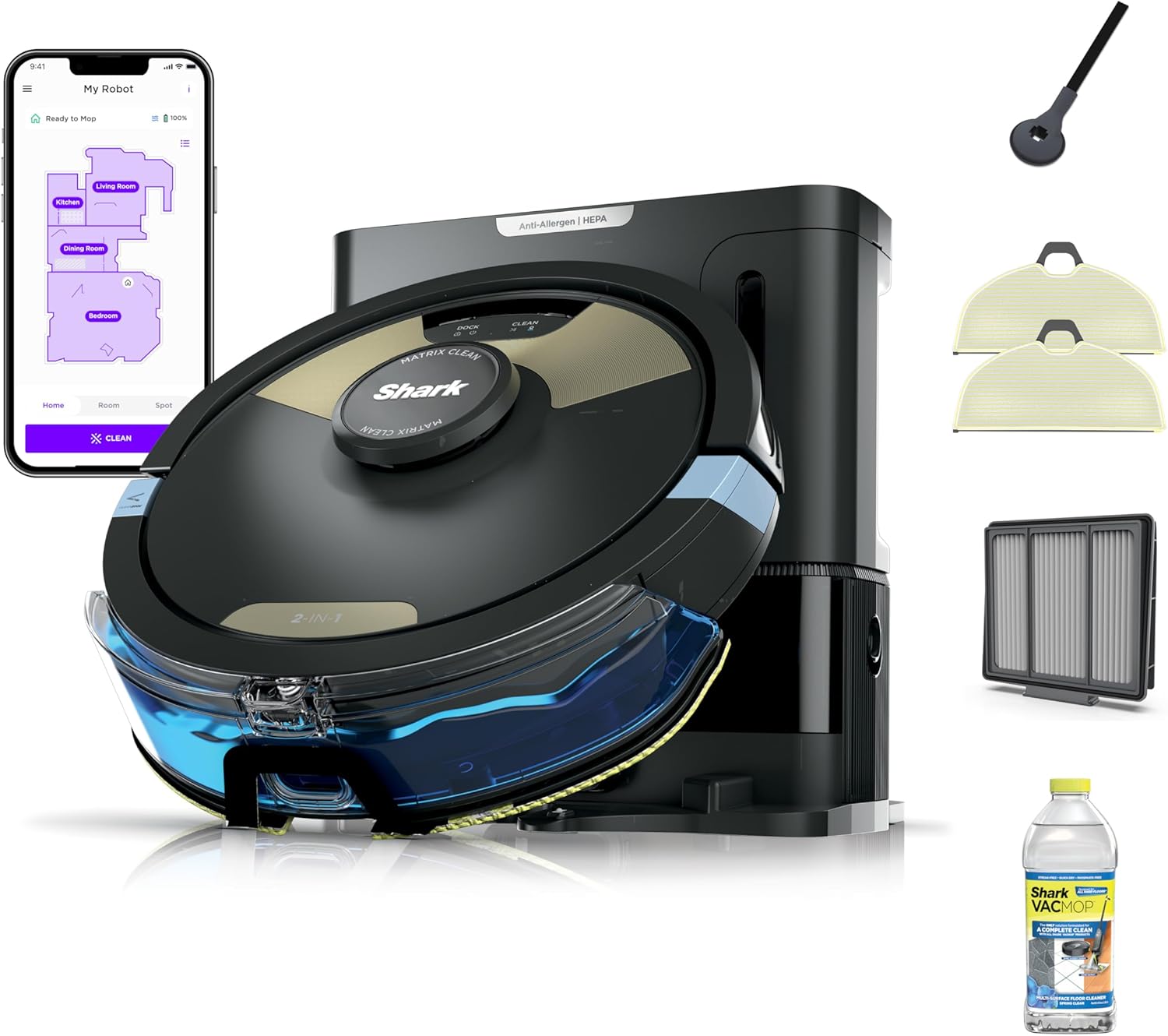
If you want a self-emptying, anti-tangle robot on a budget, the Shark Matrix Plus is the value champion. Its self-cleaning brushroll is built to actively resist hair-wrap, Matrix Clean does a back-and-forth grid pass so it doesn’t miss the fur a single pass leaves behind, and CleanEdge pulls debris out of corners and along baseboards where dog hair piles up. The XL base self-empties for up to 60 days through a sealed HEPA filter that traps 99.97% of dander and allergens, a real plus if anyone in the house reacts to the dog. It mops, maps with LiDAR, and the SharkClean app handles zones and schedules. Outstanding value for a self-empty pet robot.
What we like
- Self-cleaning brushroll actively fights hair-wrap, and Matrix Clean’s grid pass grabs the fur one pass leaves behind
- Sealed HEPA self-empty base traps 99.97% of dander, genuinely helpful in an allergy household
- CleanEdge digs dog hair out of corners and along baseboards where it drifts and packs down
- The cheapest self-empty + LiDAR robot we’d trust for pet hair, strong value
The catches
- No obstacle-avoidance camera, so clear cords and pick up after a puppy before a run
- Sonic mopping is light-duty, fine for maintenance, not a deep scrub of dried-on messes
- App and mapping are good but a step behind iRobot and Roborock for polish
Do robot vacuums actually work for pet hair?
Short answer: yes, a good one is brilliant for pet hair, and a bad one is a waste of money. The difference is entirely down to a handful of features. A robot vacuum can’t replace a deep weekly clean with an upright or a cordless stick vacuum, but for the daily job, the constant drift of fur that a shedding dog leaves on every floor, it’s the most useful machine you can own. It runs while you’re out, it gets under the sofa where hair hides, and it means the floors never reach the “oh no, the in-laws are coming” stage.
The robots that fail at pet hair all fail the same three ways: the brush tangles and stops spinning, the bin is too small and fills in a day, or the suction is too weak to lift fur out of carpet. Every pick on this page is chosen specifically to beat those three failure modes, which is why a “best robot vacuum” list and a “best robot vacuum for pet hair” list look quite different. Get the right one and it genuinely keeps a shedding home under control; get a generic budget model and you’ll spend more time cutting hair off the brush than you save.
Anti-tangle brush rolls: the #1 feature for dog hair
If you read one section, read this one. The number-one reason a robot vacuum dies in a dog household is hair wrapping the brush roll. Long fur winds tighter and tighter around a traditional bristle brush until the motor strains, the brush stops turning, and the robot is just pushing hair around in circles. On a bristle-brush robot you’ll be cutting a felted rope of hair off the roller every week, and that’s the chore that makes people give up on robots entirely.
The fix is an anti-tangle brush design, and there are two good approaches:
- Rubber / silicone brushes with no bristles (the iRobot Roomba approach): hair slides off rubber fins instead of winding into bristles, and what does collect wipes off in seconds. The j7+’s twin rubber brushes are a big part of why it copes so well with shedders.
- Active anti-tangle systems (Roborock’s Dual Anti-Tangle System, Shark’s self-cleaning brushroll): a built-in comb or blade physically strips hair off the roller as it spins, so it’s cut and sucked into the bin instead of wrapping. Roborock’s is the most effective of our picks for genuinely long, fine dog hair.
What to avoid: a cheap robot with a plain bristle brush and no anti-tangle feature. It’ll work for a fortnight, then become a weekly de-hairing chore. For a dog, especially a long-haired or double-coated breed, the anti-tangle brush is not a “nice to have,” it’s the whole ballgame. (The same hair-wrap problem plagues upright vacuums too; it’s why we obsess over brush design in our best vacuum for dog hair guide.)
Self-empty bases: do you need one for a shedding dog?
For a shedding dog, a self-empty base is close to essential. A robot vacuum’s onboard bin is tiny, often around half a litre, and a heavy shedder can fill it in a single clean. Without a self-empty dock you’ll be emptying a dust-puffing little bin every day, which defeats the entire point of buying a robot to save effort.
A self-empty base (Roomba’s Clean Base, Roborock’s auto-empty dock, Shark’s XL HEPA base) solves it: when the robot finishes, it docks and a powerful vacuum in the base sucks the bin into a large bag or bin that holds 30 to 60+ days of debris. With a shedding dog you simply empty the dock once a month or so instead of the robot daily. Every pick on this page has one, because for a pet home it’s the feature that makes a robot genuinely hands-off.
| Dock feature | Why it matters for a shedding dog |
|---|---|
| Auto-empty (self-empty) | The big one, empties the robot’s tiny bin into a large base so you’re not doing it daily. 7 to 9 weeks (Roborock) or up to 60 days (Roomba, Shark, eufy) between dock empties. |
| Sealed HEPA in the base | Traps dog dander and allergens (Shark: 99.97% at 0.3 micron) instead of puffing it back into the room, a real help if anyone’s allergic. |
| Bagged vs bagless dock | Bagged docks (Roomba) contain the dust when you swap them, cleaner for allergy homes; bagless docks (Shark) save on consumables. |
| Mop wash & dry | On all-in-one stations (eufy Omni C20) the dock also washes and dries the mop pad, handy if you want vacuum and mop with near-zero upkeep. |
The one trade-off: self-empty docks are tall and take up floor space, and emptying them stirs up a puff of dust (the sealed-HEPA bagged docks are best here). For a shedding household it’s a trade worth making every time.
How much suction (Pa) do you need for pet hair?
Suction in robot vacuums is measured in Pa (pascals), and the numbers have crept up fast, budget models sit around 2,500 to 4,000 Pa, the mid-range (our eufy) runs ~7,000 Pa, our Roborock hits 10,000 Pa, and flagships push 15,000 to 35,000 Pa. More Pa isn’t automatically “better,” but for pet hair it matters in one specific place: carpet.
On hard floors, dog hair sits on top and even a modest 4,000 to 7,000 Pa robot sweeps it up easily, here the brush design matters more than raw suction. On carpet and rugs, fur works down into the pile and grips, and that’s where stronger suction earns its keep: you want roughly 7,000 Pa or more for low-pile, and the more the better for thick or high-pile carpet. Look for an auto carpet-boost feature too, the robot senses carpet and ramps suction up automatically, then drops it on hard floor to save battery and noise.
Our honest take: for a typical home that’s mostly hard floor with some low-pile rugs, the eufy’s 7,000 Pa is plenty. If you have a lot of carpet, or a heavy double-coated shedder, step up to the Roborock’s 10,000 Pa. If your home is mostly thick carpet, a robot is best as a daily top-up and you’ll still want a powerful upright or cordless for the weekly deep clean. More on the floor question next.
Carpet vs hardwood: which robot for which floor?
The best robot vacuum for your dog hair depends a lot on your floors. Robots behave very differently on carpet and hard floor, and matching the machine to the surface is half the battle.
- Mostly hardwood, tile or laminate? You have the easy job. Dog hair sits on top, so prioritise a good anti-tangle brush and a self-empty base over raw suction, any of our four will shine, and a vacuum-and-mop combo (Roborock, eufy, Shark) lets the robot mop the muddy paw-prints too. If hard floors are your whole world, see our best vacuum for pet hair and hardwood floors guide for the full picture.
- Lots of carpet and rugs? Prioritise suction (Pa) and a carpet-boost mode that ramps power on carpet, our 10,000 Pa Roborock is the pick. Fur burrows into pile and is much harder to extract than off a hard floor, so a robot is best paired with a strong upright for the deep weekly clean.
- A mix (most homes)? Look for auto floor detection, the robot boosts suction on carpet and, on the mopping combos, lifts the mop off the carpet so it doesn’t drag a wet pad across your rug. All of our combo picks do some version of this.
One more floor note for pet owners: a robot’s slim height matters. Hair drifts and collects under sofas, beds and cabinets, exactly the spots you never reach by hand, so a low-profile robot (the eufy is just 3.35") earns its keep by getting under there daily. If hardwood is your priority, the hardwood pet-hair guide goes deeper on scratch-safe brushes and mopping.
Mapping, apps and pet features that actually help
Beyond the big three (anti-tangle, self-empty, suction), a few smart features genuinely make a robot better in a pet home, and a few are just marketing. The ones worth caring about:
- LiDAR or camera mapping. A robot that maps your home (LiDAR on the Roborock and Shark, camera-vision on the Roomba) cleans in efficient straight rows and remembers the layout, far better fur coverage than a cheap robot that bounces around randomly and misses patches.
- No-go zones & pet zones. In the app you can fence off the dog’s water bowl, food station and bed so the robot doesn’t knock the bowl over or vacuum the bed at 2pm. This is the single most useful “pet” app feature, every mapping robot here supports it.
- Obstacle / pet-waste avoidance. The Roomba j7+’s camera identifies and steers around solid pet waste (with iRobot’s free-replacement P.O.O.P. guarantee), cords and socks. If you have a puppy in training, this alone can justify the j7+, running a robot over a mess is a nightmare you only want to avoid once.
- HEPA filtration. A sealed HEPA filter (Shark) traps dog dander rather than recirculating it, worth it if anyone in the house has allergies.
- Scheduling. Set it to run every day while you’re out and the daily hair never builds up. Pair it with a quick weekly pass of a cordless vacuum on the furniture and stairs the robot can’t reach.
What you can mostly ignore: voice assistants, “AI dirt detection” buzzwords, and ever-bigger Pa numbers past what your floors need. For a dog, the features that matter are the unglamorous ones, the brush that doesn’t tangle and the dock that empties itself.
Robot vs upright or cordless for pet hair: do you need both?
Honest answer for a dog household: a robot vacuum is the best tool for the daily job, but most shedding homes are happiest with a robot and a good handheld or upright for the rest.
The robot owns the floors, it runs every day, gets under furniture, and stops hair ever building up into a problem. But a robot can’t do the furniture, the stairs, the car, the dog bed, or a deep carpet extraction, that’s where a cordless stick vacuum or an upright comes in. The winning combination for most dog owners is: a robot vacuum running daily on the floors, plus a cordless for a quick weekly pass over the sofa, stairs and the dog’s favourite spots. For hair on everything but the floor, upholstery, bedding, your clothes, the car seats, we have a whole guide on how to get dog hair off everything. And if you’re weighing the big upright brands, our Dyson vs Shark for pet hair comparison breaks down which wins for shedders.
So you don’t strictly need both, a robot alone will transform your floors, but the robot-plus-cordless combo is what actually keeps a heavy-shedding home looking clean everywhere, not just on the ground.
Best robot vacuum for pet hair: common questions
Do robot vacuums work for pet hair?
Yes, a well-chosen robot vacuum works very well for pet hair, and it’s the best tool for the daily job of keeping shed fur off your floors. The key is buying one built for it: you need an anti-tangle brush (rubber rollers or an active hair-cutting system) so dog hair doesn’t wrap and jam the brush, a self-empty base so you’re not emptying a tiny bin every day, and enough suction (around 7,000 Pa-plus) to lift fur out of carpet. A cheap robot with a plain bristle brush will tangle and disappoint; a proper pet-hair robot like the Roborock Q7 M5+ or Roomba j7+ genuinely keeps a shedding home under control.
What’s the best robot vacuum that won’t get tangled in dog hair?
The Roborock Q7 M5+ is our top pick for tangle-free dog hair, thanks to its Dual Anti-Tangle System, a comb that physically strips hair off the roller as it spins, plus a tangle-resistant side brush, so long, fine fur is cut and sucked into the bin instead of wrapping around the brush. The iRobot Roomba j7+ is the other strong choice: its twin rubber brushes have no bristles for hair to wind into, and the Shark Matrix Plus uses a self-cleaning brushroll. Whatever you buy, still check the small edge-sweeping side brush every couple of weeks, even the best anti-tangle robots collect a little hair there.
Do I need a self-emptying robot vacuum if I have a dog?
For a shedding dog, a self-emptying base is close to essential. A robot’s onboard bin is tiny, often around half a litre, and a heavy shedder can fill it in a single clean, so without a dock you’d be emptying a dusty little bin every day. A self-empty base (Roomba’s Clean Base, Roborock’s auto-empty dock, Shark’s XL HEPA base) sucks the robot’s bin into a large bag or bin that holds 30 to 60+ days of debris, so you empty the dock about once a month instead. It’s the feature that makes a robot genuinely hands-off in a pet home, every robot we recommend here has one.
How much suction (Pa) does a robot vacuum need for pet hair?
It depends on your floors. On hard floors dog hair sits on top, so even a modest 4,000 to 7,000 Pa robot sweeps it up, the brush design matters more than raw suction there. On carpet, fur burrows into the pile, so you want roughly 7,000 Pa or more for low-pile and the most you can get for thick carpet. Look for an auto carpet-boost that ramps suction on carpet automatically. For a mostly-hard-floor home the eufy Omni C20’s 7,000 Pa is plenty; for lots of carpet or a heavy double-coated shedder, step up to the Roborock’s 10,000 Pa.
Are robot vacuums good for hardwood floors with a dog?
Yes, hardwood is the easiest surface for a robot vacuum and pet hair. Fur sits on top of sealed hard floors, so a robot with a good anti-tangle brush sweeps it up easily without needing huge suction, and a slim, low-profile robot gets under sofas and beds where hair drifts. Many of our picks are vacuum-and-mop combos (Roborock, eufy, Shark), so the robot can mop muddy paw-prints off the wood too, just make sure it has auto floor detection so it lifts or avoids the mop on any rugs. For a hardwood-first home, see our dedicated best vacuum for pet hair and hardwood floors guide.
How often do you have to clean a robot vacuum used for dog hair?
Less than you’d think with the right model, but never zero. With a self-empty base you empty the dock roughly once a month instead of the robot daily. The brush needs a look about every two weeks in a shedding home, even an anti-tangle roller can collect a little hair on the small edge-sweeping side brush, which snips off in seconds. Rinse or replace the filter every month or two (more often in an allergy household), and wipe the sensors and charging contacts occasionally. That’s it, far less work than the daily hand-vacuuming a shedding dog would otherwise demand.