 Dog Gear, Sized Right
Is Air Conditioning Good for Dogs? (Vet-Informed Guide)
Yes — with nuance. The right temperature range, knowing which dogs need it most, and pairing AC with the right cooling gear makes all the difference.
Air conditioning is safe and beneficial for most dogs, but owners frequently get the details wrong: setting it too cold, trusting fans in humid heat, or not knowing which dogs are genuinely at risk without it. This guide covers safe temperature ranges, which breeds need cooling most urgently, the humidity factor most owners overlook, warning signs to watch for, and the gear that keeps dogs comfortable when the AC isn’t running around the clock.
What temperature is safe for dogs indoors?
Most dogs are comfortable between 68°F and 77°F (20–25°C). Below 65°F they can get uncomfortably cold; above 80°F many dogs start to struggle, and above 85°F heat stress becomes a real risk for vulnerable dogs.
Humidity is the variable most owners underestimate. Dogs cool themselves by panting — evaporating moisture from their tongues and upper airways. When indoor humidity climbs above 60%, that evaporation slows dramatically. A 78°F room at 70% humidity stresses a dog more than an 80°F room at 40% humidity. Air conditioning helps on both fronts: it cools and dehumidifies.
| Indoor Temp | What it means for most dogs |
|---|---|
| Below 60°F (15°C) | Too cold for short-coated, small, senior, or ill dogs |
| 60–68°F (15–20°C) | Comfortable for most healthy adults; monitor thin-coated or arthritic dogs |
| 68–77°F (20–25°C) | Ideal range for the majority of dogs |
| 77–82°F (25–28°C) | Warm but manageable for healthy dogs with shade and water |
| 82–88°F (28–31°C) | Uncomfortable; high-risk dogs can deteriorate quickly |
| Above 88°F (31°C) | Dangerous for all dogs — heat stress and heatstroke risk |
Which dogs need air conditioning the most?
Not every dog is equally vulnerable to heat. Six categories of dogs need AC more urgently than a healthy adult retriever lounging on a tile floor:
Flat-faced (brachycephalic) breeds
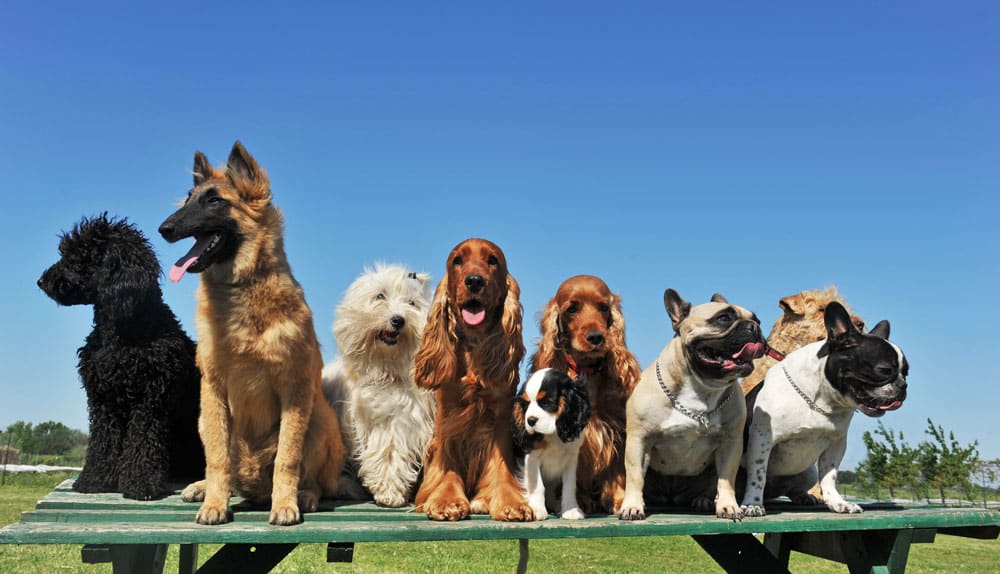
Bulldogs, French Bulldogs, Pugs, Boxers, Boston Terriers, Shih Tzus, and Pekingese have compressed airways that make panting — the dog’s primary cooling mechanism — significantly less efficient. These breeds can overheat indoors at temperatures other dogs handle without trouble. If you own a brachycephalic breed, AC from late spring through early fall is less of a comfort feature and more of a health requirement. Their anatomy simply doesn’t allow them to dissipate heat the way longer-nosed dogs can.
Senior dogs (7+ years for large breeds, 10+ for small breeds)
Thermoregulation declines with age. Older dogs are slower to detect that they’re getting too hot, slower to ramp up their panting response, and often have reduced cardiovascular capacity that makes sustained heat harder to manage. A dog who handled summers easily at five may struggle at ten without the same support. Senior dogs should have year-round access to a climate-controlled space regardless of how heat-tolerant they were when younger.
Overweight and obese dogs
Fat is an excellent insulator. Overweight dogs carry extra insulation around their core organs, slowing the rate at which body heat can escape. They also tire faster when panting hard. If your vet has flagged your dog’s weight, summer heat is one more compelling reason to address it — in the meantime, controlled indoor temperatures matter more for these dogs than for lean animals.
Double-coated breeds in summer
There is a persistent myth that shaving a Husky, Malamute, Chow Chow, or Samoyed helps them stay cool in summer. Veterinary guidance consistently says don’t shave double coats — the outer guard hairs reflect solar radiation and the undercoat helps regulate airflow next to the skin. However, in hot ambient conditions these coats also slow heat loss from the body surface. Air conditioning moves cooled air into their environment so the coat’s insulating properties work in the dog’s favour rather than against it.
Puppies under 6 months
Young puppies have immature thermoregulation. They also tend to play hard in bursts without recognising early heat stress signals the way adult dogs do. Keep puppies in a comfortable temperature range — 68–75°F — during hot weather and watch them more actively than you would an adult dog.
Dogs with cardiac or respiratory conditions
Any condition that compromises breathing or circulation makes heat harder to tolerate. If your dog has a diagnosed heart or lung condition, speak with your vet about specific safe temperature ranges rather than relying on general guidance. Their threshold may be lower than what applies to a healthy animal.
Signs of overheating: practical things to watch for
Even with AC running, dogs can overheat if the unit can’t keep up, the dog is high-risk, or the system malfunctions while you’re out. These are the practical signals an attentive owner should know:
- Heavy, rapid, or laboured panting — especially out of proportion to activity level or ambient temperature
- Excessive drooling — saliva production increases as the dog tries to boost evaporative cooling from the mouth
- Gums that look very red or very pale — normal gum colour is pink and moist; extremes in either direction warrant immediate attention
- Lethargy or reluctance to move — a dog who normally greets you at the door and is now flat and unresponsive to normal cues
- Vomiting or diarrhoea — heat stress can cause acute gastrointestinal symptoms
- Unsteady walking, wobbling, or disorientation
We’re not giving you a home-diagnosis checklist because heatstroke symptoms overlap with other emergencies and the appropriate response is the same regardless: professional evaluation, and cooling while you get there. What matters is recognising the early signals before they escalate.
The temperature-shock problem: don’t cool too fast
A common mistake is bringing a dog directly from 95°F outdoor heat into a 65°F air-conditioned room. A rapid temperature drop of 20°F or more is a physiological stress event — it can trigger muscle cramps, shivering, and in some dogs respiratory discomfort as the body suddenly shifts from aggressive heat-dumping to heat-conserving mode.
A better approach when returning from outdoor heat:
- Let the dog rest in shade, a covered porch, or a garage for 10–15 minutes before moving to the cooled interior. This gives the body time to begin adjusting.
- Set AC to 72–75°F rather than the lowest possible setting when you know dogs will be coming in from the heat — the transition is gradual rather than abrupt.
- Offer water immediately on return indoors. Rehydration supports the body’s temperature regulation and replaces what was lost through panting.
The other related issue is prolonged exposure to dry AC air. AC dehumidifies as it cools, and extended time in very dry air can cause dogs to drink more than usual. This is not harmful — in fact, it’s the body working correctly — but it means fresh water availability matters even more when AC is running continuously. In very arid climates where the indoor air becomes extremely dry, some owners run a humidifier alongside the AC to keep indoor humidity in a comfortable 40–50% range.
AC vs fans: what actually works for dogs
This distinction is important to get right because many owners assume a fan is “good enough” when it frequently isn’t — particularly in humid conditions or for high-risk dogs.
Dogs cool primarily by panting — evaporating moisture from their respiratory tract — not by sweating through their skin the way humans do. Sweat glands in dogs are concentrated in their paw pads. When a human sits in front of a fan, the moving air accelerates sweat evaporation from skin across the body surface and the person cools down. When a dog sits in front of a fan, the effect is far smaller because there is almost no skin sweat to evaporate.
A fan does provide meaningful cooling in one scenario: if the dog is actively wet. Evaporating surface water from a wet coat or wet towel applied to the belly and paws does produce real cooling. But in hot ambient conditions, a fan blowing 85°F air at a dry dog accomplishes very little.
| Cooling method | How it works for dogs | Effective? |
|---|---|---|
| Air conditioning | Lowers ambient temperature + dehumidifies, reducing thermal load on panting | Yes — most reliable |
| Fan (dry dog) | Moves air but doesn’t lower temperature; minimal paw-pad sweat evaporation | Low — limited benefit in real heat |
| Fan + wet dog | Accelerates surface water evaporation — genuine cooling effect | Moderate — short-lived (20–30 min) |
| Cooling mat or bed | Absorbs body heat passively via conduction; no electricity needed | Good — solid supplement to AC |
| Damp towel on paws/belly/groin | Cool contact + minor evaporative cooling on high blood-flow areas | Good for short-term relief |
The practical upshot: air conditioning is the only method that reliably lowers the ambient temperature in a room. Fans and wet cooling are useful short-term supplements when AC is not available, but they are not reliable substitutes for high-risk dogs during serious heat events.
Humidity: the factor most indoor cooling advice ignores
Dogs in humid climates face a fundamentally different problem than dogs in dry heat. In a dry desert environment, a dog at 85°F can still pant with reasonable efficiency — dry air pulls moisture away quickly. In a 78°F room at 75% relative humidity, panting barely works because the surrounding air is already heavily saturated with water vapour and can absorb very little more.
Air conditioning systems remove moisture from the air as a natural byproduct of the cooling process — this is why the coil develops condensation and why there is always a drain or drip from a functioning AC unit. For dogs, this dehumidification can matter as much as the temperature reduction itself. Stepping into an air-conditioned building in August feels dramatically better than standing in the shade outdoors at the same temperature, largely because of that moisture removal.
If you live in a consistently humid climate — the Southeast US, the Gulf Coast, subtropical and coastal regions, or parts of northern Europe in summer — AC becomes more critical for dogs than the temperature reading alone suggests. A 75°F room at 40% humidity is meaningfully more comfortable for a dog than a 73°F room at 80% humidity.
What about dry climates?
In low-humidity environments, dogs manage moderate heat better because their panting is more effective. But the trade-off is faster dehydration: dogs lose more moisture through panting in dry air. If you’re in a dry climate using AC, prioritise constant access to fresh water. Dry AC air increases their thirst beyond what the temperature alone would cause, and dehydration compounds heat stress rather than counteracting it.
Cooling gear that extends the reach of air conditioning
Air conditioning does not help when the dog is outdoors, in a vehicle, or in a room the AC cannot adequately reach. The following products are designed to extend cooling beyond what the AC provides on its own — all confirmed and linked to our full guides:
Cooling dog beds and mats
Gel-filled and water-activated cooling mats work passively — they absorb the dog’s body heat through direct contact, with no electricity required. They are useful on hot nights when the room is cool but the dog is generating heat faster than the ambient air carries it away, in vehicles, or in any space without AC. We have tested a range of these in our guide to cooling dog beds for large dogs, covering how different fill types perform over repeated use and which hold up best in hot-climate conditions.
Cooling vests for outdoor and active use
Evaporative cooling vests are soaked in water, wrung out, and fitted on the dog before walks or outdoor activity. As the vest fabric dries, it draws heat from the dog’s body — the same principle as human sweat but engineered for the shape and physiology of a dog. They are particularly useful in direct sun with dry-ish heat. In very high humidity they are less effective because the surrounding air is already saturated. Our guide to cooling vests for dogs includes options specifically suited to flat-faced and large breeds, where fit and coverage matter most.
Orthopedic beds with airflow design
Memory foam does trap some heat, but the bigger airflow advantage in orthopedic beds comes from raised or cot-style designs that allow air to circulate underneath the dog. If your dog has joint problems and needs orthopedic support, you do not have to choose between support and heat management — modern designs account for both. Our orthopedic dog bed guide covers options that balance proper joint support with the ventilation older or heavier dogs benefit from.
Air-conditioned dog houses for outdoor dogs
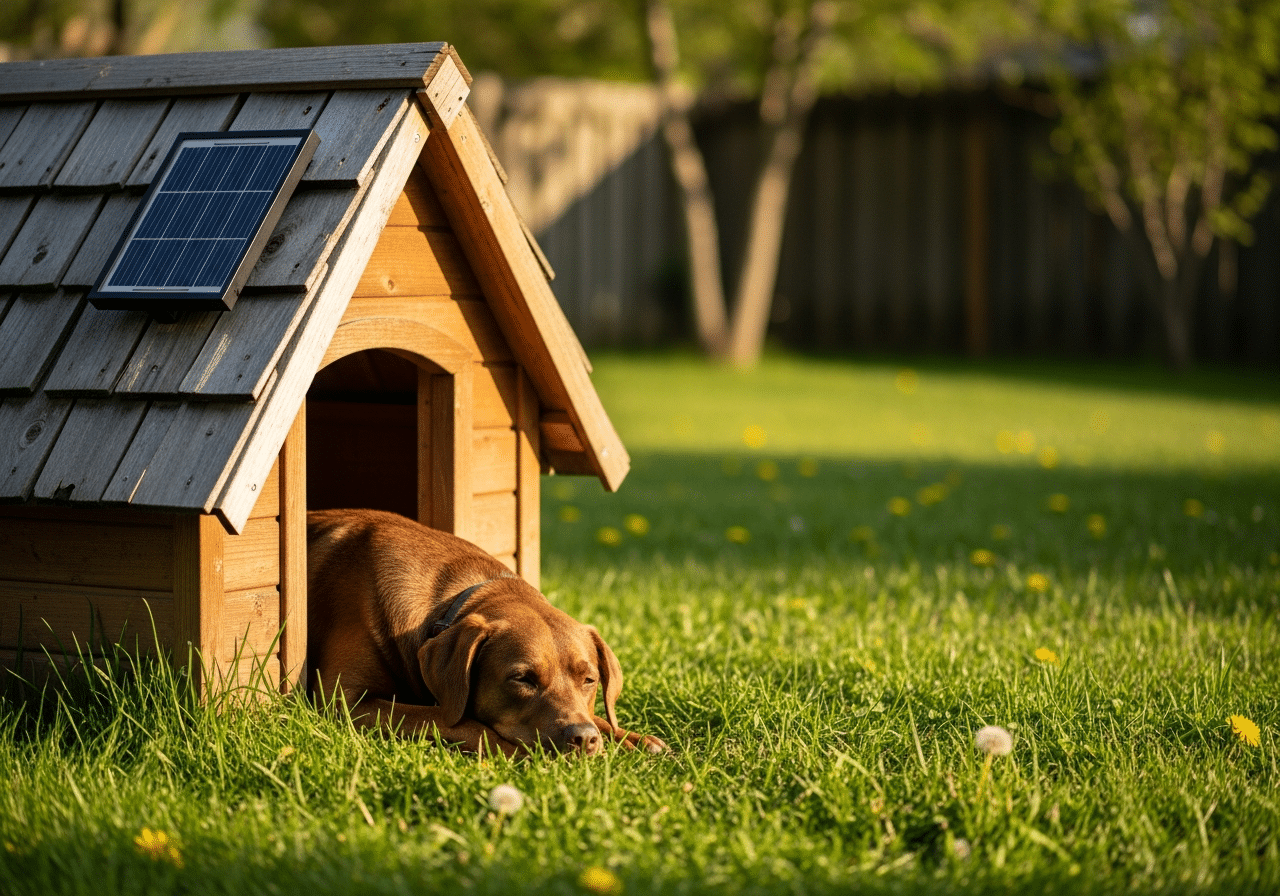
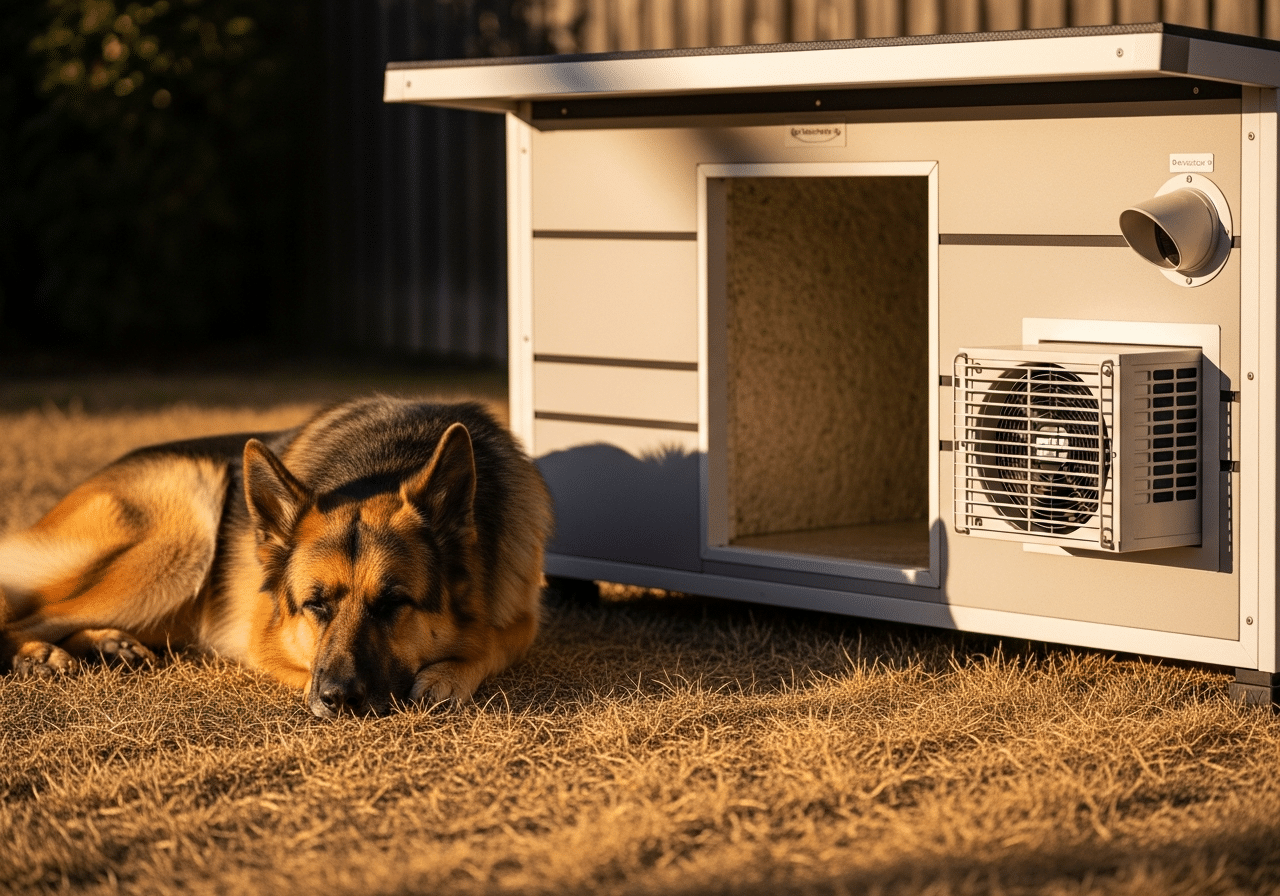
If your dog spends time outdoors, a standard dog house in summer becomes the opposite of shelter — a dark, poorly ventilated space that amplifies outdoor heat rather than reducing it. Purpose-built insulated dog houses with integrated cooling units are a growing category designed specifically for this problem. We cover available options, size guidance, and power requirements in our air-conditioned dog house guide.
Practical AC settings for dogs home alone
The most common question from working owners: what temperature should the thermostat be set to when leaving a dog home all day?
General guidance by dog type:
- Healthy adult dogs of most breeds: 74–78°F is a comfortable holding temperature for 8–10 hour periods. The room may drift 2–3°F during the day; setting 74°F keeps the upper end around 77°F.
- Brachycephalic breeds: Set no higher than 72°F. Their reduced cooling efficiency means a cooler baseline matters more for them than for other dogs.
- Senior dogs or dogs with diagnosed health conditions: Match to your vet’s specific guidance; in the absence of that, 72–74°F is conservative and safe.
- Puppies under 6 months: 72–75°F; avoid rooms where AC airflow is poor (closed utility rooms, bathrooms) and ensure the puppy cannot trap itself somewhere the air doesn’t circulate.
Setting AC below 65°F is unnecessary for most dogs and counterproductive for thin-coated breeds. Dogs’ normal body temperature runs 101–102.5°F, so a 65°F room already represents a 36-degree differential from core temperature — that requires continuous metabolic effort to maintain. A Greyhound, Whippet, Boxer, or Doberman will shiver in a 65°F room even in summer.
- Fresh water available in at least two locations — AC air is drying and increases thirst
- Air vents not blocked by furniture and not blowing directly onto sleeping spots
- AC filter clean — a clogged filter cuts cooling efficiency by 15–25%
- A cooling mat positioned in the dog’s usual resting area as a fallback if the AC underperforms
- For high-risk dogs: someone who can check in mid-day during extreme heat events
A cooling mat is a genuinely useful backup layer, not just a redundancy. AC units can trip breakers, develop refrigerant issues, or underperform on extreme heat days when the outdoor temperature climbs well above the design threshold. See our cooling dog beds guide for the passive options that work without electricity as a fallback.
Air Conditioning and Dogs — Common Questions
Is it okay to leave air conditioning on for dogs when you’re not home?
Yes — leaving AC on for a dog home alone is one of the most practical things you can do during hot weather. Set it to 72–78°F depending on breed (cooler end for flat-faced dogs). Make sure fresh water is available in multiple locations, air vents are clear, and the filter is clean so the unit works efficiently. A cooling mat as a fallback is also worth having in place.
What indoor temperature is too hot for a dog?
Most dogs start to struggle above 82°F indoors. Above 88°F is dangerous for all dogs. Vulnerable breeds — flat-faced, senior, or overweight — should not spend extended time in rooms above 78°F. Humidity compounds the risk significantly: a 78°F room at 70% humidity stresses a dog more than an 82°F room at 40% humidity because panting becomes less effective at high humidity.
Can dogs get too cold in air conditioning?
Yes. Below 65°F, thin-coated breeds (Greyhounds, Boxers, Whippets, Dobermans) and older or ill dogs can experience cold stress. Dogs’ normal body temperature is 101–102.5°F, so a 65°F room requires continuous metabolic effort to stay warm. Set AC no colder than 68°F for most dogs, and watch thin-coated breeds for shivering even at moderate AC settings.
Do fans actually help dogs cool down?
Only marginally when dry. Dogs cool by panting, not by sweating through their skin, so a fan blowing warm air at a dry dog does very little. Fans help when the dog is wet — the moving air evaporates surface water and produces real cooling. For reliable temperature reduction, air conditioning is significantly more effective than a fan alone, especially in humid conditions where fan air also carries high moisture.
Should I leave the AC on for my dog when I go to work?
Yes, if outdoor temperatures are above 80°F or your home heats up significantly during the day. The cost of running AC for 8–10 hours is far outweighed by the risk of heat stress or an emergency vet visit. Set 74–78°F for most dogs; 72°F for flat-faced breeds. A cooling mat in their usual resting spot adds a low-cost backup layer in case the AC underperforms.
Is air conditioning good for brachycephalic (flat-faced) dogs?
More than for any other dog type. Bulldogs, Pugs, French Bulldogs, and similar breeds have compressed airways that make panting — the primary canine cooling mechanism — far less efficient. They can overheat indoors at temperatures other dogs handle comfortably. AC is a health tool for these breeds, not an optional comfort item. Set the thermostat to 72°F or lower during hot weather.
Does indoor humidity affect how well dogs cope with heat?
Yes, significantly. Dogs cool by evaporating moisture during panting. High indoor humidity slows that evaporation and makes panting less effective. Air conditioning helps by both lowering temperature and removing humidity — in humid climates, that dehumidification can matter as much as the temperature reduction. If possible, keep indoor humidity below 60% during hot weather.