 Dog Gear, Sized Right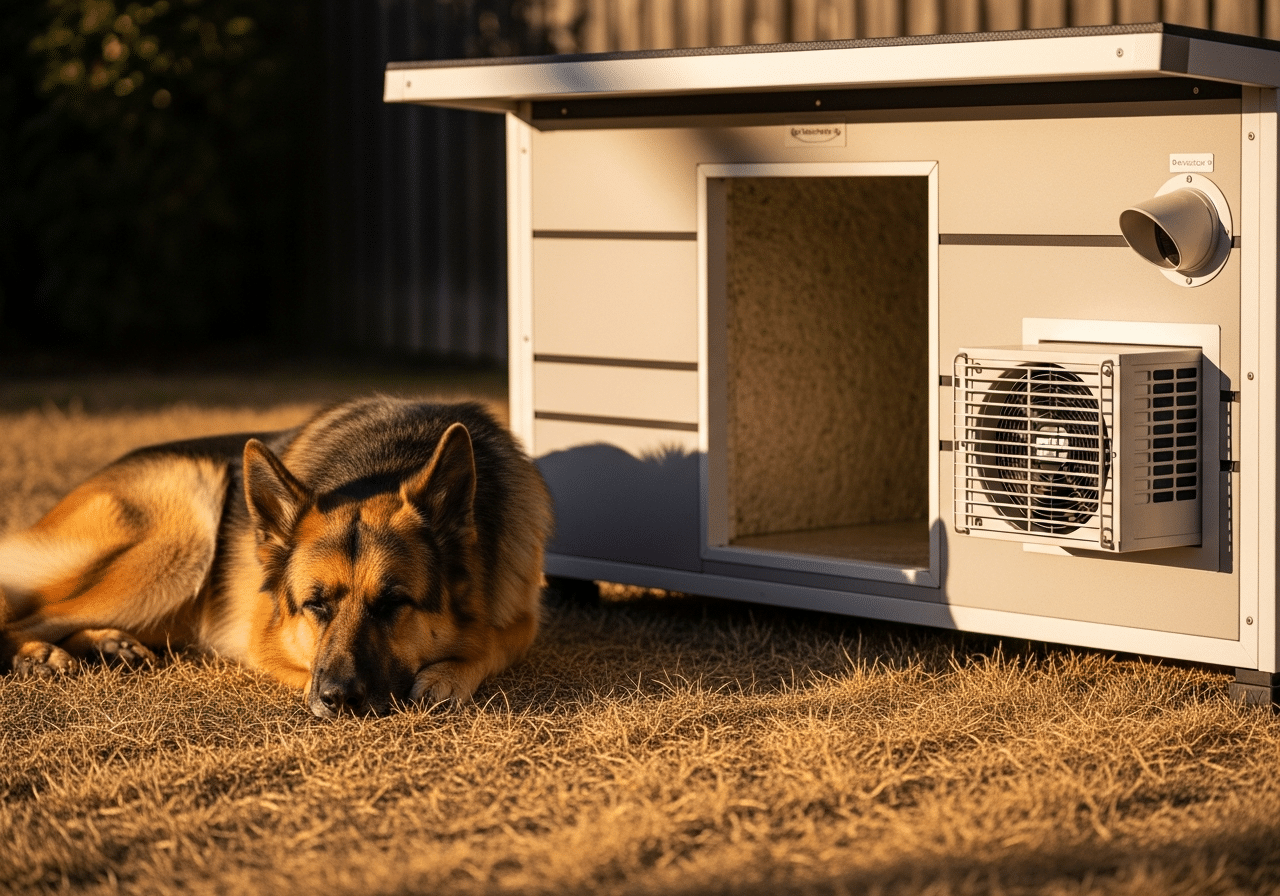
Air-Conditioned Dog Houses: Do You Need One? (Guide)
Most dogs do fine with shade and a cooling mat, here is when a real AC unit is actually worth it.
Air conditioning a dog house sounds like the ultimate summer move. And for the right dog in the right climate, it can be genuinely life-saving. But for most dogs, even large breeds spending real time outdoors, a well-insulated, ventilated house with a cooling mat handles the heat at a fraction of the cost and complexity. This guide tells you exactly when AC makes sense, which type of cooling to use, how to size and power it, and what to do instead when full AC is overkill.
When Does a Dog Actually Need an AC Dog House?
The short answer: when the temperature inside the dog house consistently stays above 85 to 90°F during peak heat and the dog cannot move somewhere cooler on its own. Below that threshold, shade, airflow, and a cooling mat are enough for most healthy adult dogs with normal coats.
Climate Is the Biggest Variable
Phoenix in July regularly hits 110°F by mid-afternoon. Houston combines 95°F heat with 80% humidity that prevents evaporative cooling from working at all. Miami stays above 85°F for five or six months straight. In those climates, outdoor dogs left alone during the day face a genuinely dangerous environment if their shelter traps heat.
Contrast that with Denver, where summer afternoons hit 90°F but drop to the mid-60s at night, or Seattle, where the occasional hot spell rarely lasts more than a few days. In those places, good insulation, ventilation, and shade will handle the job without any powered cooling at all.
The practical test: put a thermometer inside your current dog house at the hottest point of the day (typically 1 to 4pm). If it reads above 90°F consistently during the months your dog is outside, you have a real problem to solve. If it stays under 85°F, passive improvements almost always close the gap.
High-Risk Breeds. When Cooling Is a Medical Need
Certain dogs are physiologically bad at shedding heat, and for them the safe threshold is lower:
- Brachycephalic breeds. Bulldogs, French Bulldogs, Pugs, Boston Terriers, Boxers, Shih Tzus. Their shortened airways restrict airflow, so they cannot pant efficiently. A temperature that is merely uncomfortable for a Labrador can cause heatstroke in a Bulldog within 20 minutes.
- Double-coated thick-fur breeds. Siberian Huskies, Alaskan Malamutes, Chow Chows, Samoyeds, Bernese Mountain Dogs. Their coats are optimized for cold climates. In sustained heat above 80°F, they carry a significant thermal load that shade alone does not fully address.
- Senior dogs (7+ years for large breeds, 10+ for small). Thermoregulation becomes less efficient with age, and older dogs are slower to show visible signs of distress before heatstroke sets in. They deserve extra margin.
- Overweight dogs. Extra mass generates more metabolic heat and makes it harder to lose. A dog that is 20% over ideal weight in 90°F heat is meaningfully more at risk than one at an ideal body condition score.
- Dogs on certain medications. Antihistamines, diuretics, and some cardiac medications can impair heat regulation. If your dog is on long-term medication and spends time outdoors in heat, check with your vet about cooling precautions.
If your dog falls into any of these groups and you live somewhere with serious summer heat, AC is not indulgent, it is a reasonable safety investment. The calculus changes when the alternative is an emergency vet visit for heatstroke.
The Situation Matters as Much as the Breed
A brachycephalic dog that can come indoors during peak heat (noon to 4pm) and only uses the dog house for morning and evening time probably does not need powered cooling. The same dog in an outdoor kennel all day, no indoor access, owner away at work, is a completely different situation. AC becomes most defensible when all of these are true:
- The dog cannot self-regulate (choose shade, move inside, find cool ground independently)
- The owner cannot check on the dog during peak heat hours
- The climate stays hot for weeks or months, not just occasional days
- The dog has at least one risk factor (breed, age, weight, medication)
The Honest Answer: What Most Dogs Actually Need
Here is what most outdoor dog owners actually need: a dog house that does not trap heat, positioned in genuine shade, with a cooling mat inside. That combination, not full AC, is the right starting point for the majority of dogs and the majority of climates.
A poorly insulated dog house sitting in direct afternoon sun can easily be 25 to 30°F hotter inside than the outside air temperature. Fixing the structure first matters: an AC unit cooling a poorly insulated box just bleeds energy through the walls and costs far more to run than it needs to.
The cost-effective upgrade path, in order:
- Position for shade. If afternoon sun hits the roof directly, move the house or add a shade sail over it. This alone can cut interior temperature by 15°F with zero ongoing cost.
- Insulate and ventilate. Rigid foam insulation on the roof and walls keeps the thermal mass down. A ventilation gap, a ridge vent or raised roof cap, lets hot air escape passively. These modifications cost $20-$60 on a wood house and make a measurable difference within hours.
- Add a cooling mat. A gel or water-fill cooling mat inside the house handles the heat the dog itself generates, body heat that ambient-air cooling does not directly address. See our tested picks in the best cooling dog beds guide.
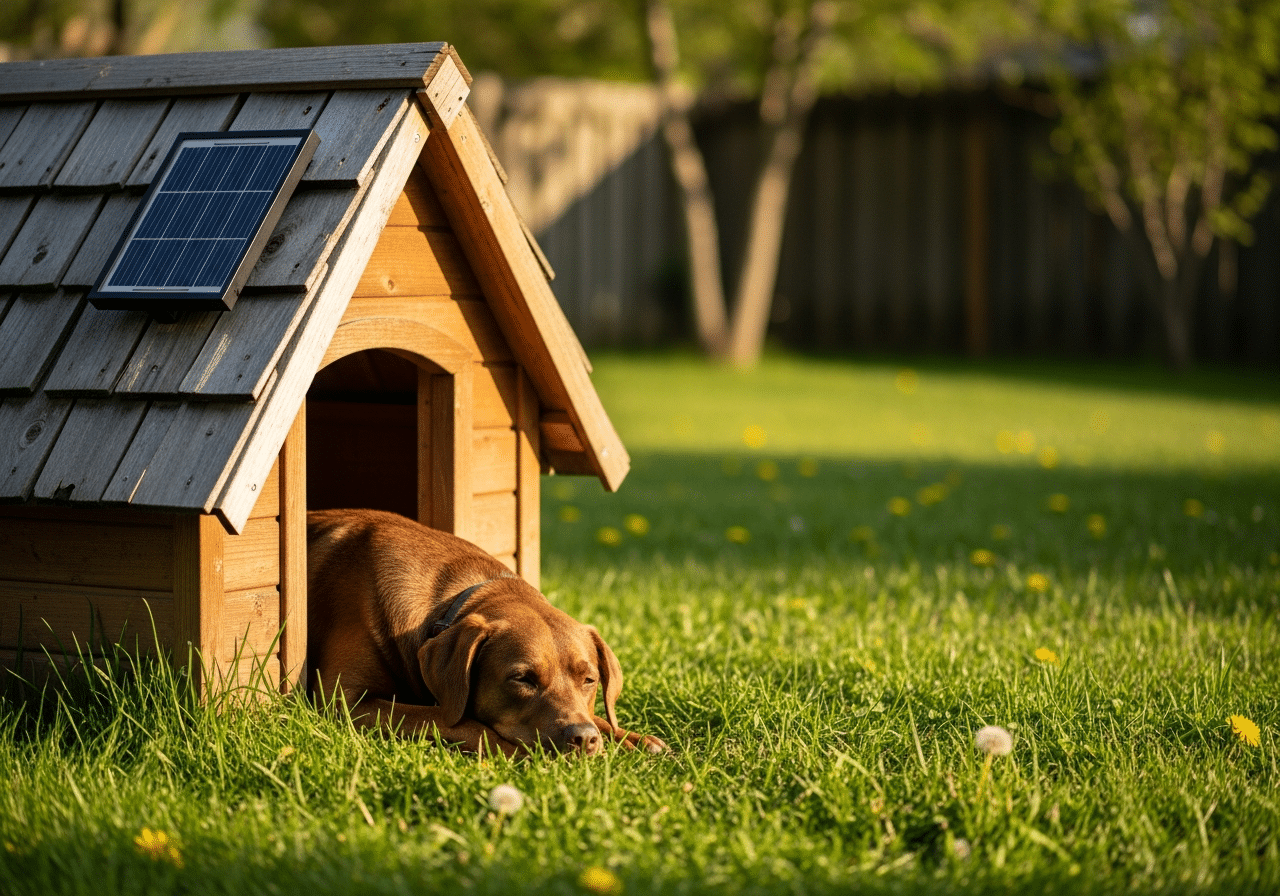
- Add a fan. A clip-on or box fan positioned to push air through (inlet on one side, exhaust on the other) can strip several degrees of heat at a cost of $15-$40. A solar-powered exhaust fan requires no cord at all.
- Then, if still needed, add powered cooling. Only after the structure is sound, shaded, and ventilated.
The same logic applies at the dog level: a cooling vest worn during outdoor activity is often more effective than any dog-house modification for a dog that moves around rather than resting in one place.
Types of Air Conditioning for a Dog House
Once you have confirmed powered cooling is warranted, there are five main approaches. They differ significantly in upfront cost, running cost, effectiveness, and which dog-house sizes they suit.
1. True Window or Wall-Mount AC Units
A standard window AC unit (5,000 to 8,000 BTU for most dog-house sizes) installed through a cut opening in the wall is the most effective solution available. It cools and dehumidifies, can be thermostat- controlled, and gives you the same result as conditioning a small room.
Pros: genuinely effective in any climate including humid coastal and Gulf Coast regions; can be controlled remotely with a smart plug or smart thermostat; lasts 10 to 15 years with basic annual maintenance (cleaning the filter, inspecting the seal).
Cons: requires a dedicated 120V power circuit accessible within 25 to 50 feet; installation means cutting a wall opening and sealing around the unit with weatherstripping and foam; upfront cost is typically $150-$350 for the unit plus $150-$350 professionally installed outlet if one is not already present. The dog house needs to be structurally solid enough to support the unit’s weight (40 to 65 lbs for a small window AC).
Best for: permanent outdoor setups in consistently hot climates. Southeastern US, Southwest desert, Gulf Coast, where grid power is accessible and the dog house is a long-term fixture.
2. Portable AC Units Ducted Into the Dog House
A portable AC unit sits outside or adjacent to the dog house and connects via a flexible duct/hose to an opening in the wall. This avoids cutting a permanent structural opening and lets you move the unit elsewhere in winter.
Pros: no permanent wall modification; can serve double duty cooling a garage or workshop during winter; slightly easier to install than a window unit in a non-standard structure.
Cons: portable ACs are less efficient than window units, they exhaust some warm air back unless carefully ducted, and their single-hose designs recirculate room air less effectively. Running costs are typically 20 to 30% higher than a comparable window unit for equivalent cooling output. They are also noisier and require the dog to be comfortable near the unit’s sound and airflow.
Best for: situations where the owner wants flexibility, no permanent modification to the structure, or the ability to repurpose the unit.
3. Thermoelectric (12V) Dog House Coolers
These are small Peltier-effect cooling units marketed specifically for dog houses, RVs, and pet enclosures. They draw 12V DC power (battery, solar, or a DC power adapter) and can reduce interior temperature by 15 to 25°F in a small, well-insulated structure.
Pros: very low power draw (40 to 80W) makes them ideal for solar setups; no compressor means they are whisper-quiet; cheap to purchase ($80-$180); no installation beyond mounting and running a power cable.
Cons: limited cooling capacity, a 20°F drop in a 100°F environment leaves the interior at 80°F, which is adequate for most dogs but not enough if exterior temperatures are extreme (110°F+). Less effective in humid climates because Peltier devices also generate heat on the hot side that must be vented outside. Suitable only for small dog houses (under roughly 35 to 40 cubic feet).
Best for: small-to-medium dogs in moderately hot climates where solar power is already in use or preferred. See our best air-conditioned dog house guide for specific thermoelectric models we have tested and verified.
4. Evaporative (Swamp) Coolers. Dry Climates Only
Evaporative coolers pass air over a water-saturated pad. The water evaporates and drops air temperature by 15 to 30°F. They use very little energy (a fraction of a compressor-based AC) and cost $50-$200 for a unit suitable for a dog house.
Critical limitation: they only work when the air is dry. Relative humidity above 50 to 55% and effectiveness drops sharply. Above 70% humidity, they can actively make conditions worse by increasing moisture without meaningfully reducing temperature, this accelerates heat exhaustion in dogs, which rely on panting (its own form of evaporative cooling) to stay safe.
Best for: Arizona, Nevada, New Mexico, eastern California, and the Great Basin region, places with hot-dry summers. Do not use in Florida, Louisiana, the Gulf Coast, or anywhere with a humid summer climate.
5. Upgraded Insulation + High-CFM Fan
This is not true air conditioning, it cannot cool below outdoor ambient temperature, but it is routinely underestimated. A properly insulated dog house with a 150 to 250 CFM fan drawing air through from a shaded inlet can maintain interior temperature within 3 to 5°F of shaded outdoor ambient, rather than the 25 to 30°F above ambient that a poorly insulated box in direct sun achieves.
If outdoor ambient temperature in the shade stays under 85°F during the day, this setup handles the job without any powered cooling. A solar-powered exhaust fan ($40-$80) makes it entirely passive, no power cable, no running cost. Paired with a cooling mat, this represents a genuinely robust solution for mild-to-moderate climates without the complexity of a compressor unit.
How to Size an AC Unit for a Dog House
Getting the size right matters. Oversizing causes short-cycling, the unit turns on and off too frequently, wears out faster, and fails to dehumidify properly because it cools air too quickly to pull moisture out. Undersizing means the unit runs continuously without reaching target temperature.
Step 1: Calculate interior volume. Measure the interior in feet: length × width × height. A typical large-dog house might be 4 ft × 3 ft × 3.5 ft = 42 cubic feet. A double-dog house or extra-large breed kennel might be 5 × 4 × 4 = 80 cubic feet.
Step 2: Match BTU to volume. These figures assume a well-insulated house in full shade. Add 10% for poor insulation, add 20% for direct afternoon sun on the roof.
| Interior Volume | Suitable Dog Size | Recommended BTU | Unit Type |
|---|---|---|---|
| Under 20 cu ft | Small (under 25 lb) | 2,000 to 4,000 BTU | Thermoelectric or mini-portable |
| 20 to 35 cu ft | Medium (25 to 60 lb) | 4,000 to 5,000 BTU | Thermoelectric or small window unit |
| 35 to 55 cu ft | Large (60 to 100 lb) | 5,000 to 6,000 BTU | 5,000 BTU window unit |
| 55 to 80 cu ft | XL / multi-dog (100 to 150 lb) | 6,000 to 8,000 BTU | 6,000 to 8,000 BTU window unit |
| Over 80 cu ft | Giant breed or kennel run | 8,000 to 12,000 BTU | 8,000+ BTU window unit |
Thermoelectric note: most thermoelectric units are rated in BTU equivalents, but they do not perform the same as compressor-based units at the same nominal rating. As a conservative rule, double the compressor BTU you would need before looking at thermoelectric models, so if the table suggests 4,000 BTU, look at thermoelectric units rated at 8,000 BTU equivalent or higher.
Power Supply and Running Costs
Power access is often the practical sticking point. A compressor-based AC unit requires 120V grid power; a thermoelectric unit can run off a solar battery setup. Here is what each scenario looks like.
Grid Power
A window or portable AC unit needs a standard 120V outlet within reach. For runs longer than 25 feet from the nearest outlet, use a 12-gauge (AWG 12) outdoor-rated extension cord, a lighter 14-gauge cord will overheat under sustained AC load. For permanent installations, a GFCI-protected outdoor outlet wired by a licensed electrician is the right answer ($150-$350 installed). Do not run an extension cord under a fence or across a damp yard long-term, it is a fire and shock hazard.
Running cost estimate at $0.13/kWh (US average, 2024):
- 5,000 BTU window unit (500W): ~$20-$38/month running 8 to 10 hours per day
- Thermoelectric unit (60W): ~$2-$5/month for the same run time
- Evaporative cooler (150W): ~$6-$12/month plus minimal water usage
Insulation quality significantly affects running cost: a poorly insulated house can require the unit to run 40 to 60% more hours to maintain the same temperature compared to a properly insulated one.
Solar Power
A 12V thermoelectric cooler can run from a 100 to 200W solar panel and a 50 to 100Ah lithium or AGM battery with no grid connection at all. This is practical for remote kennels, farm setups, or yards where running power to the dog house would require trenching or significant electrical work. Budget $150-$400 for panel + battery + charge controller. A compressor-based window AC cannot run from a typical residential solar battery setup without a substantial (and expensive) inverter and battery bank.
| Setup | Upfront Cost | Monthly Running Cost (8 hrs/day) | Best Climate |
|---|---|---|---|
| Insulation + passive ventilation | $30-$80 | <$2 | Mild (ambient <85°F in shade) |
| Insulation + solar exhaust fan | $60-$140 | $0 | Mild-moderate, any humidity |
| Thermoelectric (12V) | $80-$180 | $2-$6 | Moderate dry heat, small houses |
| Evaporative (swamp) cooler | $60-$200 | $6-$12 | Hot-dry climates only |
| Window AC 5,000 BTU | $150-$300 + outlet | $20-$38 | Any climate, any humidity |
| Portable AC ducted in | $200-$450 | $30-$55 | Any climate |
What Most Dogs Actually Need Instead
Before committing to a powered cooling unit, run through this checklist. Most dogs that owners believe need AC actually need one or two of these alternatives instead, and at a fraction of the cost.
Cooling Dog Beds and Mats
A quality cooling mat placed inside a well-ventilated dog house handles body heat, the thermal load generated by the dog itself, which ambient-air cooling does not directly address. Gel and water-fill cooling mats work without power and can drop the dog’s contact-surface temperature by 5 to 10°F. They are especially effective in a shaded, ventilated house where the ambient temperature is already manageable.
See our independently tested picks in the best cooling dog beds guide, we cover gel mat options for outdoor use and elevated cot styles that allow airflow underneath the dog’s entire body.
Cooling Vests
For dogs that are active outdoors, fetching, walking, playing in the yard, a cooling vest is often more immediately effective than any dog-house modification. Evaporative vests keep a moist layer against the dog’s body and can extend safe outdoor activity time by 30 to 50% in moderate heat. They are not a substitute for shade and shelter, but they meaningfully change what is safe during active time outside.
Upgrade the Structure Itself
If the current dog house is an ageing flimsy plastic box sitting in afternoon sun with no insulation, retrofitting a cooling unit onto it is like putting a window AC in a tent. The right move may be a structural upgrade first. Our dog houses guide covers picks at every price point, including houses with factory-built insulation, raised floors for underfloor airflow, and double-walled roofs that measurably reduce heat absorption compared to single-wall plastic designs. Some of our top-rated picks maintain interior temperatures 15 to 20°F cooler than budget alternatives with no powered cooling at all.
For the full picture on powered cooling options, including specific thermoelectric and window-AC setups we have verified, see our best air-conditioned dog house guide.
Explore our dog-house and cooling guides
Your Air-Conditioned Dog House Questions Answered
At what temperature does a dog need AC in their dog house?
If the interior of the dog house consistently exceeds 85 to 90°F during peak heat, powered cooling is worth considering, especially for brachycephalic breeds (Bulldogs, Pugs, French Bulldogs), senior dogs, or dogs that cannot move to a cooler space. Use a thermometer placed inside during the hottest part of the day (1 to 4pm) to get the real number. For dogs with normal coats and indoor access, 90°F is the common warning threshold. For flat-faced breeds, the threshold is closer to 80 to 85°F because their limited panting efficiency means heat accumulates faster.
What is the best type of AC for a dog house?
For small dog houses (under 35 cubic feet) in moderate heat, a 12V thermoelectric cooler is the simplest and cheapest option ($80-$180, runs off solar). For larger structures or genuinely hot and humid climates, a 5,000 to 6,000 BTU window unit installed through the wall is most effective. Evaporative (swamp) coolers are cost-effective but only work in dry climates with humidity under 50%. Portable AC units ducted in work in any climate but cost more to run than window units. See our best air-conditioned dog house guide for specific vetted models.
Can I put a window AC unit in a dog house?
Yes, a small 5,000 to 6,000 BTU window AC unit can be installed through a cut opening in the wall of a solid wood dog house. You need a 120V outdoor-rated outlet within reach (use 12-gauge extension cord for runs over 25 feet, or have an electrician add a GFCI outlet). The opening needs to be sealed around the unit with foam weatherstripping, and the structure should be sturdy enough to support the unit’s weight (40 to 65 lbs). Most small window AC units designed for 100 to 150 sq ft rooms are correctly sized for a large dog house.
How much does it cost to run an AC unit for a dog house?
A 5,000 BTU window AC unit running 8 to 10 hours per day at the 2024 US average rate of $0.13/kWh costs approximately $20-$38 per month. A thermoelectric (12V) unit drawing 60 to 80W costs $2-$6 per month for the same run time but provides less cooling capacity. Evaporative coolers fall between those two. Insulation quality matters enormously: a poorly insulated house can require 40 to 60% more run time to hold the same temperature versus a well-insulated one, significantly increasing monthly cost.
Do brachycephalic dogs need an air-conditioned dog house?
Brachycephalic breeds. Bulldogs, French Bulldogs, Pugs, Boston Terriers, Boxers, have restricted airways and cannot pant efficiently. In climates with consistent summer temperatures above 85°F, outdoor housing for these breeds should include either powered cooling or guaranteed indoor access during the hottest part of the day (noon to 4pm). These breeds face meaningfully higher heatstroke risk than normal-airway dogs and should never be left outside unsupervised in summer heat without active cooling measures.
Will a cooling mat work instead of an AC unit in a dog house?
For most dogs in most climates, yes. A quality gel or water-fill cooling mat addresses body heat, the thermal load the dog generates itself, which ambient-air AC doesn’t directly help with. Pair it with a well-ventilated, insulated house in shade and you cover most realistic scenarios. The cooling mat cannot cool below ambient air temperature, so if the interior of the house is consistently above 95°F, powered cooling is still needed. See our best cooling dog beds guide for specific mat picks we have verified.
What are the main advantages of an air-conditioned dog house?
The main advantages: (1) consistent safe interior temperature regardless of outdoor heat, critical for high-risk dogs (brachycephalic, senior, thick-coat breeds); (2) reduced heatstroke risk for dogs left outside during peak hours without indoor access; (3) lower humidity inside the shelter in humid climates, which also reduces mold and mildew; (4) more restful sleep in hot climates. The main downsides are installation cost and ongoing electricity use. For dogs with reliable indoor access and owners home during the day, a cooling mat plus ventilation usually covers the same bases at far lower cost. For AC-specific product options, see our air-conditioned dog house hub.